Adiabatic Temperature Rise and MTSR: Thermal Safety Fundamentals
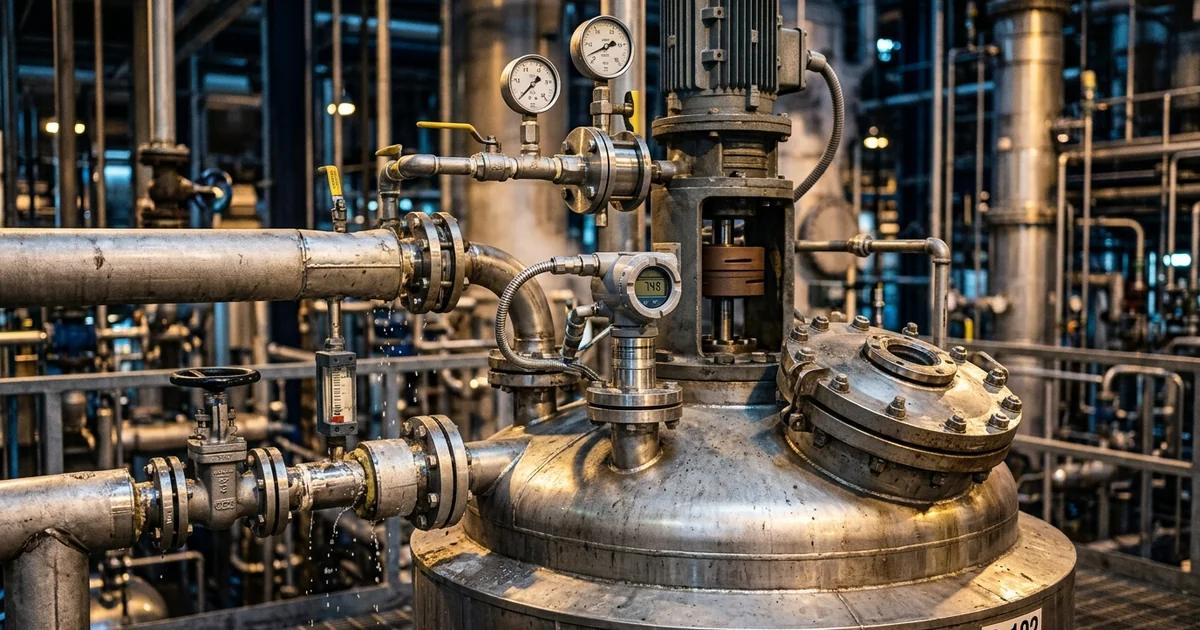
A reaction that a chemist runs safely in a flask can reach a temperature in a plant reactor that ruins the batch, damages the vessel, or injures the people near it. What changed is not the chemistry but the ability to remove heat. The adiabatic temperature rise — the temperature the batch would reach if every joule of reaction heat stayed in the liquid — is the first number that says how bad a cooling failure could get. Paired with the maximum temperature of the synthesis reaction (MTSR), it turns a vague worry into a ranked, defensible assessment. This guide explains what both quantities mean, how a competent study finds them, and which decisions they govern: reactor choice, cooling design, protective layers and emergency planning. It reflects the evidence-first standard we apply to process safety review work before a scale-up decision is made.
What Adiabatic Temperature Rise Actually Means
The word "adiabatic" describes a boundary condition, not a real operating mode. It assumes zero heat crosses the vessel wall, nothing is lost to the surroundings, and nothing boils off. Under that assumption, all the energy the reaction releases goes into warming the reaction mass itself. The adiabatic temperature rise (ΔTad) is how much warmer the batch gets as a result. It is the reference point every cooling-failure scenario starts from, because a total loss of cooling is close enough to adiabatic that the idealisation is conservative and useful.
The calculation is deliberately simple: ΔTad equals the heat of reaction per unit mass (ΔHr) divided by the specific heat capacity of the reaction mass (cp). The value of ΔHr comes from a measurement on the real recipe — most reliably reaction calorimetry, not a textbook figure for a similar reaction. As an illustration only, using round numbers rather than values to design against: a step releasing 150 kJ/kg into a mass with cp near 2.0 kJ/(kg·K) gives a ΔTad of about 75 K. Stoessel's reference text on thermal safety takes a heat capacity of roughly 1.8–2.0 kJ/(kg·K) as typical for organic reaction masses.
Three properties of ΔTad make it the right place to start:
- It is scale-independent — a temperature rise, not a heat duty, so the same number applies whether the batch is 2 litres or 20 cubic metres.
- It is a hard ceiling for the desired reaction — the batch cannot get hotter than the process temperature plus ΔTad from the synthesis reaction alone.
- It is sensitive to input error — because ΔHr sits in the numerator, a 20 percent error in the measured heat of reaction is a 20 percent error in the predicted temperature.
ΔTad on its own, though, over-states the realistic case, because it assumes the whole step is still waiting to react at the instant cooling fails. The next section corrects for that.
From ΔTad to MTSR: Why Accumulation Changes the Number
In most real processes, part of the reaction has already happened when a cooling failure occurs. Only the unreacted, accumulated fraction can still release heat. The maximum temperature of the synthesis reaction (MTSR) is the process temperature plus that accumulated fraction of ΔTad — never more than the process temperature plus the full ΔTad, and usually well below it. This is why two plants running the identical chemistry can face very different hazards: the one that doses faster, or colder, carries more unreacted material and lands at a higher MTSR.
Accumulation is the variable a process design can actually move. In a semi-batch process, the feed rate sets how much reagent is present but unreacted at any moment. Slow the feed, or hold it until the reaction is confirmed to be running, and accumulation falls. That is the core idea behind dosing-controlled operation: the feed pump becomes a safety control, because stopping it caps the energy still available to the batch.
Once MTSR is known, it has to be compared against two other temperatures before anyone can say whether the process is safe. Those are the subject of the next section.
The Four Temperature Levels of a Cooling Failure
Stoessel's cooling-failure scenario frames thermal risk as a race between four temperatures. The assessment is not "what is ΔTad" but "in what order are these four levels reached, and what happens at each one". The order decides whether a loss of cooling is a recoverable upset or the start of a runaway.
| Level | What it is | Set by |
|---|---|---|
| Tp — process temperature | The normal operating temperature of the step | The recipe |
| MTSR | Highest temperature the desired reaction can reach after cooling is lost | Process temperature, accumulation, ΔTad |
| MTT — maximum temperature for technical reasons | Boiling point at operating pressure, or the temperature at the vessel's pressure limit | Solvent, pressure, vessel rating |
| TD24 | Temperature at which the secondary decomposition has a time to maximum rate (TMRad) of 24 hours | Decomposition kinetics of the reaction mass |
The logic of the scenario runs in steps. Cooling is lost at Tp. The accumulated reagent reacts adiabatically and drives the batch toward MTSR. If MTSR is below both MTT and TD24, the batch settles and the event is survivable with no chemistry beyond the intended reaction. If MTSR is above MTT, the reaction mass boils, and evaporative cooling plus the relief system now carry the load. If MTSR is above TD24, the decomposition can be reached, and its own — usually much larger — adiabatic temperature rise takes over. Reaching TD24 is the point most incident investigations identify as where a controllable event became an uncontrollable one.
Severity and Probability: Reading ΔTad and TMRad Together
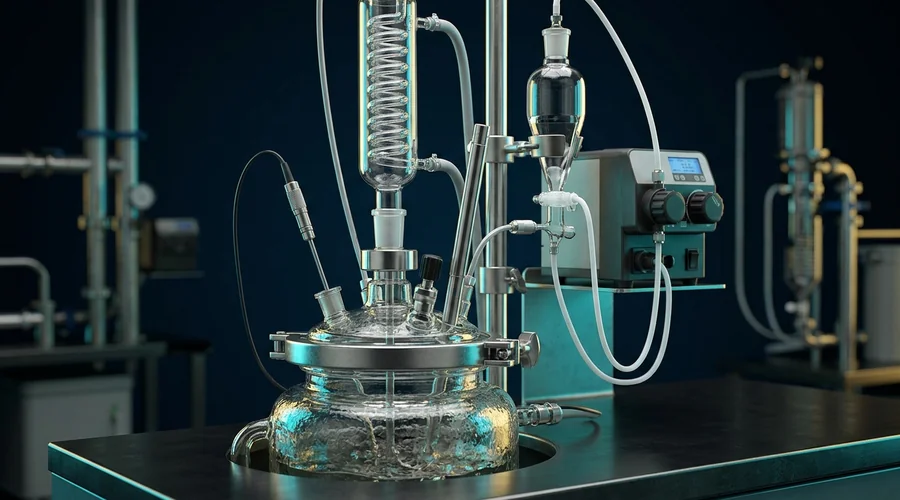
A thermal hazard has two dimensions, and each maps to a different measured quantity. Severity is how much damage a runaway would do, and it scales with the adiabatic temperature rise of whatever reaction is running away — the synthesis reaction, or worse, the decomposition — plus any gas or pressure it generates. Probability is how likely the runaway is to reach an uncontrollable rate before anyone can intervene, and it is read from the time to maximum rate under adiabatic conditions (TMRad).
Stoessel's framework, widely used through CCPS training, puts rough bands on both:
- Severity — a ΔTad up to about 50 K is often treated as low; 50–200 K as medium; above 200 K as high, and above 400 K as potentially catastrophic. Gas generation or a sharp pressure rise moves a case up a band regardless of temperature.
- Probability — a TMRad of 24 hours or more at the relevant temperature is treated as low; roughly 8–24 hours as medium; under 8 hours as high, because there is little time to detect and respond.
These bands are a starting grid for ranking a portfolio of process steps, not a pass/fail test for any one of them. A step with a modest ΔTad that sits just below a decomposition onset can be more dangerous than a larger ΔTad with wide margins. Severity and probability always have to be read against MTT and TD24 for the specific system.
Criticality Classes: How the Four Temperatures Rank
The criticality classification turns the ordering of MTSR, MTT and TD24 into five classes, from 1 (inherently safe against a cooling failure) to 5 (a decomposition runaway is essentially unavoidable once cooling is lost). It is the output a competent assessor produces, and it drives what protective measures a process needs — from basic process control at Class 1 to engineered safety instrumentation, quench systems or route redesign at Class 4 and 5.
| Class | Temperature ranking after cooling loss | What it means |
|---|---|---|
| 1 | MTSR < MTT < TD24 | Batch settles at MTSR, below boiling and decomposition. Could in principle run adiabatically. |
| 2 | MTSR < TD24 < MTT | Synthesis reaction still safe, but decomposition sits below the boiling barrier if the batch is pushed further. |
| 3 | MTT < MTSR < TD24 | Reaction mass boils. Evaporative cooling and the relief system are the active safety barrier; decomposition not reached. |
| 4 | MTT < TD24 < MTSR | Boiling occurs first and may hold temperature, but if it cannot, MTSR is high enough to trigger decomposition. |
| 5 | TD24 < MTT < MTSR | Decomposition is reached before boiling can provide any barrier. Highest criticality. |
Whether boiling actually protects a Class 3 or Class 4 process depends on evaporative cooling capacity and relief sizing, which is a separate DIERS study and outside the scope of this article. The class alone tells you how hard the process is working its safeguards, and whether reducing MTSR — usually by cutting accumulation — could move it to a safer class. This is exactly the kind of decision a chemical reaction engineering review addresses before equipment is specified.
ΔTad, ΔHr, MTSR and MTT: How the Terms Differ
These four terms appear together in every thermal safety report, and they are routinely confused. Two describe the chemistry, one describes the process, and one describes the equipment. Keeping them separate is what lets an assessment be audited rather than argued over.
| Term | What it is | Typical unit | What it bounds |
|---|---|---|---|
| ΔHr | Heat of reaction — energy released per unit mass of reaction mass | kJ/kg | The total energy available from the step |
| ΔTad | Adiabatic temperature rise — ΔHr divided by cp | K | The temperature swing if all that energy stays in the batch |
| MTSR | Maximum temperature of the synthesis reaction — Tp plus the accumulated fraction of ΔTad | °C | How hot the desired reaction can drive the batch after a failure |
| MTT | Maximum temperature for technical reasons — boiling point or pressure-limited temperature | °C | The ceiling the equipment imposes, independent of the chemistry |
Troubleshooting: When Scale-Up Surprises Point Back to These Numbers
Most thermal problems that appear during scale-up were visible in advance in the ΔTad, MTSR and TD24 data — if that data was collected, and read. Recognising the pattern tells a plant team where to look first instead of treating each batch upset as its own mystery.
| Symptom on scale-up | What the numbers usually explain |
|---|---|
| Batch temperature overshoots setpoint during dosing | Accumulation is higher than the design case assumed, so MTSR is higher too; the feed is outrunning the reaction |
| Temperature keeps climbing after the feed is stopped | Significant unreacted reagent has accumulated; on the bench the reaction tracked the feed, at plant scale it did not |
| Reaction mass boils or vents during a cooling upset | MTSR sits above MTT — a Class 3 or higher process — so evaporative cooling and relief are now the active barrier |
| A second, faster exotherm appears well above the process temperature | MTSR exceeded TD24 and the secondary decomposition was reached |
| Bench step was "not exothermic enough to worry about", plant batch was | ΔTad was estimated from a literature ΔHr, not measured on the real recipe |
| The cooling-failure case in the HAZOP has no data behind it | ΔTad, MTSR and TD24 were never measured for this recipe and vessel |
Read this way, the thermal data set is diagnostic as well as predictive. A plant that keeps meeting the same category of surprise has a gap in its thermal data, not a run of bad luck. A reactor temperature control review often surfaces the same gap from the instrumentation side.
What a Competent Thermal Safety Assessment Involves
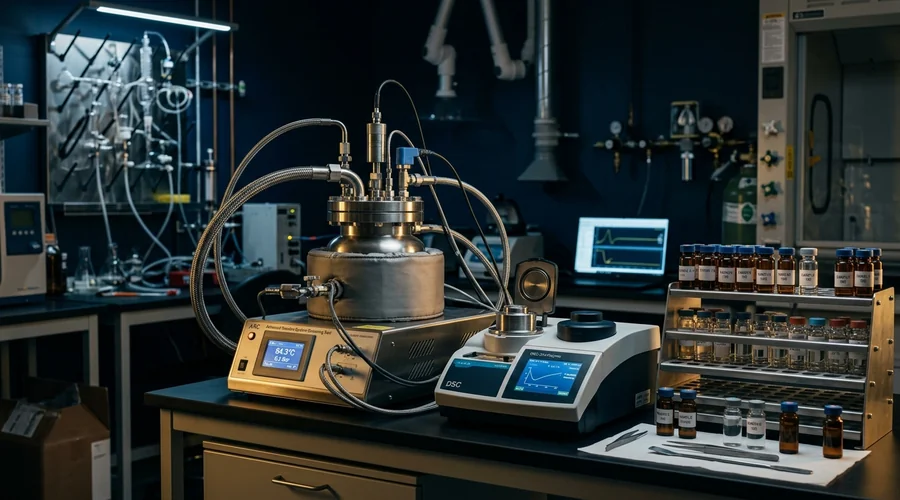
Producing these numbers is specialist process safety engineering, not a calculation a plant team completes from a datasheet. A competent assessment measures ΔHr and the heat release profile by reaction calorimetry on the intended recipe, characterises the accumulation profile for the real dosing strategy, and screens the reaction mass for secondary decomposition with DSC and adiabatic calorimetry to establish TD24. Only then can MTSR be placed against MTT and TD24, a criticality class assigned, and a basis of safety defined. Organisations such as AIChE's Center for Chemical Process Safety (CCPS) publish the methodology this work follows.
The thermal safety assessment described here is site- and recipe-specific. It requires calorimetric and decomposition data measured for the actual reaction mass, at conditions representative of the intended process, and it must be carried out and interpreted by qualified process safety engineers against the regulatory regime that applies to the site. In the United States that is typically the framework in OSHA's Process Safety Management standard (29 CFR 1910.119) and the EPA's Risk Management Program; equivalent regimes apply elsewhere. This article explains what the quantities mean and why they matter. It is not a substitute for that assessment, and none of the values in it should be adopted for a real process.
Our scale-up support engagements start with exactly this work for any process heading toward a larger vessel on estimated thermal data. Where the route or the reactor itself needs re-evaluating alongside it, our wider process and EHS consulting picks up from there — including for manufacturers scaling processes in India, the Gulf and Southeast Asia.
Frequently Asked Questions
What is adiabatic temperature rise?
Adiabatic temperature rise, written ΔTad, is the temperature increase a reacting batch would experience if every joule of reaction heat stayed in the liquid and none was removed through the jacket, lost to the surroundings, or carried away by evaporation. It is the worst-case thermal swing for a given step, calculated by dividing the heat of reaction per unit mass by the specific heat capacity of the reaction mass.
It matters because it sets the ceiling on how hot a cooling failure can drive the batch from the desired reaction alone. A small ΔTad means a lost-cooling event is a nuisance; a large one means it is a hazard that needs engineered protection.
How do you calculate adiabatic temperature rise?
The adiabatic temperature rise is the heat of reaction per kilogram of reaction mass divided by the specific heat capacity of that mass, so ΔTad = ΔHr ÷ cp. The heat of reaction comes from a measurement — most reliably reaction calorimetry on the actual recipe — not from a literature value for a similar reaction. The heat capacity is measured or estimated for the real mixture, and is often near 1.8 to 2.0 kJ/(kg·K) for organic reaction masses according to Stoessel's reference text.
Because ΔHr appears directly in the numerator, an error in the measured heat of reaction becomes an equal percentage error in the predicted temperature rise. That is why the input data has to be process-representative rather than borrowed.
What is MTSR in process safety?
MTSR stands for the maximum temperature of the synthesis reaction. It is the highest temperature the desired reaction can drive the batch to after a cooling failure, and it accounts for the fact that some unreacted reagent has usually accumulated in the vessel. MTSR is the process temperature plus the accumulated fraction of the adiabatic temperature rise, so it is always at or below the process temperature plus the full ΔTad.
In a semi-batch process the feed rate controls accumulation directly, which means MTSR is a number the process design can move, not just measure. It is the single value most cooling-failure assessments are built around.
What is the difference between MTSR and adiabatic temperature rise?
Adiabatic temperature rise, ΔTad, is a property of the chemistry: the full temperature swing if the entire step reacted with no heat removal. MTSR is a property of the process at a moment in time: the temperature the batch would actually reach, given how much reagent has accumulated unreacted when cooling is lost. If accumulation is 40 percent, MTSR sits at the process temperature plus 40 percent of ΔTad, not the full value.
You measure ΔTad once for a given recipe; MTSR changes with feed rate, dosing temperature and the point in the batch you assume the failure happens. Both are needed, because ΔTad bounds the hazard and MTSR quantifies the realistic case.
What is the maximum temperature for technical reasons (MTT)?
MTT is the temperature ceiling imposed by the equipment rather than the chemistry. In an open system vented to atmosphere it is normally the boiling point of the reaction mass at operating pressure, because the batch cannot get hotter than that without boiling off solvent. In a closed system it is the temperature at which pressure reaches the vessel's design limit or the set pressure of the relief device.
MTT matters in a cooling-failure assessment because boiling can act as a secondary heat sink. If MTSR sits above MTT, the reaction mass boils, and whether that evaporative cooling actually holds the temperature depends on a separate relief-system evaluation.
What is TD24 in thermal safety?
TD24 is the temperature at which the time to maximum rate of the secondary decomposition reaction, under adiabatic conditions, is 24 hours. It is a practical marker for how much margin exists between the desired reaction and the onset of an uncontrolled decomposition.
If MTSR stays comfortably below TD24, a cooling failure that drives the batch to MTSR will not, on its own, trigger decomposition within a shift. If MTSR exceeds TD24, the assessment has to assume the decomposition can be reached, which usually changes the required protective measures. TD24 comes from decomposition screening data such as DSC and adiabatic calorimetry on the actual reaction mass.
Is a 50 K adiabatic temperature rise dangerous?
A ΔTad around 50 K is often treated as the threshold below which a runaway of the desired reaction is unlikely to cause serious harm, and above which engineered controls usually become necessary, in the severity scheme set out in Stoessel's thermal safety framework. It is a guide, not a verdict.
A 50 K rise that pushes the batch past a decomposition onset, or that generates gas and raises pressure, can be far more serious than a 120 K rise in an inert, high-boiling system with wide margin to any secondary reaction. Severity has to be judged against MTT and TD24 for the specific system, not against ΔTad alone.
Reviewing a Cooling-Failure Scenario Before Scale-Up?
Global Formulation runs thermal hazard assessment, process safety review and HAZOP facilitation for processes approaching a larger vessel — from scoping the calorimetry to assigning a criticality class and defining the basis of safety.
Talk to Our Process Safety Team