Continuous Manufacturing in Pharmaceutical Production: Technology and Implementation
When a single out-of-specification batch can pull a medicine off the market for months, the batch itself starts to look like the problem. Traditional pharmaceutical production pushes material through isolated steps — dispense, blend, granulate, dry, compress, coat — with hold points, sampling, and laboratory testing between each one, so a failure anywhere can force rejection of the whole lot. Continuous manufacturing in pharmaceutical production replaces those disconnected steps with one integrated line: powder is metered in at one end, monitored in real time as it flows, and finished tablets emerge at the other. This article explains what continuous manufacturing actually involves, the unit operations and process analytical technology that make it work, where ICH Q13 and the FDA now stand, and how to judge whether the move from batch is worth the capital for a given product. It is written for manufacturers and entrepreneurs weighing that decision on the engineering and economics, not on the trend.
Why Batch Manufacturing Limits Pharmaceutical Production
Batch processing has run the pharmaceutical industry for a century, and it works, but its structure creates cost and risk that are hard to design out. Every transfer between a blender, a granulator, a dryer, and a tablet press means material sitting in intermediate containers, waiting for a laboratory result before the next step can begin. That waiting is inventory, floor space, and time, and the disconnected steps make it difficult to see the process as a whole until the end. Understanding where batch loses ground is the starting point for judging what a continuous line buys back.
- Scale-up risk — a formula developed in a small blender behaves differently in a production vessel ten or a hundred times larger, so mixing, granulation, and drying all have to be re-optimised and re-validated at commercial scale.
- Hold points and testing lag — intermediates are quarantined pending results, adding days to a cycle and tying up working capital in partly finished stock.
- All-or-nothing rejection — a deviation is usually attributed to the whole batch because there is limited ability to trace which material was actually affected.
- Large, dedicated equipment — batch vessels are sized for the lot, so a plant carries big, expensive machines that spend much of their time idle between campaigns.
- Slow response to demand — changing output means running more or fewer discrete batches, each with its own setup, cleaning, and release cycle.
None of this makes batch manufacturing wrong; for many products it remains the right choice. But it explains why regulators and large manufacturers have pushed for an alternative that shrinks the equipment, removes the hold points, and lets quality be judged continuously rather than after the fact.
What Continuous Manufacturing in Pharmaceutical Production Actually Means
Continuous manufacturing in pharmaceutical production connects the unit operations into a single line that runs at a steady state: raw materials are fed in continuously, flow through the process without stopping, and finished product comes out at a constant rate. The defining features are the absence of intermediate storage, equipment sized only for the material passing through at any instant, and a control system that monitors the process in real time. Because output is set by run time rather than vessel size, the same validated line can make a clinical-scale quantity or a commercial-scale quantity — a shift often summarised as scaling out, not scaling up. This is why pharmaceutical and healthcare developers increasingly design new products for a continuous line from the first laboratory batch.
- Steady-state operation — after a defined startup period the line reaches constant flow, composition, and conditions, and the bulk of production happens in that stable window.
- Residence time distribution — a characterised model of how long any given particle spends in the line, which is what allows a disturbance to be traced to a specific segment of output.
- Material diversion — when a monitored attribute drifts outside limits, the affected material is automatically routed to waste rather than into product, so only that portion is lost.
- Flexible batch definition — batch size is set by mass or time at a defined flow rate, decoupling it from the equipment.
- Integrated data — sensor, feeder, and press data are collected continuously and tied to the material that produced them.
With the principle established, the practical question is what physically sits on the skid. The two dominant configurations for tablets are continuous direct compression and continuous wet granulation.
The Unit Operations in a Continuous Line
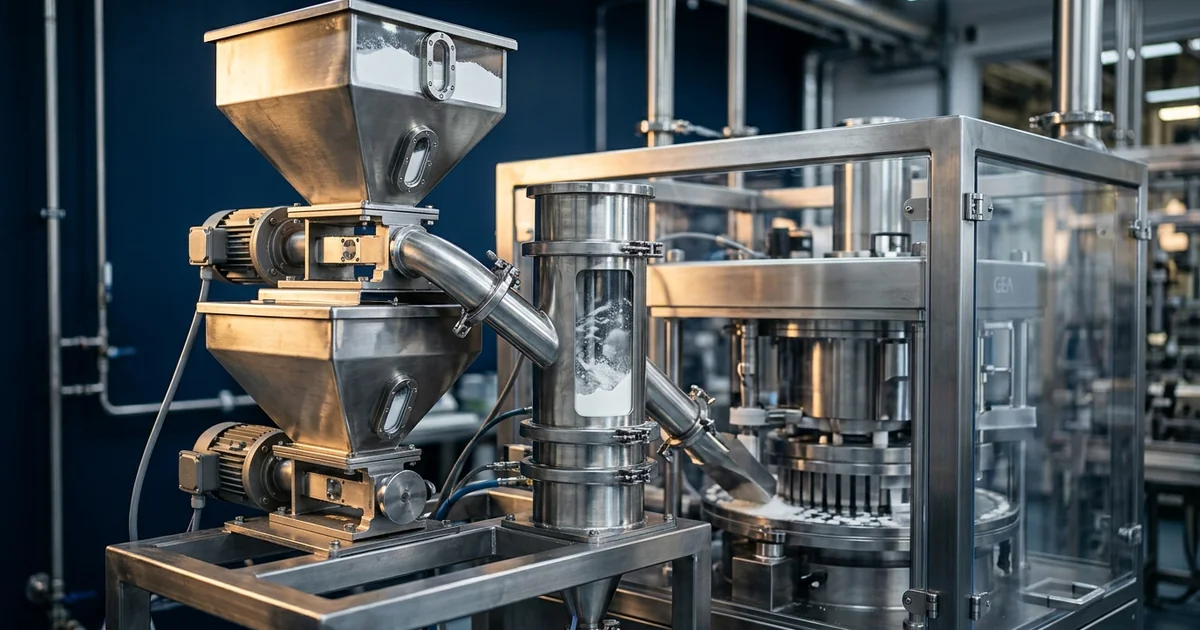
A continuous tablet line is a chain of small, connected unit operations, each doing the same job as its batch equivalent but in a flowing stream. The front end is always gravimetric feeding: loss-in-weight feeders meter each powder — active ingredient, fillers, disintegrant, lubricant — at a controlled mass flow rate into a continuous blender. What comes after the blender depends on whether the formulation can be compressed directly or needs granulation first. The choice is a formulation decision as much as an equipment one, and it should be made during development, not imposed later.
| Step | Continuous direct compression | Continuous wet granulation |
|---|---|---|
| Feeding | Gravimetric loss-in-weight feeders for each component | Gravimetric loss-in-weight feeders for each component |
| Blending | Continuous convective blender to target uniformity | Continuous pre-blend before granulation |
| Granulation | Not used | Twin-screw wet granulator with continuous liquid addition |
| Drying | Not used | Continuous fluid-bed or other continuous dryer |
| Conditioning | Lubricant addition, sometimes a second blender | Milling, lubrication, final blend |
| Compression | Rotary tablet press fed directly from the line | Rotary tablet press fed directly from the line |
| Best suited to | Well-flowing, compressible blends; lower-dose and moderate-dose actives | Poorly flowing or poorly compressible powders; high drug loading |
Direct compression is the simpler line — fewer operations, no water, no drying — so it is the preferred route whenever the formulation supports it. Wet granulation adds the twin-screw granulator and a continuous dryer, which brings more control parameters but also handles materials that would never compress directly. Either way, feeding accuracy sets the ceiling on final quality: if a feeder pulses or a refill disturbs the flow, every downstream measurement inherits that error, which is why the control system watches the feeders as closely as it watches the tablets.
Process Analytical Technology and Real-Time Release
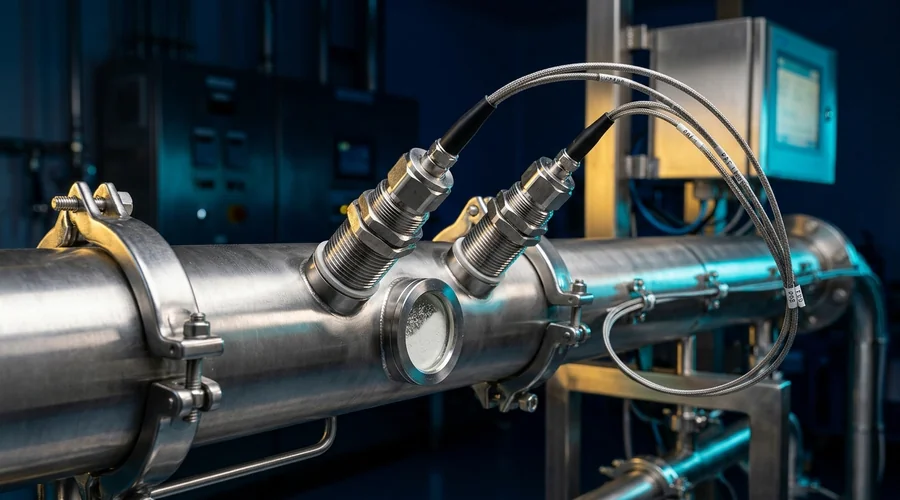
In a continuous line there is no large batch sitting in a vessel to sample, so quality has to be measured as material moves. Process Analytical Technology — PAT — is the set of in-line and on-line instruments and models that do this: spectroscopic probes in the powder stream, sensors on the press, and the chemometric models that turn a raw spectrum into a number a control system can act on. Done well, PAT does more than monitor; it lets a manufacturer replace some or all end-product laboratory testing with real-time release testing, where the decision to release is based on data gathered during production. This is a core reason companies invest in a robust analytical and stability programme alongside the line itself.
- Near-infrared and Raman spectroscopy — probes in or after the blender measure blend uniformity and active concentration continuously; Raman is often used where NIR signals overlap.
- Tablet-level sensing — press force data, checkweighing, and at-line or in-line spectroscopy assess individual tablet weight, hardness, and content.
- Soft sensors and models — where a property cannot be measured directly, a validated model predicts it from feeder rates, blender data, and spectra.
- Feedback and feedforward control — the system adjusts feed rates or diverts material automatically when a monitored attribute moves toward a limit.
- Model lifecycle management — chemometric models drift as raw materials and instruments change, so they need a defined maintenance and revalidation process.
PAT and real-time release are where continuous manufacturing earns its quality argument: instead of trusting that a tested sample represents an untested batch, the manufacturer has a near-complete record of every unit made. That record is also what regulators expect to see, which brings the discussion to the approval path.
Regulatory Position: FDA, ICH Q13, and the Approval Path
Regulatory uncertainty was, for years, the main reason companies hesitated to adopt continuous manufacturing, and that has changed decisively. The FDA approved the first product made by a continuous process in 2015 — a switch from batch for an already-marketed drug — and has since approved a series of others, both new products and batch-to-continuous conversions, while actively encouraging adoption through its emerging-technology programme. The publication of process analytical technology guidance and, more importantly, the ICH Q13 guideline has given the industry a harmonised framework. Working within an established regulatory pathway for FDA, ICH, and USP compliance is now the norm rather than a negotiation from first principles.
- ICH Q13 — reached Step 4 in November 2022 and adopted as guidance by the FDA and other regulators; it covers batch definition, residence time distribution, process dynamics, startup and shutdown, disturbances, and material diversion for both drug substance and drug product.
- Fits existing guidelines — Q13 clarifies that continuous manufacturing sits within the current ICH quality framework (development, risk management, pharmaceutical quality systems) rather than needing a separate regime.
- Emerging-technology engagement — regulators offer early dialogue programmes so novel control strategies are discussed before submission, reducing review risk.
- Global consistency — because Q13 is an ICH text, a control strategy built to it is more readily accepted across major markets, easing multi-region filings.
- Post-approval flexibility — a well-constructed filing can define ranges for run time and throughput, so routine changes in batch size do not require a variation.
The practical takeaway is that the regulatory question has moved from “will they accept it?” to “is our control strategy well enough justified?” That shifts the burden back onto engineering and development — and onto the economics of the decision.
Implementation: Cost, Facility, and When to Switch
Adopting continuous manufacturing is a capital and capability decision, not just a technology purchase. The line hardware, the PAT instruments, the automation and data infrastructure, and the model-development work all have to be funded before the first commercial tablet, and the organisation needs people who can run and maintain a model-based control strategy. Against that, the line is smaller, the facility footprint shrinks, scale-up work largely disappears, and inventory and release times fall. Whether the trade favours continuous depends on the specific product, and the honest answer for many existing products is that it does not. A structured assessment — ideally with a pharmaceutical formulation consultant who has run the comparison before — keeps the decision grounded.
- Assess the formulation — is it, or can it be made, well-flowing and directly compressible? A formula designed for continuous direct compression is far cheaper to implement than one forced through granulation.
- Forecast volume and lifecycle — enough sustained volume and enough remaining years on the product are needed to amortise the capital and the model work.
- Value the strategic benefits — supply agility, reduced scale-up risk for narrow-therapeutic-index drugs, and support for smaller distributed or onshore sites can tip a marginal case.
- Plan the facility and data systems — continuous lines need tight integration between equipment, PAT, and the manufacturing execution system; retrofitting that into an old plant is often the hidden cost.
- Build the control strategy early — the residence time distribution study, the diversion logic, and the PAT models are long-lead items and should start in development, not after.
The clearest wins are new products designed for a continuous line from the outset, high-volume generics competing on cost, and companies rethinking their manufacturing network around smaller, more flexible sites. For a low-volume product late in its lifecycle running on a depreciated batch line, staying with batch is usually the rational choice. The right framework is to evaluate continuous manufacturing product by product, with formulation, volume, and facility strategy on the table together — and to treat process validation from R&D to commercial and GMP facility design as part of the same decision, not as afterthoughts.
Frequently Asked Questions
What is continuous manufacturing in pharmaceutical production, and how is it different from batch?
In a batch process, material is moved through a sequence of separate operations — dispensing, blending, granulation, drying, compression, coating — and it sits in intermediate containers while each step is completed and, usually, tested before the next one starts. Continuous manufacturing connects those operations into a single line: raw powders are metered in continuously by gravimetric feeders, flow through blending and, if needed, granulation and drying, and come out as finished tablets, all while the line runs.
Nothing waits in a drum between steps, and the equipment is small because it only ever contains the material passing through it at that moment. The output is the same dosage form; what changes is that the process runs at a steady state and is monitored continuously rather than sampled at the end.
Is continuous manufacturing only used for tablets?
Oral solid dosage forms — tablets and, to a lesser extent, capsules — are where continuous manufacturing is most mature and where most approved products sit, because powder handling, blending and compression adapt well to a flowing line. Continuous direct compression and continuous wet granulation lines for tablets are commercially available from several equipment vendors.
The same principles are being applied to drug substance synthesis, to some semi-solid and liquid processes, and to biologics through continuous perfusion culture and continuous chromatography, though those are less standardised. For a company starting out, a tablet product is almost always the practical entry point.
What counts as a "batch" when the process never stops?
A batch is still a defined, traceable quantity of product made under the same conditions, but in continuous manufacturing it is defined by time or by mass rather than by an equipment load. Under the ICH Q13 framework, a company can define batch size as the quantity produced over a stated run time at a defined mass flow rate, or as the amount of input material processed.
This makes batch size flexible: the same validated line can produce a small quantity for a clinical study or a large quantity for commercial supply by running longer, without changing the process. The residence time distribution model for the line lets the manufacturer trace exactly which output material was affected by any disturbance, so only that portion is diverted.
What is Process Analytical Technology and why is it central to continuous manufacturing?
Process Analytical Technology, or PAT, is the use of in-line or on-line measurements to monitor and control a process in real time instead of relying only on laboratory testing of samples afterward. In a continuous line, spectroscopic probes — commonly near-infrared or Raman — sit in the powder stream and measure attributes such as blend uniformity and tablet potency as material passes, feeding a control system that adjusts feed rates or diverts material if a value drifts.
Because there is no large batch sitting in a vessel to sample, this continuous measurement is the only practical way to demonstrate that the process stayed in a state of control. PAT is therefore not an optional add-on to continuous manufacturing; it is part of the core control strategy and has to be developed alongside the formulation.
What did ICH Q13 change for companies adopting continuous manufacturing?
ICH Q13, which reached Step 4 in November 2022 and has been adopted as guidance by the FDA and other regulators, gave the industry a single harmonised set of expectations for continuous manufacturing of both drug substances and drug products. Before it, companies negotiated concepts such as batch definition, residence time distribution, process dynamics, startup and shutdown, and material diversion with each regulator individually, which added risk and delay.
Q13 sets out common scientific and regulatory principles for those topics and clarifies that continuous manufacturing fits within existing ICH quality guidelines rather than needing a separate regime. In practice it lowers the regulatory uncertainty that used to be one of the main reasons companies hesitated.
Does continuous manufacturing reduce or increase regulatory risk?
For a well-executed project it reduces long-term risk, but it front-loads effort. The upside is that an integrated line with real-time monitoring produces a rich, continuous record of process performance, supports real-time release testing, and removes many of the scale-up changes that trigger post-approval variations, because commercial supply is made by running the same line longer rather than moving to bigger equipment.
The cost is that the control strategy, the PAT models, the residence time distribution characterisation and the diversion logic all have to be developed and justified before approval, and reviewers in some regions have less experience assessing them. Engaging with a regulator's emerging-technology or innovation programme early is the standard way to manage that.
When does switching to continuous manufacturing make financial sense?
The economics favour continuous manufacturing when a product has enough volume and a long enough remaining lifecycle to amortise the capital and the model-development work, or when supply agility and scale-up risk reduction have strategic value. It is compelling for new products designed for a continuous line from the start, for high-volume generics competing on cost, for narrow-therapeutic-index drugs where consistency matters, and for companies pursuing smaller, distributed or onshore facilities.
It is usually not worth retrofitting for a low-volume niche product late in its patent life, or where an existing batch line is fully depreciated and running well. The decision should be made product by product, with the formulation, the volume forecast and the facility strategy considered together.
Evaluating Continuous Manufacturing for a Product?
Global Formulation provides continuous manufacturing implementation support, continuous tablet manufacturing consulting, process analytical technology and real-time release testing product development services, and continuous granulation contract services for pharmaceutical companies and CDMOs.
Talk to Our Formulation Team