Setting Up a Cosmetics Manufacturing Unit: GMP Facility Requirements
A first production batch that looks perfect can still be unsellable. A regulator inspects the unit, finds raw materials stored next to finished cartons, no batch records, an uncalibrated pH meter and a mixing room that shares a doorway with the toilet, and the licence application stops there. That is the difference between formulating a product and running a cosmetics manufacturing GMP facility — the second is a building, a set of systems and a paper trail, not a recipe. Getting it wrong is expensive: retrofitting good manufacturing practice into a plant that is already running costs far more than designing it in, and in the meantime nothing ships. This guide covers what ISO 22716 actually asks for, how to lay out and zone the plant so clean and dirty flows never cross, what the air, surface and water systems need to deliver, how to select and qualify equipment, what the quality control laboratory does, and a realistic staged path for a small unit that cannot build the whole thing at once. It reflects the facility-and-quality-systems work we do alongside formulation in cosmetics and personal care consulting.
Why GMP Decides Whether You Can Legally Sell Cosmetics
Good manufacturing practice is not a quality badge a brand chooses to pursue — in the major markets it is the condition for placing a product on the market at all. The regulatory position has hardened over the last decade, and a new manufacturer that treats GMP as a later upgrade is building a plant it may not be allowed to use. The specifics differ by market, but the direction is the same everywhere: the manufacturing conditions behind a cosmetic are now inspected, not assumed.
- European Union — Article 8 of the Cosmetics Regulation makes manufacturing in accordance with GMP a legal requirement, and a Commission Decision names ISO 22716 as the standard that is presumed to satisfy it
- United States — the Modernization of Cosmetics Regulation Act directs the FDA to establish enforceable GMP requirements, replacing decades of voluntary guidance with a mandatory rule
- India and other markets — a manufacturing licence from the state or national cosmetics regulator is the gateway to legal sale, and the inspection behind that licence checks premises, equipment, records and testing
- Export and retail — retailers, distributors and contract-manufacturing clients routinely require a third-party ISO 22716 certificate as a condition of doing business, regardless of the home-market rule
The practical consequence is that facility design and quality systems belong at the start of the project plan, next to the formulation and the brand, not in a phase-two budget. Every later section of this guide assumes that decision has been made. The place to begin is the standard that defines the target.
What a Cosmetics Manufacturing GMP Facility Requires: ISO 22716 in Practice
ISO 22716, Cosmetics — Good Manufacturing Practices (GMP) — Guidelines, is the reference standard for a cosmetics manufacturing GMP facility. It is written as guidance rather than a rigid specification, which is often misread as permission to be informal. In reality it sets clear expectations across every part of the operation, and an inspector or auditor works through those parts one by one — the FDA's own GMP inspection checklist for cosmetics is organised around the same subject areas. It covers the production, control, storage and shipment of finished cosmetics — it deliberately excludes research and development and it does not cover worker safety or environmental protection, which sit under other law.
The standard is organised around the parts of the operation that can affect product quality:
- Personnel — an organisation chart, defined responsibilities, training records, hygiene and health rules, and control of visitors and untrained staff
- Premises — located, designed and maintained to protect the product, allow effective cleaning, and minimise mix-ups and cross-contamination
- Equipment — suitable for purpose, cleanable, calibrated, maintained, and installed so it can be used and cleaned properly
- Raw and packaging materials — purchased to specification, quarantined on receipt, tested or verified, released before use, and stored under control
- Production — written manufacturing and packaging instructions, in-process checks, line clearance, and a batch record built as the work happens
- Finished products — released against a specification, stored and shipped under control, with retention samples kept
- Quality control laboratory — methods, sampling, out-of-specification handling and reagent control
- Supporting systems — treatment of non-conforming product, waste, subcontracting, deviations, complaints and recalls, change control, internal audits and documentation
The general principles of GMP that run through all of this are consistent: write down what you will do, do what you wrote, record that you did it, and be able to trace any batch forward and back. That mindset, applied from the first batch, is what a new unit is really building toward. The physical expression of it starts with how the building is arranged.
Cosmetic Plant Facility Design: Layout and Zoning
The single most important design decision is the direction materials move through the building. A well-designed cosmetic plant flows in one direction, from goods-in to dispatch, so that incoming raw materials and outgoing finished goods never share a doorway, a corridor or a moment in time. Cross-contamination and product mix-up — the two failures ISO 22716 most wants premises to prevent — are almost always layout failures before they are cleaning failures. Retrofitting flow into a building chosen for its rent is the most common and most costly mistake a startup makes.
A typical zoning sequence for a cosmetic unit runs in this order:
- Goods-in and quarantine — a receiving bay where incoming materials are logged and held pending release, physically separate from released stock
- Raw material warehouse — controlled temperature and humidity, pest-proofed, with released materials clearly segregated from quarantined and rejected
- Dispensing / weighing room — a dedicated space where batch quantities are weighed out, ideally with local extraction for powders and volatiles
- Water purification plant — sited close to the processing area to keep the distribution loop short
- Compounding and processing — the controlled room where bulk is made; the highest-care zone in the building
- Bulk hold — a defined area or vessel park for approved bulk awaiting filling
- Filling and primary packaging — where product meets its container; treated as a care zone because the product is still open
- Secondary packaging — cartoning and labelling, a lower-care zone because the product is now sealed
- Finished-goods quarantine and release store — batches held here until QC release, then dispatch
People and waste need their own routes. Staff enter through a changing room that acts as a hygiene threshold into the care zones, ideally on a path separate from the material flow. Waste, rejects and returns leave by a route that does not pass back through clean areas. Fragrance and strong colour operations are frequently segregated into their own room or run as isolated campaigns, because those residues are the hardest to clean out and the easiest to carry into the next product. This zoning logic is set out in the facility section of our cosmetics and personal care guide, which this article expands into the GMP detail.
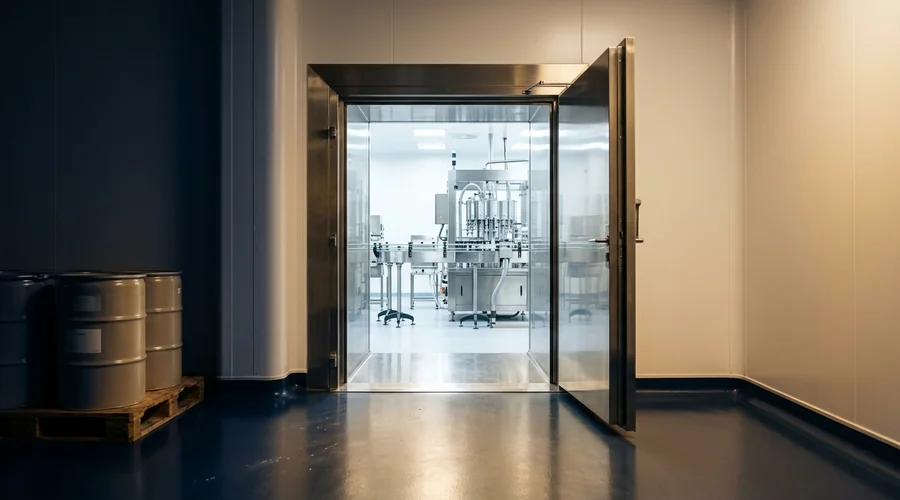
A layout that gets the flow right makes every downstream system easier; a layout that gets it wrong cannot be fixed by cleaning harder. With the rooms in the right order, the next question is what those care-zone rooms have to deliver.
Air, Surfaces and Water Systems in the Care Zones
The compounding and filling rooms are where the product is open to the environment, so they carry the tightest requirements for surfaces, air and water. None of this needs to reach pharmaceutical cleanroom classification for most cosmetics, but each system has to be specified, built to that specification, and shown to hold it. The goal is a room whose cleanliness you can demonstrate with data, not assert.
Surfaces and finishes
Every surface in a care zone has to be cleanable and non-shedding. That means seamless resin flooring with coved skirting so there is no wall-to-floor crevice, washable wall panels or coated blockwork, sealed ceilings, and coved or sealed junctions throughout. Fixtures are minimised, and the ones that remain are stand-off mounted so the wall behind them can be wiped. Drains in wet rooms are trapped and, where risk is higher, capped between uses.
Air handling
The care zones are supplied with filtered air, usually held at a small positive pressure relative to the corridor so that air leaks outward rather than drawing unfiltered air in — the containment logic described for cleanroom pressure cascades. Filtration grade is matched to product risk: a coarse pre-filter plus a fine final filter is common, with HEPA filtration reserved for higher-microbial-risk products. Temperature and humidity are controlled because both affect emulsion processing and microbial growth, and the air-change rate is set high enough to clear the room between operations.
Water systems
Water is normally the largest single ingredient in a cosmetic and the most frequent route for contamination, so it is treated as a raw material with its own specification. Most plants generate purified water on site by reverse osmosis, often followed by deionisation, ultraviolet treatment and final filtration. The storage and distribution loop is designed to keep water circulating continuously with no dead legs, because a stagnant blind branch is exactly where biofilm establishes. Conductivity and microbial count are monitored on a schedule, and the loop sanitisation method is defined and recorded.
Get the surfaces, air and water right and the room supports clean production by default. The equipment inside it is the next system to specify.
Cosmetic Manufacturing Equipment Setup and Qualification
The equipment list for a cosmetic plant is short at its core and expands with the product range. What matters under GMP is not only that the equipment can make the product, but that it is the right material of construction, can be cleaned to a verifiable standard, is calibrated where it measures, and has documented evidence that it was installed and performs as intended. Buying a vessel is the easy part; qualifying it is the GMP part.
The core of an emulsion or lotion plant:
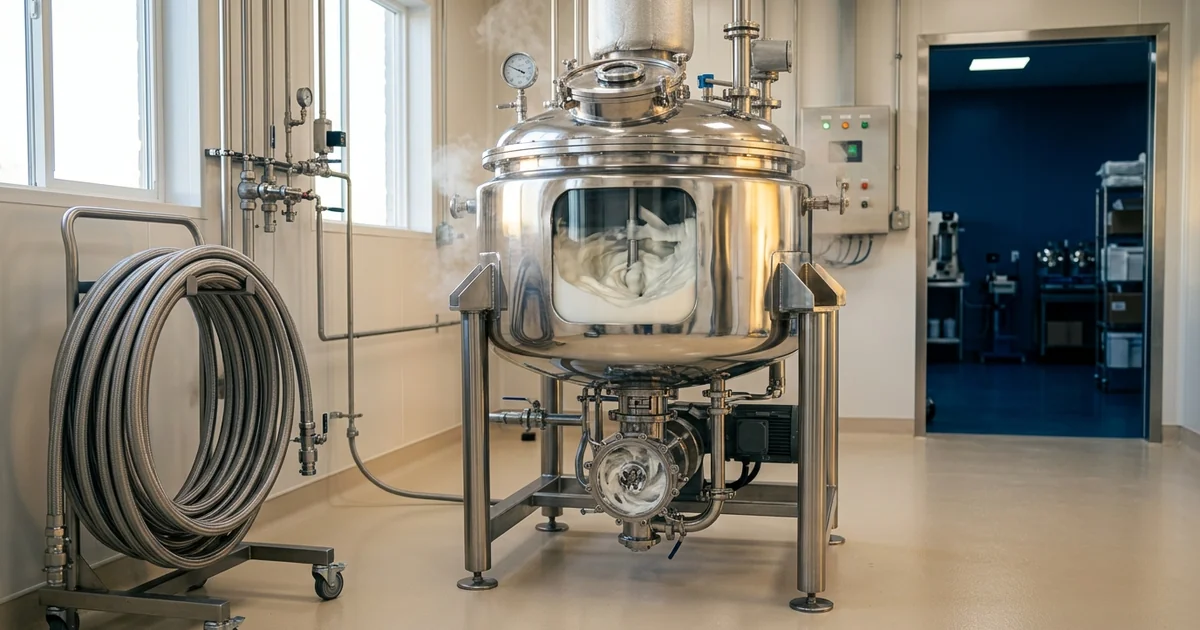
- Jacketed mixing vessel — stainless steel, grade 304 for many products and 316L where chloride or low pH is a concern, with an anchor or contra-rotating sweep agitator to move the bulk and scrape the wall
- High-shear homogeniser — bottom-mounted in the vessel or in a recirculation loop, to reduce droplet size and build a stable emulsion
- Jacket heating and cooling — a hot water or steam source and a chilled water source, sized to heat and cool a full batch in a workable time
- Water purification system — sized to peak batch demand, not average, so a large batch does not outrun the supply
- Weighing equipment — scales with range and resolution matched to both major ingredients and low-dose actives, preservatives and fragrance
- Filling machine — matched to the pack format, whether bottle, jar, tube or sachet, with change parts for the SKU range
- Cleaning equipment — the tools and, where used, the clean-in-place capability to bring the vessel and lines back to a verified clean state between batches
Qualification is usually structured as installation qualification, operational qualification and performance qualification — confirming the equipment is installed correctly against the specification, operates across its intended range, and consistently makes conforming product. For a small unit this can be proportionate and lean, but it cannot be skipped: an inspector will ask for the evidence that the homogeniser does what the batch record assumes it does. Calibration of every measuring device — scales, pH meters, thermometers, pressure gauges, timers — is scheduled, recorded and traceable to a reference standard.
| Equipment | GMP-relevant requirement | Common startup shortcut that fails audit |
|---|---|---|
| Mixing vessel | Food/cosmetic-grade stainless, cleanable, documented material certificate | Mild-steel or unknown-grade tank; no material certificate |
| Homogeniser | Performance qualified against the process it is assumed to deliver | Installed and used with no OQ/PQ evidence |
| Weighing scales | Calibrated to a traceable standard on a defined schedule | Retail kitchen scale, never calibrated |
| pH meter | Calibrated with fresh buffers before each use, logged | Calibrated once at purchase |
| Water system | Loop design without dead legs, monitored, sanitised on schedule | Municipal tap water or a static storage tank |
| Filling line | Fill weight/volume checked and recorded through the run | Hand filling with no in-process weight check |
Qualified equipment feeding a documented process is only half the quality picture. The other half is the laboratory that decides whether what came out is fit to sell.
The Cosmetic Plant Quality Control Laboratory
The quality control laboratory is the gate every batch passes through before it reaches a customer. Its job is narrow and non-negotiable: check incoming materials against specification before they are released to production, test in-process bulk at defined points, and test finished product against its release specification. A batch that has not been through that gate, with a documented pass, cannot be sold — that is the rule the whole facility exists to support.
The routine finished-product checks for a typical cosmetic:
- Appearance and odour — against a retained reference standard for the product
- pH — within the specification range, using a calibrated meter
- Viscosity or rheology — the flow behaviour a consumer will notice and a filling line depends on
- Fill weight or volume — checked through the packaging run, not just at the start
- Microbial content — total viable count and absence of specified organisms, per the product's limits
- Active assay — where a marketing or efficacy claim depends on a defined active level
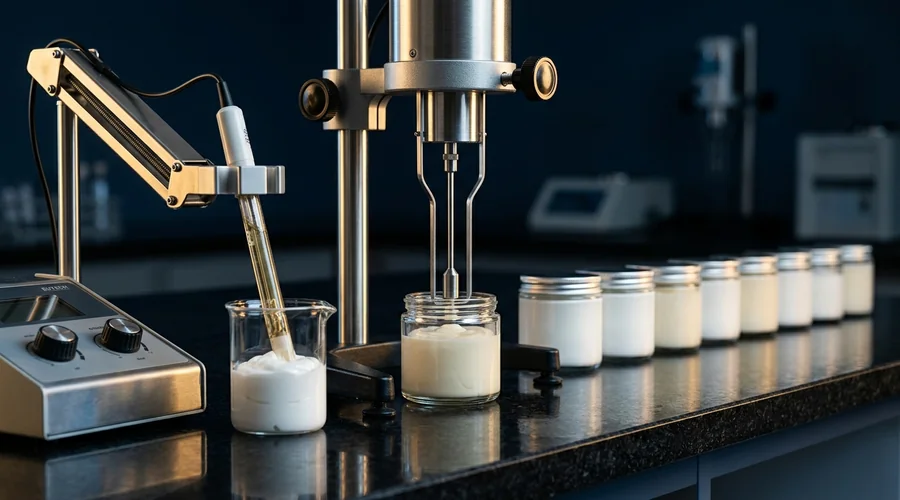
Beyond batch release, the laboratory runs or coordinates stability studies, preservative efficacy testing, and the retention-sample programme — the same discipline covered in our guide to how cosmetic formulations are developed from concept to commercial. Small manufacturers commonly keep a basic physical-chemistry bench in house — balance, pH meter, viscometer, oven — and contract microbiology and analytical assay to a qualified external laboratory. ISO 22716 allows this, provided the subcontractor is qualified and the arrangement is documented, including how out-of-specification results are handled and communicated.
With premises, equipment and laboratory defined, the last question is how a small operation gets there without building all of it on day one.
A Realistic Path for a Small-Batch Cosmetic Manufacturing Unit
Very few new cosmetic businesses can build a full GMP plant before their first sale, and they do not have to. What they cannot do is skip GMP and plan to add it later — the compliant path is to build small but build correctly, so the plant scales up rather than being rebuilt. The staged approach below keeps every batch defensible while the operation grows into its full facility.
- Start with contract manufacturing — commission an existing GMP-certified manufacturer for the first SKUs while the brand, formulation and demand are proven; this defers the capital and de-risks the launch, an option explored in our guide to manufacturing without a factory
- Design the small unit to ISO 22716 from the first drawing — one-directional flow, cleanable finishes, a real water loop and a changing-room threshold, even at 300 to 500 square feet
- Qualify a minimum equipment set — one properly specified jacketed vessel with a homogeniser, calibrated scales and pH meter, an adequate water system, and a filling method with in-process weight checks
- Contract out what you cannot yet do in house — microbiology, analytical assay and stability testing to a qualified laboratory, documented as a subcontracting arrangement
- Build the documentation from batch one — specifications, manufacturing instructions, batch records, calibration and cleaning logs, and a retention-sample store; this is the part that cannot be backdated
- Add capacity and bring testing in house as volume justifies it — larger vessels, a second line, an expanded laboratory, and finally third-party ISO 22716 certification when a market or customer requires it
The through-line is that GMP is a design decision, not a certificate you buy at the end. A unit that is small but correctly built can pass an inspection, supply a cautious retailer, and grow without demolition. A unit that is large but informally run fails the first serious audit and stops shipping while it is fixed. Build the discipline in from the first batch, and the facility grows with the business instead of constraining it.
Frequently Asked Questions
What standard governs a cosmetics manufacturing GMP facility?
The reference standard is ISO 22716, Cosmetics — Good Manufacturing Practices (GMP) — Guidelines. It covers the production, control, storage and shipment of cosmetic products, and sets expectations for personnel, premises, equipment, raw and packaging materials, production, finished products, the quality control laboratory, out-of-specification handling, waste, subcontracting, deviations, complaints and recalls, change control, internal audits and documentation.
In the European Union, Article 8 of the Cosmetics Regulation makes GMP a legal requirement and a Commission Decision names ISO 22716 as the standard presumed to satisfy it. In the United States, the Modernization of Cosmetics Regulation Act directs the FDA to set enforceable GMP requirements, and the FDA's long-standing GMP inspection checklist for cosmetics tracks the same subject areas. ISO 22716 is a guideline, not a cleanroom specification — it does not impose a particle class, but it does require premises designed to protect the product.
Do cosmetics need a cleanroom like pharmaceuticals?
Not in the classified-cleanroom sense that sterile pharmaceutical manufacturing requires. ISO 22716 asks for premises that protect the product, allow effective cleaning, and prevent mix-ups and cross-contamination — it does not mandate an ISO 14644-1 particle class.
In practice, most cosmetic plants build a controlled but unclassified processing area: smooth cleanable epoxy floors and coved skirting, washable wall and ceiling finishes, filtered air supply at slight positive pressure to the corridor, controlled temperature and humidity, and airlocks or pass-throughs between the corridor and the room where open bulk is handled. Products with higher microbial risk justify tighter air filtration and gowning. The design target is a room you can prove is clean, not a room certified to a semiconductor standard.
How should a cosmetic plant be zoned to prevent cross-contamination?
The layout should move material in one direction, from goods-in to dispatch, without clean and dirty flows crossing. A typical zoning runs: quarantine and raw material warehouse, a dispensing or weighing room, the water purification plant, the compounding and processing area, a bulk hold area, the filling and primary packaging room, secondary packaging, finished-goods quarantine and release store, then dispatch.
People enter through a changing room and, ideally, a separate route from materials. Waste and returns leave by a path that does not re-enter clean areas. Fragrance and colour handling are often segregated or campaigned because they are the hardest residues to clean out. The principle is that a raw material drum and a finished carton should never share the same doorway at the same time.
What equipment does a small-batch cosmetic manufacturing unit need?
The core of an emulsion plant is a jacketed stainless steel mixing vessel — grade 304 is acceptable for many products, 316L where chloride or acid content is a concern — fitted with an anchor or contra-rotating sweep agitator and a high-shear homogeniser, either bottom-mounted or as a recirculation loop. Around it sit a heating and cooling source for the jacket, a water purification system sized to peak batch demand, weighing scales with a range and resolution matched to both major and minor ingredients, a filling machine appropriate to the pack format, and cleaning equipment.
A basic quality control bench needs a calibrated pH meter, a viscometer, a balance, an oven and a laminar-flow hood or a contracted laboratory for microbiological testing. Starting small does not remove the GMP obligations — it changes the scale of the equipment, not the need to qualify and calibrate it.
What water quality is required for cosmetic manufacturing?
Water is usually the largest single ingredient in a cosmetic and it is the most common route for microbial contamination, so it is treated as a raw material with its own specification. Most plants produce purified water on site by reverse osmosis, often followed by deionisation, ultraviolet treatment and final filtration.
The distribution loop should be designed to keep water moving — a continuously circulating loop with no dead legs — because stagnant water in a blind branch is where biofilm establishes. The water is tested routinely for conductivity and microbial count, and the sanitisation method for the loop, whether hot water, ozone or chemical, is defined and recorded. A plant that uses municipal supply directly is accepting a contamination risk that a preservative system then has to carry alone.
What does the cosmetic plant quality control lab actually do?
The quality control laboratory checks incoming materials against specification before release to production, tests in-process bulk at defined points, and tests finished product before it is released for sale. For a cosmetic, the finished-product checks typically include appearance, odour, pH, viscosity or rheology, fill weight or volume, and microbial content, plus active-ingredient assay where a claim depends on it.
The lab also runs or coordinates stability studies and preservative efficacy testing, and it holds retention samples of each batch. Small manufacturers frequently keep a basic physical-chemistry bench in house and contract microbiology and analytical assay to an external laboratory, which is acceptable under ISO 22716 provided the subcontractor is qualified and the arrangement is documented. The lab's core function is that no batch reaches a customer without a documented pass against its release specification.
Is ISO 22716 certification mandatory to start manufacturing cosmetics?
Compliance with GMP is a legal requirement in the EU and is becoming enforceable in the US, but a third-party ISO 22716 certificate is not universally required to begin manufacturing, especially for domestic sale in markets with a simple notification system. What is expected everywhere is that the operation actually follows GMP: controlled premises, calibrated equipment, batch records, released raw materials, finished-product testing, and traceability.
Formal certification becomes important when supplying export markets, retailers, or contract-manufacturing clients who require it as a condition of business, and when a regulator in a stricter market inspects. The practical approach for a startup is to design and operate to ISO 22716 from the first batch, keep the documentation, and pursue certification when a customer or market makes it necessary — retrofitting GMP into a running plant is far more expensive than building to it.
Planning a Cosmetics Manufacturing Unit?
Global Formulation provides cosmetics consultancy — ISO 22716 facility design, plant layout and flow, HVAC and water system specification, equipment selection and qualification, quality-system documentation, and a staged scale-up plan.
Talk to Our Formulation Team