NSF H1 Certification Pathway for Food-Grade Lubricants
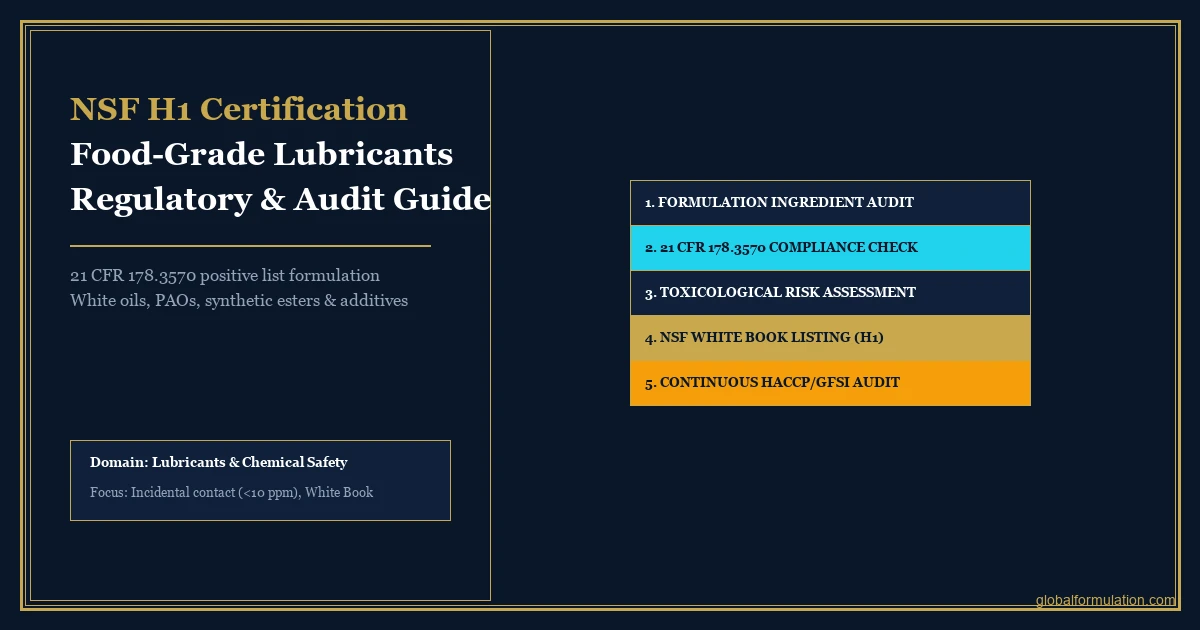
NSF H1 certification for food-grade lubricants is the credential food and beverage manufacturers demand before any lubricant is allowed near a production line. Without it, a lubricant supplier is locked out of an entire market segment, and a food manufacturer using an uncertified lubricant risks a failed GFSI audit, a product recall, or regulatory action if incidental contact ever occurs. NSF International administers the H1 registration program that succeeded USDA's original approval scheme, screening every ingredient in a formulation against FDA's permitted substances for incidental food contact under 21 CFR 178.3570. This guide walks through who needs H1 certification, what the ingredient and documentation requirements actually demand, and the realistic timeline for getting a food-grade lubricant registered — current to NSF's registration program as administered in 2026.
What NSF H1 Certification Is and Why It Exists
NSF H1 exists because food processing equipment cannot run without lubrication, yet any lubricant used near exposed food creates a contamination risk if a formulation contains ingredients unsafe for human ingestion. Before a dedicated approval system existed, food manufacturers had no independent way to verify that a lubricant supplier's "food-safe" claim actually meant anything, leaving auditors and regulators with no consistent standard to check against.
The United States Department of Agriculture (USDA) originally administered a lubricant approval program with H1, H2, H3, and 3H classifications, but discontinued the service in 1998 due to resource constraints. NSF International, an independent standards and certification organization, took over the classification system that same year and continues to operate it today as the NSF Nonfood Compounds Registration Program. H1 covers lubricants where incidental, non-intentional food contact is possible; H2 covers lubricants restricted to equipment with no possibility of food contact; H3 covers soluble and edible oils used as release-type lubricants; and 3H covers release agents applied directly to food-contact surfaces. Most GFSI-recognized food safety schemes — SQF, BRCGS, and FSSC 22000 — now reference NSF registration directly in their audit checklists.
Scope: Who Needs NSF H1 Certification
The practical scope of NSF H1 is broader than most manufacturers assume. Any lubricant, grease, hydraulic fluid, or chain oil used at a point in a food or beverage processing facility where incidental contact with food, food packaging, or food-contact surfaces is technically possible falls within H1's intended use case — not just lubricants applied directly to food-contact machine parts. Auditors under GFSI-aligned schemes increasingly expect H1 lubrication across an entire production floor as a default policy, rather than a risk-by-risk judgment call at each lubrication point.
Lubricant manufacturers and formulators fall into scope whenever they intend to market or sell a product for use in food, beverage, or pharmaceutical processing environments. This includes conveyor lubricants, gear oils for mixers and packaging lines, hydraulic fluids for food-grade equipment, chain and wire rope lubricants, and food-grade greases for bearings near exposed product. The table below summarizes where each NSF category applies.
| NSF Category | Use Case | Contact Type | Typical Application |
|---|---|---|---|
| H1 | Incidental food contact possible | Non-intentional, low background level | Conveyor lubricants, gear oils, hydraulic fluids on production lines |
| H2 | No food contact possible | None — equipment isolated from food zone | Lubricants for equipment outside the food-contact area |
| H3 | Soluble or edible oil lubrication | Direct, low-level intentional | Hooks, trolleys, and equipment in meat and poultry plants |
| 3H | Release agent | Direct application to food-contact surfaces | Pan release agents, dough dividers, mold release |
Key Requirements: What NSF H1 Registration Demands
NSF H1 registration rests on one non-negotiable rule: every single ingredient in the formulation, at every concentration used, must appear on FDA's list of substances permitted for incidental food contact. There is no partial compliance — a single disqualified additive, colorant, or trace impurity blocks the entire product from registration, regardless of how minor its role in the formulation.
- Base fluid compliance — white mineral oil (21 CFR 172.878), polyalphaolefins, polyalkylene glycols, or synthetic esters cleared for incidental food contact use
- Additive package screening — thickeners, antioxidants, anti-wear agents, and corrosion inhibitors must each individually appear on the permitted substances list under 21 CFR 178.3570
- Concentration limits — several permitted substances carry maximum use-level restrictions that must not be exceeded in the finished formulation
- Manufacturing consistency — the product must be manufactured exactly as registered, with no undisclosed substitutions of raw material grade or supplier
- Labeling accuracy — the NSF registration mark and category (H1) must be used only for the specific formulation NSF has approved, not extended to variants without separate registration
Formulators who try to adapt an existing industrial lubricant for H1 use by simply swapping the base oil typically discover that several additives in the original package are disqualified outright, forcing a full additive redesign rather than a substitution.
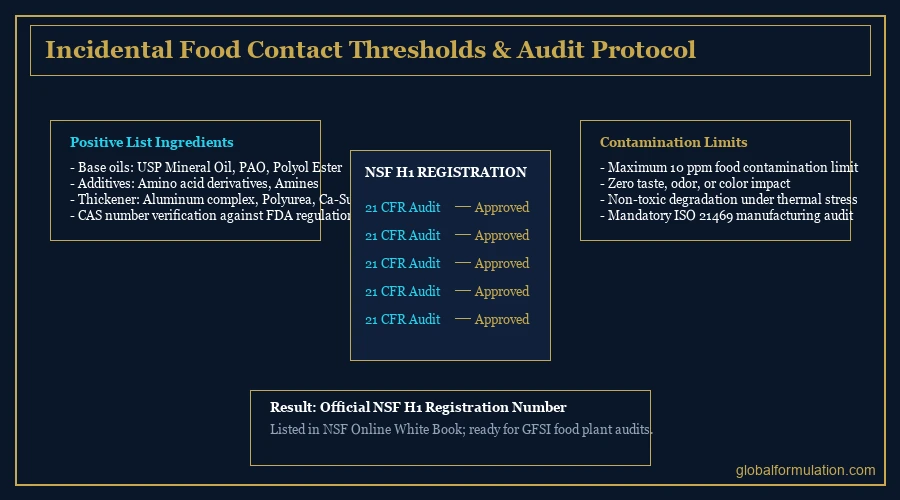
The NSF H1 registration pathway moves from ingredient-level screening through formulation review to final listing — each stage must be documented and held on file for audit.
Testing and Documentation Requirements
The documentation burden for NSF H1 registration falls almost entirely on proving ingredient pedigree rather than generating new test data — provided every ingredient is already cleared for incidental food contact use. Formulators who select only from NSF's registered and listed ingredients database can often avoid new toxicological testing altogether, which is why ingredient sourcing decisions matter as much as the finished formulation chemistry.
The core documentation package NSF requires includes a full formulation disclosure (every ingredient and its exact concentration), a letter of guarantee or compliance statement from each raw material supplier confirming the ingredient's regulatory status for incidental food contact, safety data sheets for all raw materials, and manufacturing process documentation confirming batch consistency. Where an ingredient is not yet on the pre-approved list, the manufacturer must also submit supporting toxicological data consistent with FDA's food contact substance evaluation framework.
- Formulation disclosure — complete ingredient list with exact concentrations, submitted confidentially to NSF
- Supplier letters of guarantee — written confirmation from each raw material supplier of the ingredient's food contact regulatory status
- Safety data sheets — current SDS for every raw material used in the formulation
- Manufacturing records — batch records demonstrating the product is made consistently to the registered specification
- Toxicological data — required only for ingredients not already on NSF's approved list
A complete, well-organized submission package is the single biggest factor separating a four-week registration from a review that stalls for months on document requests.
Step-by-Step NSF H1 Registration Pathway
Registering a food-grade lubricant with NSF follows a defined sequence that begins well before any paperwork reaches NSF's review team. Formulators who front-load ingredient verification save weeks of back-and-forth later, because most delays trace back to a single non-compliant additive discovered mid-review.
- Screen every candidate ingredient against the permitted substances list. Before finalizing any formulation, check each base fluid, thickener, and additive against 21 CFR 178.3570 and NSF's own registered ingredients database. Eliminate any substance not cleared for incidental food contact use at the intended concentration.
- Finalize the formulation and confirm concentration limits. Where a permitted substance carries a maximum use-level restriction, verify the finished formulation stays within that limit. Document the calculation for each restricted ingredient.
- Assemble the submission package. Compile the full formulation disclosure, supplier letters of guarantee, safety data sheets, and manufacturing process documentation. Incomplete submissions are the most common cause of extended review timelines.
- Submit to NSF's Nonfood Compounds Registration Program for review. NSF reviews the formulation against its ingredient database and FDA's permitted substances framework. If any ingredient requires toxicological evaluation, NSF will request supporting data before proceeding further.
- Receive registration and add the product to NSF's public listing. Once approved, the product is added to NSF's White Book online registry, and the manufacturer may use the H1 registration mark on labeling and marketing materials for that specific formulation.
- Maintain annual renewal and report formulation changes. NSF registration requires annual renewal and periodic facility audits. Any change to the formulation — a different antioxidant, a new base oil supplier grade, an altered thickener ratio — must be reported and may require re-registration.
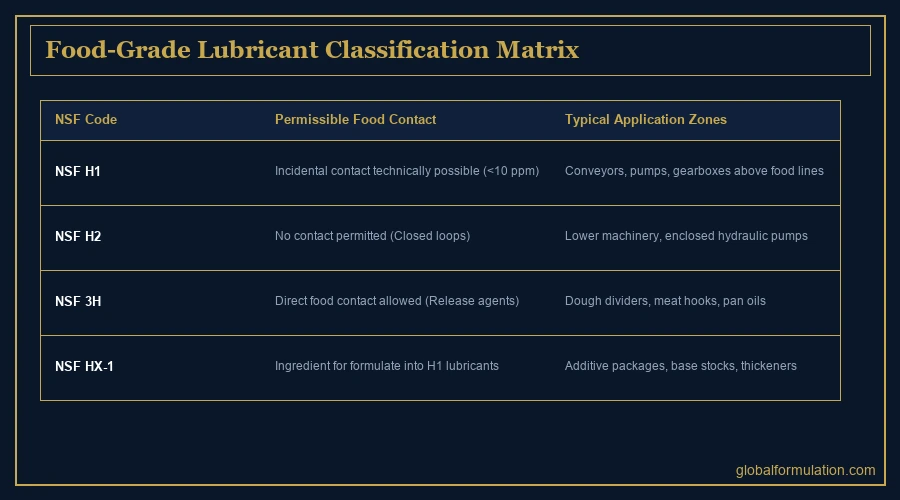
H1, H2, H3, and 3H each cover a distinct contact scenario — matching the right category to the actual application prevents both under-specification and unnecessary cost.
Realistic Timeline and Cost Expectations
For a lubricant manufacturer building a first H1-registered product, the timeline and investment required depend almost entirely on whether the formulation is built from ingredients already on NSF's pre-approved list. Understanding this driver up front prevents the common mistake of committing to a formulation before checking ingredient eligibility.
When every ingredient is already registered and listed with NSF, submission review typically takes four to eight weeks from a complete, well-documented package. If any ingredient requires individual toxicological review — because it has not previously been cleared for incidental food contact — the timeline extends to three to six months or longer, since NSF must evaluate supporting safety data or the manufacturer must commission new studies. The main cost categories are the NSF registration and annual renewal fees, any regulatory consultancy engaged to screen ingredients and assemble the submission package, and — only if novel ingredients are involved — toxicological testing or data licensing costs.
Formulators developing new food-grade products alongside our broader lubricants formulation work typically find that selecting from NSF's approved ingredient list at the design stage, rather than after a formulation is finalized, is the single most effective way to control both timeline and cost.
Common Mistakes Manufacturers Make — and How to Avoid Them
Most NSF H1 registration delays and rejections trace back to a handful of recurring errors, not obscure regulatory technicalities. Formulators who understand these patterns in advance can structure their development process to avoid them entirely rather than discovering them mid-submission.
- Reformulating by base oil swap alone — assuming a food-grade base oil is sufficient while leaving an industrial additive package unchanged, when several additives are typically disqualified for incidental food contact use
- Incomplete supplier documentation — submitting without current letters of guarantee from every raw material supplier, which stalls NSF review until the gap is filled
- Marketing as "food-grade" before registration completes — using H1 language or the NSF mark before formal registration is confirmed, creating labeling compliance exposure
- Silent formulation changes after registration — substituting a raw material grade or supplier without notifying NSF, risking suspension of an active registration
- Confusing H1 with H3 or 3H — specifying H1 for an application that actually involves direct food contact, which requires the more restrictive H3 or 3H category instead
A disciplined ingredient-screening step at the earliest formulation stage, paired with a documented change-control process after registration, addresses nearly all of these failure patterns before they cost a manufacturer months of delay.
Frequently Asked Questions
Do I need NSF H1 certification if my lubricant never directly touches food?
How is NSF H1 different from USDA's old H1 approval program?
Which base oils and additives are allowed in an NSF H1 lubricant formulation?
How long does NSF H1 registration actually take?
Does NSF H1 certification need to be renewed?
Can an H1 lubricant also be labeled food-grade or edible?
Do I need to test my formulation for toxicology before applying to NSF?
Need Regulatory Guidance for Your Food-Grade Lubricant Launch?
Our team provides end-to-end regulatory strategy — from ingredient screening and formulation review through to NSF submission support and ongoing compliance monitoring.
Get a Free Consultation