Adhesives & Sealants Formulations Encyclopedia
About this book
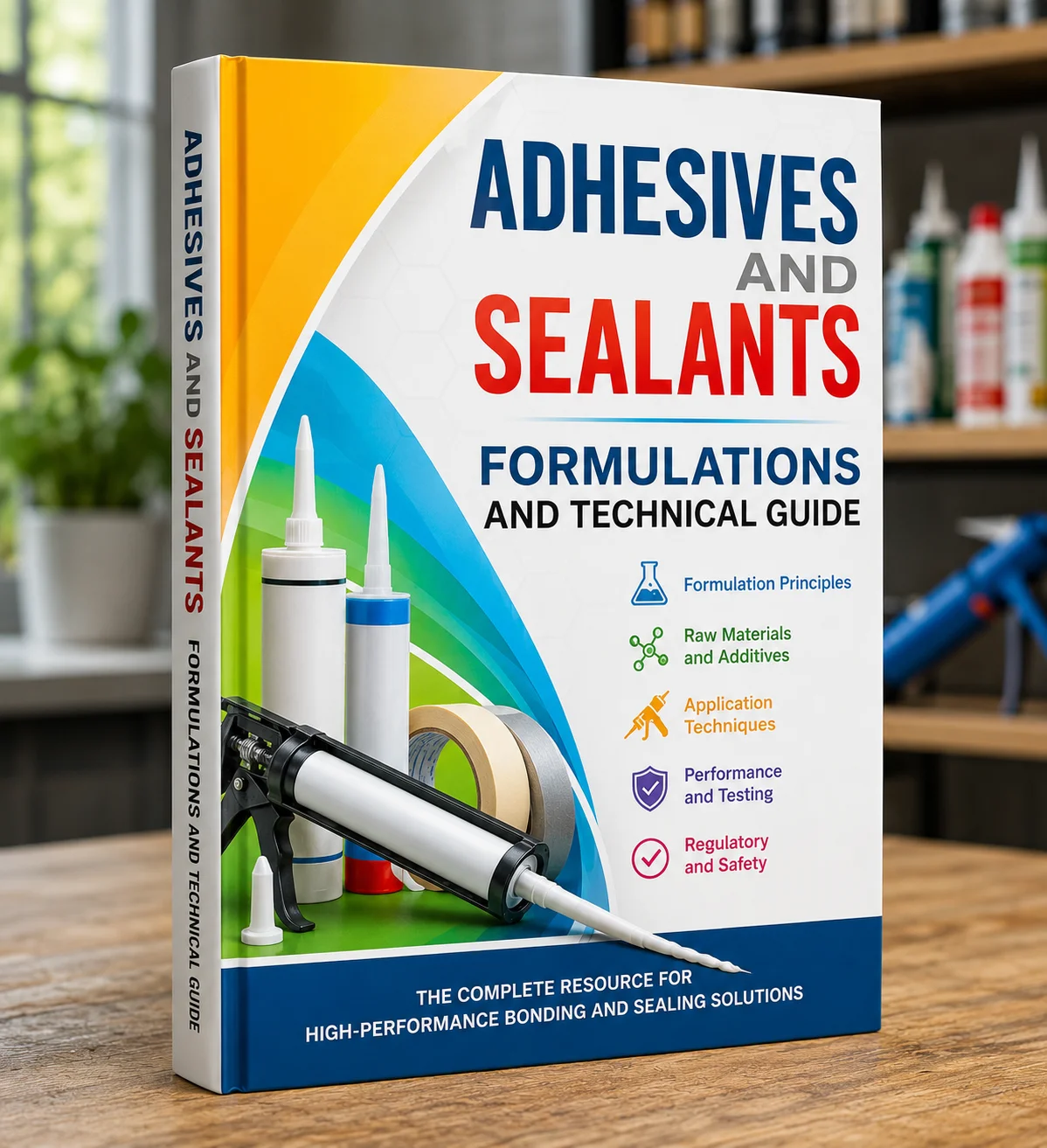
Adhesives & Sealants Formulations Encyclopedia is a comprehensive technical reference spanning all eight major adhesive and sealant chemistry families — waterborne (PVA, acrylic PSA), hot-melt (EVA, polyolefin, reactive PUR), contact and solventborne (neoprene, SBS, footwear PU), reactive (2K epoxy, cyanoacrylate, anaerobic, UV-cure), silicone sealants (acetoxy and neutral-cure), polyurethane sealants (1K and 2K), MS-polymer hybrid sealants and acrylic/butyl construction sealants. It is a single working library for adhesive and sealant manufacturers, construction chemicals producers and industrial bonding engineers — covering the polymer backbone, cure mechanism, formulation rationale, substrate compatibility and QC targets for every system.
The technology
The encyclopedia develops the distinct polymer chemistry and cure mechanisms of each adhesive family: PVA emulsion polymerisation and D2/D3/D4 crosslinking with MDI; EVA hot-melt rheology, viscosity and open-time balance; PUR reactive hot-melt moisture-cure kinetics; polychloroprene crystallisation rate and contact-adhesive open time; bisphenol-A epoxy / polyamide cure, stoichiometry and Tg prediction; cyanoacrylate anionic polymerisation and substrate compatibility; anaerobic dimethacrylate redox cure and thread-sealing mechanism; RTV-1 silicone condensation cure and acetoxy vs neutral oxime chemistry; MS polymer silane-terminated polyether hydrolysis and condensation; polyurethane prepolymer moisture cure and NCO/OH ratio design. Across all families, tack-peel-shear performance, rheology and open time, substrate surface energy and pretreatment, and the QC test methods that characterise adhesive and sealant performance (ASTM D1002, D1876, D903, D1002; ISO 8339; EN 204) are treated in consistent depth.
Inside the formulations
Starting-point formulations for each adhesive and sealant family give resin/polymer backbone, tackifier, crosslinker, filler, plasticiser and additive loadings as % w/w, with cure schedule or application temperature window, open time, set time, QC targets and substrate compatibility matrix. Two-component systems (epoxy, 2K PU sealant) are presented as Part A and Part B with mix ratios. Waterborne formulations include solids content, pH and viscosity targets. Hot-melt formulations include application temperature, open time and set time at 23°C.
What you get
- Formulations across 8 adhesive and sealant chemistry families
- PVA D1–D4 wood adhesives, acrylic PSA, carpet and laminating adhesives
- EVA, polyolefin and reactive PUR hot-melt formulations with application temperature data
- Polychloroprene, SBS and polyurethane contact and solventborne adhesive systems
- Epoxy 2K structural, cyanoacrylate, anaerobic and UV-cure reactive adhesives
- Acetoxy and neutral-cure silicone, 1K/2K PU and MS-polymer hybrid sealants
- QC targets: viscosity, open time, lap shear strength, peel strength, movement accommodation factor
- Substrate compatibility tables and surface preparation guidance for all systems
Technical details
- Format
- A4 PDF · instant digital download
- Scope
- PVA · acrylic PSA · EVA/PO/PUR hot-melt · contact · epoxy · CA · silicone · PU · MS-polymer sealants
- Standards
- EN 204 · ISO 11600 · ASTM C920 · ASTM D1002/D1876/D903 · ISO 8339 · ASTM D1002
- Tiers
- Economy · Mid-range · Premium · Specialist
- Audience
- Adhesives manufacturers · construction chemicals producers · bonding engineers
- Series
- Industrial Chemicals & Adhesives Series · Volume 1
Eight adhesive and sealant chemistries — one encyclopedia. Stop researching each family separately and build your complete product range from PVA wood glue to MS-polymer hybrid sealant from a single validated technical reference.
Who is this book for?
Adhesives Manufacturer
You produce one or two adhesive types and want to expand your range into polyurethane reactive hot-melt, 2K epoxy, MS polymer or solventborne contact adhesives without rebuilding the chemistry from scratch.
Construction Chemicals Producer
You make building chemicals (grouts, waterproofing, tile adhesives) and want to extend into high-value sealants — silicone, MS polymer hybrid and polyurethane — with formulations that meet ISO 11600 and ASTM C920 movement accommodation.
Industrial Bonding Engineer
You specify and develop structural and semi-structural adhesive solutions for industrial assembly, automotive, electronics or footwear bonding and need a reference covering tensile shear strength, peel, open time, cure profile and substrate compatibility.
Table of Contents
- Adhesion mechanisms: mechanical interlocking, chemical bonding, diffusion, electrostatic
- Substrate preparation: surface energy, cleaning, priming and activation
- Rheology, open time, set time and creep resistance
- Bond strength testing: lap shear (ASTM D1002), T-peel (D1876), climbing drum peel
- Sealant movement accommodation factor and ISO 11600 joint-design principles
- PVA wood glue (D2/D3/D4 water-resistance grades) — polyvinyl acetate emulsion
- Cross-linked acrylic emulsion adhesive for laminating
- Pressure-sensitive adhesive (PSA) acrylic emulsion — peel, tack and shear balance
- Carpet and flooring adhesive (SBR latex + tackifier)
- Paper and packaging adhesive (starch, dextrin, PVAc blends)
- EVA hot-melt adhesive (ethylene-vinyl acetate + rosin tackifier + wax)
- Polyolefin (APO/APAO) hot-melt for non-wovens and hygiene
- Reactive polyurethane hot-melt (PUR, moisture-cure) for laminates
- Pressure-sensitive hot-melt (SIS/SBS + tackifier + oil) for labels
- Application temperature, open time and pot-stability optimisation
- Polychloroprene (neoprene) contact adhesive — solventborne and waterborne
- SBS rubber-based solventborne contact adhesive
- Footwear and leather bonding adhesive (PU in MEK/toluene)
- Chloroprene solution adhesive for heat-resistant bonding
- Flash point, VOC content and substrate preparation requirements
- Epoxy 2K adhesive: bisphenol-A resin + polyamide / amine hardener
- Epoxy film adhesive and structural aerospace-type system
- Cyanoacrylate (CA) instant adhesive — ethyl, methyl and flexible grades
- Anaerobic thread-locking and pipe-sealing adhesive (dimethacrylate)
- UV-cure optical and glass bonding adhesive (urethane acrylate)
- Acetoxy-cure silicone sealant (RTV-1, general purpose)
- Neutral-cure silicone sealant (oxime-cure, non-corrosive)
- Polyurethane 1K moisture-cure sealant (isocyanate-terminated prepolymer)
- Polyurethane 2K sealant (prepolymer Part A + polyol Part B)
- MS-polymer hybrid sealant (silane-modified polyether — isocyanate-free)
- Acrylic emulsion sealant and butyl rubber sealant for construction joints
See what's inside
Frequently asked questions
They are validated starting points. You will need to bench-test and adapt treat rates to your specific raw material lots, but you start from a working formulation — not a blank sheet.
The handbook is a PDF — high-resolution A4, printable, with bookmarks and a linked table of contents. You receive an instant download link and it is also available in your library indefinitely.
Up to 5 downloads are included with your purchase. If you need more, contact us and we will reset your download limit.
Yes. The handbook opens with a fundamentals section that explains the underlying chemistry and ingredient functions before presenting formulations — so beginners can follow the rationale, not just the recipe.
Yes. Every family includes multiple starting-point formulations at economy, mid-range and specialty performance tiers, with component ratios (% w/w), cure schedules and substrate compatibility notes. QC targets for each family match its critical performance metrics — viscosity, open time, bond strength or movement accommodation factor.
MS polymer (silane-modified polyether) is isocyanate-free, paintable, low odour and moisture-curing — combining the elasticity of silicone with the paintability of polyurethane. Silicone offers superior UV and temperature resistance but cannot be painted. Polyurethane 1K gives excellent adhesion and movement accommodation but involves isocyanate chemistry. All three are formulated in this handbook with their distinction made explicit.
Yes. PUR reactive hot-melt — an isocyanate-terminated prepolymer that moisture-cures after application — is treated as a distinct category from thermoplastic EVA and polyolefin hot-melts. PUR gives structural-grade final bond strength once cured, making it the system of choice for furniture laminates and automotive interior bonding.
Yes. Sealant movement accommodation factor design, ISO 11600 class F-EXT-25 LM, ASTM C920 Type S and M classifications, and joint-design principles are covered alongside the formulations for silicone, MS polymer and polyurethane construction sealants.
Yes. PVA wood glue formulations are provided across D1 (interior dry), D2 (interior humid), D3 (exterior, short-term) and D4 (exterior structural, fully waterproof) classes to EN 204, with crosslinker type and treat rate explained for each durability class.