Cosmetics Formulations
About this book
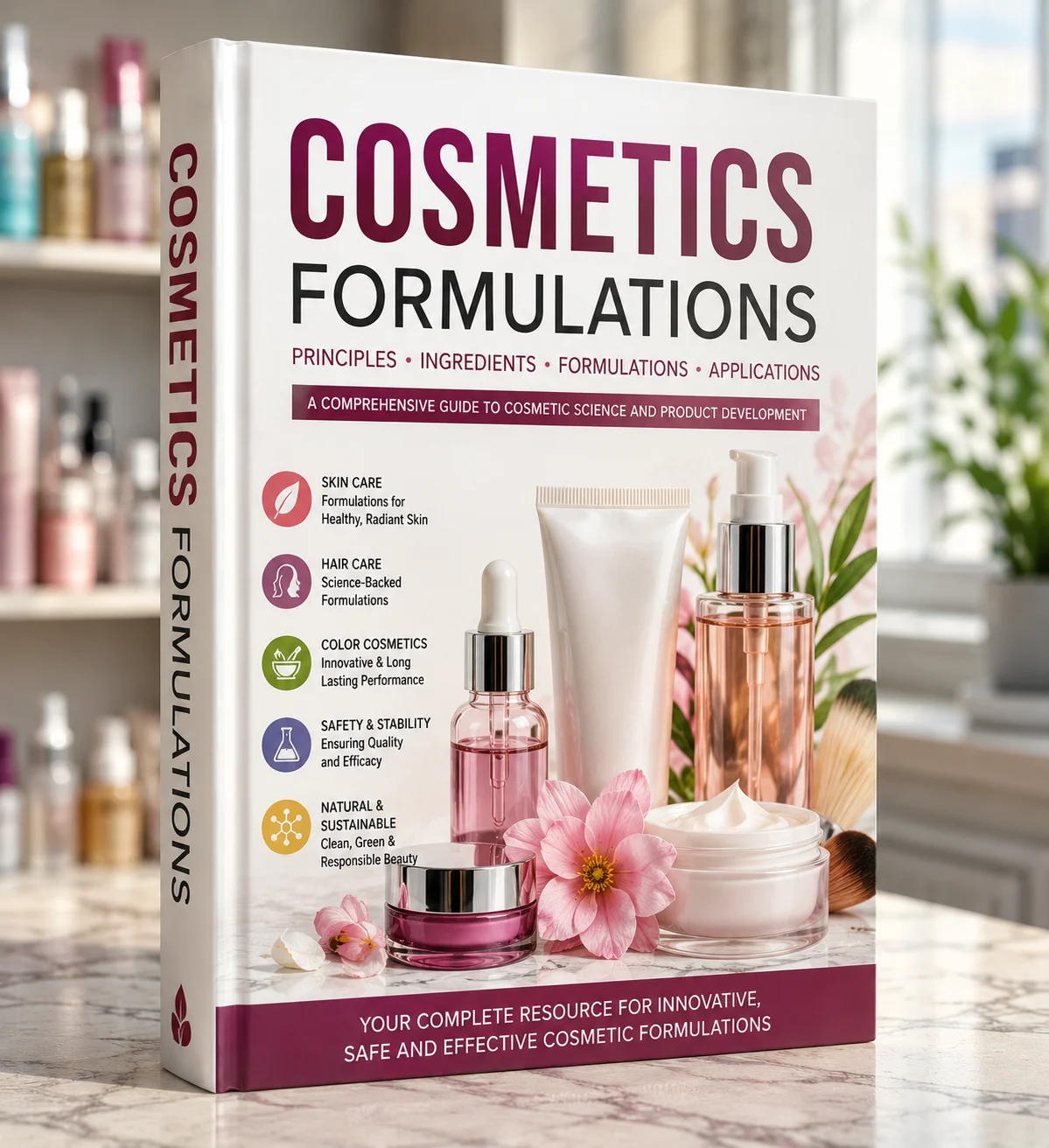
Cosmetics Formulations is a complete technical reference spanning the full personal care product range — skin care (day cream, serum, sunscreen, spot treatment), hair care (shampoo, conditioner, hair mask), body care (lotion, body wash, shower gel), colour cosmetics (foundation, lipstick, mascara) and specialty active formulations (Vitamin C, retinol, niacinamide, hyaluronic acid). Every formulation is built as a phase-structured starting point with INCI-named ingredients, % w/w, order of addition, preservation system, pH target and QC specifications — for cosmetics formulators, brand founders and contract manufacturers who need to go from concept to manufacturable product.
The technology
The handbook builds on emulsion science from first principles: oil-in-water (O/W) and water-in-oil (W/O) emulsion theory, HLB-based emulsifier selection, interfacial tension and Ostwald ripening, self-emulsifying wax systems and PEG-free alternatives. Surfactant chemistry for cleansers covers anionic (SLES, AOS, SLES-free amino acid alternatives), amphoteric (CAPB, betaine) and nonionic (APG, alkyl polyglucoside) systems with synergistic mildness and foaming balance. Cationic conditioner chemistry (BTMS-50, DMDAHT, cetrimonium chloride) and film-former deposition on hair are developed for the conditioner and hair-mask section. Active-ingredient delivery — stabilised Vitamin C at pH 3.5, encapsulated retinol, glycolic acid at pH 3.5–4.0, niacinamide at pH 5.5–7.0, hyaluronic acid molecular weight selection — is treated with formulation context. Preservation science follows ISO 11930 criteria with practical guidance on preservative combinations, pH dependence and challenge test interpretation.
Inside the formulations
All formulations are structured by phase (oil phase / water phase / cool-down additions) with % w/w, INCI name, function and sourcing tier. Every block includes manufacturing method, processing temperature, pH adjustment, QC targets (pH, viscosity at specified spindle/rpm, appearance, microbial limits, accelerated stability protocol), variants and modifications, and INCI-order labelling guidance. Natural and organic variants are provided alongside conventional formulations in each category.
What you get
- Phase-structured cosmetics formulations across skin care, hair care, body care and colour cosmetics
- INCI-named ingredients with % w/w, function, order of addition and sourcing tier
- SPF 15 / 30 / 50+ sunscreen formulations — mineral, chemical and hybrid UV filter systems
- Specialty active serums: stabilised Vitamin C, encapsulated retinol, niacinamide, HA
- Preservation systems benchmarked to ISO 11930 — phenoxyethanol, naticide, ECOCERT alternatives
- Natural and Cosmos/Ecocert-eligible variants in every product category
- QC targets: pH, viscosity, microbial limits, accelerated stability and challenge-test criteria
- EU Cosmetics Regulation 1223/2009 compliance notes and CPNP data references
Technical details
- Format
- A4 PDF · instant digital download
- Scope
- Skin care · hair care · body care · colour cosmetics · specialty actives
- Standards
- INCI nomenclature · EU 1223/2009 · ISO 22716 GMP · ISO 11930 · Cosmos/Ecocert
- Tiers
- Economy · Mid-range · Premium · Natural/Organic
- Audience
- Brand founders · contract manufacturers · cosmetics R&D chemists
- Series
- Cosmetics & Personal Care Series · Volume 1
Stop spending months getting emulsion stability and preservation systems right — get phase-structured cosmetics formulations with INCI-named ingredients, pH targets, stability protocols and ISO 11930 challenge-test guidance built in.
Who is this book for?
Cosmetics Brand Founder
You are launching a skin care or hair care brand and need manufacturable, phase-structured formulations with INCI-named ingredients, preservation systems and accelerated stability protocols — not vague ingredient lists or percentages without context.
Contract Manufacturer
You develop cosmetics formulations for brands and need a broad reference library covering O/W and W/O emulsions, surfactant-based cleansers, cationic conditioners, colour cosmetics and active delivery systems to accelerate client briefs.
Formulation Chemist
You work in cosmetics R&D and want a structured technical reference to benchmark your emulsion systems, preservation efficacy testing, active-ingredient delivery and HLB-based emulsifier selection across the full product range.
Table of Contents
- O/W and W/O emulsion theory — HLB, interfacial tension, Ostwald ripening
- Emulsifier chemistry: self-emulsifying waxes, PEG-free systems, lecithin
- Preservation systems: phenoxyethanol, naticide, benzyl alcohol/EDTA, Euxyl PE 9010
- ISO 11930 challenge-test protocol and preservative efficacy criteria
- EU Cosmetics Regulation 1223/2009 — restricted ingredients, CPNP, INCI labelling
- Light day cream and moisturising lotion (O/W, SPF-ready)
- Rich night cream (O/W high oil-phase, ceramide and niacinamide active)
- Anti-ageing serum: retinol, peptides, hyaluronic acid formulation
- Sunscreen SPF 15 / SPF 30 / SPF 50+ (mineral and hybrid filters)
- Spot treatment and AHA/BHA exfoliant (glycolic, lactic, salicylic acid)
- Clarifying shampoo (SLES + CAPB + conditioning polymer)
- Conditioning shampoo (conditioning quats, dimethicone)
- Cationic rinse-off conditioner (BTMS-50, cetyl alcohol)
- Deep treatment hair mask (protein, panthenol, argan oil)
- Scalp treatment and anti-dandruff formulation (ZPT, selenium sulfide)
- Body lotion O/W (light skin feel, fast absorption)
- Rich body butter (W/O, shea and cocoa butter base)
- Shower gel and body wash (SLES/CAPB/betaine system)
- Liquid hand soap (sulfate-free APG + glycerin variant)
- Intimate hygiene care (pH 4.5, lactic acid buffered, mild surfactants)
- Fluid foundation and BB cream (O/W emulsion, iron oxide pigments)
- Lipstick and tinted lip balm (anhydrous wax base)
- Lip gloss (polybutene + silicone base)
- Mascara (aqueous dispersion, film-former, fibre system)
- Nail treatment and base coat formulation
- Stabilised Vitamin C (L-ascorbic acid, ascorbyl glucoside, MAP) serum
- Encapsulated retinol formulation (pH-sensitive delivery)
- Niacinamide 5% and 10% serum with hyaluronic acid
- Natural and organic variants: Cosmos-certified emulsifiers, ECOCERT preservatives
- Vitamin C + E + Ferulic acid synergistic antioxidant serum
See what's inside
Frequently asked questions
They are validated starting points. You will need to bench-test and adapt treat rates to your specific raw material lots, but you start from a working formulation — not a blank sheet.
The handbook is a PDF — high-resolution A4, printable, with bookmarks and a linked table of contents. You receive an instant download link and it is also available in your library indefinitely.
Up to 5 downloads are included with your purchase. If you need more, contact us and we will reset your download limit.
Yes. The handbook opens with a fundamentals section that explains the underlying chemistry and ingredient functions before presenting formulations — so beginners can follow the rationale, not just the recipe.
Yes. Every ingredient in every formulation is listed by its INCI (International Nomenclature of Cosmetic Ingredients) name with INCI declaration order guidance, making the formulations directly usable for EU, UK, US and global product labelling.
Yes. Preservation systems are designed and benchmarked against ISO 11930 challenge-test criteria. Restricted and prohibited ingredient status under EU 1223/2009 is flagged where relevant, and CPNP notification data requirements are referenced for each category.
Yes. Each product category includes at least one natural or naturally-derived variant using plant-based emulsifiers (Olivem 1000, sunflower seed wax), natural preservatives (naticide, rosemary CO2 extract, radish root ferment) and certified-organic actives eligible for Cosmos or Ecocert certification.
Yes. SPF 15, SPF 30 and SPF 50+ formulations are included covering mineral (zinc oxide, titanium dioxide), chemical (avobenzone, octocrylene, octinoxate) and hybrid UV filter systems, with in-vitro SPF testing references and EU critical wavelength / UVA protection guidance.
Yes. Self-preserving anhydrous formulations (lipsticks, balms, butters) and low-water-activity systems are covered. The handbook also addresses multifunctional ingredients with preserving activity (glycols, caprylyl glycol, ethylhexylglycerin) and the ISO 11930 Category A criteria for claiming reduced preservation.