Fertilizers & Agricultural Formulations
About this book
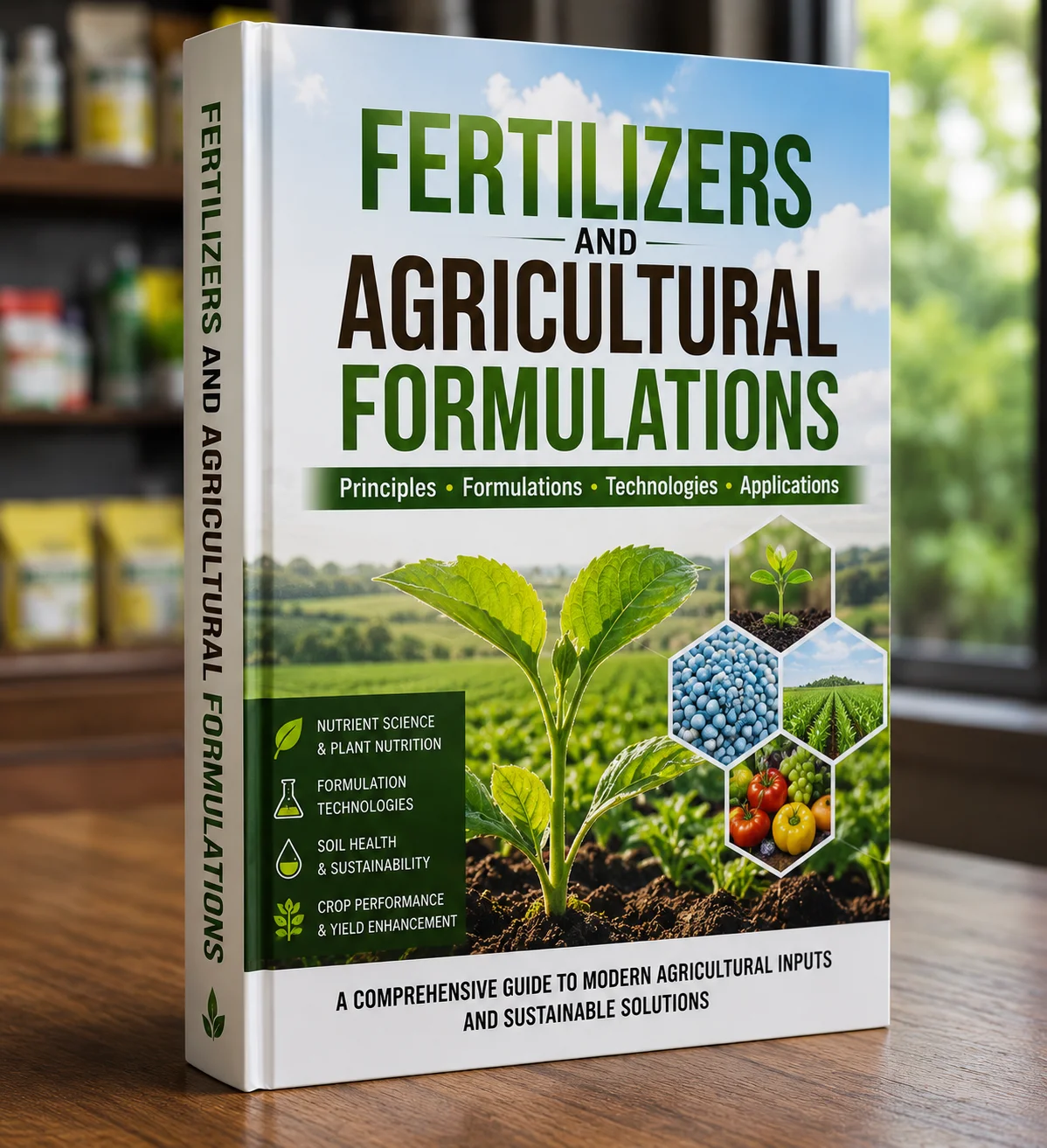
Fertilizers & Agricultural Formulations is a comprehensive technical reference covering the full range of agricultural input manufacture — NPK granular and compound fertilizers, fully water-soluble fertigation grades, chelated micronutrient blends, liquid fertilizers, humic acid biostimulants, seaweed extracts and amino acid concentrates, alongside the five principal crop-protection formulation types (EC, SC, WP, WG and SL). Written for fertilizer manufacturers, agro-chemical formulators and agricultural input entrepreneurs, every formulation is a validated starting point grounded in plant nutrition science, formulation chemistry and the regulatory framework that governs the sector — FCO, CIPAC, WHO and BIS.
The technology
The handbook develops plant nutrition chemistry from the soil up: macronutrient N/P/K forms and solubility, micronutrient availability as a function of soil pH, and the chelation chemistry of EDTA, DTPA and EDDHA that makes trace elements plant-available in alkaline soils. Bulk-blending physics — particle-size matching to prevent segregation, compatibility rules to avoid caking (urea-ammonium nitrate limits, phosphate-calcium precipitation) — are treated alongside granulation (prill, compaction, extrusion, fluidised-bed) for controlled-release and WG products. Crop-protection formulation technology covers emulsifiable concentrate solvent selection and emulsifier HLB for spontaneous emulsification, suspension concentrate wet-milling and rheology, wettable powder carrier and dispersant system design, and the CIPAC physical stability test protocol (54°C/14-day accelerated storage) that validates each formulation type.
Inside the formulations
Formulations give blend ratios and guaranteed analysis for NPK fertilizer grades, chelate type and treat rate for micronutrient products, extraction parameters and quality targets for biostimulants, and worked starting-point formulations for each crop-protection type with % w/w, solvent/carrier selection rationale, emulsifier or dispersant system, manufacturing method and CIPAC QC targets. Registration dossier physical-chemical data (density, pH, viscosity, particle size, spontaneous dispersibility) is tabulated for all crop-protection formulations.
What you get
- NPK granular blend formulations with guaranteed analysis and bulk-blending compatibility tables
- Fully water-soluble NPK fertigation grades (19:19:19, 13:40:13, 0:52:34, 6:12:36+TE)
- EDTA / DTPA / EDDHA chelated micronutrient liquid and powder formulations
- Humic acid, seaweed extract, amino acid and PSB biostimulant formulations
- Crop-protection formulation types: EC, SC, WP, WG, SL with CIPAC QC targets
- Spreading, wetting, sticker and penetrant adjuvant formulations
- Registration dossier physical-chemical data for all crop-protection formulation types
- FCO / CIPAC / BIS / WHO standard references integrated into every formulation
Technical details
- Format
- A4 PDF · instant digital download
- Scope
- NPK fertilizers · water-soluble grades · micronutrients · biostimulants · EC/SC/WP/WG/SL
- Standards
- FCO (India) · CIPAC · WHO pesticide specs · BIS IS standards · FAO specifications
- Tiers
- Economy · Mid-range · Premium · Specialist
- Audience
- Fertilizer manufacturers · agro-chemical formulators · agricultural input entrepreneurs
- Series
- Agricultural Inputs & Crop Sciences Series · Volume 1
Agricultural input formulation is governed by FCO, CIPAC and WHO standards — navigate every requirement with validated fertilizer and crop-protection formulations across NPK, water-soluble, biostimulant and EC/SC/WP/WG/SL types.
Who is this book for?
Fertilizer Manufacturer
You produce or blend fertilizers and want to expand from urea and single-superphosphate into NPK compounds, fully water-soluble fertigation grades, EDTA-chelated micronutrient blends and humic acid biostimulants — with guaranteed analysis documentation and FCO compliance.
Agro-Chemical Formulator
You formulate or toll-manufacture crop-protection products and need technically correct emulsifiable concentrate (EC), suspension concentrate (SC), wettable powder (WP), water-dispersible granule (WG) and soluble liquid (SL) formulations that meet CIPAC and WHO physical-chemical specifications.
Agricultural Input Entrepreneur
You are entering the agricultural inputs market — fertilizers, micronutrients, biostimulants or crop-protection products — and need a technical reference covering plant nutrition chemistry, formulation science and the regulatory framework from FCO to CIPAC from first principles.
Table of Contents
- Macronutrient chemistry: N (urea, ammonium, nitrate), P (ortho, poly), K (chloride, sulphate)
- Micronutrient availability: Zn, Fe, Mn, Cu, B, Mo — soil pH and chelation
- EDTA, DTPA, EDDHA chelate stability and selectivity series
- Compatibility rules: phosphate-calcium precipitation, urea-ammonium nitrate limits
- FCO (Fertiliser Control Order) guaranteed analysis and labelling requirements
- Urea-based NPK bulk-blend formulation (28:10:10, 20:20:00, 12:32:16)
- Ammonium phosphate grades: DAP (18:46:0), MAP (11:52:0)
- Controlled-release granules: polymer-coated urea, sulphur-coated urea
- Boronated NPK and micronutrient-fortified granular blends
- Bulk-blending compatibility charts and segregation prevention
- Fully water-soluble NPK (haemoglobin-free, chloride-free grades for drip and foliar)
- Fertigation grades: 19:19:19, 13:40:13, 0:52:34 soluble concentrates
- Foliar spray micronutrient solutions (Zn, B, Fe-EDTA, Mn-EDTA)
- Liquid NPK suspension fertilizer (LSNF, clear solution grade)
- Humic acid liquid concentrate and potassium humate formulation
- Humic acid and fulvic acid powder and liquid (Leonardite extraction)
- Seaweed extract formulation (Ecklonia maxima, Ascophyllum nodosum)
- Amino acid concentrate (enzymatic hydrolysis vs chemical hydrolysis)
- Soil wetting agent (alkyl polyglucosides, organosilicone spreaders)
- Phosphate solubilising bacteria (PSB) carrier-based biostimulant
- Emulsifiable concentrate (EC): solvent selection, emulsifier HLB, spontaneous emulsification test
- Suspension concentrate (SC): wet milling, suspension stability, anti-caking agents
- Wettable powder (WP): carrier, wetter, dispersant, CIPAC sieve test
- Water-dispersible granule (WG): extrusion and fluidised-bed granulation
- Soluble liquid (SL): pH adjustment, chelant for metal active ingredients, anti-foam
- Spreading and wetting adjuvants: non-ionic, anionic and organosilicone
- Sticker, penetrant and drift-reduction adjuvants
- CIPAC MT 36 (spontaneous dispersibility), MT 46 (wet sieve), MT 168 (spray-dried)
- Physical stability: CIPAC accelerated storage test (54°C / 14 days)
- Physical-chemical dossier data: pH, density, viscosity, particle size, solubility
See what's inside
Frequently asked questions
They are validated starting points. You will need to bench-test and adapt treat rates to your specific raw material lots, but you start from a working formulation — not a blank sheet.
The handbook is a PDF — high-resolution A4, printable, with bookmarks and a linked table of contents. You receive an instant download link and it is also available in your library indefinitely.
Up to 5 downloads are included with your purchase. If you need more, contact us and we will reset your download limit.
Yes. The handbook opens with a fundamentals section that explains the underlying chemistry and ingredient functions before presenting formulations — so beginners can follow the rationale, not just the recipe.
Yes. All crop-protection formulations are cross-referenced to CIPAC monograph physical-chemical specifications and FCO Fertiliser Control Order requirements. Registration dossier data — density, pH, viscosity, particle size, spontaneous dispersibility — is included for EC, SC, WP, WG and SL types.
EDTA (ethylenediaminetetraacetic acid), DTPA (diethylenetriaminepentaacetic acid) and EDDHA (ethylenediamine-N,N-di(2-hydroxyphenylacetic acid)) are all covered. The handbook explains the pH-stability windows, metal-selectivity series and application scenarios for each chelate type — EDTA for Zn/Mn/Cu, DTPA for Fe above pH 6.5, EDDHA for Fe in alkaline soils.
Yes. Fully water-soluble, chloride-free NPK grades for fertigation (drip, sprinkler) and foliar application are formulated across multiple NPK ratios (19:19:19, 13:40:13, 0:52:34, 6:12:36+TE), with solubility in hard water, electrical conductivity and compatibility with agrochemicals noted.
Yes. Humic and fulvic acid liquids and powders, seaweed extract concentrates (enzymatic and alkaline extraction), amino acid hydrolysates (enzymatic vs chemical hydrolysis comparison) and phosphate-solubilising bacteria (PSB) carrier-based products are all formulated as distinct sub-categories with application rates and efficacy science explained.
Yes. Formulations and QC targets are cross-referenced to Indian FCO and IS standards alongside CIPAC, WHO and FAO specifications, making the handbook applicable to Indian manufacturers targeting domestic BIS/FCO compliance as well as export-oriented formulators working to international agrochemical standards.