Surfactant Biodegradability: OECD 301 and EU Detergents Regulation
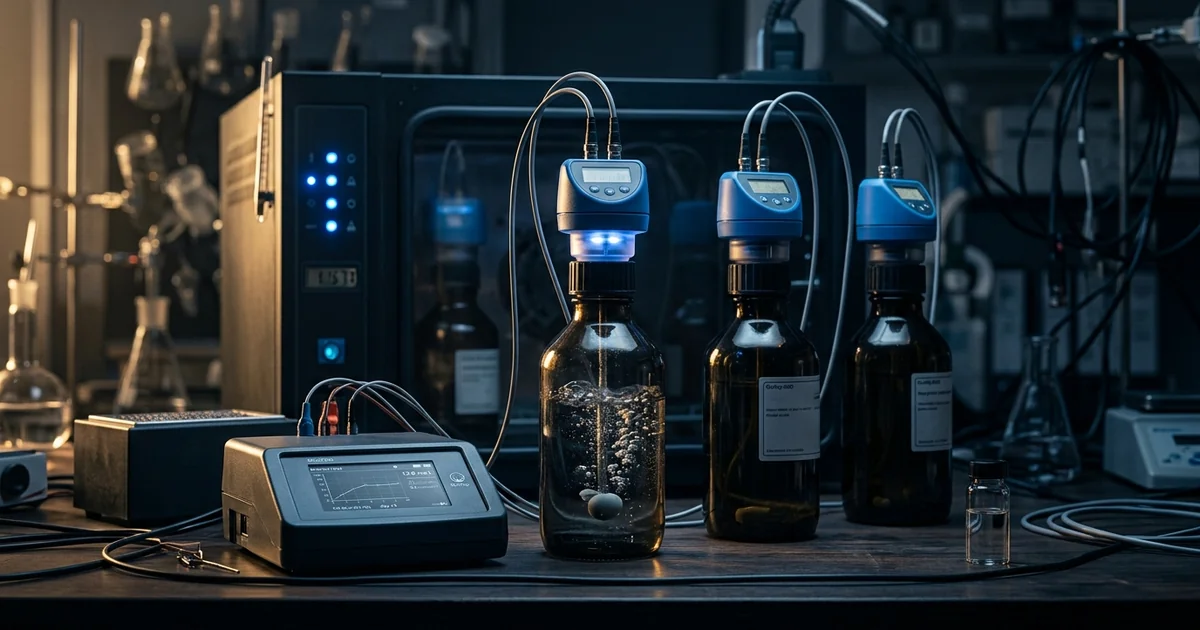
Surfactant biodegradability under OECD 301 is the single test result that decides whether a detergent formulation can legally enter the EU market at all. Under EU Regulation (EC) No 648/2004, every organic surfactant in a detergent must meet the ultimate biodegradability criteria, and the standard evidentiary route is a documented pass on one of the OECD 301 ready biodegradability tests. Getting this wrong is not a minor labelling issue — a surfactant without valid biodegradability data cannot legally be placed on the market, which means blocked customs clearance, rejected retailer listings, and a reformulation forced under time pressure rather than planned in advance. This article walks through how the OECD 301 test series works, what Regulation 648/2004 actually requires, and how to build a biodegradability documentation trail that survives an enforcement audit, as the regulation stands at time of writing.
What EU Detergents Regulation 648/2004 Is and Why It Exists
EU Regulation (EC) No 648/2004 on detergents entered into force in 2005, replacing a patchwork of earlier national and EU directives with a single harmonised framework covering surfactant biodegradability, labelling, and ingredient disclosure across the European Economic Area. Its central environmental purpose is straightforward: surfactants that resist breakdown in wastewater treatment accumulate in rivers, lakes, and sediment, where they disrupt aquatic ecosystems and, in the case of some legacy chemistries, bioaccumulate up the food chain.
The regulation's biodegradability requirement is built directly on the OECD Guidelines for the Testing of Chemicals, specifically the OECD 301 series of ready biodegradability tests. Rather than inventing a proprietary EU test method, the regulation adopts the internationally recognised OECD framework, which means data generated for one market under OECD 301 is generally portable to other jurisdictions that reference the same guideline. The full consolidated text of the regulation is published on EUR-Lex.
Scope: Who It Applies To and Which Surfactants Are Covered
Regulation 648/2004 applies to any manufacturer or importer placing a detergent — defined broadly to include laundry detergents, dishwashing products, industrial and institutional cleaners, and any preparation containing surfactants intended for washing and cleaning processes — on the EU market. The surfactant biodegradability obligation attaches to the organic surfactant itself, not to the finished detergent as a blend, so every individual surfactant substance used must independently satisfy the criteria.
The regulation does not exempt small manufacturers, private-label formulators, or low-volume specialty products — there is no de minimis threshold based on production volume or company size. It does distinguish between different surfactant classes for testing purposes, since anionic, nonionic, cationic, and amphoteric surfactants can behave differently under the same OECD 301 method depending on solubility and volatility.
| Surfactant Class | Typical Example | Common OECD 301 Method | Notes |
|---|---|---|---|
| Anionic | Linear alkylbenzene sulfonate (LAS) | OECD 301B | Well-characterised; extensive existing data available |
| Nonionic | Alcohol ethoxylates (AEO) | OECD 301B or 301E | Ethoxylate chain length affects test outcome |
| Cationic | Quaternary ammonium compounds | OECD 301D | Antimicrobial activity can inhibit test inoculum; closed-bottle method preferred |
| Amphoteric | Betaines (e.g., cocamidopropyl betaine) | OECD 301B | Generally readily biodegradable; data widely published |
Key Requirements: What Surfactant Biodegradability Compliance Demands
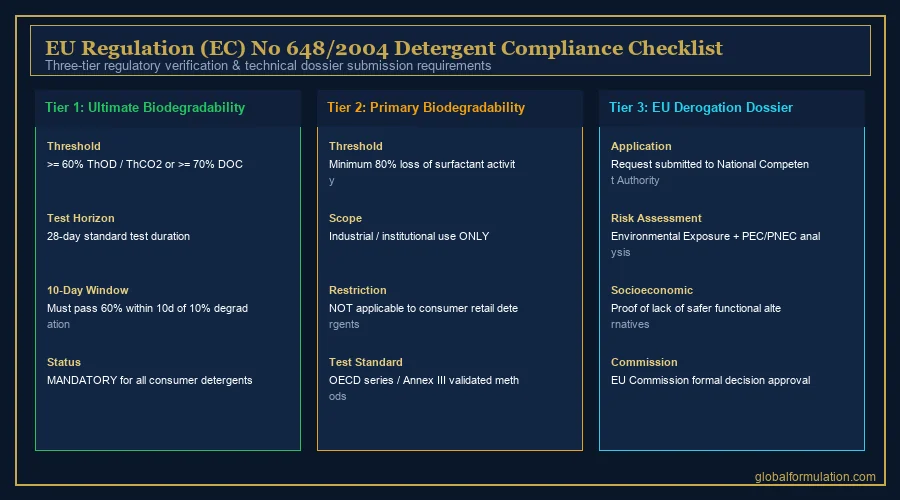
The core requirement under Regulation 648/2004 is that every surfactant achieves ultimate aerobic biodegradability, evidenced in practice by a ready biodegradability pass under OECD 301. Meeting this bar is not optional documentation — it is a market-access precondition, and the regulation gives Member State authorities the power to demand supporting test data at any time, not only at initial product launch.
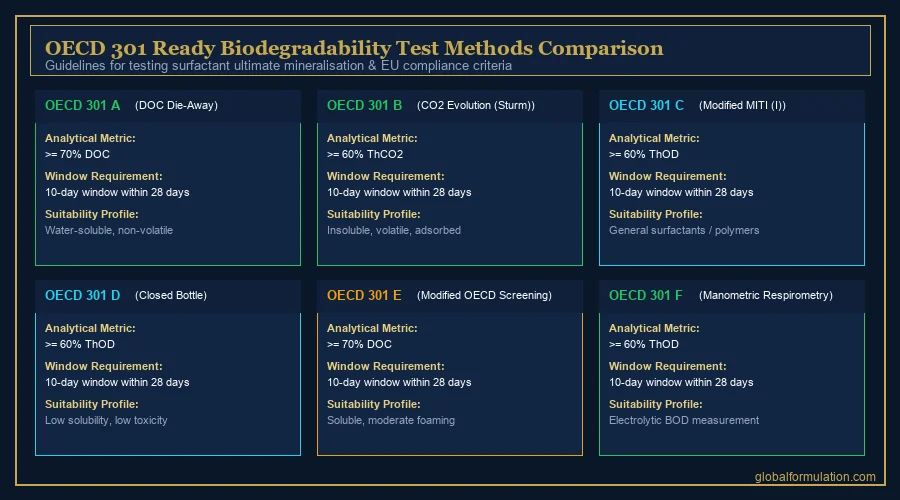
- Ready biodegradability pass — at least 60% (CO2 evolution/DOC die-away) or 70% (DOC removal) mineralisation within the 10-day window inside a standard 28-day OECD 301 test
- Substance-specific data — biodegradability evidence must reference the exact surfactant substance and manufacturing route used, not a generic class-level claim
- Derogation pathway for failed substances — Article 6 allows continued use of a non-readily-biodegradable surfactant only after a documented environmental risk assessment, an exception rarely pursued
A formulation team that assembles this evidence at launch and never revisits it generally stays compliant, provided the surfactant identity itself never changes — but a supplier switch or process change resets the clock on what evidence is actually valid.
Testing and Documentation Requirements
Holding a biodegradability claim without the underlying test report is not defensible under audit. Regulation 648/2004 requires manufacturers to keep documentation available to enforcement authorities on request, and that documentation needs to trace cleanly from the specific surfactant used in a formulation to a specific, valid OECD 301 test report.
- Full OECD 301 test report — including method variant used, inoculum source, percentage degradation curve, and the specific 10-day window pass/fail determination
- Substance identity confirmation — CAS number and, where relevant, isomer or ethoxylation degree matching exactly between the tested material and the material actually purchased and used
- Supplier certificate of analysis — confirming the surfactant batch composition is consistent with the substance referenced in the biodegradability report
- Ingredient disclosure documentation — the consumer-facing and safety-data-sheet ingredient lists required under the regulation's separate labelling provisions
Published literature data or a supplier's technical data sheet can support a biodegradability claim, but only if it references the OECD 301 method explicitly and the tested substance matches what is actually being used — a generic marketing claim of "biodegradable" carries no weight in an enforcement review.
Step-by-Step Surfactant Biodegradability Compliance Pathway
Establishing surfactant biodegradability compliance for a detergent formulation follows a predictable sequence, whether the manufacturer is launching a new product or auditing an existing one. The steps below reflect the practical order a formulator should follow from raw material selection through to a defensible compliance file.
- Identify every surfactant substance in the formulation by CAS number. Build a complete list, including minor co-surfactants and foam boosters, since the obligation applies to every organic surfactant present, not only the primary one.
- Search for existing OECD 301 data referencing the exact substance. Check supplier technical data sheets and published literature first — well-established surfactants like LAS and common alcohol ethoxylates usually already have public data.
- Commission OECD 301 testing for any substance lacking valid data. Select the appropriate method variant (301A–301F) based on the surfactant's solubility, volatility, and potential inhibitory effect on the microbial inoculum.
- Confirm the 10-day window pass threshold is met. Verify the test report shows at least 60% or 70% mineralisation (depending on method) achieved within 10 days of first reaching 10% degradation, inside the 28-day test.
- Assemble and retain the compliance file. Compile CAS confirmation, the full test report, and certificates of analysis into a file available for immediate production on enforcement request.
- Re-verify on any supplier or process change. Treat a change in surfactant supplier, manufacturing route, or raw material grade as a trigger to re-confirm that existing biodegradability data still applies.
Realistic Timeline and Cost Expectations
The time and cost required to establish surfactant biodegradability compliance vary sharply depending on whether existing OECD 301 data already covers the surfactants in a formulation. Well-established surfactant chemistries carry a much lighter compliance burden than novel or highly specific structures.
For a formulation built entirely on commodity surfactants with published biodegradability data — common LAS, standard alcohol ethoxylates, common betaines — compliance file assembly is largely a documentation exercise, typically completed within one to two weeks of gathering supplier certificates and existing test reports. Where a surfactant lacks existing data, commissioning a fresh OECD 301 test through a contract laboratory typically takes six to ten weeks from sample submission to final report, since the test itself runs a full 28-day incubation before data analysis and reporting. Cost drivers include the laboratory testing fee itself, any repeat testing if an inhibitory effect complicates the first attempt, and internal regulatory affairs time spent matching substance identities across supplier documentation.
Our work across the household and industrial cleaners formulation practice builds biodegradability screening into surfactant selection at the formulation stage, so testing gaps surface before a product is close to launch rather than after.
Common Mistakes Detergent Manufacturers Make — and How to Avoid Them
Surfactant biodegradability non-compliance rarely comes from ignoring the regulation outright. It comes from treating biodegradability as a class-level property rather than a substance-specific one, or from losing track of exactly which surfactant grade is in current production.
- Relying on generic "biodegradable" marketing claims — a supplier or marketing claim without a specific OECD 301 method reference and matching CAS number is not audit-defensible
- Assuming a surfactant class is uniformly compliant — ethoxylation degree and alkyl chain length within the same surfactant family can shift biodegradability outcomes; data for one grade does not automatically cover another
- Not re-checking after a supplier switch — a new surfactant supplier may produce a chemically similar but not identical substance, invalidating previously held test data
- Confusing ready and ultimate biodegradability — assuming a substance that eventually degrades (ultimate) satisfies the stricter ready biodegradability threshold when it does not
For formulation and regulatory support across multi-surface cleaner surfactant selection and pH-driven cleaning formulation, building biodegradability verification into the standard surfactant sourcing review avoids exactly these gaps.
Frequently Asked Questions
Does every surfactant in a detergent need to pass OECD 301 testing?
What is the difference between ready biodegradability and ultimate biodegradability?
Which OECD 301 test method should I choose for a surfactant?
What happens if my surfactant fails ready biodegradability under OECD 301?
Does OECD 301 test anaerobic biodegradability too?
Do I need to retest a surfactant I have used compliantly for years?
Need Regulatory Guidance for Your Product Launch?
Our team provides end-to-end regulatory strategy — from compliance gap analysis and dossier preparation to authority submissions and ongoing monitoring.
Get a Free Consultation