Epoxy Coating Systems — Floor, Tank & Structural Formulation Guide
About this book
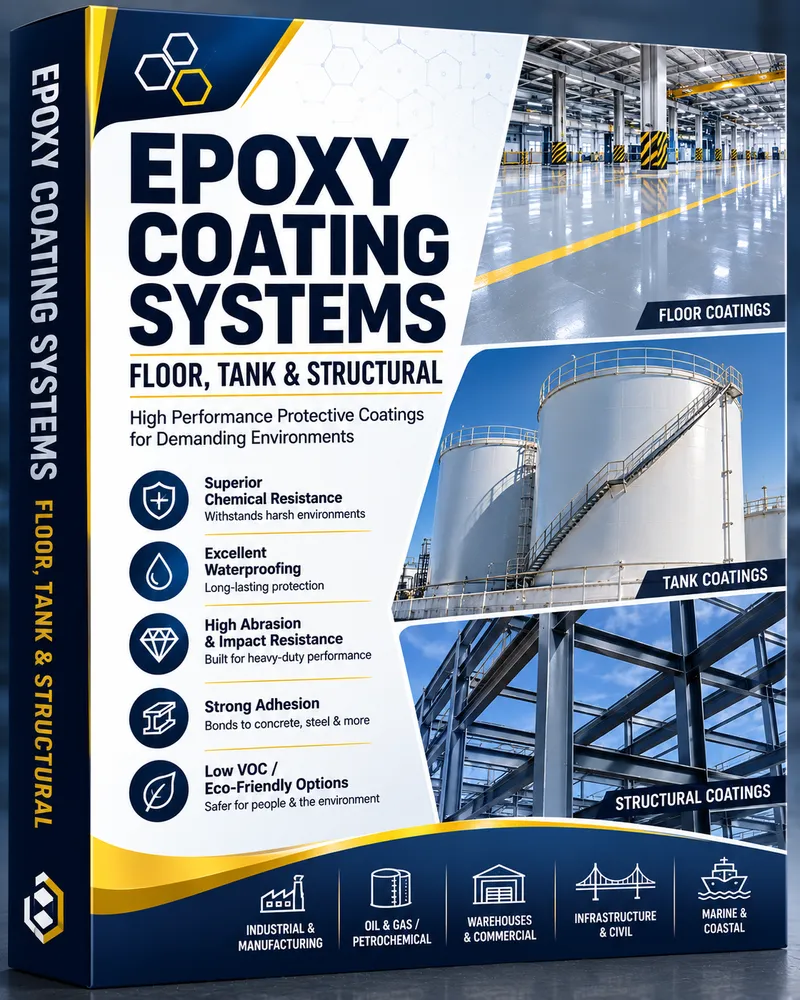
Epoxy Coating Systems — Floor, Tank & Structural Formulation Guide is a comprehensive technical formulations reference covering 36 starting-point formulations across 9 sub-categories: solventborne and waterborne epoxy floor coatings, solventborne and waterborne structural anti-corrosive primers, solventborne and waterborne tank/immersion linings, solvent-free 100%-solids systems, phenalkamine-cured surface-tolerant mastics, and epoxy phenol novolac chemical-resistant tank linings. It gives protective coatings formulators, specification engineers, and coatings entrepreneurs the chemical foundation to manufacture epoxy systems validated against SSPC-SP, ASTM, and ISO 12944 test methods.
The technology
The handbook covers epoxy coating chemistry from first principles: DGEBA and epoxy phenol novolac resin selection by epoxide equivalent weight (EEW); amine hardener classes — polyamidoamine, cycloaliphatic, phenalkamine, and aromatic amine adducts — selected by amine-hydrogen equivalent weight (AHEW) stoichiometry and end-use requirement; Pigment Volume Concentration held below Critical PVC to preserve barrier continuity in immersion and structural service; reactive diluent chemistry for 100%-solids, zero-VOC systems; flash-rust inhibition for waterborne primers on bare steel; and mandatory post-cure bake schedules for maximum chemical-resistance grades.
Inside the formulations
All 36 formulations are structured across Economy, Mid-range, Premium, and Specialty tiers spanning the 9 sub-categories. Each formulation provides a Part A (resin)/Part B (hardener) component table with % w/w, IUPAC-named raw materials, PVC relative to CPVC, VOC per EPA Method 24, DFT recommendation, manufacturing method, and QC release targets citing the relevant ASTM/ISO test method.
What you get
- 36 starting-point epoxy coating formulations across 9 sub-categories
- Full waterborne/solventborne coverage for floor, primer, and tank-lining chemistry families
- Solvent-free 100%-solids systems and phenalkamine-cured cold/damp-tolerant mastics
- Detailed Part A/Part B component tables with % w/w, AHEW mix ratios, and sourcing tier
- PVC/CPVC and VOC stated in every formulation block, with DFT recommendations
- Manufacturing SOPs with amine-handling and two-pack mix-ratio protocols
- Troubleshooting guide: amine blush, osmotic blistering, flash rusting, chemical-resistance failure
Technical details
- Format
- A4 PDF · instant digital download
- Extent
- ~63 pages · 36 formulations · 9 categories
- System types
- Floor coating · Structural primer · Tank/immersion lining · 100%-solids · Mastic · Novolac
- Standards
- SSPC-SP · ASTM D4541/D4060/D543/D5162/D523/D522 · ISO 9227/12944/2409/2808 · EPA Method 24
- Tiers
- Economy (amidoamine) · Mid-range (dual-hardener) · Premium (cycloaliphatic) · Specialty (novolac/aromatic amine)
- Audience
- Protective coatings formulators · specification engineers · coatings entrepreneurs
- Series
- Paints & Coatings Handbook Series · Volume 2 — Industrial Protective Coatings
Formulate the full range of industrial epoxy coating systems — floor, structural primer, tank/immersion lining, 100%-solids, mastic, and chemical-resistant novolac — with 36 validated starting-point formulations spanning both waterborne and solventborne chemistry.
Who is this book for?
Protective Coatings Formulator
You manufacture or contract-blend industrial epoxy coatings and need validated starting formulations across floor, primer, tank-lining, and mastic chemistries with correct amine-hydrogen equivalent weight (AHEW) hardener stoichiometry.
Coatings Specification Engineer
You specify or approve coating systems for structural steel, storage tanks, and industrial floors and need a technical reference on PVC/CPVC barrier design and chemical-resistance architecture to evaluate supplier systems.
Coatings Brand Entrepreneur
You want to add industrial epoxy protective coatings to your paints and coatings portfolio, tiered from economy floor enamel to specialty chemical-resistant tank linings, backed by ASTM/ISO-aligned formulations.
Table of Contents
- DGEBA and epoxy phenol novolac resin chemistry: epoxide equivalent weight (EEW) and crosslink density
- Amine hardener classes: polyamidoamine, cycloaliphatic, phenalkamine, and aromatic amine adducts, with AHEW stoichiometry
- Pigment Volume Concentration relative to Critical PVC and its governing role in film barrier permeability
- Solvent, waterborne dispersion, and 100%-solids reactive-diluent systems compared
- Specifications and standards: SSPC-SP surface preparation, ISO 12944 exposure categories, NSF/ANSI 61 and NORSOK M-501 as reference anchors
- Solventborne and waterborne epoxy floor coatings — self-levelling and broadcast systems
- Solventborne and waterborne anti-corrosive structural primers with zinc phosphate and micaceous iron oxide
- Flash-rust inhibition for waterborne primers applied directly to bare steel
- Solventborne and waterborne tank/immersion linings, formulated below CPVC for barrier continuity
- Solvent-free (100%-solids) reactive-diluent epoxy systems for zero-VOC floor and tank application
- Potable-water and offshore/marine service formulation considerations (NSF/ANSI 61, NORSOK M-501 reference)
- Surface-tolerant epoxy mastics for hand/power-tool cleaned steel and marine maintenance painting
- Phenalkamine-cured cold- and damp-tolerant formulations for uncontrolled ambient application
- Epoxy phenol novolac chemical-resistant tank linings for concentrated acid and aggressive-solvent service
- Two-stage mill-base/let-down manufacturing sequence with amine-handling protocols
- QC testing: pull-off adhesion (ASTM D4541), holiday detection (ASTM D5162), salt spray (ISO 9227)
- Troubleshooting guide: amine blush, osmotic blistering, flash rusting, and chemical-resistance failure
See what's inside
Frequently asked questions
They are validated starting points. You will need to bench-test and adapt treat rates to your specific raw material lots, but you start from a working formulation — not a blank sheet.
The handbook is a PDF — high-resolution A4, printable, with bookmarks and a linked table of contents. You receive an instant download link and it is also available in your library indefinitely.
Up to 5 downloads are included with your purchase. If you need more, contact us and we will reset your download limit.
Yes. The handbook opens with a fundamentals section that explains the underlying chemistry and ingredient functions before presenting formulations — so beginners can follow the rationale, not just the recipe.
They’re differentiated primarily by Pigment Volume Concentration relative to Critical PVC (CPVC) and hardener selection. Tank linings and structural primers are formulated well below CPVC to keep the film binder-continuous and minimise permeability — critical for barrier protection. Floor coatings can run a wider PVC range depending on gloss/aesthetic needs. Mastics use surface-tolerant hardener chemistry (polyamidoamine, phenalkamine) suited to marginally prepared steel rather than maximum barrier performance. Each end-use domain gets its own formulation architecture, not a shared recipe with a different pigment loading.
Because they require genuinely different formulation chemistry — different resin dispersion mechanism, different hardener classes (water-dispersible vs. solvent-cut), different cure kinetics — not just a solvent swap. The handbook treats waterborne and solventborne as fully independent sub-categories throughout, each with its own formulation cluster, so you get a complete, chemistry-correct system for whichever route your application or VOC requirements call for.
The formulations are designed toward those specifications — using inert extenders, high-conversion cure to minimise extractables, and NORSOK-referenced primer/mastic architecture — but formal NSF/ANSI 61 or NORSOK certification always requires dedicated third-party testing beyond formulation design. The handbook flags this explicitly wherever it applies and gives you a technically sound starting point for that certification process, not a substitute for it.
Polyamidoamine gives the best wetting and surface tolerance on marginally prepared steel, at the cost of lower ultimate chemical resistance — good for mastics and economy primers. Cycloaliphatic amines cure to a higher crosslink density and Tg, giving better chemical resistance and hardness — used across the mid-range to specialty tiers. Phenalkamine is CNSL-derived and specifically tolerates cold and damp application conditions, making it the standard choice for marine and offshore maintenance painting where ambient control isn’t available. The handbook selects between them formulation-by-formulation based on which property the end use actually needs.