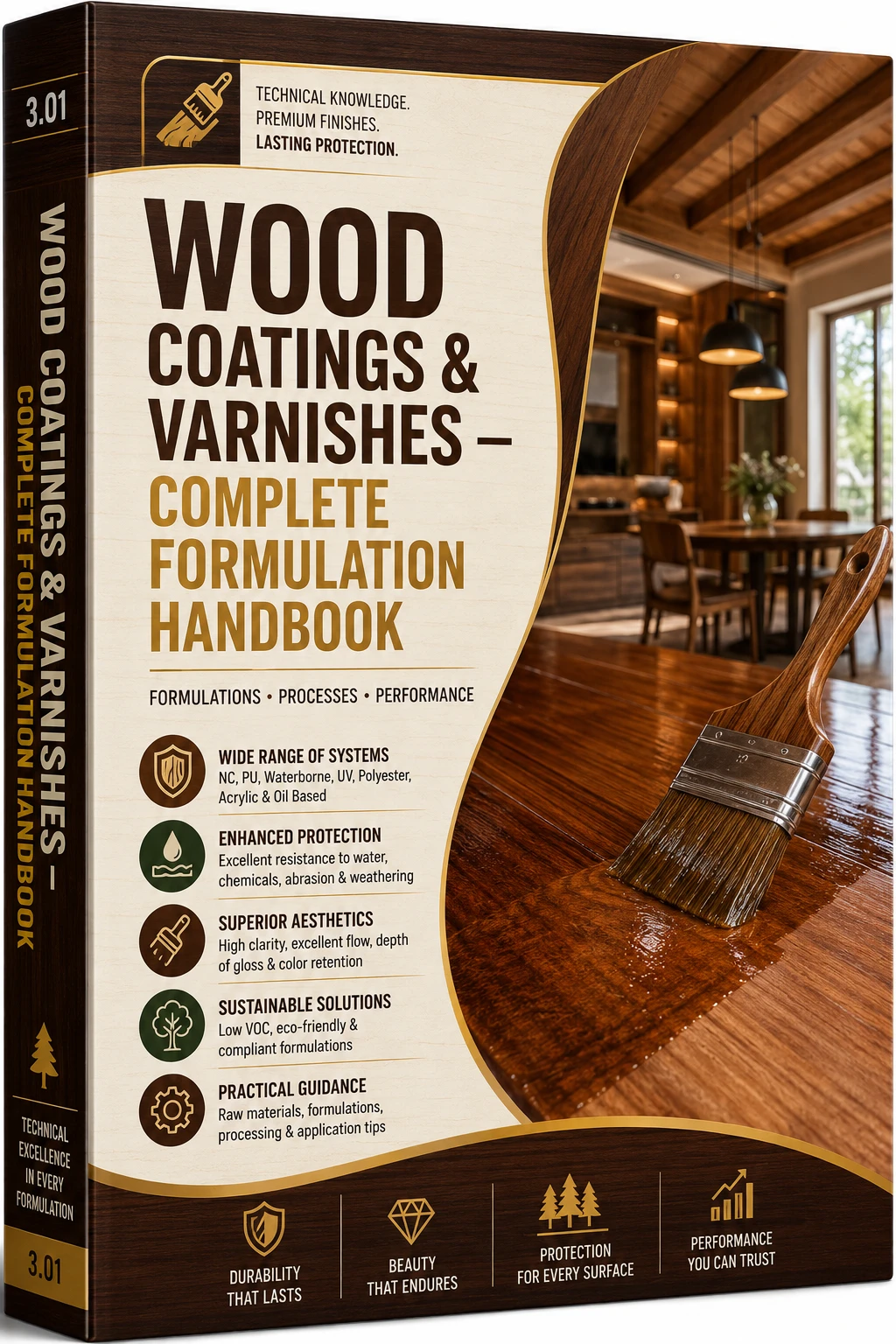
Wood Coatings & Varnishes — Complete Formulation Handbook
About this book
Wood Coatings & Varnishes — Complete Formulation Handbook is a comprehensive technical formulations reference covering 64 starting-point formulations across 16 sub-categories: waterborne and solventborne sanding sealers and knot-sealing primers, interior decorative stains, exterior preservative stains, waterborne and solventborne clear varnishes, nitrocellulose lacquer and its waterborne acrylic alternative, 100%-solids UV-curable coatings, furniture and cabinetry finishes through acid-catalysed conversion varnish, and wood floor and deck enamels with anti-slip aggregate. It gives wood coatings formulators, furniture and millwork specification engineers, and coatings entrepreneurs the chemical foundation to manufacture wood finishes validated against ASTM, KCMA/ANSI, and EN 927 test methods.
The technology
The handbook covers wood coating chemistry from first principles: binder film-formation across six distinct cure chemistries — coalescence, autoxidative, 2-pack catalytic, acid-catalysed amino-resin condensation, solvent-evaporation, and UV free-radical photopolymerisation; Pigment Volume Concentration relative to Critical PVC as it applies to both clear and pigmented wood finishes; grain-raising control and tannin/resin barrier chemistry specific to wood substrates; UV-absorber/HALS protection of both the binder film and the underlying wood lignin; and the post-2023 REACH reclassification of cobalt driers reflected throughout the raw-materials selection.
Inside the formulations
All 64 formulations are structured across Economy, Mid-range, Premium, and Specialty tiers spanning the 16 sub-categories. Each formulation provides an IUPAC-named component table with % w/w, PVC/VOC/DFT recommendations, manufacturing method, and QC release targets citing the relevant ASTM, KCMA/ANSI, or EN test method.
What you get
- 64 starting-point wood coating formulations across 16 sub-categories
- Full WB/SB coverage for sanding sealers, knot-sealing primers, and clear varnishes
- Interior decorative stains (pigmented wiping, dye, gel) and exterior UV-blocking preservative stains
- Nitrocellulose lacquer alongside its waterborne acrylic alternative, plus 100%-solids UV-curable systems
- Furniture and cabinetry pigmented finishes through fully acid-catalysed conversion varnish
- IUPAC-named component tables with % w/w, PVC/VOC/DFT recommendations per formulation block
- Manufacturing SOPs for mill-base/let-down, nitrocellulose dissolution, acid-catalysed conversion varnish, two-component polyurethane, and UV-cure line processing
Technical details
- Format
- A4 PDF · instant digital download
- Extent
- 93 pages · 64 formulations · 16 categories
- System types
- Sanding sealer · Stain · Clear varnish · Lacquer · UV-cure · Furniture finish · Floor/deck enamel
- Standards
- ASTM D3023/D5402/D4060/D523/D3359/D4541/D2793/D2244/E313/G154/D2243/D1200 · ISO 1524/2409/2812-1 · ANSI A326.3 · DIN 51130 · KCMA/ANSI A161.1 · EN 927 series
- Tiers
- Economy (WB sealer/stain) · Mid-range (1-pack PU varnish) · Premium (2K PU/UV-cure) · Specialty (acid-catalysed conversion varnish)
- Audience
- Wood coatings formulators · furniture and millwork specification engineers · coatings entrepreneurs
- Series
- Paints & Coatings Handbook Series · Volume 3 — Wood & Decorative Finishes
Formulate the full range of wood coatings — sanding sealers, decorative and preservative stains, clear varnishes, lacquers, UV-cure systems, and furniture and floor finishes — with 64 validated starting-point formulations spanning six distinct cure chemistries.
Who is this book for?
Wood Coatings Formulator
You manufacture or contract-blend wood finishes and need validated starting formulations across sealers, stains, varnishes, lacquers, and UV-cure systems with correct PVC relative to Critical PVC and cure-chemistry selection.
Furniture & Millwork Specification Engineer
You specify or approve finishing systems for furniture, cabinetry, flooring, or architectural millwork and need a technical reference on film-formation mechanisms and substrate-specific chemistry to evaluate supplier systems.
Coatings Brand Entrepreneur
You want to add wood coatings and varnishes to your paints and coatings portfolio, tiered from economy sanding sealers to specialty UV-cure and acid-catalysed conversion varnish systems, backed by ASTM/EN-aligned formulations.
Table of Contents
- Binder film-formation across six cure chemistries: coalescence, autoxidative, 2-pack catalytic, acid-catalysed amino-resin condensation, solvent-evaporation, and UV free-radical photopolymerisation
- Pigment Volume Concentration relative to Critical PVC as applied to clear and pigmented wood finishes
- Grain-raising control and tannin/resin barrier chemistry specific to wood substrates
- UV-absorber/HALS protection of both binder and underlying wood lignin
- The post-2023 REACH reclassification of cobalt driers and its effect on raw-materials selection
- Waterborne and solventborne (WB/SB) wood sanding sealers and knot-sealing primers
- Interior decorative wood stains: pigmented wiping stains, dye stains, and gel stains
- Exterior preservative stains with UV-blocking and dry-film fungicide packages
- Waterborne and solventborne clear wood varnishes: 1-pack oil-modified polyurethane and 2-component aliphatic polyurethane
- Nitrocellulose lacquer and its waterborne acrylic alternative
- 100%-solids UV-curable wood coatings
- Furniture and cabinetry pigmented finishes through fully acid-catalysed conversion varnish
- Wood floor and deck enamels with anti-slip aggregate
- Manufacturing SOPs: two-stage mill-base/let-down processing, nitrocellulose dissolution, acid-catalysed conversion varnish, two-component polyurethane, and UV-cure line processing
- QC testing citing ASTM D3023/D5402/D4060/D523/D2793, KCMA/ANSI A161.1, and EN 927-1 to 927-6
- Troubleshooting guide: grain raising, tannin bleed-through, solvent blushing, nitrocellulose lacquer yellowing, and moisture-driven exterior film failure
See what's inside
Frequently asked questions
They are validated starting points. You will need to bench-test and adapt treat rates to your specific raw material lots, but you start from a working formulation — not a blank sheet.
The handbook is a PDF — high-resolution A4, printable, with bookmarks and a linked table of contents. You receive an instant download link and it is also available in your library indefinitely.
Up to 5 downloads are included with your purchase. If you need more, contact us and we will reset your download limit.
Yes. The handbook opens with a fundamentals section that explains the underlying chemistry and ingredient functions before presenting formulations — so beginners can follow the rationale, not just the recipe.
Because wood finishing spans genuinely different film-formation mechanisms depending on the end use — coalescence for waterborne dispersions, autoxidative cure for oil-modified polyurethane, 2-pack catalytic cure for aliphatic polyurethane, acid-catalysed amino-resin condensation for conversion varnish, solvent-evaporation for nitrocellulose lacquer, and UV free-radical photopolymerisation for 100%-solids UV-cure systems. Each mechanism dictates its own raw-material selection, application method, and cure schedule, so the handbook treats every cure chemistry as its own formulation family rather than presenting one binder with substitution notes.
Nitrocellulose lacquer remains the reference standard for the fast-drying, easily-rubbed-out finish furniture and cabinetry manufacturers expect, but its solvent content and yellowing over time have pushed many production lines toward waterborne acrylic alternatives that avoid both issues. The handbook formulates both as complete, independent systems so you can match the finish characteristics your market demands against the solvent-emission and stability constraints your production line and target market actually have.
Cobalt driers have long been the standard catalyst for autoxidative cure in oil-modified polyurethane and alkyd-type wood finishes, but their post-2023 REACH reclassification affects how they can be sourced, labelled, and used in EU-market formulations. The handbook reflects this reclassification throughout the raw-materials selection for every autoxidative-cure formulation, so the drier guidance you’re working from is current rather than referencing a superseded regulatory status.
The formulations are built toward EN 927-1 to 927-6, which govern classification, natural weathering, and artificial weathering test methods for exterior wood coatings, along with the UV-blocking and dry-film fungicide package needed to pass them. Formal EN 927 certification always requires dedicated third-party exposure testing beyond formulation design, so the handbook gives you a technically sound starting point for that certification process rather than a substitute for it.