Epoxy Coatings Formulations
About this book
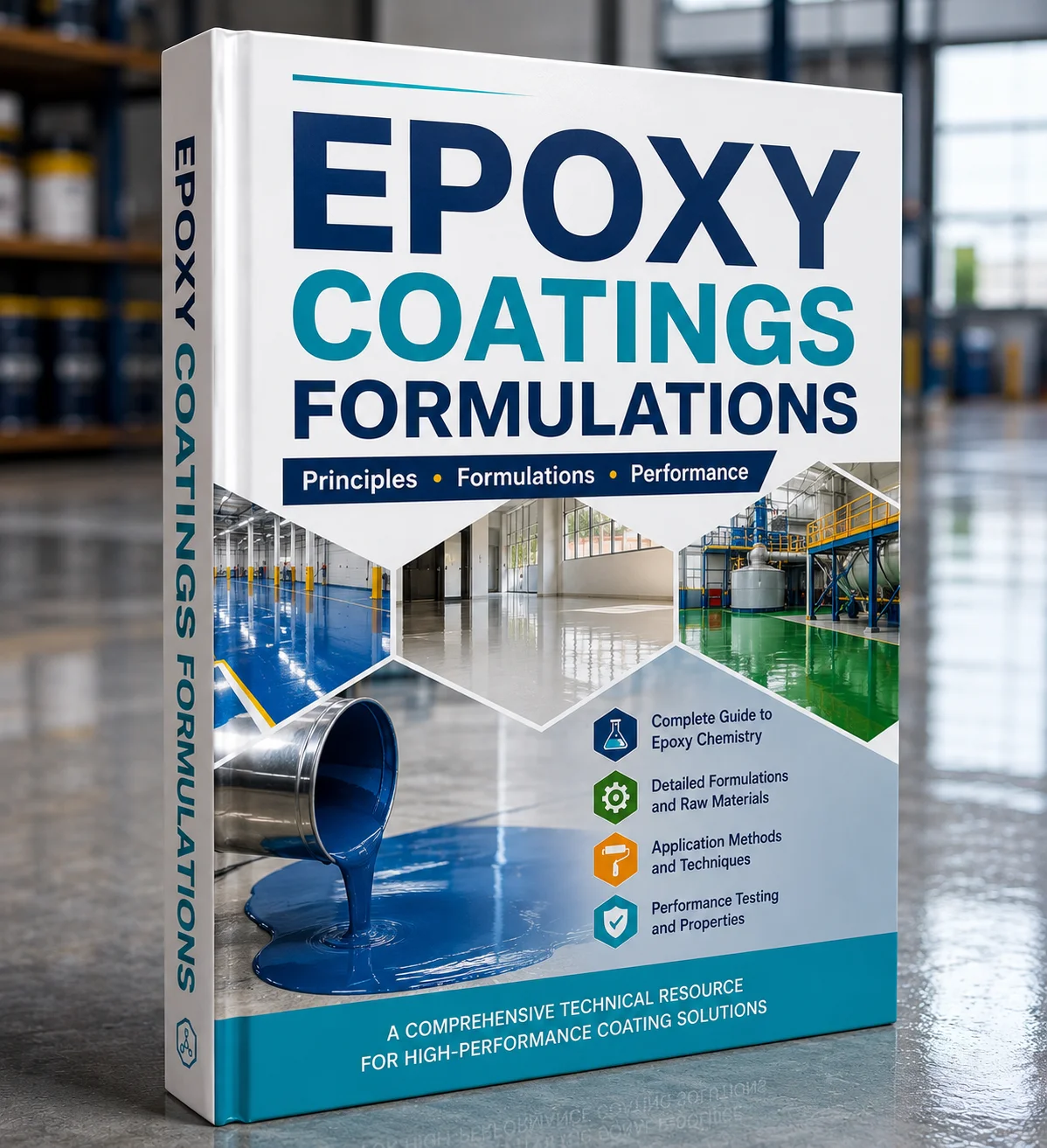
Epoxy Coatings Formulations is a focused technical reference for the full range of protective and industrial epoxy coating systems — anti-corrosive primers (conventional and zinc-rich), high-build industrial maintenance coatings and epoxy mastics, self-levelling and broadcast flooring systems, anti-static ESD and food-grade floor coatings, and tank linings and chemical-resistant coatings (epoxy novolac, bisphenol-F and solvent-free grades). Every formulation is a two-pack starting point structured as Part A and Part B with stoichiometrically calculated mix ratios, validated for use by coatings manufacturers, industrial flooring contractors and plant engineers.
The technology
The handbook develops epoxy resin chemistry from first principles: the bisphenol-A diglycidyl ether (BADGE) EEW–viscosity–Tg relationship, the higher chemical resistance and lower viscosity of bisphenol-F resins, and the multi-functional crosslink density of epoxy novolac for aggressive immersion service. The curing agent matrix — aliphatic and cycloaliphatic amines, polyamides (flexibility and adhesion), amidoamines (fast cure, water tolerance), Mannich base (low-temperature, phenalkamine variants), anhydrides (electrical grade) — is treated mechanistically with stoichiometry and AHEW calculation explained for each system. Zinc-rich primer cathodic protection, pigment volume concentration and zinc dust particle size are developed for both inorganic and organic zinc-rich grades. Flooring technology covers self-levelling epoxy flow and levelling, quartz-broadcast decorative systems, ESD conductive network design, and food-grade compliance. Anti-corrosion performance is framed through ISO 12944 corrosivity categories C1–Im3.
Inside the formulations
All formulations are structured as Part A (resin / pigment / extender — % w/w) and Part B (hardener — % w/w) with mix ratio, induction time, pot life at 23°C, application temperature range, DFT target, QC targets (gel time, adhesion, hardness, chemical resistance) and the stoichiometric basis for the mix ratio. Surface preparation requirements (Sa 2.5, Sa 3, SSPC-SP 6) and application conditions (ambient temperature, substrate temperature, dew point clearance) are specified for each system.
What you get
- Two-pack epoxy formulations — Part A and Part B with stoichiometric mix ratios
- Anti-corrosive primers: conventional zinc phosphate, inorganic zinc-rich and organic zinc-rich
- High-build mid-coats, epoxy mastic surface-tolerant and fast-cure maintenance coatings
- Flooring systems: self-levelling, broadcast quartz, ESD anti-static and food-grade
- Tank linings: epoxy novolac (pH 0–14), bisphenol-F, solvent-free (NSF 61) and phenalkamine cold-cure
- Pot life, induction time, DFT and cure schedule data for all systems
- QC targets: adhesion (cross-cut/pull-off), hardness, MEK rub, chemical resistance
- ISO 12944 corrosivity category selection guide and surface preparation specifications
Technical details
- Format
- A4 PDF · instant digital download
- Scope
- Anti-corrosive primers · maintenance coatings · flooring · tank linings
- Chemistry
- BADGE · bisphenol-F · epoxy novolac · zinc-rich · solvent-free · waterborne epoxy
- Standards
- ISO 12944 · SSPC · NACE/AMPP · ASTM D · ISO 2409 · ISO 4624 · NSF 61 · FDA 21 CFR
- Tiers
- Economy · Mid-range · Premium · Specialist
- Audience
- Protective coatings manufacturers · flooring contractors · plant engineers
- Series
- Paints & Coatings Handbook Series · Volume 3
Epoxy coatings fail for three reasons — wrong resin-hardener stoichiometry, inadequate surface preparation and incorrect cure schedule. This handbook solves all three for every epoxy application: primers, maintenance coatings, flooring and tank linings.
Who is this book for?
Protective Coatings Manufacturer
You make anti-corrosive and protective coatings and want a technically rigorous reference for developing two-pack epoxy systems — zinc-rich primers, high-build mid-coats, epoxy mastic and fast-cure maintenance formulations — across solventborne and waterborne platforms.
Industrial Flooring Contractor
You install or supply industrial epoxy flooring and want to develop or private-label your own self-levelling, broadcast quartz, anti-static ESD and food-grade floor coating systems with verified mix ratios, cure profiles and substrate preparation standards.
Chemical Plant Engineer
You specify coatings for tank linings, pipe coatings and chemical-resistant surfaces in food, pharmaceutical, water or petrochemical plants — you need formulation-level understanding of epoxy novolac, bisphenol-F and solvent-free lining chemistry to evaluate products and diagnose failures.
Table of Contents
- Bisphenol-A diglycidyl ether (BADGE) — EEW, viscosity, Tg
- Bisphenol-F epoxy — lower viscosity, higher chemical resistance than BADGE
- Epoxy novolac resins — high crosslink density, temperature and solvent resistance
- Curing agent families: aliphatic amine, cycloaliphatic amine, polyamide, amidoamine, Mannich base, anhydride
- Stoichiometry, EEW/AHEW calculation, mix ratio and pot-life control
- Solventborne high-build epoxy anti-corrosive primer (zinc phosphate pigment)
- Waterborne epoxy primer (BADGE emulsion + cycloaliphatic amine dispersion)
- Inorganic zinc-rich epoxy primer (85% zinc in dry film, weldable)
- Organic zinc-rich epoxy primer (40–60% zinc)
- Epoxy wash primer and adhesion promoter for aluminium and galvanised steel
- High-build epoxy mid-coat (250–300 µm DFT, barrier protection)
- Epoxy mastic surface-tolerant coating (penetrating, wet-surface compatible)
- Abrasion-resistant epoxy (aluminium oxide filler, DIN 53516 Taber abrasion)
- Fast-cure low-temperature epoxy amine adduct system (5°C cure)
- Epoxy-polyurethane hybrid topcoat (gloss retention and UV stability)
- Self-levelling epoxy floor coating (bisphenol-A, cycloaliphatic amine, 2–3 mm DFT)
- Broadcast quartz-aggregate decorative floor system
- Anti-static ESD floor coating (conductive carbon and ionomer network)
- Food-grade FDA/EC 1935/2004-compliant epoxy floor coating
- Epoxy screed and heavy-duty floor topping (quartz-filled, 4–6 mm)
- Epoxy novolac tank lining (solventborne, immersion grade, pH 0–14)
- Bisphenol-F chemical-resistant coating (aromatic solvents, oxidising acids)
- Solvent-free epoxy lining (100% solids, zero VOC, NSF 61 water contact)
- Phenalkamine-cured epoxy for low-temperature and humid cure
- Coal-tar epoxy for buried pipelines and marine immersion (NACE/AMPP)
- Gel time, pot life and induction time testing (ASTM D1200, D2196)
- DFT measurement: wet film comb and dry film gauge (SSPC-PA 2)
- Adhesion: cross-cut (ISO 2409), pull-off (ISO 4624), bend test
- Holiday detection and pinhole testing for lining applications
- Failure-mode diagnosis: amine blush, solvent popping, adhesion loss, undercutting
See what's inside
Frequently asked questions
They are validated starting points. You will need to bench-test and adapt treat rates to your specific raw material lots, but you start from a working formulation — not a blank sheet.
The handbook is a PDF — high-resolution A4, printable, with bookmarks and a linked table of contents. You receive an instant download link and it is also available in your library indefinitely.
Up to 5 downloads are included with your purchase. If you need more, contact us and we will reset your download limit.
Yes. The handbook opens with a fundamentals section that explains the underlying chemistry and ingredient functions before presenting formulations — so beginners can follow the rationale, not just the recipe.
Yes. Every two-component formulation is structured as Part A (resin, pigment, extender) and Part B (hardener/curing agent) with stoichiometrically calculated mix ratios by weight and volume, induction/sweat-in time, pot life at 23°C and application window guidance.
Yes. For anti-corrosive primers and floor coatings where waterborne systems are technically viable, both waterborne (BADGE emulsion + cycloaliphatic amine dispersion) and solventborne (BADGE in aromatic/ketone solvents + polyamide hardener) formulations are provided with performance comparison notes.
Zinc-rich epoxy primers — inorganic (85% Zn in dry film) and organic (40–60% Zn) — provide cathodic protection to steel in addition to barrier effect, and are weldable without significant fume increase. Conventional epoxy anti-corrosive primers rely on barrier and inhibitive pigments (zinc phosphate, strontium chromate-free alternatives). Both are formulated in this handbook with their intended service environment defined.
Yes. A food-grade epoxy floor coating is formulated to comply with FDA 21 CFR and EU EC 1935/2004 food-contact material regulations, using non-toxic curing agents (cycloaliphatic diamine or phenalkamine), and a separate NSF 61-compliant solvent-free lining is provided for potable water contact.
Yes. Epoxy novolac (phenol-formaldehyde glycidyl ether, multi-functional EEW 170–180) provides high crosslink density for immersion in acids, alkalis, solvents and oxidising media. Bisphenol-F has lower viscosity than BADGE, enabling higher solids and thicker films without solvent. Both are formulated as tank and vessel linings with chemical resistance charts.