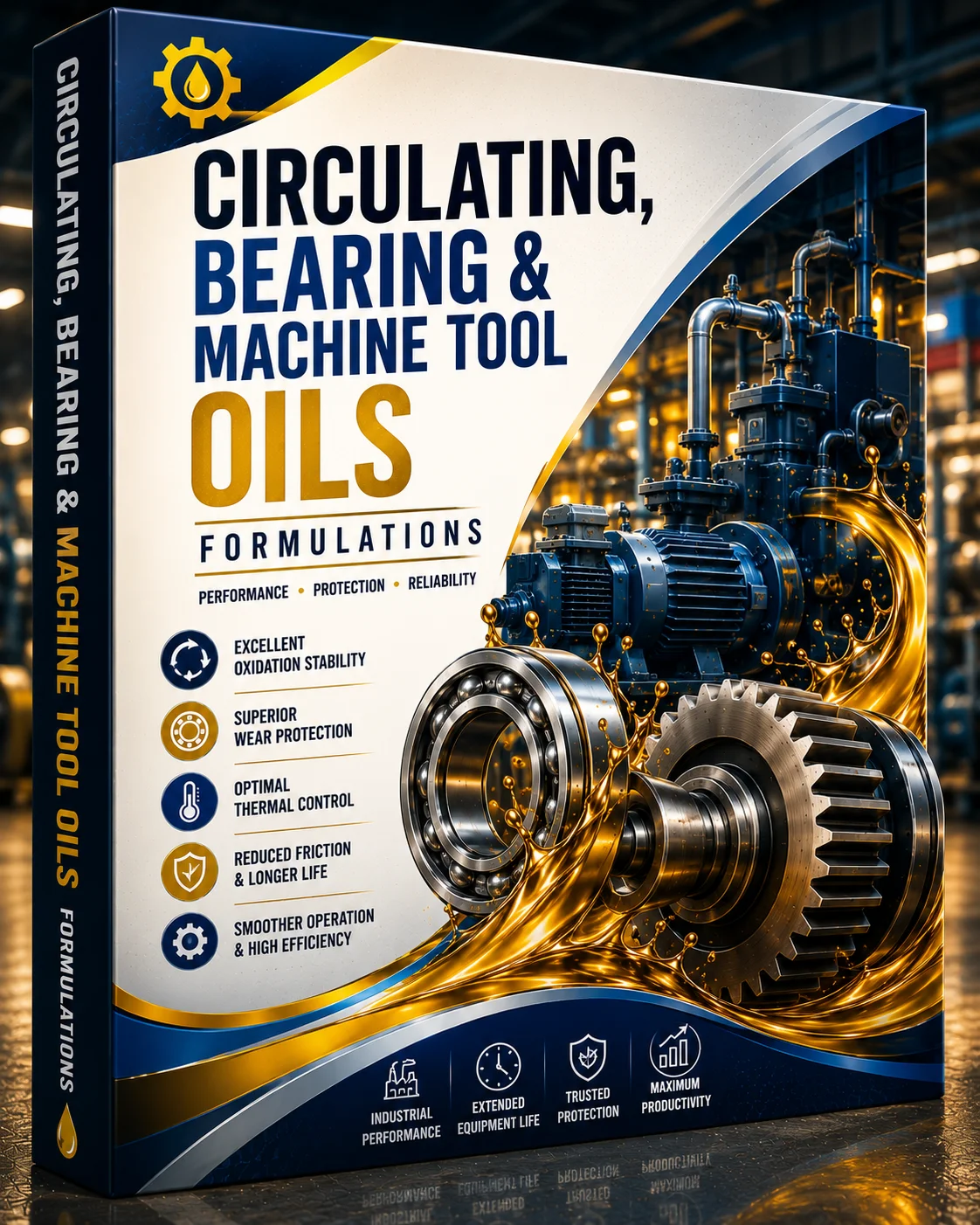
Circulating, Bearing & Machine Tool Oils — Formulation Handbook
About this book
Circulating, Bearing & Machine Tool Oils — Formulation Handbook is a focused technical reference covering 48 validated starting-point formulations across 12 sub-categories: R&O and AW circulating oils, turbine-quality long-life oils, plain and rolling-element bearing oils from ultra-light spindle to heavy journal-bearing duty, machine tool slideway and headstock/spindle oils, combined circulatory-hydraulic fluids, and biodegradable/food-grade circulating and bearing oils. Viscosity grades span ISO VG 2 through VG 150, with formulations mapped to ISO 6743-2, DIN 51524, DIN 51515, and Cincinnati Milacron P-47.
The technology
The handbook covers recirculating-lubricant chemistry from first principles: hydrodynamic film formation in plain bearings versus elastohydrodynamic contact in rolling-element bearings; the stick-slip mechanism in machine tool slideways and the friction-modifier chemistry (glycerol monooleate, oleamide) that suppresses it; phenolic/aminic/ZDDP synergistic antioxidant architecture for long-life turbine and circulating duty; demulsibility and foam-control chemistry specific to continuously recirculated systems; and base oil selection across Group I/II mineral, Group III, PAO, and naphthenic oils, including the pressure-viscosity and flash-point constraints that make PAO mandatory at ultra-precision spindle viscosity grades.
Inside the formulations
All 48 formulations (F1–F48) are structured across Economy, Mid-range, Premium, and Specialty tiers across 12 sub-categories. Each formulation provides a component table (% w/w and chemical class), tier and base-oil summary, a step-by-step blending method note, target property specifications mapped to the relevant ASTM/ISO/DIN test method, and a stability note flagging expected TOST life or demulsibility performance for that base-oil/additive combination.
What you get
- 48 starting-point formulations across 12 sub-categories
- R&O, AW hydraulic-grade, and turbine-quality circulating oils from ISO VG 22 to 100
- Plain and rolling-element bearing oils spanning ultra-light spindle (VG 2) to heavy journal-bearing duty (VG 150)
- Machine tool slideway oils with stick-slip suppression and headstock/spindle oils for high-speed grinding
- Combined circulatory-hydraulic dual-service oils and biodegradable HEES/NSF H1 food-grade formulations
- Detailed component tables with % w/w, chemical class, and treat rates
- Manufacturing SOPs covering blending sequence, QC testing, filtration, and storage/shelf life
- Condition-monitoring guidance and root-cause troubleshooting for in-service oil defects
Technical details
- Format
- A4 PDF · instant digital download
- Extent
- ~73 pages · 48 formulations · 12 categories
- Grades
- ISO VG 2 to 150 · Circulating, bearing, and machine tool duty
- Standards
- ISO 3448 · ISO 6743-2 · DIN 51524-1/2/3 · DIN 51515-1/2 · Cincinnati Milacron P-47 · ASTM D1401/D943/D2272/D892
- Tiers
- Economy (Group I) · Mid-range (Group II) · Premium (Group III/PAO) · Specialty (PAO/biodegradable/food-grade)
- Audience
- Lubricant blenders · machine tool OEMs · plant reliability and lubrication engineers
- Series
- Lubricants & Automotive Fluids Series · Volume 3 · Book 3.05
Formulate the full spectrum of recirculating industrial lubricants — R&O and turbine-quality circulating oils, plain and rolling-element bearing oils, and precision machine tool slideway and spindle oils — with 48 validated starting-point formulations across ISO VG 2 to 150.
Who is this book for?
Industrial Lubricant Blender
You manufacture or supply circulating and bearing oils and need validated starting formulations across R&O, AW, and turbine-quality categories with correct antioxidant synergy, demulsibility, and foam-control chemistry.
Machine Tool OEM / Precision Engineering Technical Manager
You specify slideway and spindle lubricants for CNC machining centres and grinding equipment, and need to understand the friction-modifier chemistry behind stick-slip suppression and the base-oil choices behind ultra-precision spindle performance.
Plant Reliability / Lubrication Engineer
You manage centrally-supplied circulating oil systems in paper machines, steel mills, and turbines, and need deep technical grounding in TOST oxidation life, demulsibility, and condition-monitoring interpretation to set correct drain intervals.
Table of Contents
- ISO 3448 viscosity grade classification and ISO 6743-2 family symbols (L, R, P, G, C)
- Lubrication regimes: hydrodynamic plain-bearing film, EHL rolling-element contact, and slideway stick-slip mechanism
- Base oil selection: Group I/II mineral, Group III/PAO, and naphthenic oils by application
- Additive technology: phenolic/aminic antioxidant synergy, rust inhibitors, AW/EP chemistry, and OFM friction modifiers
- Performance testing: TOST, RPVOT, demulsibility (D1401), foam sequence (D892), and filterability
- Sub-cat 1: R&O circulating oils — mineral, Group I/II
- Sub-cat 2: R&O circulating oils — premium/semi-synthetic, Group III/PAO
- Sub-cat 3: AW hydraulic-grade circulating oils (DIN 51524 HLP)
- Sub-cat 4: Turbine-quality circulating oils — long-life, DIN 51515
- Sub-cat 5: Plain (journal/sleeve) bearing oils — light duty
- Sub-cat 6: Plain bearing oils — heavy duty / high-load
- Sub-cat 7: Rolling-element bearing oils — spindle & angular contact
- Sub-cat 8: Rolling-element bearing oils — general industrial
- Sub-cat 9: Machine tool slideways — stick-slip inhibited, halogen-free (Cincinnati P-47)
- Sub-cat 10: Machine tool headstock/spindle oils — precision, low-foam
- Sub-cat 11: Combined circulatory-hydraulic oils — dual-service (HLP)
- Sub-cat 12: Biodegradable & food-grade circulating/bearing oils (HEES, NSF H1)
- Blending equipment, sequence, and quality control testing
- Filtration, cleanliness, storage, and shelf life
- In-service condition monitoring, common defects, and compatibility notes
See what's inside
Frequently asked questions
They are validated starting points. You will need to bench-test and adapt treat rates to your specific raw material lots, but you start from a working formulation — not a blank sheet.
The handbook is a PDF — high-resolution A4, printable, with bookmarks and a linked table of contents. You receive an instant download link and it is also available in your library indefinitely.
Up to 5 downloads are included with your purchase. If you need more, contact us and we will reset your download limit.
Yes. The handbook opens with a fundamentals section that explains the underlying chemistry and ingredient functions before presenting formulations — so beginners can follow the rationale, not just the recipe.
Both are rust-and-oxidation-inhibited with no AW additive (ISO 6743-2 type R). The distinction is oxidation life and demulsibility performance: standard R&O oils on Group I/II base target TOST life of 2,000–3,000 hours, while turbine-quality oils use a phenolic + aminic + ZDDP synergistic antioxidant package on Group II/III base to reach 4,000–5,000+ hours per DIN 51515-1, since turbine drain intervals are measured in years and a failed antioxidant package cannot be corrected by simple top-up.
Stick-slip is a velocity-dependent instability caused by the static friction coefficient exceeding the dynamic coefficient at the low sliding speeds typical of machine tool feed drives (1–100 mm/min) — it is a friction-curve problem, not a viscosity problem. Glycerol monooleate and oleamide adsorb polar films on the cast-iron/steel slideway that flatten the µs/µk ratio toward 1.0, eliminating the hesitate-then-lurch motion that causes surface finish errors, regardless of how well the base viscosity is matched.
At these very light grades, mineral oil flash points drop to unacceptably low levels for safe operation, while PAO maintains a flash point of roughly 160°C even at ISO VG 2. PAO also has a higher pressure-viscosity coefficient than mineral oil at equivalent viscosity, which is critical for building an adequate elastohydrodynamic film thickness in the high-speed rolling-element bearings these spindles use — a requirement mineral oil cannot meet at this viscosity range.
Demulsibility (ASTM D1401) measures how quickly an oil releases water it has picked up from condensation or process contact, rather than holding it as a stable emulsion. Circulating oils must separate water rapidly to prevent corrosion, microbial growth, additive depletion, and bearing fatigue in the reservoir. It is governed mainly by base oil choice — Group II/III demulsify faster than Group I — and by avoiding emulsifying additives like overbased detergents, which is why the handbook flags demulsibility risk explicitly wherever a rust-inhibitor treat rate is pushed higher.