Industrial Gear Oils — Enclosed, Open & Worm Gear Formulation Guide
About this book
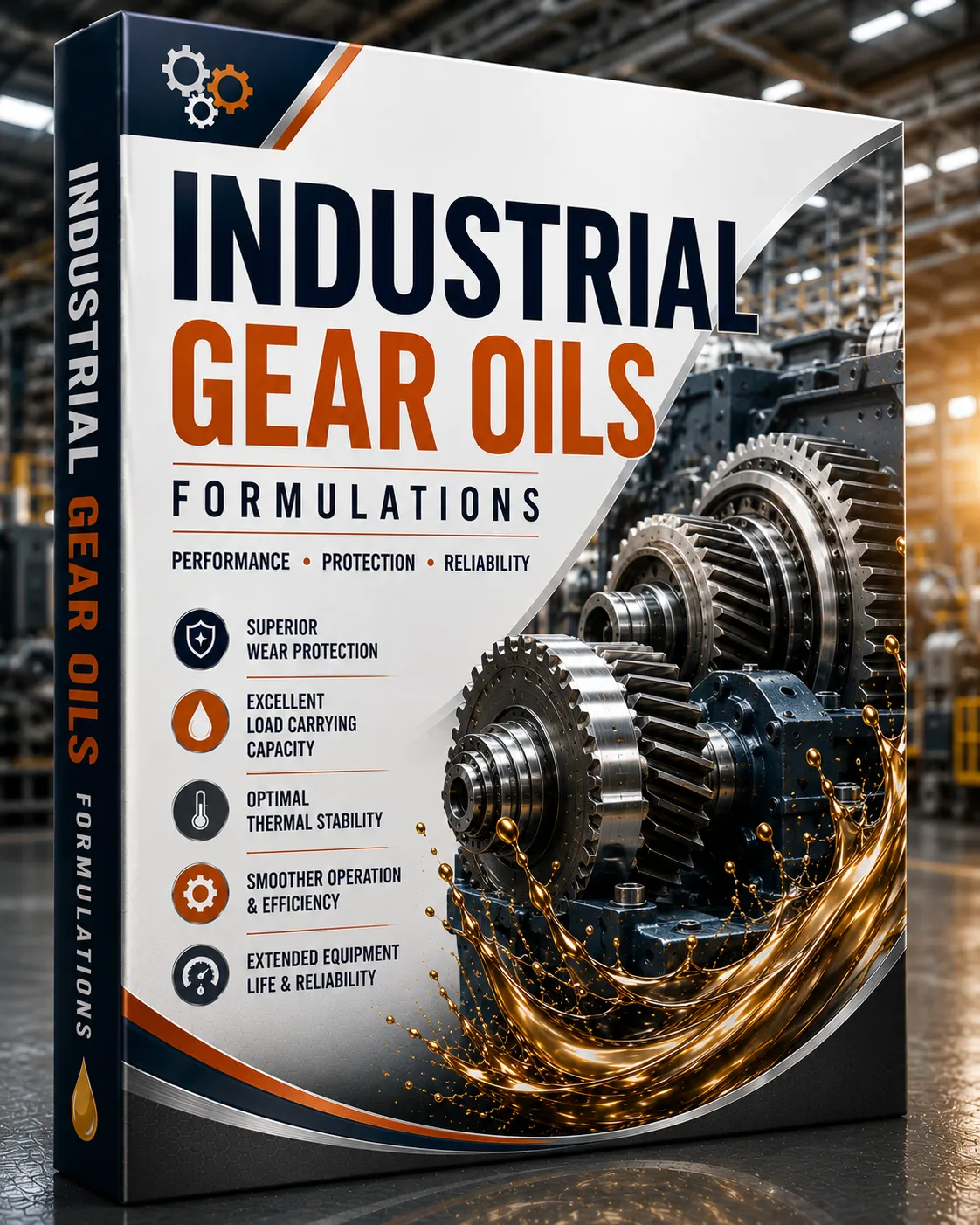
Industrial Gear Oils — Enclosed, Open & Worm Gear Formulation Guide is the definitive formulation handbook for industrial gear lubricants, covering 48 validated starting-point formulations across 12 sub-categories spanning enclosed EP gear oils (ISO 6743-6 CKB/CKC/CKD), open gear lubricants, worm gear oils, compounded gear oils, biodegradable VDMA 24568 products, and NSF H1 food-grade gear oils. Viscosity grades span ISO VG 68 to 1000+, with Economy through Specialty tiers across mineral, Group II, Group III, PAO, PAG, polyol ester, and food-grade base stocks.
The technology
The handbook covers gear lubricant chemistry from first principles: hydrodynamic and elastohydrodynamic film formation under gear-mesh rolling/sliding contact; layered sulphur-phosphorus EP/AW chemistry (sulphurised hydrocarbons for high-load iron sulphide films, ZDDP/amine phosphate for boundary-regime iron phosphate films); copper-alloy passivation with benzotriazole/tolyltriazole; friction-modifier chemistry (fatty acids, glycerol monooleate) specific to worm gear sliding contact; and base oil selection spanning Group I mineral through PAO, PAG, and polyol ester. Regulatory coverage includes VDMA 24568 biodegradability and NSF H1 food-grade compliance.
Inside the formulations
All 48 formulations (F1–F48) are structured across Economy, Mid-range, Premium, and Specialty tiers across 12 sub-categories. Each formulation provides a component table (% w/w and sourcing tier), ISO VG viscosity grade, target physical and chemical specifications, step-by-step blending sequence, QC release targets, and known incompatibility warnings — including copper-corrosion and antifoam-overdose failure modes.
What you get
- 48 starting-point gear oil formulations across 12 sub-categories
- Enclosed EP gear oils (ISO 6743-6 CKB/CKC/CKD) from economy R&O to fully synthetic ISO VG 320/460
- Open gear lubricants — mineral adhesive-film and synthetic fluid types for cement, mining, and kiln drives
- Worm gear oils — mineral compounded and PAO/ester synthetic, both with friction-modifier and copper-passivation chemistry
- Biodegradable VDMA 24568 and NSF H1 food-grade enclosed gear oil formulations
- Detailed component tables with % w/w, EP/AW treat rates, and sourcing tier guidance
- Manufacturing SOPs covering blending sequence, addition-order rules, and pilot batch protocol
- Troubleshooting tables for blending-stage failures and in-service gear oil failure modes
Technical details
- Format
- A4 PDF · instant digital download
- Extent
- ~125 pages · 48 formulations · 12 categories
- Grades
- ISO VG 68 to 1000+ · Enclosed, open, and worm gear duty
- Standards
- ISO 6743-6 (CKB/CKC/CKD) · DIN 51517 · AGMA 9005 · VDMA 24568 · NSF H1
- Tiers
- Economy (mineral) · Mid-range (Group II) · Premium (Group III/PAO) · Specialty (PAG/ester/food-grade)
- Audience
- Lubricant blenders · gearbox OEM and maintenance engineers · lubricant brand entrepreneurs
- Series
- Lubricants & Automotive Fluids Series · Volume 3 · Book 3.04
Formulate the full range of industrial gear lubricants — enclosed EP, open gear, worm gear, compounded, biodegradable and food-grade — with 48 validated starting-point formulations spanning ISO VG 68 to 1000+ across mineral and synthetic base stocks.
Who is this book for?
Industrial Lubricant Blender
You manufacture or supply industrial gear oils and need validated starting formulations across enclosed, open, and worm gear categories with correct EP/AW additive treat rates, copper passivation, and viscosity grade selection.
Gearbox OEM / Maintenance Engineer
You specify or maintain enclosed gearboxes, open gear drives, and worm reducers across cement, steel, mining, and paper machine applications, and need to understand the chemistry behind drain interval, EP performance, and copper-alloy compatibility decisions.
Lubricant Brand Entrepreneur
You want to launch an industrial gear oil range covering the full application spectrum — from economy mineral enclosed gear oils to specialty NSF H1 food-grade and VDMA 24568 biodegradable products.
Table of Contents
- Gear mesh tribology: hydrodynamic and elastohydrodynamic (EHL) film formation under rolling/sliding contact
- Sulphur-phosphorus EP chemistry: layered iron sulphide and iron phosphate boundary films
- Base oil selection across Group I through PAO, PAG, and polyol ester for ISO VG 68–1500
- Copper passivation: benzotriazole/tolyltriazole requirements for worm gear bronze compatibility
- Standards landscape: ISO 6743-6 (CKB/CKC/CKD), DIN 51517, AGMA 9005, VDMA 24568, NSF H1
- Sub-cat 1: Economy ISO VG 150/220 R&O-inhibited enclosed gear oil [MIN]
- Sub-cat 2: Mid-range ISO VG 220/320 EP-type enclosed gear oil [MIN]
- Sub-cat 3: Premium ISO VG 320/460/680 heavy-duty EP enclosed gear oil [MIN]
- Sub-cat 4: Premium ISO VG 68/100/150 low-viscosity high-speed gear oil [SYN]
- Sub-cat 5: Specialty ISO VG 320/460 fully synthetic enclosed gear oil [SYN]
- Sub-cat 6: ISO VG 460/680/1000 open gear lubricant — mineral fluid, adhesive-film type [MIN]
- Sub-cat 7: Open gear lubricant — synthetic fluid type [SYN]
- Sub-cat 8: ISO VG 150/220/460 worm gear oil — fatty-acid compounded mineral type [MIN]
- Sub-cat 9: ISO VG 220/460 worm gear oil — PAO/ester synthetic type [SYN]
- Sub-cat 10: ISO VG 220/320 compounded gear oil [MIN]
- Sub-cat 11: Biodegradable enclosed gear oil — PAG/ester, VDMA 24568 compliant [SYN]
- Sub-cat 12: NSF H1 food-grade gear oil [SYN]
- Blending equipment, vessel requirements, and critical addition-sequence rules
- Pilot batch protocol and scale-up considerations
- Base oil grades and additive treat-rate reference tables
- Blending-stage failures and in-service gear oil failure modes
- Appendices: glossary, key test methods, and formulation index
See what's inside
Frequently asked questions
They are validated starting points. You will need to bench-test and adapt treat rates to your specific raw material lots, but you start from a working formulation — not a blank sheet.
The handbook is a PDF — high-resolution A4, printable, with bookmarks and a linked table of contents. You receive an instant download link and it is also available in your library indefinitely.
Up to 5 downloads are included with your purchase. If you need more, contact us and we will reset your download limit.
Yes. The handbook opens with a fundamentals section that explains the underlying chemistry and ingredient functions before presenting formulations — so beginners can follow the rationale, not just the recipe.
Worm gears operate under near-pure sliding contact between a steel worm and bronze wheel, which precludes full elastohydrodynamic film formation and generates high friction. Enclosed helical/bevel gears run mostly rolling contact and rely on EP chemistry for occasional boundary events. Worm gear oils instead need fatty-acid or glycerol monooleate friction modifiers to reduce the boundary friction coefficient from ~0.10–0.14 down to 0.04–0.07, plus mandatory copper passivation (BTA/TTA) since active-sulphur EP additives corrode the bronze wheel. The handbook keeps these two additive architectures in separate sub-categories rather than trying to force one package to serve both duties.
VDMA 24568 is the German mechanical-engineering association standard for biodegradable, rapidly-hydrolysable lubricants (HEES-type) used in wind turbine gearboxes and other environmentally sensitive applications. It requires the base oil to meet OECD 301B biodegradability thresholds, typically met with saturated synthetic esters or PAG, combined with metal-free or ashless EP/AW additive packages so the fully formulated oil — not just the base stock — passes biodegradability testing. The book’s Sub-category 11 formulation is built around this constraint from the base-oil stage.
Economy Group I mineral formulations rely more heavily on sulphurised olefin EP additives at the higher end of the 0.5–3.0% range because the base oil itself contributes little to film strength. Premium synthetic PAO/Group III formulations can run a lighter, more balanced sulphur-phosphorus package since the higher-VI base oil already delivers a thicker EHL film at operating temperature, which lets the formulation prioritise oxidation life and extended drain interval instead of maximum EP treat rate.
Every ingredient — base oil and every additive — must appear on the FDA 21 CFR 178.3570 or equivalent approved-substance list for incidental food contact. This excludes conventional ZDDP and most sulphur-phosphorus EP chemistry, so H1 gear oils are built on white mineral oil or PAO base stocks with GRAS-listed or H1-approved antiwear and antioxidant systems. Sub-category 12 in the handbook is formulated specifically within these constraints for bakery, dairy, and pharmaceutical gearbox applications.