Hydraulic Oils — Formulation Handbook (Volume 3)
About this book
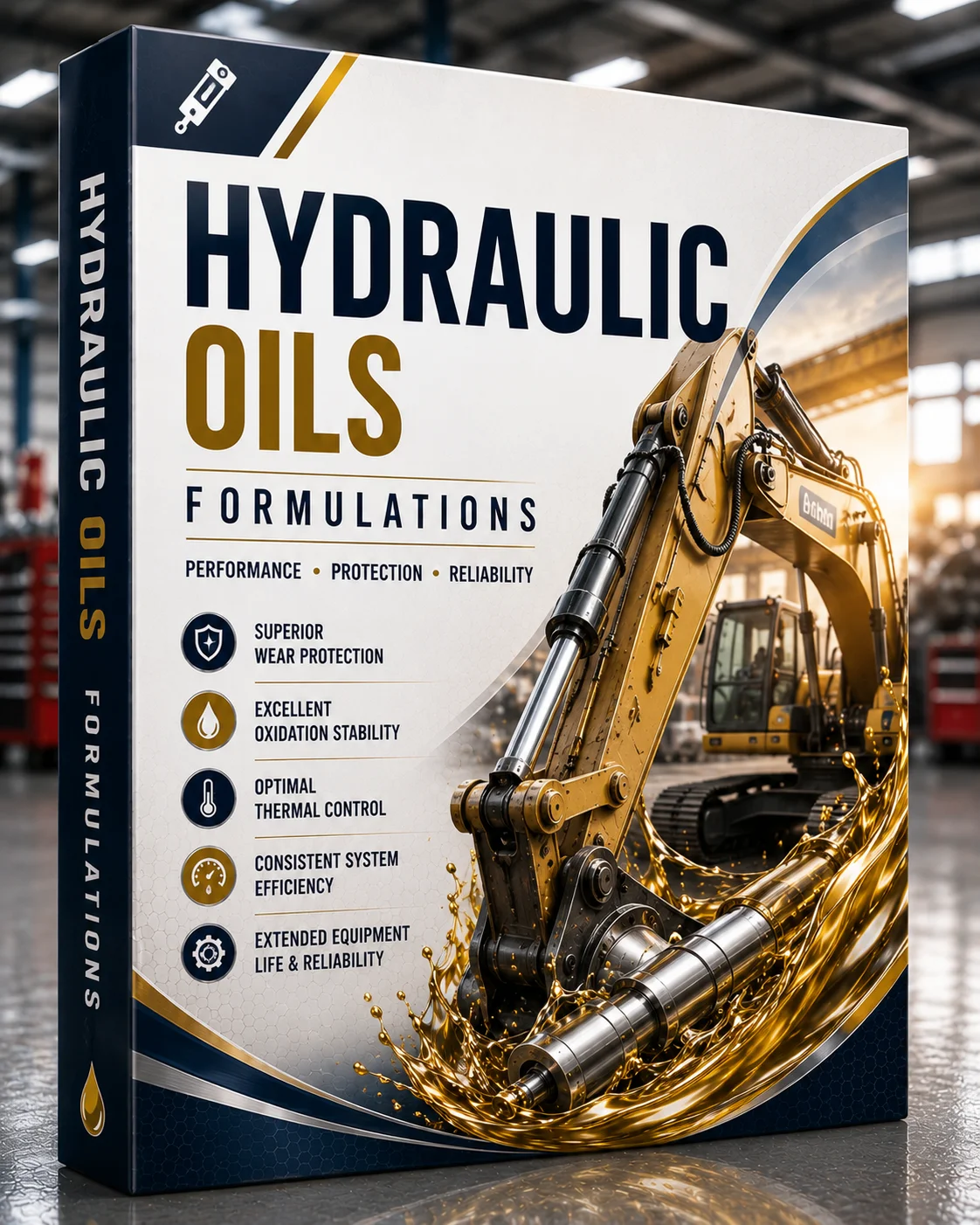
Hydraulic Oils — Formulation Handbook (Volume 3) is a comprehensive technical formulations reference covering 48 starting-point formulations across 12 sub-categories, spanning R&O, antiwear, high-viscosity/multi-grade, zinc-free/ashless, water-based and phosphate ester fire-resistant, and biodegradable (HETG/HEES/HEPG/HEPR) hydraulic fluids, plus an ultra-high-performance PAO tier. It gives hydraulic fluid blenders, fluid power engineers, and lubricant entrepreneurs the chemical foundation to manufacture hydraulic fluids that meet ISO 11158, ISO 15380, ISO 12922, and DIN 51524.
The technology
The handbook covers hydraulic fluid chemistry from first principles: base oil selection across Group I–V and its effect on oxidation stability, seal compatibility, and additive solvency; ZDDP vs. ashless antiwear chemistry for boundary-lubrication protection at pump and valve internals; antioxidant systems and their role in preventing varnish and sludge formation in continuously recirculating, aerated reservoirs; demulsibility and filterability design for modern servo hydraulic cleanliness requirements; and the distinct base-fluid chemistries underlying fire-resistant (water-glycol, phosphate ester) and biodegradable (ester, PAG, PAO) fluid families.
Inside the formulations
All 48 formulations are structured across Economy, Mid-range, Premium, and Specialty tiers spanning the 12 sub-categories. Each formulation provides a component table (% w/w and sourcing tier), target ISO VG grade and viscosity index, antiwear/antioxidant treat rates, blending sequence, and QC release targets aligned with ASTM D445, D2270, D2272, D892, D1401, and D2882.
What you get
- 48 starting-point hydraulic fluid formulations across 12 sub-categories
- R&O, AW, HVI, zinc-free/ashless, fire-resistant, and biodegradable chemistry coverage
- NSF H1 food-grade and OEM-anchored (Bosch Rexroth, Denison/Parker) formulation guidance
- Detailed component tables with % w/w, antiwear treat rates, and sourcing tier guidance
- Viscosity, oxidation life (RPVOT/TOST), and filterability QC targets with test methods
- Blending sequences and additive-solvency management guidance by base oil group
- Varnish, cavitation, and filter-blinding troubleshooting guide for in-service fluids
Technical details
- Format
- A4 PDF · instant digital download
- Extent
- ~190 pages · 48 formulations · 12 categories
- Fluid types
- R&O · AW · HVI/multi-grade · Zinc-free · Fire-resistant (HFA/HFC/HFDR) · Biodegradable (HETG/HEES/HEPG/HEPR) · PAO
- Standards
- ISO 11158 · ISO 15380 · ISO 12922 · DIN 51524-1/2/3 · ASTM D6158
- Tiers
- Economy (Group I R&O) · Mid-range (Group II AW) · Premium (HVI/ashless) · Specialty (fire-resistant/biodegradable)
- Audience
- Hydraulic fluid blenders · fluid power engineers · lubricant entrepreneurs
- Series
- Lubricants & Automotive Fluids Series · Volume 3
Formulate the full range of hydraulic fluids — R&O, antiwear, high-viscosity-index, zinc-free, fire-resistant, and biodegradable — with 48 validated starting-point formulations mapped to ISO 11158, ISO 15380, ISO 12922, and DIN 51524.
Who is this book for?
Hydraulic Fluid Blender
You manufacture or contract-blend hydraulic oils and need validated starting formulations across mineral, HVI, zinc-free, fire-resistant, and biodegradable chemistries with correct antiwear and antioxidant treat rates.
Fluid Power Systems Engineer
You specify or maintain hydraulic circuits in industrial, mobile, or offshore equipment and need a technical reference on viscosity stability, filterability, and varnish control to evaluate and monitor in-service fluids.
Lubricant Brand Entrepreneur
You want to build out a hydraulic fluid range for your industrial lubricants portfolio, tiered from Group I R&O oils to biodegradable ester and PAO chemistries, backed by ISO/DIN-aligned formulations.
Table of Contents
- The four roles of a hydraulic fluid: energy transmission, lubrication, heat transfer, and sealing
- Base oil chemistry across Group I–V: oxidation stability, seal compatibility, and solvency trade-offs
- Antiwear chemistry: zinc dialkyldithiophosphate (ZDDP) vs. ashless (TCP/phosphate ester) systems
- Oxidation and thermal stability: antioxidant depletion, varnish formation, and RPVOT/TOST life
- Cleanliness and filterability: ISO 4406 codes and ISO 13357 filterability requirements for servo systems
- ISO VG 32/46/68 rust & oxidation (R&O) hydraulic oil — HL/HH type
- ISO VG 32/46/68 antiwear (AW) hydraulic oil — HM type
- High-viscosity AW hydraulic oil for heavy industrial presses
- HVI/multi-grade hydraulic oil (HV type) for wide-temperature mobile equipment
- Zinc-free/ashless AW hydraulic oil for servo-valve and NSF H1 food-grade applications
- Water-based fire-resistant fluids: HFA emulsion and HFC water-glycol types
- Phosphate ester fire-resistant fluid (HFDR) for aviation and offshore fire-hazard installations
- Biodegradable HETG (vegetable ester) and HEES (synthetic ester) hydraulic fluids per ISO 15380
- Biodegradable HEPG (polyalkylene glycol) and HEPR (PAO-based) hydraulic fluids
- Ultra-high-performance PAO hydraulic oil for demanding non-biodegradable service
- Blending sequences and additive solvency management by base oil group
- QC testing: viscosity/VI, RPVOT/TOST oxidation life, D892 foam, D1401 demulsibility, D2882 vane pump wear
- OEM approval landscape: Bosch Rexroth, Eaton/Vickers, Denison/Parker, Caterpillar TO-4, John Deere JDM
- Troubleshooting guide: varnish/sludge deposition, cavitation erosion, and filter blinding
See what's inside
Frequently asked questions
They are validated starting points. You will need to bench-test and adapt treat rates to your specific raw material lots, but you start from a working formulation — not a blank sheet.
The handbook is a PDF — high-resolution A4, printable, with bookmarks and a linked table of contents. You receive an instant download link and it is also available in your library indefinitely.
Up to 5 downloads are included with your purchase. If you need more, contact us and we will reset your download limit.
Yes. The handbook opens with a fundamentals section that explains the underlying chemistry and ingredient functions before presenting formulations — so beginners can follow the rationale, not just the recipe.
R&O (rust & oxidation inhibited, HL/HH type) is the base-level formulation with no dedicated antiwear film-forming chemistry — suited to low-pressure, gear-pump systems. AW (antiwear, HM type) adds ZDDP or ashless antiwear chemistry for the higher contact pressures in vane and piston pumps, and is the most common industrial grade. HVI/multi-grade (HV type) further raises the viscosity index using Group III/PAO base stock or VI improvers, giving stable viscosity across a wide temperature swing — essential for mobile equipment that cold-starts and then runs hot. The handbook formulates all three as fully separate tiers.
ZDDP is highly effective and economical antiwear chemistry, but its zinc and phosphorus content is unsuitable for some servo-valve systems (ash deposition on fine clearances) and is prohibited in NSF H1 food-grade fluids. Ashless AW packages (typically TCP or phosphate ester based) avoid this at a cost and, in some formulations, antiwear-performance trade-off. The handbook includes a dedicated zinc-free/ashless sub-category covering both servo-system and NSF H1 food-grade use cases.
No — both are fundamentally different base fluid chemistries, not additive variants of mineral oil. Fire-resistant fluids use water-glycol or phosphate ester bases whose chemistry suppresses combustion directly; biodegradable fluids use polyol ester, PAG, or PAO bases selected for OECD 301B/302B biodegradability. Each has its own seal-compatibility and additive-solvency requirements, and the handbook formulates each as an independent chemistry family rather than retrofitting a mineral-oil additive package onto a different base.
The handbook cites these as technical anchors — the formulations are built toward the vane-pump and piston-pump test requirements those specifications reference — but formal OEM approval always requires submission and testing by the OEM’s own approved laboratory. That process sits outside formulation design and is the manufacturer’s responsibility.