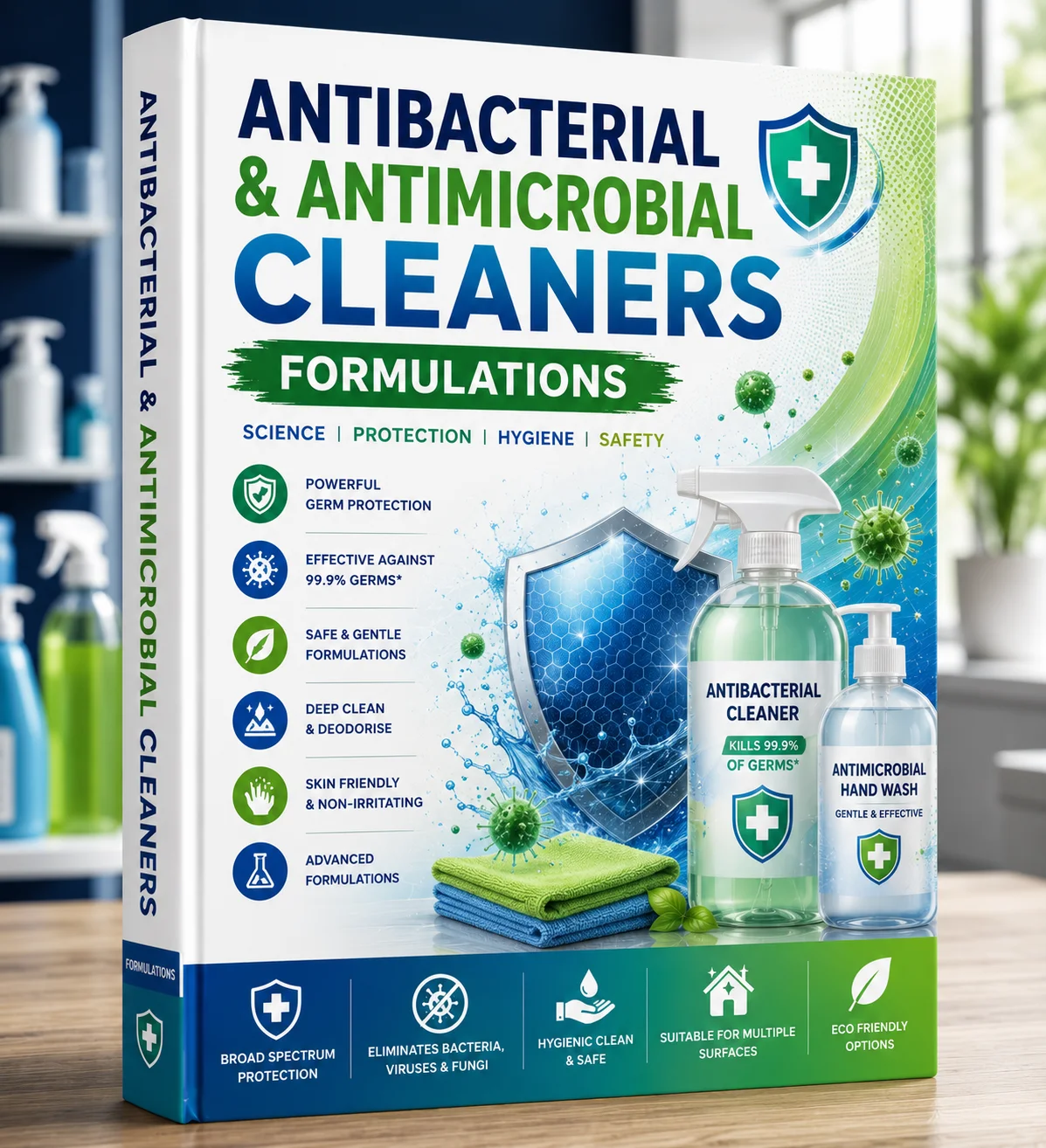
Antibacterial & Antimicrobial Cleaners — Actives & Formulation Guide
About this book
Antibacterial & Antimicrobial Cleaners — Actives & Formulation Guide is a professional technical reference containing 32 validated formulations across 8 product categories of medicated and antiseptic skin washes. Spanning pre-operative surgical scrubs, daily hygienic washes, alcohol-free quat sanitizers, salicylic acid face washes, Zinc Ricinoleate odor absorbers, and veterinary therapeutic shampoos, this book provides the physical chemistry, compounding SOPs, and troubleshooting protocols required to manufacture high-efficacy germicidal products.
The technology
The guide explains the biochemistry of skin antisepsis: biguanide cell-membrane disruption, phenolic enzyme inactivation, quaternary ammonium membrane lysis, and iodophor oxidation. It details surfactant chassis design, micellar solubilisation limits for PCMX, and electrolyte tolerance in polymer networks. Efficacy testing targets are aligned with EN 1499, EN 12791, and ASTM E1174 standards, with GHS and EU BPR requirements integrated throughout.
Inside the formulations
All 32 formulations are presented across Economy, Mid-range, Premium, and Specialty tiers in 8 sub-categories. Each block features a complete component table with INCI/IUPAC names, % w/w, functions, and sourcing tiers, alongside a detailed compounding method, pH/viscosity QC targets, stability profiles, and chemical mechanisms.
What you get
- 32 starting-point formulations across 8 antiseptic skin wash sub-categories
- Surgical scrubs (4% active CHG), Castile PCMX scrubs, and stabilized PVP-I prep washes
- Alcohol-free Benzalkonium and Benzethonium Chloride foaming hand washes
- Dermatological face washes with 0.5%–2% Salicylic Acid and anti-inflammatory Niacinamide
- Deodorising body washes using Zinc Ricinoleate and Piroctone Olamine active absorbers
- Unscented food-service sanitising hand soaps utilizing natural Lactic Acid
- Veterinary therapeutic shampoos with CHG and Miconazole Nitrate at pH 6.5–7.5
- Manufacturing SOPs, batch record templates, raw material profiles, and troubleshooting matrices
Technical details
- Format
- A4 PDF · instant digital download
- Scope
- Surgical scrubs · PCMX washes · QAC cleansers · PVP-I prep · Acne washes · Anti-odor washes · Food-service soaps · Pet shampoos
- Chemistry
- Chlorhexidine Gluconate · Chloroxylenol (PCMX) · Benzalkonium Chloride · Povidone-Iodine · Salicylic Acid · Zinc Ricinoleate · Piroctone Olamine · Sulfur · Miconazole
- Standards
- EN 1499 · EN 12791 · ASTM E1174 · USP Monograph · IS 15396 · FSSAI · CDSCO
- Tiers
- Economy · Mid-range · Premium · Specialty
- Audience
- Antiseptic manufacturers · cosmetics R&D chemists · animal health brands · contract packers
- Series
- Household & Industrial Cleaners Series · Volume 4 · Book 4.04
Formulating high-performance personal, medical, and veterinary antimicrobial skin washes requires balancing strict biocide compatibility and skin-barrier integrity. Get 32 validated formulations from surgical scrubs to therapeutic pet shampoos, ready for commercial production.
Who is this book for?
Hygiene Product Manufacturer
You produce household, clinical, or industrial cleaners and want to expand your range into high-margin medicated soaps, surgical scrubs, and anti-odor washes.
Personal Care R&D Chemist
You need to develop antimicrobial washes that avoid skin-barrier damage and active neutralization (such as CHG with anionic surfactants) using validated nonionic/amphoteric systems.
Animal Health Brand Founder
You want to launch medicated veterinary shampoos (like chlorhexidine/miconazole blends) formulated at pet-neutral pH ranges (6.5–7.5) to treat animal skin infections.
Table of Contents
- Biocidal actives and mechanisms of action: CHG, PCMX, QACs, PVP-I, Salicylic Acid
- Surfactant-active compatibility: preventing cationic-anionic neutralization and active deactivation
- Skin acid mantle physiology and lipid-barrier protection dynamics
- Regional biocide regulations: CDSCO (India), EU BPR (PT1), US FDA OTC Monographs
- Surgical Hand Scrubs (CHG-Based) — F1 to F4 (2% & 4% active CHG, and CHG-isopropanol boost)
- Hygienic Hand Washes (PCMX-Based) — F5 to F8 (traditional Castile soap and sulfate-free)
- QAC Skin Washes (BAC/BZT) — F9 to F12 (alcohol-free foaming and hospital-grade BAC)
- Povidone-Iodine Antiseptic Cleansers — F13 to F16 (7.5% & 10% PVP-I, and stabilized foaming prep)
- Medicated Acne & Salicylic Acid Washes — F17 to F20 (0.5% to 2.0% active SA, and tea tree synergy)
- Deodorising & Anti-Odor Washes — F21 to F24 (Zinc Ricinoleate and Piroctone Olamine active absorbers)
- Triclosan-Free Industrial & Food-Service Hand Washes — F25 to F28 (biodegradable Lactic Acid and BAC)
- Veterinary & Pet Medicated Shampoos — F29 to F32 (chlorhexidine/miconazole at pet-neutral pH 6.5–7.5)
- SS316L mixing vessel requirements, dual-motion agitators, and filtration
- Detailed manufacturing sequence (SOP) and raw material addition order
- 1,000 kg batch record template
- Scale-up notes: polymer hydration shear sensitivity and saponification exotherm controls
- Key ingredients table with chemical classes, CAS numbers, and sourcing tiers
- Supplier and substitution guidelines for specialty thickeners and mild surfactants
- Cost-tier registration and Bill of Materials (BoM) impact guide
- Troubleshooting matrices: cationic deactivation, iodine loss, PCMX crystal sedimentation
- Narrative commentary on molecular degradation pathways
- Stability failure reference: phase separation, viscosity drift, fragrance fade
See what's inside
Frequently asked questions
They are validated starting points. You will need to bench-test and adapt treat rates to your specific raw material lots, but you start from a working formulation — not a blank sheet.
The handbook is a PDF — high-resolution A4, printable, with bookmarks and a linked table of contents. You receive an instant download link and it is also available in your library indefinitely.
Up to 5 downloads are included with your purchase. If you need more, contact us and we will reset your download limit.
Yes. The handbook opens with a fundamentals section that explains the underlying chemistry and ingredient functions before presenting formulations — so beginners can follow the rationale, not just the recipe.
Chlorhexidine Gluconate (CHG) and Benzalkonium Chloride (BAC) are highly cationic. When paired with anionic surfactants (SLES, SLS, or soap), they form an insoluble, electrically neutral salt complex that precipitates out of solution. This completely deactivates the biocide, rendering the log reduction zero, and collapses the surfactant foam. Nonionic and amphoteric surfactants must be used instead.
Human skin is acidic (pH 4.5–5.5), whereas dog and cat skin is close to neutral or slightly alkaline (pH 6.5–7.5). Formulating animal shampoos at human pH levels strips the pet's natural lipid barrier, causing severe dryness, irritation, and secondary infections. All veterinary shampoos in this handbook are buffered strictly to pH 6.5–7.5.
Povidone-Iodine exists in an equilibrium that releases free diatomic iodine (I₂). At pH >6.0, iodine is reduced to inactive iodide (I⁻) and iodate (IO₃⁻). To prevent this, we incorporate a phosphate-citrate buffer to lock the pH within 4.5–5.5, and add Potassium Iodate as an oxidising stabilizer to shift the equilibrium back to active diatomic iodine.
They are completely Triclosan-free, dye-free, and unscented to prevent food contamination. Efficacy is driven by natural, biodegradable Lactic Acid and Benzalkonium Chloride, which are permitted under global food-contact safety standards (like FDA and FSSAI).