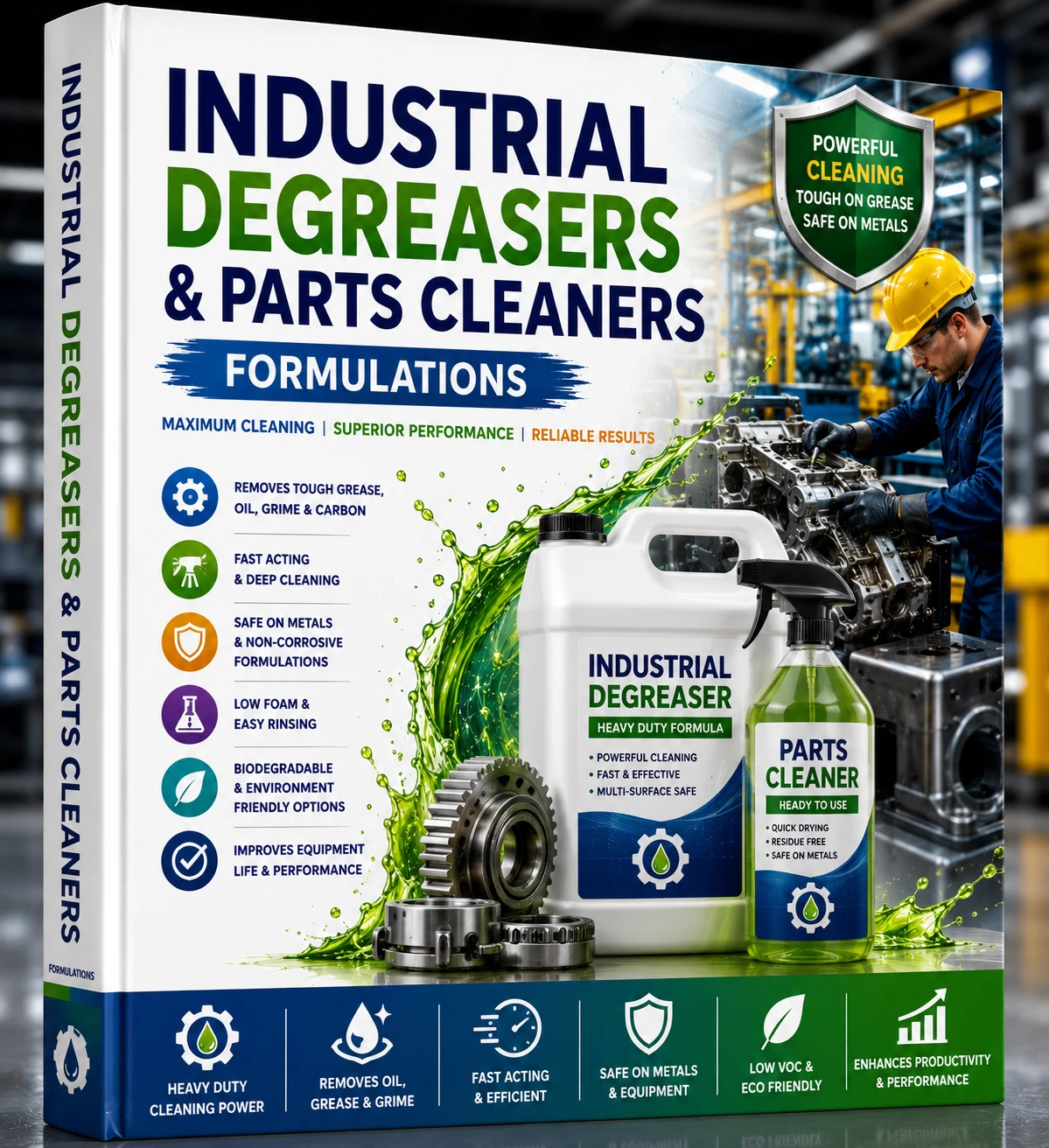
Industrial Degreasers & Parts Cleaners — Solvent & Aqueous Formulation Handbook
About this book
Industrial Degreasers & Parts Cleaners — Solvent & Aqueous Formulation Handbook is a definitive technical guide covering 52 formulations across 13 sub-categories of heavy-duty industrial cleaning fluids. It provides working starting points, chemical mechanisms, compounding sequences, and testing methods across Economy, Mid-range, Premium, and Specialty tiers. Spanning heavy alkaline dip concentrates, aircraft multi-metal safe baths, high-flash hydrocarbon washes, bio-based terpene emulsifiers, low-foam cabinet sprays, and ultrasonic detergents, this handbook is designed for chemical manufacturers, R&D chemists, and industrial fluid distributors seeking to formulate, manufacture, and quality-control industrial degreasing agents.
The technology
The book analyzes cleaning physical chemistry: saponification of fatty lipids, solvent swelling of cross-linked oils, surfactant wetting, roll-up displacement, and acoustic cavitation. It explores substrate metallurgical constraints: structural steel passivation, aluminosilicate protective barriers, and copper benzotriazole chelation. Efficacy targets are mapped to ASTM F519, ASTM F1110, ASTM D4488, and IS 16419 methods, with comprehensive GHS, REACH, and CPCB environmental guidelines integrated throughout.
Inside the formulations
All 52 formulations are structured across Economy, Mid-range, Premium, and Specialty tiers in 13 sub-categories. Each block features a complete component table with INCI/IUPAC names, % w/w, functions, and sourcing tiers, alongside a detailed compounding sequence, pH/viscosity/specific-gravity QC targets, stability profiles, and chemical mechanisms.
What you get
- 52 starting-point formulations across 13 industrial degreaser sub-categories
- Heavy-duty alkaline dip concentrates, aerospace-safe multi-metal washes, and low-foam cabinet sprays
- High-flash isoparaffinic parts washer solvents (MIL-PRF-680C Type II) and self-emulsifying solvent degreasers
- Aqueous bio-based terpene (d-Limonene) and non-volatile ester (Methyl Soyate) degreasers
- Vapor degreasing azeotropic liquids, quick-break interceptor-safe aqueous cleaners, and aerosol brake parts sprays
- Manufacturing SOPs, batch record templates, raw material profiles, and troubleshooting matrices
- Metallurgical passivation science, hydrogen embrittlement prevention, and wastewater compliance notes
Technical details
- Format
- A4 PDF · instant digital download
- Scope
- Alkaline dip · multi-metal safe · hydrocarbon solvents · emulsifiable solvents · terpene bio-degreasers · soy bio-solvents · low-foam spray · ultrasonic bath · acidic metal prep · vapor degreasing · high-pressure steam · quick-break · aerosol brake cleaners
- Chemistry
- Sodium/Potassium Hydroxide · Sodium Metasilicate · Monoethanolamine · GLDA/EDTA · Dipropylene Glycol Monobutyl/Methyl Ether · Alkyl Polyglucosides · Alcohol Ethocyanates · d-Limonene · Methyl Soyate · trans-1,2-Dichloroethylene
- Standards
- ASTM F519 · ASTM F1110 · ASTM D4488 · ASTM D93 · IS 16419 · CPCB Rules · REACH compliant
- Tiers
- Economy · Mid-range · Premium · Specialty
- Audience
- Industrial chemical manufacturers · R&D chemists · blending plant managers · distributor entrepreneurs
- Series
- Household & Industrial Cleaners Series · Volume 5 · Book 5.01
Stop trying to guess the correct surfactant-solvent balance for industrial metal cleaning — get 52 validated starting-point formulations across solvent, aqueous and bio-based degreasing technologies, complete with aerospace-safe, low-foam and quick-break spec compliance.
Who is this book for?
Industrial Cleaner Manufacturer
You blend or manufacture I&I cleaning chemicals and need robust, high-performance formulations for recirculating cabinets, dip tanks, and parts washers that meet strict substrate-safety guidelines.
Chemical Formulator / R&D Chemist
You need chemical mechanisms, GHS labeling profiles, and test targets for advanced cleaner systems (microemulsions, bio-solvents, vapor-degreasing azeotropes) to meet client specs.
Industrial Lubricant & Cleaning Entrepreneur
You want to build a complete industrial-grade degreasing and parts cleaning product line with clear cost/performance tiers (Economy to Specialty) and raw material sourcing profiles.
Table of Contents
- Mechanical substrates and organic soils compatibility (ferrous vs non-ferrous, structural aerospace aluminum)
- Saponification, solvent swelling, and microemulsion chemistry mechanisms
- Silicate passivation and yellow-metal copper corrosion protection systems
- Industry specifications: ASTM F519 (hydrogen embrittlement), ASTM F1110 (sandwich corrosion), IS 16419
- GHS hazard communication, OSHA PELs, and CPCB waste interceptor guidelines
- Heavy-duty dip-tank and floor-scrub concentrates (F1–F4)
- Aluminum-safe parts washer cleaners utilizing triethanolamine and passivating silicates (F5–F8)
- Low-foam spray cabinet formulations utilizing cloud-point nonionics
- High-shear recirculating systems and ultrasonic aqueous bath degreasers
- High-flashpoint isoparaffinic hydrocarbon parts washer solvents (MIL-PRF-680C Type II)
- Self-emulsifying solvent concentrates and terpene-based bio-degreasers (d-limonene)
- Non-volatile, bio-based ester solvents (Methyl Soyate and dibasic esters)
- Azeotropic vapor degreasing liquids and quick-break aqueous interceptor-safe cleaners
- Pressurized aerosol parts and brake cleaners
- Plant configuration: 316L stainless steel vessels, agitation parameters, thermal jacket control
- Master compounding SOPs and batch record templates for alkaline and solvent systems
- Scale-up notes: handling heats of neutralization, surfactant hydration gel-phases, foam controls
- Formulation diagnostics matrix for cloud-point separation, active silicate depletion, and syneresis
- Failure-mode analysis for metal etching, yellow-metal graying, and emulsion splitting
- Raw materials reference: CAS numbers, sourcing tiers, and substitution guides
See what's inside
Frequently asked questions
They are validated starting points. You will need to bench-test and adapt treat rates to your specific raw material lots, but you start from a working formulation — not a blank sheet.
The handbook is a PDF — high-resolution A4, printable, with bookmarks and a linked table of contents. You receive an instant download link and it is also available in your library indefinitely.
Up to 5 downloads are included with your purchase. If you need more, contact us and we will reset your download limit.
Yes. The handbook opens with a fundamentals section that explains the underlying chemistry and ingredient functions before presenting formulations — so beginners can follow the rationale, not just the recipe.
Yes. Sub-category 2 contains dedicated aluminum-safe formulations, including a specialty grade designed to conform with ASTM F519 (hydrogen embrittlement) and ASTM F1110 (sandwich corrosion) standards by leveraging triethanolamine and passivating potassium silicates while locking the neat pH under 10.0.
Standard emulsifiable solvent degreasers hold oils in a tight emulsion, which bypasses grease traps and contaminates wastewater. Quick-break degreasers (Sub-category 12) use specific nonionic and anionic combinations that emulsify grease under mechanical agitation but rapidly split the oil phase out once agitation ceases, allowing easy skimming in separators.
High-alkali compounding is highly exothermic. The SOP details charging water first, applying active cooling, and slowly metering the liquid alkali while keeping the temperature below 60 °C. Operators must wear full acid-resistant PPE, and vessels must be constructed of corrosion-resistant 316L stainless steel (never aluminum, tin, or zinc).
Yes. It includes formulations based on d-limonene (citrus terpenes), Methyl Soyate (soy methyl ester), and Dibasic Esters (DBE). These bio-derived alternatives provide high flash points, zero or low VOC profiles, and excellent biodegradability while matching or exceeding the KB solvency values of mineral spirits.