Vehicle & Fleet Cleaning Products — Car Shampoo to Industrial Wash Guide
About this book
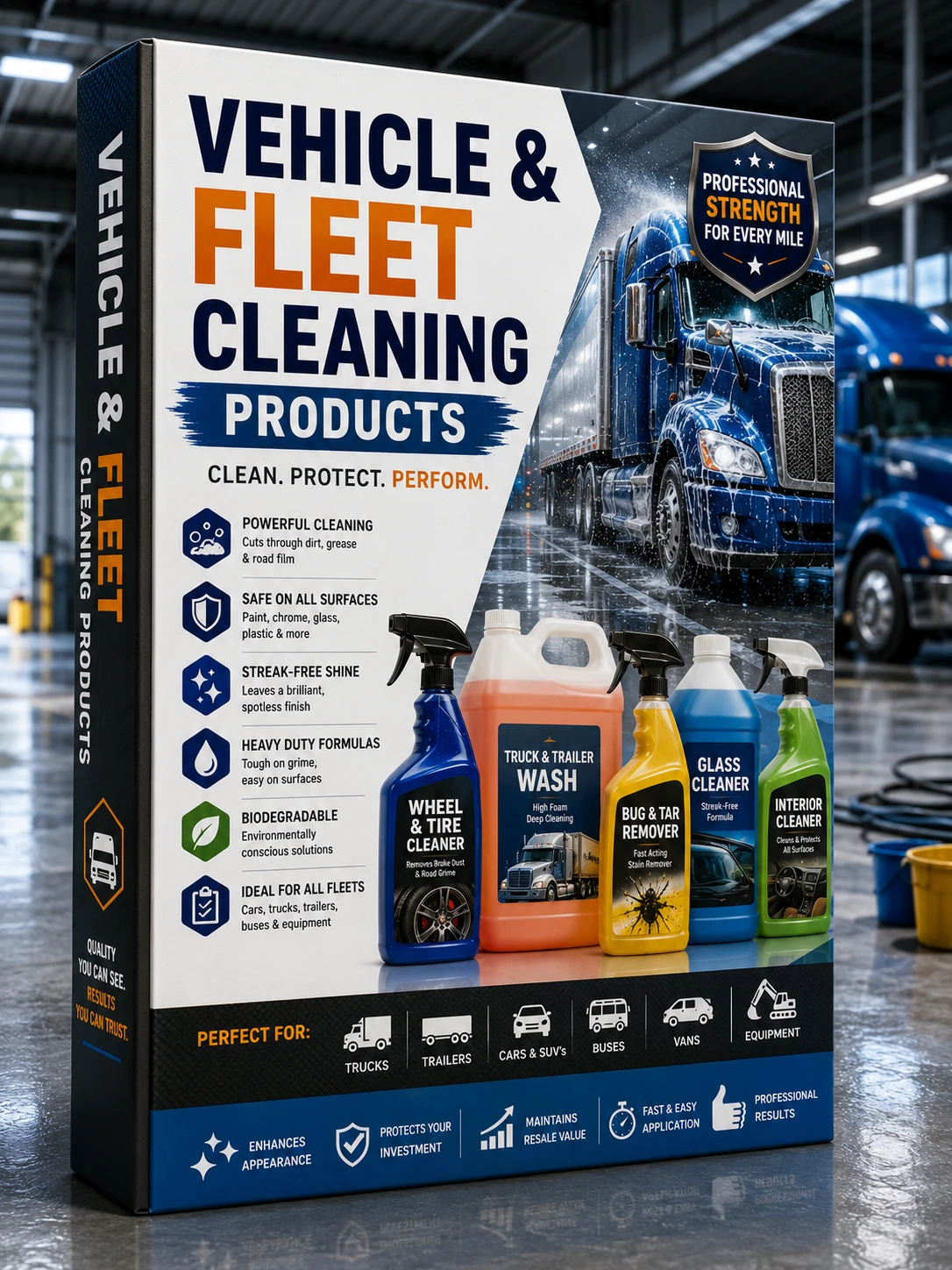
Vehicle & Fleet Cleaning Products — Car Shampoo to Industrial Wash Guide is a focused technical formulation handbook covering 32 formulations. Spanning touchless foams, carnauba wash & waxes, heavy fleet traffic film removers, iron fallout wheel cleaners, d-limonene engine degreasers, polymer waterless washes, hydrophobic glass sprays, and organic concrete descalers, it provides complete compositions, systematic SOPs, raw material sourcing tiers, and diagnostic matrices.
The technology
The handbook analyzes physical-chemical detersive mechanics: boundary-slip polymer encapsulation, touchless surfactant-builder charge repulsion, cationic wax deposition kinetics, and coordinate thiol complexation. Metallurgical safety measures detailed include silicate passivation and yellow-metal passivator inhibitors. Regulatory compliance references include OECD 301B biodegradability, ASTM F1110 sandwich corrosion safety, and quick-break separator guidelines.
Inside the formulations
All 32 formulations are presented across Economy, Mid-range, Premium, and Specialty tiers in 8 sub-categories. Each block features a complete component table with INCI/IUPAC names, % w/w, functions, and sourcing tiers, alongside a detailed compounding sequence, pH/viscosity/specific-gravity QC targets, stability profiles, and chemical mechanisms.
What you get
- 32 starting-point formulations across 8 vehicle care sub-categories
- Detailed component tables with INCI/IUPAC names, weight %, and functions
- QC test methods and specification targets mapped to ASTM, IS, and OECD standards
- Detailed manufacturing SOPs for high-shear liquid blending and microemulsions
- Troubleshooting matrices for surfactant complexation, aluminum etching, and phase separation
Technical details
- Format
- A4 PDF · instant digital download
- Extent
- ~150 pages · 32 formulations · 8 sub-categories
- Standards
- ASTM E70, ASTM D2196, ASTM D1298, ASTM D1173, ASTM D2024, ASTM F1110, OECD 301B
- Tiers
- Economy · Mid-range · Premium · Specialty
- Audience
- Vehicle care chemical manufacturers · auto-detailers · fleet operators · R&D chemists · distributor entrepreneurs
- Series
- Household & Industrial Cleaners Series · Volume 5 · Book 5.06
Formulating high-performance vehicle and fleet cleaning products requires balancing aggressive grime removal with strict substrate and user safety. Get 32 validated starting-point formulations from touchless foams to organic concrete descalers, ready for commercial production.
Who is this book for?
Vehicle Care Manufacturer
You manufacture commercial, retail, or industrial vehicle washing chemicals and need robust, high-performance formulations for pressure washing, gantries, and manual car wash bays.
Fleet Maintenance Director
You manage a large fleet of transport trucks, public buses, or heavy equipment and need verified formulations to build cost-effective, substrate-safe, own-brand cleaning programs.
Auto-Detailing Chemist
You develop high-end detailing products and need reference formulations across carnauba wash & waxes, waterless washes, iron fallout removers, and anti-fog glass cleaners.
Table of Contents
- Product category overview: clearcoat preservation, metallurgical compatibility, and hard water tolerance dynamics
- Chemistry & science: detersive mechanisms, touchless mutual charge repulsion, and cationic deposition for wash & wax
- Core raw materials register and functional additive classes (corrosion inhibitors, hydrotropes, gloss aids)
- Relevant standards & regulations: OECD 301B biodegradability, phosphate limits, ASTM F1110 sandwich corrosion, and wastewater discharge limits
- High-Foaming Touchless Car Wash Concentrates: economy, mid-range pre-wash, premium multi-substrate, and specialty snow foam
- Premium Carnauba Wash & Wax Shampoos: economy sheeting, mid-range, premium PQ-10 wax boost, and specialty residue-free matte paint cleaner
- Heavy-Duty Traffic Film Removers (TFR): economy truck, mid-range fleet, premium substrate-safe silicate, and specialty quick-break
- Acidic Wheel Cleaners & Iron Fallout Removers: economy mineral acid, mid-range organic acid, premium color-changing thioglycolate, and specialty wire wheel gel
- Engine Degreasers & Underbody Washes: economy solvent, mid-range alkaline, premium d-limonene bio-degreaser, and specialty quick-break soy wash
- Waterless Wash & Quick Detailer Sprays: economy detailer, mid-range concentrate, premium anti-static polymer, and specialty clay bar lubricant
- Glass Cleaner & Windscreen Washer Concentrates: economy, mid-range, premium hydrophobic sheeting, and specialty anti-fog
- Heavy-Duty Concrete & Transit Truck Washes: economy HCl concrete dissolver, mid-range transit, premium soy tar remover, and specialty organic urea HCl descaler
- Compounding plant requirements: 316L stainless steel, dual-motion anchor/turbine agitation, and temperature jackets
- Compounding sequence (SOP) and raw material addition order for microemulsions and cationic polymers
- 1,000 kg compounding batch sheet template for Formulation F3
- Scale-up notes: surfactant hydration gel-phases, exothermic neutralization heat, and sub-surface filling foam control
- 38 raw materials — chemical descriptions, CAS numbers, sourcing tiers, and use level guidelines
- Surfactants, builders, chelants, solvents, polymers, and corrosion passivators
- Supplier and substitution guidelines for specialty silicones, carnauba emulsions, and organic acid salts
- Troubleshooting matrices: hydrotrope coupling for TFR phase separation, silicate replenishment for aluminum staining, and cationic stabilization
- Narrative commentary on surfactant complexation prevention and amphoteric silicate passivation barriers
- Stability failure reference: phase separation, viscosity drift, and hard water precipitation
See what's inside
Frequently asked questions
They are validated starting points. You will need to bench-test and adapt treat rates to your specific raw material lots, but you start from a working formulation — not a blank sheet.
The handbook is a PDF — high-resolution A4, printable, with bookmarks and a linked table of contents. You receive an instant download link and it is also available in your library indefinitely.
Up to 5 downloads are included with your purchase. If you need more, contact us and we will reset your download limit.
Yes. The handbook opens with a fundamentals section that explains the underlying chemistry and ingredient functions before presenting formulations — so beginners can follow the rationale, not just the recipe.
Mixing cationic ingredients directly with anionic surfactants normally causes co-precipitation. Premium wash & waxes stabilize this by incorporating nonionic alkyl polyglucosides (APG) and amphoteric amine oxides as steric spacers in the micelle. When the shampoo is diluted during rinsing, the micelle destabilizes, allowing the cationic deposition polymer (Polyquaternium-10) and cationic emulsifier (Dicocodimonium Chloride) to draw the negatively charged carnauba wax droplets onto the paint clearcoat.
Alkaline cleaners with pH >11.5 strip the protective aluminum oxide layer on vehicle trims, causing permanent white etching. We include Potassium Silicate, which reacts with the active aluminum to form a protective amorphous aluminum silicate polymer film, shielding soft metals from chemical attack while maintaining high detersive power.
Brake dust consists of insoluble iron particles (Fe3+). These wheel cleaners use Sodium Thioglycolate at neutral pH (7.0–7.5). The thioglycolate acts as a reducing agent and coordinate ligand, reacting with the ferric iron to form a highly water-soluble, deep purple-colored coordination complex (Ferric Thioglycolate) that washes away easily.
Traditional cleaners emulsify road oil and grease into a stable mixture that slips past interceptor pits into municipal wastewater. Quick-break formulations use low-foaming surfactants and solvent systems that release the emulsified oil once mechanical shear ceases. This allows oil and water to separate rapidly in settle tanks, enabling clean water discharge and easy oil skimming.