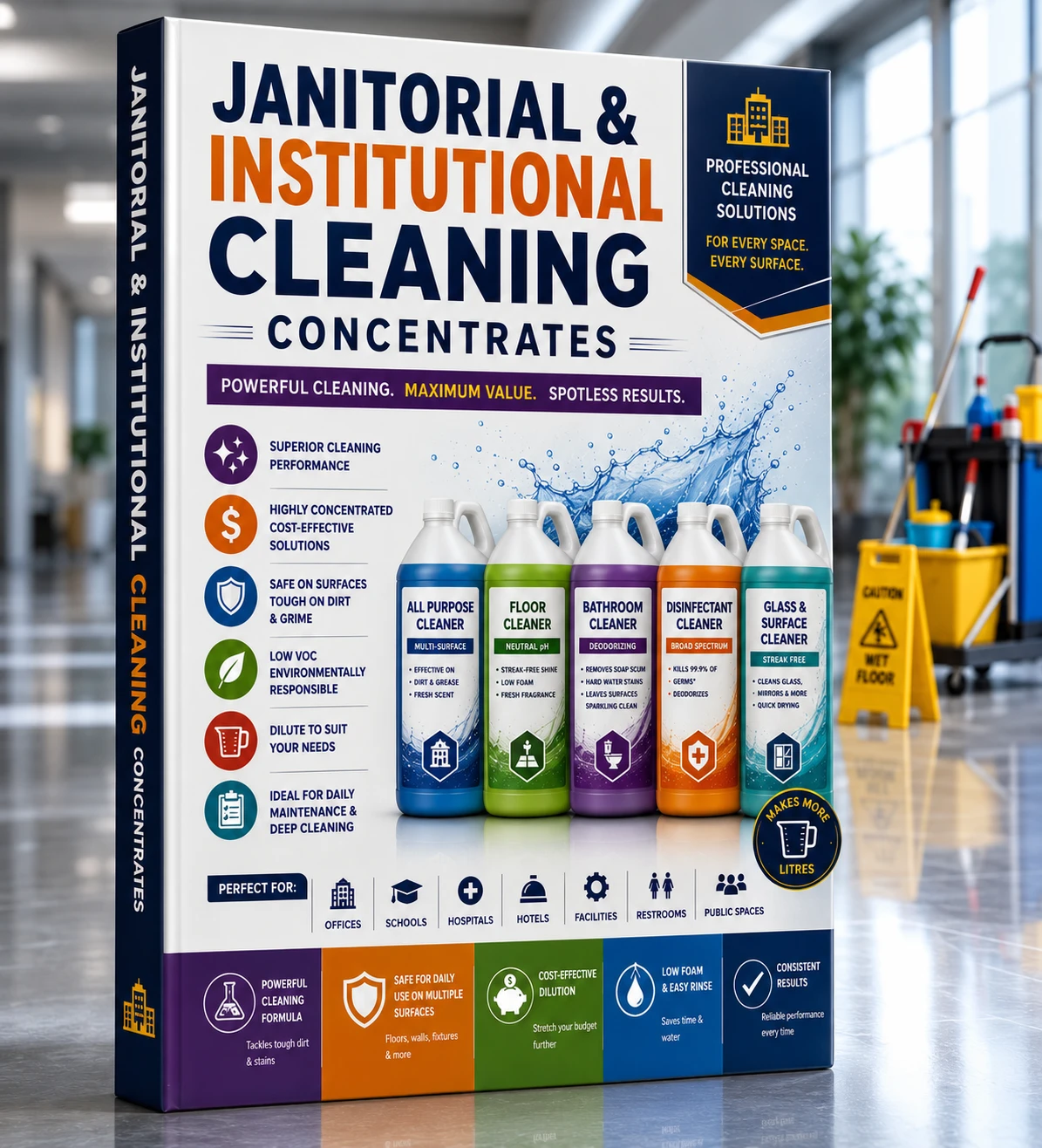
Janitorial & Institutional Cleaning Concentrates — Formulation Handbook
About this book
Janitorial & Institutional Cleaning Concentrates — Formulation Handbook is a professional technical guide detailing 32 formulations. Spanning super-concentrated glass cleaners, neutral floor washes, heavy alkaline degreasers, vertical acid restroom descalers, quat disinfectants, pine oil soaps, carpet spotters, and reactive odor neutralizers, it bridges active detersive chemistry, metallurgical safety, and dilution control mechanics.
The technology
The handbook covers I&I surfactant chemistry: wetting physics (reducing water surface tension below 30 mN/m), micellar emulsification, builder pH buffering, silicate metal passivation, quat antimicrobial disinfection, and zinc ricinoleate coordination chelation. Efficacy targets are benchmarked to ASTM D3758, ASTM D1173, ASTM E70, EN 1276, and EN 14476 standards, with GHS safety and environmental guidelines integrated throughout.
Inside the formulations
All 32 formulations are presented across Economy, Mid-range, Premium, and Specialty tiers in 8 categories. Each block details exact compositions (% w/w), systematic INCI/IUPAC ingredient names, blending sequences, QC test targets, stability profiles, and detailed scientific bases.
What you get
- 32 starting-point formulations across 8 I&I cleaning sub-categories
- Detailed component tables with INCI/IUPAC names, weight %, and functions
- QC test methods and specification targets mapped to ASTM, EN, and IS standards
- Detailed manufacturing SOPs for high-shear liquid blending and dilution control
- Troubleshooting matrices for cloud point splitting, viscosity drift, and quat deactivation
Technical details
- Format
- A4 PDF · instant digital download
- Extent
- ~150 pages · 32 formulations · 8 sub-categories
- Standards
- ASTM D3758, ASTM D1173, ASTM E70, EN 1276, EN 14476, ISO 22716
- Tiers
- Economy · Mid-range · Premium · Specialty
- Audience
- I&I cleaning chemical manufacturers · contract packers · R&D chemists · distributor entrepreneurs
- Series
- Household & Industrial Cleaners Series · Volume 5 · Book 5.05
Formulating commercial-grade cleaning concentrates requires balancing high chemical activity with substrate and user safety. Get 32 validated formulations from ultra-concentrated glass cleaners to odor counteractants, ready to bench-test and scale today.
Who is this book for?
I&I Chemical Manufacturer
You manufacture commercial or institutional cleaning chemicals and need robust, high-performance starting formulations designed for automatic dispensing and dilution control systems.
R&D Chemist
You need working reference formulations across anionic, nonionic, and cationic systems to accelerate product development and ensure compliance with ASTM and EN standards.
Janitorial Brand Founder
You are launching a professional cleaning chemical brand and need a structured, high-tier formulation set covering economy through premium and specialty categories.
Table of Contents
- Industrial detersive chemistry: wetting, emulsification, and particulate soil suspension physics
- pH and metallurgical safety: preventing polyacrylate polish stripping and carbonate stone etching
- Cationic disinfectant dynamics: QAC membrane disruption vs anionic deactivation
- Regulatory frameworks: ASTM D1173 (wetting), ASTM D3758 (cleaning efficacy), GHS labeling, and regional environmental standards
- Super-Concentrated Glass & Window Cleaners: economy, AMP-neutralised, premium anti-fog, and specialty streak-free
- All-Purpose Neutral Floor Cleaner Concentrates: economy, VCT-safe, premium low-foam, and specialty anti-static (ESD)
- Heavy-Duty Alkaline General-Purpose Degreasers: economy, multi-metal safe, premium high-dilution, and specialty butyl-free
- Acidic Bathroom Descalers & Restroom Concentrates: economy HCl descaler, organic citric, premium vertical cling, and specialty sulfamic
- Quaternary Ammonium Disinfectant & Sanitiser Concentrates: economy BAC sanitiser, mid-range dual-quat, premium soil-tolerant, and specialty veterinary germicidal
- Pine Oil & Deodorising Cleaner Concentrates: economy pine gel, mid-range emulsion, premium 85% pine oil, and specialty tall-oil soap
- Carpet Extraction Shampoos & Traffic Lane Spotters: economy encapsulation, mid-range extraction, premium enzyme spotter, and specialty anti-soiling
- Institutional Odour Neutraliser & Air Care Concentrates: economy space spray, mid-range fabric refresher, premium zinc ricinoleate complex, and specialty microencapsulated fragrance
- SS316L vessel and agitator setups for liquid blending; compounding sequences (SOP) and raw material charging protocols
- 1,000 kg batch record templates and exothermic neutralization handling procedures
- Scale-up notes: managing polymer hydration, surfactant gel-phases, and foam controls during filling
- 32 raw materials — chemical descriptions, CAS numbers, sourcing tiers, and typical level profiles
- Surfactants, builders, chelants, biocides, solvents, odor counteractants, and stabilizers
- Supplier and substitution guidelines for specialty thickeners and associative polymers
- Troubleshooting matrices: cloud point splitting, viscosity drift, enzyme deactivation, and quat precipitation
- Stability failure reference: phase separation, accelerated testing protocol (40 °C / 75% RH), and freeze-thaw cycles
See what's inside
Frequently asked questions
They are validated starting points. You will need to bench-test and adapt treat rates to your specific raw material lots, but you start from a working formulation — not a blank sheet.
The handbook is a PDF — high-resolution A4, printable, with bookmarks and a linked table of contents. You receive an instant download link and it is also available in your library indefinitely.
Up to 5 downloads are included with your purchase. If you need more, contact us and we will reset your download limit.
Yes. The handbook opens with a fundamentals section that explains the underlying chemistry and ingredient functions before presenting formulations — so beginners can follow the rationale, not just the recipe.
Quaternary ammonium compounds (QACs) are highly cationic (positively charged) biocides. Standard floor cleaners often use anionic surfactants like SLES or LABS, which carry a negative charge. When combined, the cationic quat and anionic surfactant form an insoluble, neutral salt complex. This completely deactivates the disinfectant properties and causes cloudiness or precipitation. Disinfectant concentrates must use nonionic or amphoteric surfactant systems.
High pH environments dissolve the protective oxide layer on soft metals like aluminum and zinc, leading to severe etching and discoloration. To prevent this, we incorporate passivating corrosion inhibitors like Sodium Metasilicate or Potassium Silicate. These silicates deposit a protective, microscopic amorphous silicate layer over the metal surface, blocking chemical attack while maintaining reserve alkalinity for grease removal.
Standard fragrances simply mask odors by overriding olfactory receptors. Zinc Ricinoleate is a coordination chelant that chemically traps volatile nitrogen and sulfur-based malodorous compounds (such as ammonia, hydrogen sulfide, and mercaptans) into stable, non-volatile organic complexes. This permanently removes the odor from the environment rather than temporarily masking it.
Formulations are designed to remain stable under high active matter loading, supporting extreme dilution ratios from 1:10 (for heavy-duty descaling and degreasing) up to 1:256 (for all-purpose maintenance and neutral floor cleaning).