Colour-Safe Bleach & Oxygen Bleach Products — Formulation Guide
About this book
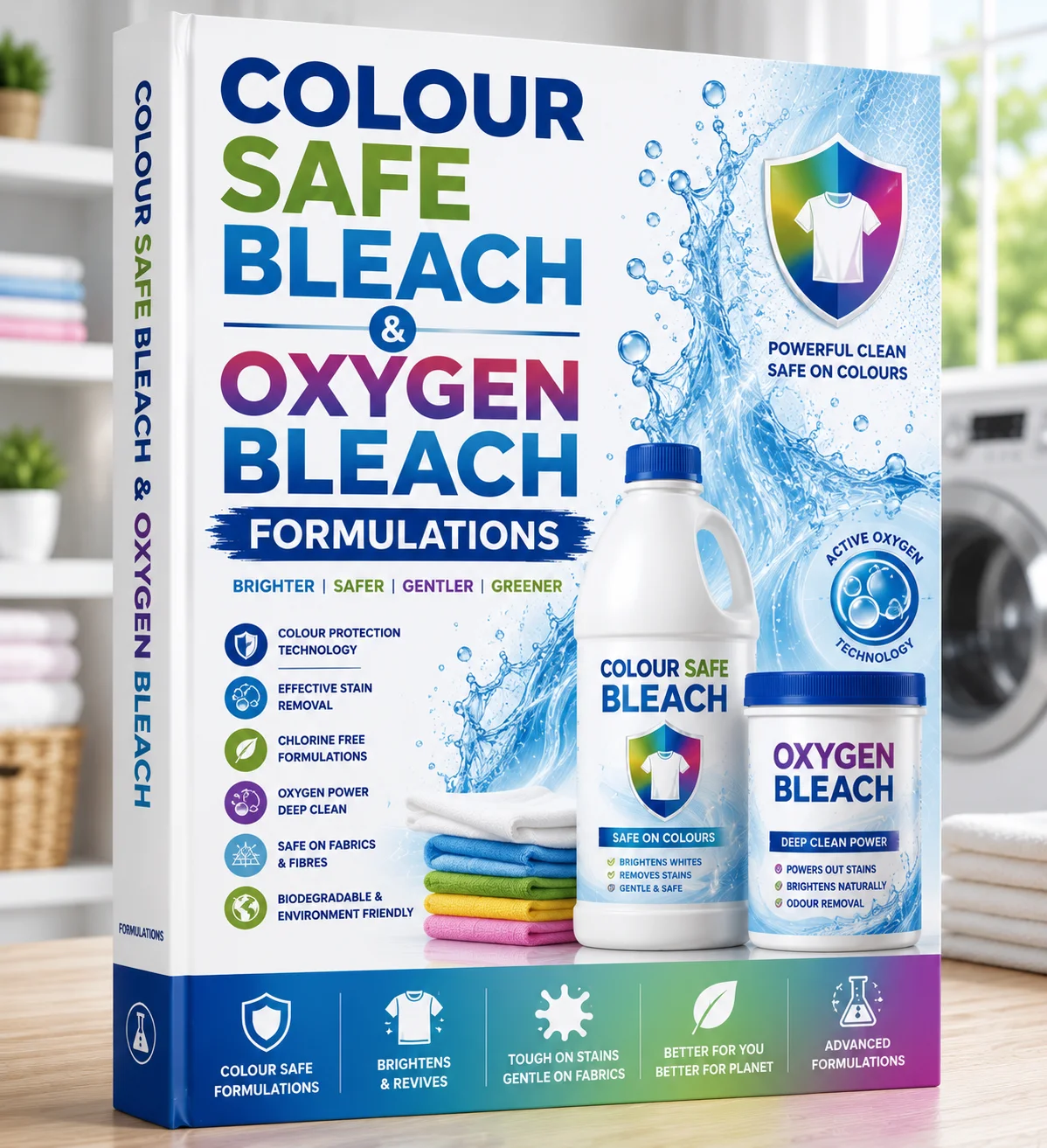
Colour-Safe Bleach & Oxygen Bleach Products — Formulation Guide is a print-grade technical reference covering 32 validated starting-point formulations across the peroxygen bleaching spectrum. Spanning economy retail powders to industrial-strength tunnel bleaches, anhydrous multi-compartment pods, and pH-neutral wool-safe liquids, this guide bridges physical chemistry, packaging safety, and commercial manufacturing requirements.
The technology
The guide details the thermodynamics of peroxygen chemistry: the equilibrium of hydrogen peroxide and perhydroxyl anions, the kinetics of TAED and NOBS perhydrolysis to peroxycarboxylic acids, and the role of organophosphonates in preventing transition-metal catalyzed decomposition. Thickener stability in oxidising environments, anhydrous liquid/powder encapsulation in PVOH film, effervescent tableting disintegrants, and steel corrosion inhibition with silicates are treated from first principles.
Inside the formulations
All 32 formulations are structured across Economy, Mid-range, Premium, and Specialty tiers in 8 sub-categories. Each includes a phase-structured component table with systematic INCI/IUPAC ingredient names, % w/w as supplied, manufacturing methods, QC targets with cited test methods (ASTM, ISO, BIS), stability notes, variants, and detailed scientific bases.
What you get
- 32 starting-point formulations across 8 peroxygen bleach sub-categories
- In-wash powder boosters, stabilized liquid bleaches, tablets, pods, and vertical gels
- pH-neutral wool and silk safe formulas with fiber-protecting silk amino acids
- Stabilization guides preventing Fenton reaction decomposition and gel viscosity loss
- Detailed manufacturing SOPs, batch record templates, and scale-up safety checklists
- Master raw materials reference and 20-entry troubleshooting failure mode tables
Technical details
- Format
- A4 PDF · instant digital download
- Extent
- ~130 pages · 32 formulations · 8 sub-categories
- Actives Covered
- Sodium Percarbonate · Hydrogen Peroxide · TAED · NOBS · HEDP · GLDA · PVP
- Standards
- BIS IS 4955/8617 · ASTM E70/D2196/D502/D4265 · OECD 301B · GHS · REACH
- Tiers
- Economy · Mid-range · Premium · Specialty
- Audience
- Detergent manufacturers · commercial laundry operators · R&D chemists · entrepreneurs
- Series
- Household & Industrial Cleaners Series · Volume 1 · Book 1.05
Oxygen-active bleaching chemistry demands precise pH control and stabilizer systems — get 32 validated starting formulations from color-safe laundry boosters to clinging bathroom peroxide gels, ready to pilot-test and manufacture.
Who is this book for?
Detergent & Bleach Manufacturer
You manufacture laundry care products and need chemically stable, print-grade starting formulations for powder and liquid color-safe oxygen bleaches.
Commercial Laundry Provider
You supply hotels, hospitals, and commercial laundries and need high-active oxygen bleach powders and liquids optimized for tunnel washer systems.
Formulation Chemist
You work in R&D and need technical reference formulations across stabilized liquids, single-dose pods/tablets, and wool-safe neutral-pH bleaches.
Table of Contents
- Inorganic peroxygen chemistry: sodium percarbonate dissociation
- Bleach activators: hydrophilic TAED and lipophilic NOBS mechanisms
- Stabilizer systems: organophosphonates (HEDP) and radical scavengers
- Delicate protein fiber safety: neutral-pH bleaching chemistry
- Specifications and standards (BIS, ASTM, GHS, REACH)
- Oxygen Bleach Laundry Powder Boosters — F1 to F4 (Economy → Specialty with NOBS)
- Stabilized Liquid Hydrogen Peroxide Bleaches — F5 to F8 (pH 2.5–4.5, HEDP/Salicylic stabilized)
- Color-Safe Pre-Soak Sanitising & Destaining Powders — F9 to F12 (high active oxygen, PVP dye-transfer inhibitors)
- Single-Dose Oxygen Bleach Tablets & Pods — F13 to F16 (effervescent tablets, anhydrous liquid/powder PVOH pods)
- Delicate-Fabric (Wool & Silk) Safe Oxygen Bleaches — F17 to F20 (pH 5.2–6.0, mild surfactants, silk amino acids)
- Ready-to-Use (RTU) Stabilized Peroxide Trigger Sprays — F21 to F24 (direct spot treatments with DPnB/limonene)
- Industrial & Institutional (I&I) High-Active Oxygen Bleach Powders — F25 to F28 (up to 80% active percarbonate with metasilicate)
- High-Density Structured Oxygen Bleach Gels — F29 to F32 (clinging polyacrylate-thickened peroxide gels)
- Mixing vessel materials of construction (SS316L passivation)
- SOP for thickener hydration, stabilizer dosing, and peroxide charging
- Batch record template
- Scale-up safety notes: exothermic decomposition risks and raw water purity
- 25 raw materials — INCI/IUPAC names, CAS numbers, functions, and sourcing tiers
- Supplier substitution guide: activators, surfactants, and phosphonates
- Cost-tier guide and BoM cost-reduction paths
- Fenton reaction transition metal catalytic decomposition prevention
- Viscosity loss in polyacrylate gels due to free-radical degradation
- Moisture caking prevention in percarbonate powders
- Stability failure reference table
See what's inside
Frequently asked questions
They are validated starting points. You will need to bench-test and adapt treat rates to your specific raw material lots, but you start from a working formulation — not a blank sheet.
The handbook is a PDF — high-resolution A4, printable, with bookmarks and a linked table of contents. You receive an instant download link and it is also available in your library indefinitely.
Up to 5 downloads are included with your purchase. If you need more, contact us and we will reset your download limit.
Yes. The handbook opens with a fundamentals section that explains the underlying chemistry and ingredient functions before presenting formulations — so beginners can follow the rationale, not just the recipe.
HEDP (1-Hydroxyethylidene-1,1-Diphosphonic Acid) coordinates trace transition metal ions (like Fe³⁺ and Cu²⁺) that act as catalysts for peroxide decomposition. By binding these metals, it prevents shelf-life degradation and pinhole damage on fabrics.
Under typical cold water conditions, hydrogen peroxide reacts too slowly. We incorporate bleach activators like TAED (hydrophilic) or NOBS (lipophilic) which undergo perhydrolysis in alkaline wash baths to generate highly active peroxycarboxylic acids in situ.
Standard oxygen bleaches operate at high pH (>10) which degrades protein-based wool and silk. Sub-category 5 (F17–F20) provides pH-neutral to slightly acidic formulations (pH 5.2–6.0) utilizing mild surfactants and conditioning silk amino acids to ensure fiber safety.