Automatic Transmission Fluids — ATF, CVT & DCT Formulation Handbook (Volume 2)
About this book
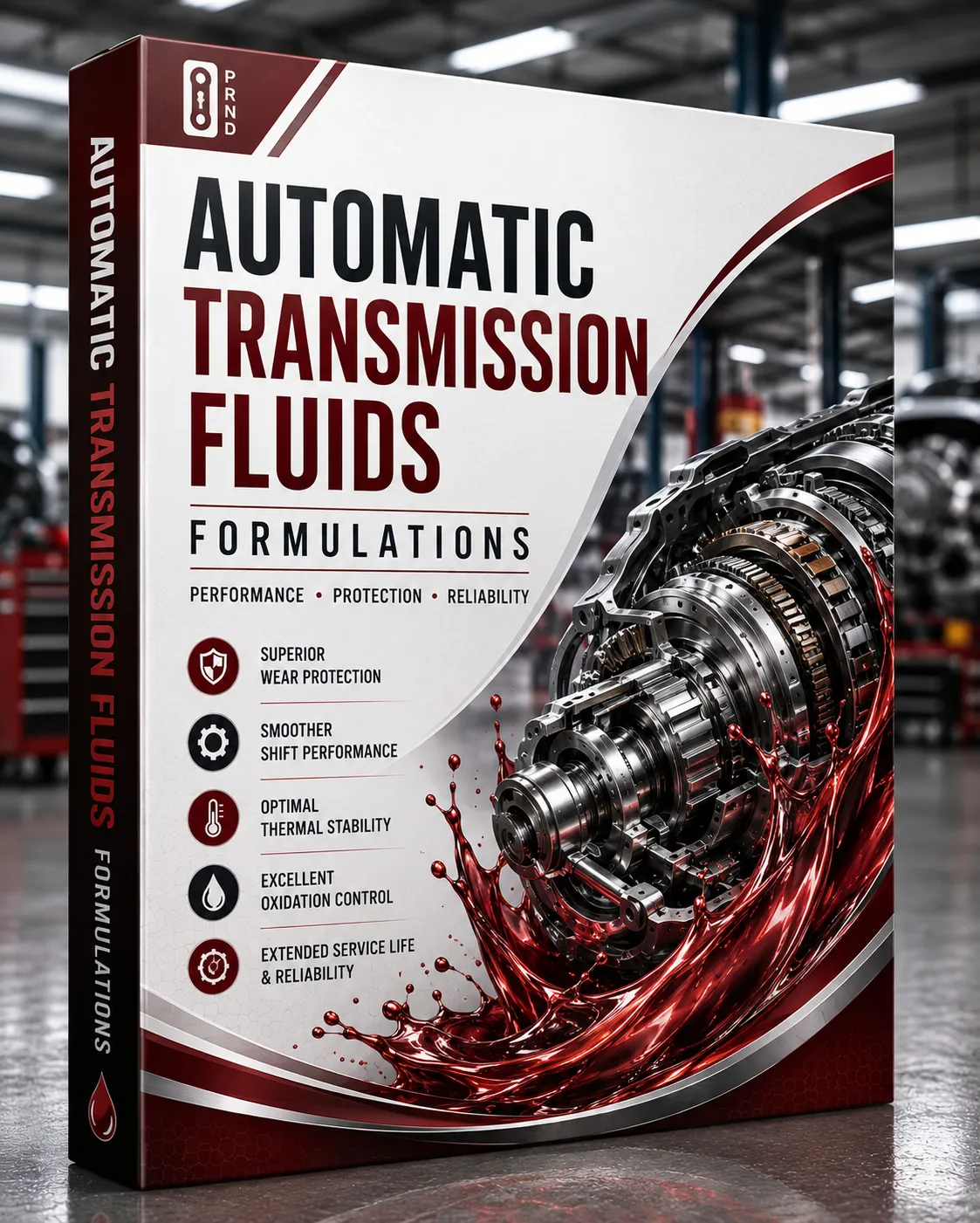
Automatic Transmission Fluids — ATF, CVT & DCT Formulation Handbook (Volume 2) is a comprehensive technical formulations reference for all modern hydraulic and mechatronic driveline fluid types. With 40 validated starting-point formulations across Economy, Mid-range, Premium, and Specialty tiers, it provides lubricant blenders, R&D chemists, and brand owners with the chemical foundation to manufacture transmission fluids that meet current OEM specifications and performance benchmarks.
The technology
The handbook covers transmission fluid chemistry from first principles: friction modifier µ-v slope engineering; TorqTransfer and JASO M315 clutch-friction test interpretation; shear-stability indices for VII (KRL, CEC L-45); thermal-oxidative stability testing (ISOT, CEC L-48); seal swell agent selection (aromatic esters, naphthenic blocks); Brookfield MRV TP-1 low-temperature viscosity limits; and Group II through Group IV PAO base oil selection. OEM specification coverage includes Dexron VI, Mercon V/LV, Allison TES-295, ZF TE-ML 14, and JATCO J-CVTF.
Inside the formulations
All 40 formulations are structured across Economy (mineral), Mid-range (semi-synthetic), Premium (full-synthetic Group III), and Specialty (PAO) tiers. Each formulation provides a 200 kg pilot batch component table (% w/w and sourcing tier), viscosity grade targets (SAE J306 or OEM-defined), target physical and chemical specifications, step-by-step blending SOPs, QC release targets referenced to ASTM methods, and the scientific basis for friction and viscometric performance.
What you get
- 40 starting-point transmission fluid formulations across ATF, CVT, and DCT categories
- Dexron VI, Mercon LV, Allison TES-295, ZF TE-ML 14, and JATCO J-CVTF specification coverage
- Detailed component tables with % w/w, friction modifier treat rates, and sourcing tiers
- µ-v curve engineering principles and anti-shudder friction modifier selection guide
- Low-temperature viscometry guide: Brookfield MRV TP-1 and D5133 requirements
- Shear stability specification guide: KRL test, CEC L-45, and viscosity grade retention
- Seal compatibility and swell agent selection for FKM, HNBR, and AO elastomers
- Blending SOPs, QC targets, and failure-mode troubleshooting (shudder, foam, sludge)
Technical details
- Format
- A4 PDF · instant digital download
- Extent
- ~165 pages · 40 formulations · ATF, CVT & DCT categories
- Grades
- ATF (Dexron VI, Mercon LV) · CVT · DCT · Allison TES-295
- Standards
- GM Dexron VI · Ford Mercon V/LV · Allison TES-295 · ZF TE-ML 14 · JATCO J-CVTF · JASO M315 · ASTM
- Tiers
- Economy (mineral) · Mid-range (semi-synthetic) · Premium (Group III) · Specialty (PAO)
- Audience
- Lubricant blenders · R&D chemists · automotive fluids brand owners · transmission specialists
- Series
- Lubricants & Automotive Fluids Series · Volume 2
Formulate ATF, CVT, and DCT fluids that meet Dexron VI, Mercon LV, and Allison TES-295 specifications — with 40 validated starting-point formulations covering every OEM tier from economy mineral to full PAO synthetic.
Who is this book for?
Lubricant Blender / Formulator
You manufacture or develop transmission fluids and need validated starting formulations with precise friction-modifier levels, viscometrics, and OEM approval targets for ATF, CVT, and DCT applications.
Automotive Fluids Brand Owner
You want to launch a complete transmission fluid product line — OEM-equivalent, licensed, or performance-tier — backed by spec-compliant formulations and clear tiering from economy to synthetic.
R&D Chemist
You work in driveline lubricant development and need a technical chemical reference covering friction modifier selection, µ-v curve engineering, seal swell chemistry, and shear-stability requirements for modern transmission systems.
Table of Contents
- Torque converter and planetary gear-set tribology: lock-up clutch friction requirements
- Friction modifier chemistry: long-chain fatty acid amides, GMO, Mo-DTC, and their µ-v slope effect
- Shudder mechanism and prevention: stick-slip dynamics and µ-v negative slope elimination
- Viscosity and low-temperature requirements: Brookfield MRV TP-1 and ASTM D5133 cranking
- Seal swell chemistry: elastomer compatibility — FKM, HNBR, AO — with ester and naphthenic-based swell agents
- Economy ATF Type A / Dexron II-equivalent (Group I/II mineral base)
- Mid-range ATF Dexron III-equivalent (Group II semi-synthetic)
- Premium Dexron VI-compliant multi-vehicle ATF (Group III synthetic)
- Specialty full-synthetic Dexron VI/Mercon LV PAO ATF for performance applications
- Heavy-duty Allison TES-295 off-road and bus ATF formulations
- Economy mineral CVT fluid (pushbelt and chain CVT compatible)
- Mid-range semi-synthetic CVT fluid (Group II/III)
- Premium fully-synthetic CVT fluid (Group III/IV)
- NS-3/NS-2 equivalent CVT fluid formulations
- Wet-clutch DCT fluid (Ford FG-1, Getrag G-DFT, Volkswagen TL 521 82 3)
- Dry-clutch DCT gear oil distinction and boundary lubrication considerations
- Premium synthetic DCT fluid for high-torque performance applications
- Agitation speed, heat requirements, and nitrogen blanketing for additive sensitivity
- Pilot blend verification: Brookfield, viscosity, foaming (D892), and µ-v bench test
- Failure-mode analysis: shudder, foam, oxidation sludge, and seal leakage troubleshooting
See what's inside
Frequently asked questions
They are validated starting points. You will need to bench-test and adapt treat rates to your specific raw material lots, but you start from a working formulation — not a blank sheet.
The handbook is a PDF — high-resolution A4, printable, with bookmarks and a linked table of contents. You receive an instant download link and it is also available in your library indefinitely.
Up to 5 downloads are included with your purchase. If you need more, contact us and we will reset your download limit.
Yes. The handbook opens with a fundamentals section that explains the underlying chemistry and ingredient functions before presenting formulations — so beginners can follow the rationale, not just the recipe.
The µ-v curve (friction coefficient vs. sliding speed) must have a positive slope in lock-up clutch conditions. If friction coefficient falls as sliding speed increases (negative slope), the clutch exhibits stick-slip oscillations — experienced as converter shudder. ATF formulation uses long-chain friction modifiers (fatty acid amides, GMO) at precisely controlled treat rates to maintain a positive µ-v slope across the operating temperature range.
Dexron VI introduced a significantly lower low-temperature viscosity limit (Brookfield MRV TP-1 at -40°C), requiring full-synthetic Group III or IV base stocks. It also mandated 150,000-cycle shear stability (KRL tapered-roller test) and tighter oxidation limits (ISOT at 175°C). Earlier Dexron II/III could use Group I/II mineral oils.
CVT fluids for pushbelt and chain continuously variable transmissions require excellent film strength at high contact pressures (up to 600 MPa in pushbelts). Group III base oils are the mainstream choice; Group IV PAO provides superior low-temperature properties and oxidation resistance for extended-drain applications. Naphthenic base oils are sometimes blended for their natural solvency and seal compatibility.
Some multi-vehicle transmission fluids claim universal coverage, but true performance optimisation requires separate formulations. ATF prioritises converter lock-up friction stability; CVT fluids must maintain high traction and film strength for steel pushbelt contact; DCT fluids must cope with wet-clutch thermal loads and precise gear-shift feel. The handbook addresses each system separately with cross-compatibility notes.