Electrical Insulating & Transformer Oils — Formulation Handbook (Volume 3)
About this book
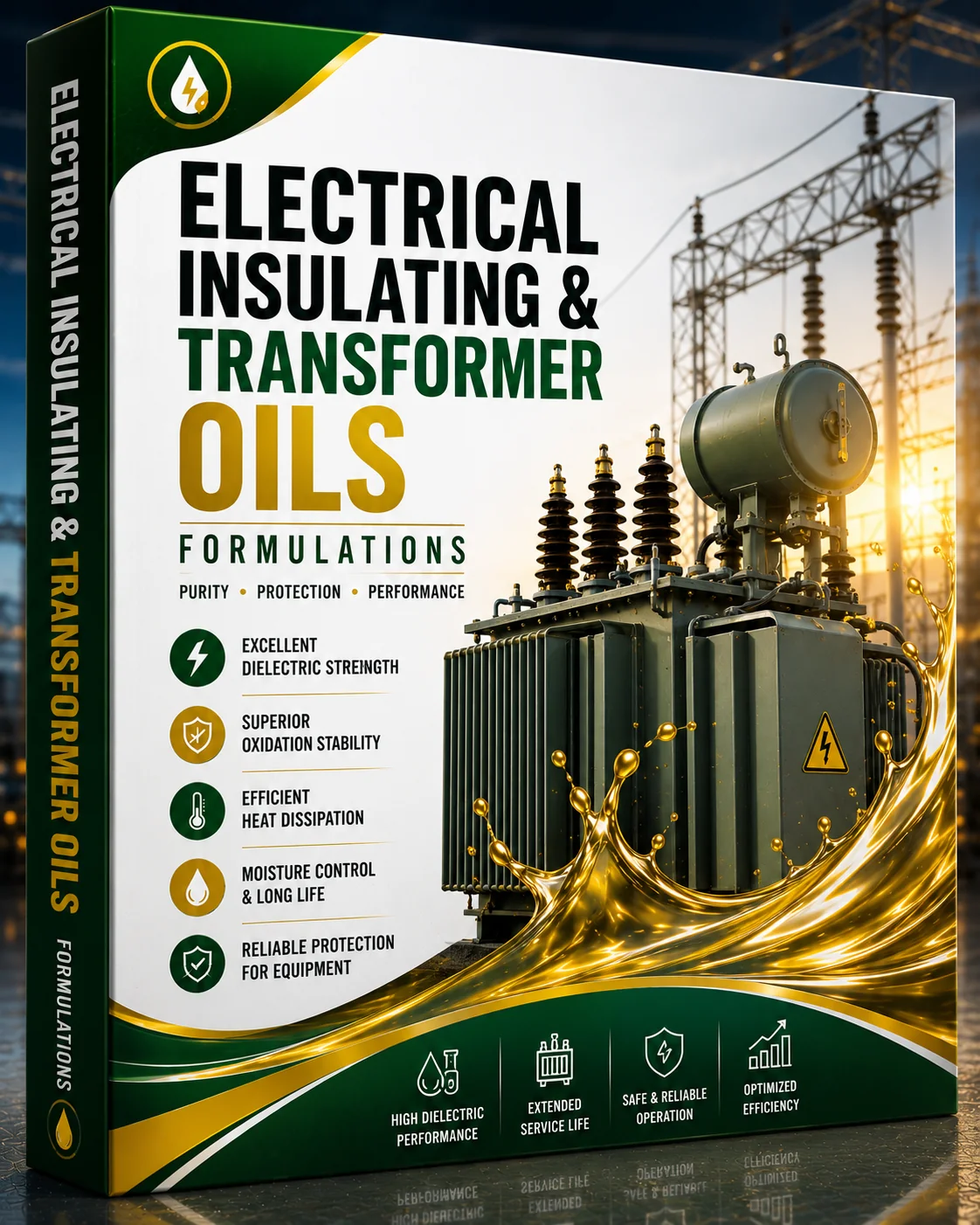
Electrical Insulating & Transformer Oils — Formulation Handbook (Volume 3) is a comprehensive technical formulations reference covering 48 starting-point formulations across 12 sub-categories, spanning naphthenic and paraffinic transformer oils, natural and synthetic ester fluids, silicone insulating fluids, and apparatus-specific oils for capacitors, cables, switchgear, OLTCs, and instrument transformers. It gives lubricant blenders, electrical fluids entrepreneurs, and utility test engineers the chemical foundation to manufacture dielectric fluids that meet IEC 60296, IEC 62770, IEC 61099, IEC 60836, and IS 335.
The technology
The handbook covers insulating fluid chemistry from first principles: DBPC antioxidant treat-rate design for inhibited vs. uninhibited oil classes; copper passivation chemistry using benzotriazole and tolyltriazole derivatives; corrosive sulphur failure mechanisms and copper sulphide deposition; dielectric performance drivers — breakdown voltage (BDV), dissipation factor (tan δ), and interfacial tension (IFT); gassing tendency under electrical and thermal stress; and base fluid selection across naphthenic mineral, paraffinic mineral, natural ester, synthetic ester, silicone (PDMS), and alkylbenzene chemistries.
Inside the formulations
All 48 formulations are structured across Economy, Mid-range, Premium, and Specialty tiers spanning the 12 sub-categories. Each formulation provides a component table (% w/w and sourcing tier), target dielectric and physical specifications (BDV, tan δ, IFT, pour point, flash point), manufacturing SOP under nitrogen blanket, and QC release targets aligned with IEC and ASTM test methods.
What you get
- 48 starting-point insulating fluid formulations across 12 sub-categories
- Naphthenic, paraffinic, natural ester, synthetic ester, silicone, and alkylbenzene coverage
- Apparatus-specific fluids: capacitor, cable, switchgear, OLTC, and instrument transformer oils
- Detailed component tables with % w/w, DBPC treat rates, and passivator dosing guidance
- Dielectric performance targets: BDV, tan δ, IFT, and gassing tendency by formulation
- Manufacturing SOPs under nitrogen blanket with moisture/oxygen exclusion protocols
- Corrosive sulphur and DGA-focused troubleshooting guide for in-service oil failures
Technical details
- Format
- A4 PDF · instant digital download
- Extent
- ~180 pages · 48 formulations · 12 categories
- Fluid types
- Naphthenic · Paraffinic · Natural ester · Synthetic ester · Silicone · Alkylbenzene
- Standards
- IEC 60296 · IEC 62770 · IEC 61099 · IEC 60836 · IS 335 · ASTM D1275
- Tiers
- Economy (naphthenic) · Mid-range (inhibited/paraffinic) · Premium (ester) · Specialty (silicone/apparatus-specific)
- Audience
- Lubricant blenders · electrical fluids entrepreneurs · utility test engineers · OEM approvers
- Series
- Lubricants & Automotive Fluids Series · Volume 3
Formulate the full range of electrical insulating fluids — naphthenic and paraffinic transformer oils, natural and synthetic esters, silicone fluids, and switchgear oils — with 48 validated starting-point formulations mapped to IEC 60296, IEC 62770, and IS 335.
Who is this book for?
Transformer Oil Blender
You manufacture or contract-blend insulating fluids and need validated starting formulations across naphthenic, paraffinic, ester, and silicone chemistries with correct DBPC antioxidant treat rates and copper-passivator dosing.
Electrical Fluids Entrepreneur
You want to enter the transformer, capacitor, and switchgear fluids market with a technically defensible product range backed by IEC/IS-aligned formulations and clear tiering from Class I mineral oils to fire-safe ester fluids.
Utility / OEM Test Engineer
You specify or approve insulating fluids for transformers, capacitors, and OLTCs and need a deep reference on BDV, tan δ, gassing tendency, and corrosive-sulphur failure mechanisms to evaluate supplier oils.
Table of Contents
- Naphthenic vs. paraffinic base stock chemistry: pour point, gassing tendency, and oxidation stability trade-offs
- Dielectric performance: breakdown voltage (BDV), dissipation factor (tan δ), and interfacial tension (IFT)
- Corrosive sulphur mechanisms: copper sulphide deposition and passivator (benzotriazole/tolyltriazole) chemistry
- Antioxidant systems: DBPC (2,6-di-tert-butyl-para-cresol) treat rates for inhibited vs. uninhibited classes
- Dissolved gas analysis (DGA) fundamentals and how formulation choices affect gassing under electrical/thermal stress
- Uninhibited naphthenic transformer oils (IEC 60296 Class I/II)
- Inhibited naphthenic transformer oils with DBPC antioxidant (Class III/IV)
- Inhibited paraffinic transformer oils for cold-climate markets (IS 335 / IEC 60296)
- Alkylbenzene insulating fluids for low-temperature and gas-blended applications (IEC 60867)
- Natural ester transformer fluids: seed-oil based, fire point ≥ 300°C (IEC 62770, K-class)
- Synthetic ester insulating fluids: pentaerythritol tetraester chemistry (IEC 61099)
- Silicone insulating fluids: polydimethylsiloxane (PDMS) formulations for fire-hazard installations (IEC 60836)
- Biodegradability, fire-point, and moisture-tolerance trade-offs across ester and silicone systems
- Capacitor impregnation oils: low-loss, high-purity formulations
- Cable impregnation oils for paper-insulated and mass-impregnated cable systems
- Switchgear and circuit breaker oils: arc-quenching and dielectric recovery requirements
- Dedicated on-load tap-changer (OLTC) oils: oxidation resistance under repeated arcing
- Instrument transformer oils for CVTs: ultra-low tan δ formulations
- Manufacturing SOPs under nitrogen blanket: moisture and oxygen exclusion protocols
- Filtration, degassing, and drying sequences for dielectric fluid production
- QC testing: BDV, tan δ, IFT, water content (Karl Fischer), and corrosive sulphur (ASTM D1275)
- Dissolved gas analysis (DGA) diagnostics and troubleshooting guide for in-service transformer oil failures
See what's inside
Frequently asked questions
They are validated starting points. You will need to bench-test and adapt treat rates to your specific raw material lots, but you start from a working formulation — not a blank sheet.
The handbook is a PDF — high-resolution A4, printable, with bookmarks and a linked table of contents. You receive an instant download link and it is also available in your library indefinitely.
Up to 5 downloads are included with your purchase. If you need more, contact us and we will reset your download limit.
Yes. The handbook opens with a fundamentals section that explains the underlying chemistry and ingredient functions before presenting formulations — so beginners can follow the rationale, not just the recipe.
Naphthenic oils have inherently better low-temperature fluidity and higher gas absorption capacity (useful in sealed transformers), making them the global default. Paraffinic oils offer superior oxidation stability and are preferred in some markets (like India, under IS 335) provided pour point depressants are used to manage cold-climate performance. The handbook covers formulation tiers for both base stock families.
Ester fluids have fire points above 300°C — more than double that of mineral oil — making them the preferred insulating fluid for indoor, underground, and fire-sensitive substations. Natural esters (seed-oil based) are readily biodegradable; synthetic esters (pentaerythritol tetraesters) offer better oxidation and hydrolytic stability. The handbook provides formulations for both, aligned to IEC 62770.
Certain sulphur compounds naturally present in some crude-derived base oils react with copper windings to form copper sulphide deposits on paper insulation, which can lead to dielectric breakdown. The handbook specifies passivator chemistry (benzotriazole and tolyltriazole derivatives) and ASTM D1275 corrosive sulphur test targets for every formulation to prevent this failure mode.
Yes. Part 5 explains how different fault types (partial discharge, thermal faults, arcing) generate characteristic gas signatures, and how base oil and additive selection influence baseline gassing tendency — essential background for anyone specifying oils that will be monitored via DGA in service.