Compressor Oils — Reciprocating, Rotary Screw & Centrifugal Formulation Handbook (Volume 3)
About this book
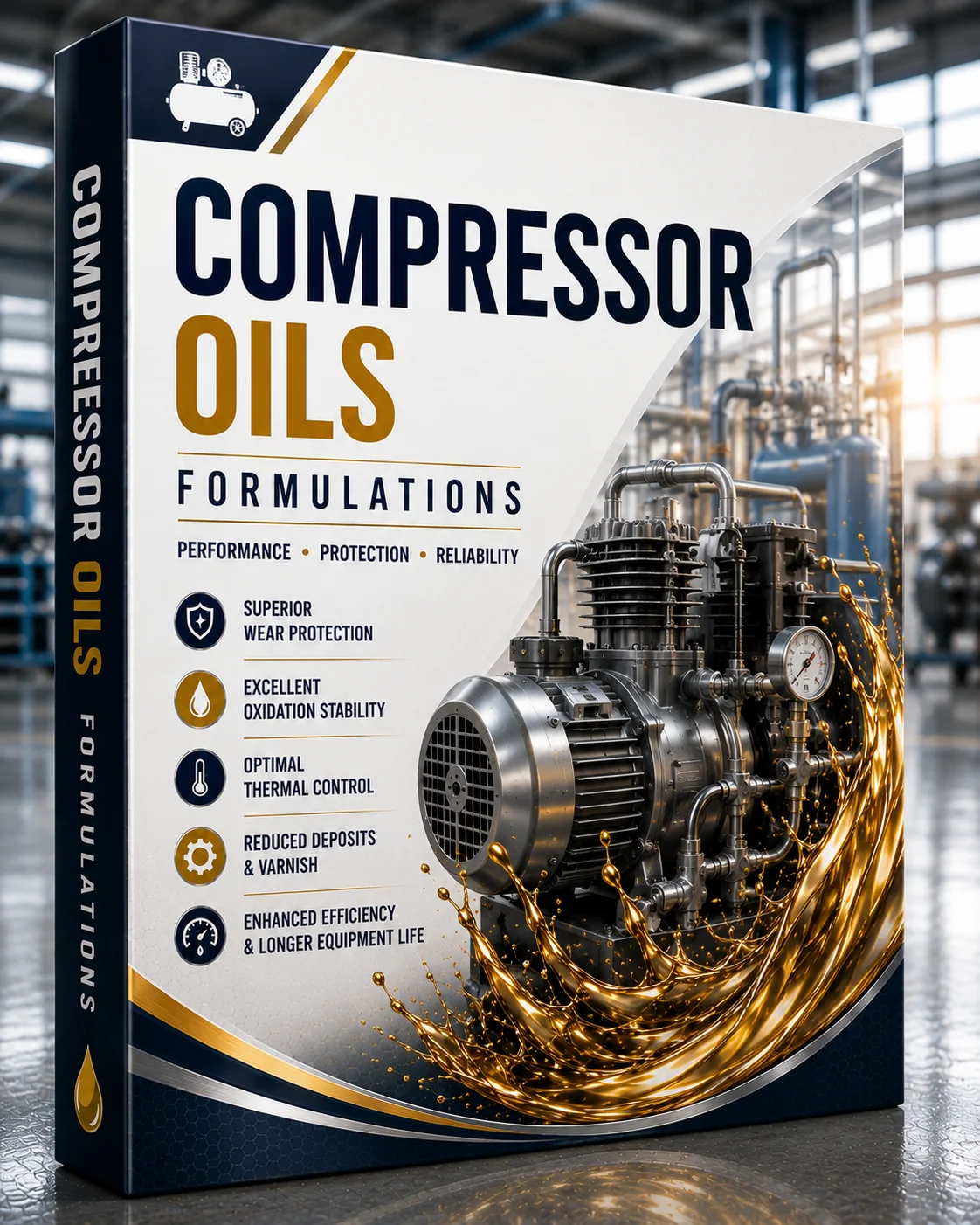
Compressor Oils — Reciprocating, Rotary Screw & Centrifugal Formulation Handbook (Volume 3) is a comprehensive technical formulations reference covering lubricants for the full range of industrial and refrigeration compressor types. With 46 validated starting-point formulations across 14 sub-categories and four performance tiers (Economy, Mid-range, Premium, Specialty), it gives lubricant blenders, formulators, and industrial engineers the chemical foundation to manufacture high-quality compressor oils that meet ISO 6743-3, refrigerant compatibility standards, and OEM specifications.
The technology
The handbook covers compressor lubricant chemistry from first principles: oxidation inhibitor mechanisms (hindered phenolic, diarylamine, phosphite synergies); antiwear film formation under mixed-lubrication boundary conditions; carbon deposit control via low-carbon-residue base oil selection; refrigerant-oil miscibility thermodynamics (POE/PAG/PVE with HFC, HFO, NH3, and CO2); and base oil selection across Group I mineral, Group II/III hydrotreated mineral, Group IV PAO, and Group V synthetic ester and PAG. Regulation coverage includes NSF H1 food-grade requirements and REACH/SDS compliance for process gas service.
Inside the formulations
All 46 formulations (F1–F46) are structured across Economy (mineral), Mid-range (Group II/III), Premium (PAO), and Specialty (ester/PAG) tiers. Each formulation provides a 200 kg pilot batch component table (% w/w and sourcing tier), ISO VG viscosity grade, target physical and chemical specifications, step-by-step blending sequence SOPs, QC release targets aligned with ASTM and ISO methods, and the scientific basis for additive selection and performance balance.
What you get
- 46 starting-point compressor oil formulations across 14 sub-categories
- Reciprocating, rotary screw, rotary vane, centrifugal, and refrigeration compressor coverage
- Refrigeration lubricants: POE (HFC/HFO), PAG (R-134a automotive), white oil (NH3), and CO2 transcritical POE
- Detailed component tables with % w/w, antioxidant treat rates, and sourcing tier guidance
- ISO VG grade selection matrix by compressor type, pressure ratio, and discharge temperature
- NSF H1 food-grade rotary screw oil formulation tier for food and pharmaceutical applications
- Manufacturing SOPs for ester, PAG, and PAO systems including contamination pre-checks
- Failure-mode troubleshooting tables: viscosity dilution, carbon deposits, foaming, and ester hydrolysis
Technical details
- Format
- A4 PDF · instant digital download
- Extent
- ~180 pages · 46 formulations · 14 categories
- Grades
- ISO VG 32, 46, 68, 100, 150 · Refrigeration (POE/PAG/PVE/mineral white oil)
- Standards
- ISO 6743-3 · DIN 51506 · NSF H1 · ASTM D2272, D943, D2533 · REACH/GHS
- Tiers
- Economy (mineral) · Mid-range (Group II/III) · Premium (PAO) · Specialty (POE/PAG)
- Audience
- Lubricant blenders · industrial engineers · maintenance managers · refrigeration specialists
- Series
- Lubricants & Automotive Fluids Series · Volume 3
Formulate compressor oils for every compressor type — reciprocating, rotary screw, centrifugal, and refrigeration — with 46 validated starting-point formulations covering mineral, synthetic ester, and PAG base stocks ready to manufacture today.
Who is this book for?
Industrial Lubricant Blender
You manufacture or supply compressor oils and need validated starting formulations across reciprocating, rotary screw, centrifugal, and refrigeration categories with correct viscosity grades, oxidation inhibitor treat rates, and anti-wear additive levels.
Lubricant Brand Entrepreneur
You want to enter the high-margin industrial lubricants market with a complete compressor oil product range backed by solid, technically defensible formulations covering air, gas, and refrigeration service.
Maintenance Engineer / Technical Manager
You manage compressor maintenance programmes and need deep technical understanding of lubricant degradation — carbon deposit formation, acid build-up, refrigerant miscibility, and viscosity dilution — to specify and monitor the right oil for each machine.
Table of Contents
- Compressor classification: dynamic (centrifugal, axial) vs. positive displacement (reciprocating, rotary screw, rotary vane)
- Thermal and oxidative stress: auto-ignition risks, carbon deposit formation mechanisms, and Conradson carbon residue
- Viscosity selection: ISO VG 32, 46, 68, 100, 150 and duty-cycle considerations
- Additive package design: antioxidants, antiwear, rust inhibitors, antifoam, and detergent-free formulation philosophy
- Refrigerant-oil miscibility: thermodynamic interactions of POE, PAG, PVE with HFC, HFO, NH3, and CO2 refrigerants
- Economy ISO VG 100 mineral oils (Group I/II) for single-stage piston compressors
- Mid-range ISO VG 100/150 Group II mineral oils with enhanced oxidation inhibition
- Premium synthetic ISO VG 68/100 diester/polyol ester compressor oils (Group V)
- Specialty ashless fully-synthetic oils for high-temperature, long-drain-interval applications
- Economy mineral ISO VG 46/68 rotary screw oils with rust/oxidation (R&O) additive packages
- Mid-range Group II/III hydrotreated mineral rotary screw oils
- Premium PAO-based synthetic rotary screw oils (ISO VG 32/46/68)
- Specialty polyol ester (POE) based rotary screw oils for food-grade and EAL applications
- ISO VG 32 turbine-quality oils for centrifugal compressor bearings and seals
- Natural gas compressor oils: ashless anti-wear formulations with gas-solubility considerations
- Sour/process gas compressor oils: H2S resistance and corrosion inhibition
- Specialty corrosion-inhibited oils for wet gas and process gas environments
- HFC refrigerant systems (R-134a, R-410A, R-32): POE and PVE lubricant chemistry
- HFO refrigerant systems (R-1234yf, R-1234ze): low-GWP POE lubricant compatibility
- Ammonia (R-717) refrigeration: mineral and PAO white oil formulations, no ester contamination
- CO2 transcritical refrigeration (R-744): POE at high pressure, miscibility curve design
- Legacy CFC/HCFC systems (R-22, R-404A): transition blends and top-up formulations
- Blending sequences for ester, PAG, and PAO based systems; compatibility pre-checks
- Drum and IBC cleanliness protocols: ester and PAG hydrolyse in residual moisture and contamination
- Failure-mode analysis: viscosity dilution (refrigerant absorption), foaming, ester hydrolysis, valve deposits
- QC testing: ASTM D2272 RBOT, D943 TOST, D2533 refrigerant compatibility, ISO 6743-3
See what's inside
Frequently asked questions
They are validated starting points. You will need to bench-test and adapt treat rates to your specific raw material lots, but you start from a working formulation — not a blank sheet.
The handbook is a PDF — high-resolution A4, printable, with bookmarks and a linked table of contents. You receive an instant download link and it is also available in your library indefinitely.
Up to 5 downloads are included with your purchase. If you need more, contact us and we will reset your download limit.
Yes. The handbook opens with a fundamentals section that explains the underlying chemistry and ingredient functions before presenting formulations — so beginners can follow the rationale, not just the recipe.
Reciprocating compressors expose the valve plate area to both high temperature (compression heat) and oxygen. If the lubricant has insufficient oxidation inhibition or is over-applied, oil mist mixes with compressed air at high temperature, oxidising to form hard carbon deposits on valve plates and intercoolers. In severe cases, these deposits auto-ignite under the right oxygen-to-carbon ratio, causing a fire or explosion. The handbook specifies low-carbon, low-residue lubricant chemistries with controlled flash points and Conradson carbon residue limits for all reciprocating applications.
Polyol esters (POE) are miscible with most HFC and HFO refrigerants across a wide temperature range, making them the default choice for modern refrigeration systems. They are susceptible to hydrolysis if moisture enters the system. Polyalkylene glycols (PAG) are used in automotive A/C compressors (typically R-134a) where OEM specifications call for PAG 46 or PAG 100; they have very high hygroscopicity and must not be mixed with mineral oils. Ammonia systems use mineral or PAO white oils specifically because ammonia is not miscible with esters — any ester contamination causes ammonia to react and deposit.
Most single-stage rotary screw compressors operating below 90°C discharge temperature use ISO VG 46. Compressors running hotter (90–110°C) or at higher pressure ratios require ISO VG 68 or even VG 100. Two-stage screw compressors with intercooling may accept VG 32. The book provides a duty-cycle selection matrix covering pressure ratio, discharge temperature, ambient temperature range, and expected drain interval to guide grade selection.
NSF H1 registration requires that every ingredient in the lubricant is listed on the FDA 21 CFR or USDA H1 approved substance list. This excludes most conventional zinc-based antiwear (ZDDP) and many rust inhibitors. Food-grade compressor oils use white mineral oil or PAO base stocks, GRAS-listed antioxidants (e.g., tocopherols or hindered phenols), and approved corrosion inhibitors. The handbook includes an H1-compliant rotary screw oil formulation tier for bakery, food processing, and pharmaceutical applications.