Soluble & Synthetic Cutting Fluids — Formulation Handbook
About this book
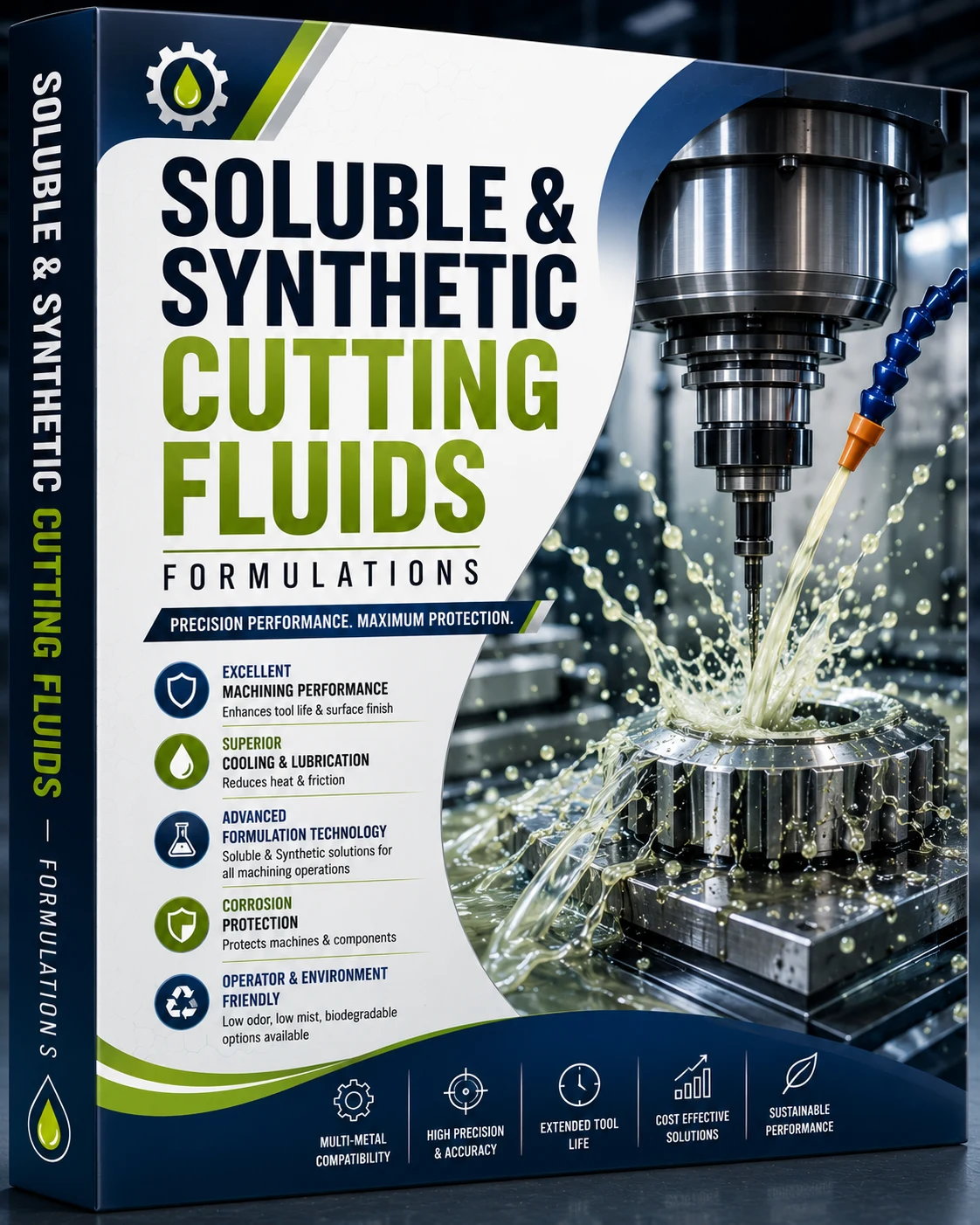
Soluble & Synthetic Cutting Fluids — Formulation Handbook is a comprehensive technical formulations reference covering 40 starting-point formulations across 10 sub-categories: conventional and heavy-duty soluble (emulsifiable) oils, low-oil and high-performance/EP semi-synthetic fluids, general-purpose and heavy-duty/EP full synthetic fluids, aluminium-safe/non-staining fluids, synthetic grinding fluids, biostable/extended-life fluids, and NSF H2 food-adjacent compliant fluids. It gives metalworking fluid blenders, coolant management specialists, and lubricant entrepreneurs the chemical foundation to manufacture water-miscible cutting and grinding fluids validated against ASTM D2881, D4627, D1479, and D3519.
The technology
The handbook covers water-miscible metalworking fluid chemistry from first principles: the emulsion-breaking cooling-lubrication mechanism that deposits a boundary oil film at the tool–chip interface while the water phase carries away bulk heat; EP/antiwear tribochemistry using sulfurised fats and olefins (with chlorinated paraffin regulatory status flagged where relevant); corrosion inhibition via alkanolamine, borate, and fatty acid soap chemistry; biostability and pH buffering across the 8.5–9.5 operating window; hard-water emulsion tolerance and sequestrant chemistry; and the full oil-content spectrum from 60–90% soluble oils through oil-free full synthetics.
Inside the formulations
All 40 formulations are structured across Economy, Mid-range, Premium, and Specialty tiers spanning the 10 sub-categories. Each formulation provides a component table (% w/w and sourcing tier) with IUPAC/CAS-identified raw materials, working dilution guidance, target emulsion/corrosion/foam performance, blending sequence, and QC release targets aligned with ASTM test methods.
What you get
- 40 starting-point cutting and grinding fluid formulations across 10 sub-categories
- Soluble oil, semi-synthetic, and full synthetic chemistry families, each fully independent
- EP-rated heavy-duty variants alongside aluminium-safe and grinding-specific fluids
- Detailed component tables with % w/w, CAS numbers, and sourcing tier guidance
- Emulsion stability, corrosion, foam, and biostability QC targets with ASTM test methods
- Manufacturing blending sequences and hard-water/regulatory substitution guidance
- Troubleshooting guide: emulsion splitting, rancidity, flash rusting, foaming, and staining
Technical details
- Format
- A4 PDF · instant digital download
- Extent
- ~65 pages · 40 formulations · 10 categories
- Fluid types
- Soluble (emulsifiable) oil · Semi-synthetic · Full synthetic · Grinding fluid
- Standards
- ASTM D2881 · D4627 · D1479 · D3519 · E2275 · EU REACH/SVHC · NSF/ANSI H2
- Tiers
- Economy (soluble oil) · Mid-range (heavy-duty/semi-synthetic) · Premium (synthetic) · Specialty (NSF H2/grinding)
- Audience
- Metalworking fluid blenders · coolant management specialists · lubricant entrepreneurs
- Series
- Lubricants & Automotive Fluids Series · Volume 4 — Metalworking Fluids
Formulate the full range of water-miscible metalworking fluids — soluble oils, semi-synthetic, and full synthetic — with 40 validated starting-point formulations covering general machining through grinding, EP-rated heavy cuts, and NSF H2 food-adjacent service.
Who is this book for?
Metalworking Fluid Blender
You manufacture or contract-blend cutting and grinding fluids and need validated starting formulations across soluble oil, semi-synthetic, and full synthetic chemistries with correct emulsifier, EP additive, and biocide treat rates.
Coolant Management Specialist
You manage sump fluids on the shop floor and need a technical reference on emulsion stability, corrosion protection, and biostability to diagnose and correct in-service fluid failures before they cause downtime.
Lubricant Brand Entrepreneur
You want to add a metalworking fluids range to your industrial lubricants portfolio, tiered from economy soluble oils to synthetic grinding and NSF H2 food-adjacent fluids, backed by ASTM-aligned formulations.
Table of Contents
- The emulsion-breaking cooling-lubrication mechanism: how oil-in-water emulsions deposit a boundary film precisely at the tool–chip interface
- The oil-content spectrum: soluble (60–90% oil), semi-synthetic (5–30% oil), and full synthetic (oil-free) fluid classes
- EP/antiwear tribochemistry: sulfurised fats and olefins, and the regulatory status of chlorinated paraffin EP additives
- Corrosion inhibition and pH buffering: alkanolamine/borate chemistry and the 8.5–9.5 working pH window
- Biostability, hard-water tolerance, and foam control across recirculating sump service life
- Conventional soluble (emulsifiable) oils for general-purpose turning, milling, and drilling
- Heavy-duty soluble oils for ferrous machining with elevated EP treat
- Semi-synthetic fluids, low oil content — translucent micro-emulsions for general shop use
- Semi-synthetic fluids, high performance/EP — for demanding ferrous cuts
- Full synthetic cutting fluids, general purpose — oil-free formulations for maximum cooling
- Full synthetic cutting fluids, heavy-duty/EP — chemical lubricity packages matching soluble-oil EP performance
- Aluminium-safe/non-staining fluids for non-ferrous and mixed-metal shops
- Synthetic grinding fluids engineered for fine filterability and clarity at high flow rates
- Biostable/extended-life fluids for long sump-life recirculating systems
- Food/medical-adjacent (NSF H2) compliant fluids and the scope of what this tier does and does not certify
- Yellow-metal and multi-metal compatibility considerations across all tiers
- Blending sequences for emulsifier packages and EP additive incorporation
- QC testing: hard-water emulsion stability (ASTM D1479), corrosion (ASTM D4627), foam (ASTM D3519), biostability challenge testing
- Troubleshooting guide: emulsion splitting, rancidity/odour, flash rusting, foaming, and staining failures
See what's inside
Frequently asked questions
They are validated starting points. You will need to bench-test and adapt treat rates to your specific raw material lots, but you start from a working formulation — not a blank sheet.
The handbook is a PDF — high-resolution A4, printable, with bookmarks and a linked table of contents. You receive an instant download link and it is also available in your library indefinitely.
Up to 5 downloads are included with your purchase. If you need more, contact us and we will reset your download limit.
Yes. The handbook opens with a fundamentals section that explains the underlying chemistry and ingredient functions before presenting formulations — so beginners can follow the rationale, not just the recipe.
It comes down to oil content in the concentrate and how each fluid lubricates. Soluble oils (60–90% mineral oil) form a milky emulsion that breaks at the hot tool–chip interface to deposit a boundary oil film. Semi-synthetics (5–30% oil) form translucent micro-emulsions that blend a reduced oil film with synthetic lubricity additives. Full synthetics contain no oil at all — they rely entirely on dissolved synthetic esters, polyglycols, and chemical EP additives for lubrication, giving the best cooling but requiring a more carefully engineered additive package. The handbook covers all three as fully separate formulation families.
Extreme-pressure (EP) additives react with the freshly cut metal surface at the high flash temperatures generated during chip formation, forming a sacrificial reaction film that reduces adhesive wear. Sulfurised fats and olefins are the primary EP chemistry used throughout this book. Chlorinated paraffins are an older EP option, but short-chain chlorinated paraffins are now restricted under EU REACH and listed as a Persistent Organic Pollutant under the Stockholm Convention — the handbook flags this regulatory status wherever relevant and provides non-chlorinated substitution routes.
Freshly machined steel flash-rusts within minutes if left unprotected. Alkanolamines, borates, and fatty acid soaps adsorb onto or passivate the exposed ferrous surface to prevent this, while the working fluid is buffered to pH 8.5–9.5 — a range that also happens to be hostile to most bacteria, supporting biostability alongside corrosion control. The handbook specifies both the inhibitor package and pH target for every formulation.
Yes, as one Specialty-tier sub-category for fluids used in food-adjacent manufacturing environments. This handbook addresses that tier’s formulation approach; full food-grade compliance across the wider range of food-contact lubricants is covered comprehensively in the companion food-grade lubricants handbook — formal NSF registration always requires certified testing regardless of formulation design.