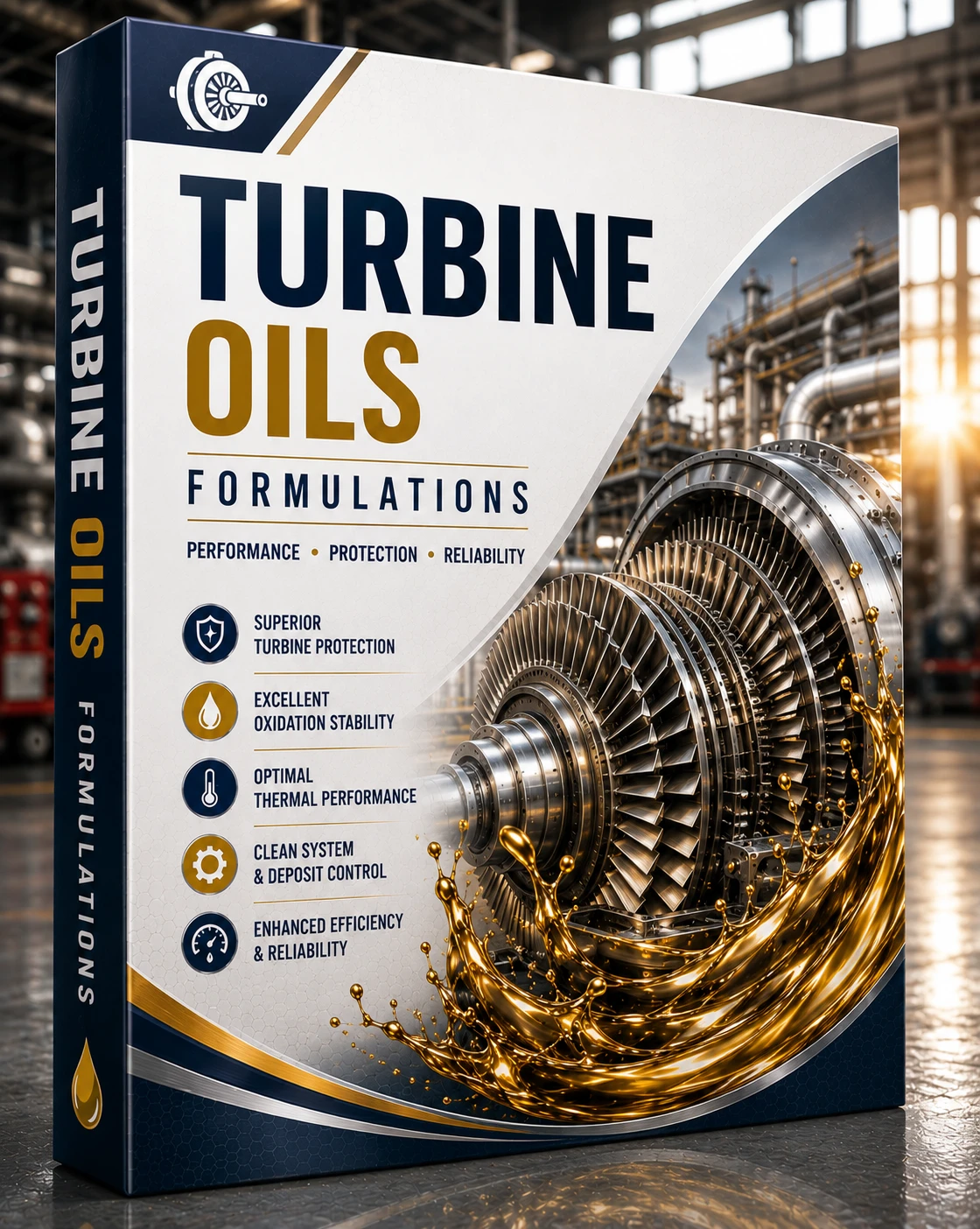
Turbine Oils — Steam & Gas Turbine Formulation Handbook (Volume 3)
About this book
Turbine Oils — Steam & Gas Turbine Formulation Handbook (Volume 3) is a comprehensive design and formulation guide covering 40 starting-point formulations across 10 sub-categories for steam, gas, wind, and hydro turbine lubricants. It gives lubricant blenders, power plant engineers, and wind O&M teams the chemical foundation to manufacture long-life turbine oils that meet GEK, Siemens, and ISO 8068 specifications.
The technology
The handbook covers turbine lubricant chemistry from first principles: hindered phenolic and aminic antioxidant synergies for extended oxidation life; demulsibility and rapid water-separation design; air-release and foam-control additive balance; varnish formation mechanisms and mitigation strategies; and base oil selection across Group I mineral, Group II/II+ hydrotreated mineral, Group III, and PAO/ester synthetic chemistries for wind gearbox and specialty applications.
Inside the formulations
All 40 formulations are structured across Economy (Group I), Mid-range (Group II), Premium (Group II+/III), and Specialty (PAO/ester/phosphate ester) tiers. Each formulation provides a component table (% w/w and sourcing tier), target ISO VG grade, physical and chemical specifications, blending sequence, and QC release targets aligned with ASTM D943, D1401, D892, and D2272 methods.
What you get
- 40 starting-point turbine oil formulations across 10 sub-categories
- Steam, gas, wind gearbox, and hydro turbine lubricant coverage
- Fire-resistant phosphate ester EHC control fluid formulations
- Detailed component tables with % w/w, antioxidant treat rates, and sourcing tier guidance
- Demulsibility, foam-control, and varnish-mitigation additive strategies
- QC targets for oxidation life (TOST), demulsibility, foam, and varnish potential
- Failure-mode troubleshooting guide: sludge, varnish, foaming, and additive depletion
Technical details
- Format
- A4 PDF · instant digital download
- Extent
- ~160 pages · 40 formulations · 10 categories
- Grades
- ISO VG 32, 46, 68, 100 · Wind gearbox VG 320/460 · Phosphate ester EHC fluids
- Standards
- GEK 28143/32568 · Siemens TLV 9013 · ISO 8068 · ASTM D943, D1401, D892, D2272
- Tiers
- Economy (Group I) · Mid-range (Group II) · Premium (Group II+/III) · Specialty (PAO/ester)
- Audience
- Lubricant blenders · power plant engineers · wind O&M teams · hydro operators
- Series
- Lubricants & Automotive Fluids Series · Volume 3
Formulate steam, gas, wind, and hydro turbine lubricants with 40 validated starting-point formulations across every base-oil tier, engineered for long service life and mapped to GEK, Siemens, and ISO 8068 specifications.
Who is this book for?
Turbine Lubricant Blender
You manufacture or contract-blend turbine oils and need validated starting formulations across steam, gas, wind, and hydro turbine categories with correct oxidation-inhibitor treat rates and demulsibility performance.
Power Plant / Wind O&M Engineer
You specify or maintain turbine lubrication systems and need a deep technical reference on oxidation life, water-separability, and varnish-formation control to evaluate and monitor in-service oils.
Lubricant Brand Entrepreneur
You want to add a turbine oil range to your industrial lubricants portfolio and need technically defensible formulations tiered from Group I mineral to PAO/ester synthetic, backed by OEM-aligned specifications.
Table of Contents
- Turbine oil duty differences: steam, gas, wind gearbox, and hydro turbine service conditions
- Oxidation stability chemistry: hindered phenolic and aminic antioxidant synergies for long-drain service
- Demulsibility and water-separability: why turbine oils must shed water rapidly (unlike engine oils)
- Air release and foam control: entrained-air risks in high-throughput turbine lubrication systems
- Varnish formation mechanisms: soft-contaminant deposition on servo valves and bearings
- Economy ISO VG 32/46 Group I turbine oils for industrial steam turbines
- Mid-range Group II turbine oils with enhanced oxidation life for combined-cycle plants
- Premium Group II+/III turbine oils for aeroderivative and heavy-duty gas turbines
- Specialty high-temperature synthetic turbine oils for peaking and cyclic-duty gas turbines
- Wind turbine gearbox oils: PAO/ester synthetic formulations for micropitting resistance (ISO VG 320/460)
- Extreme-temperature wind turbine oils for cold-climate and offshore installations
- Hydro turbine governor and bearing oils: ISO VG 32/46 formulations with strong demulsibility
- Kaplan and Francis turbine-specific lubricant considerations and seal-compatibility notes
- Fire-resistant phosphate ester turbine control fluids for high-pressure hydraulic governor systems
- EHC (electrohydraulic control) fluid formulations and varnish-mitigation additive packages
- Turbine oil flushing fluids for commissioning and system changeover
- Biodegradable ester-based turbine oils for environmentally sensitive hydro installations
- Blending sequences and antioxidant dosing control for long-life turbine oil batches
- QC testing: ASTM D943 TOST oxidation life, D1401 demulsibility, D892 foam, D2272 RPVOT
- Varnish potential testing (MPC / ASTM D7843) and mitigation additive strategies
- Failure-mode analysis: sludge and varnish deposits, foaming, and additive depletion in service
See what's inside
Frequently asked questions
They are validated starting points. You will need to bench-test and adapt treat rates to your specific raw material lots, but you start from a working formulation — not a blank sheet.
The handbook is a PDF — high-resolution A4, printable, with bookmarks and a linked table of contents. You receive an instant download link and it is also available in your library indefinitely.
Up to 5 downloads are included with your purchase. If you need more, contact us and we will reset your download limit.
Yes. The handbook opens with a fundamentals section that explains the underlying chemistry and ingredient functions before presenting formulations — so beginners can follow the rationale, not just the recipe.
Turbine lubrication systems circulate large oil volumes through bearings and governor systems where steam condensate or process water ingress is common. If the oil emulsifies water instead of shedding it, the emulsion degrades the oil film at bearings and can cause governor valves to stick. The handbook specifies demulsibility-focused additive packages (ASTM D1401 target times) for every turbine formulation.
Varnish forms when oxidation by-products and soft contaminants become insoluble as the oil ages, depositing on servo valves, bearings, and filters — a leading cause of unplanned turbine trips. The handbook covers antioxidant selection (hindered phenolic/aminic synergies), varnish-potential testing (MPC/ASTM D7843), and mitigation additive strategies to extend oil life before varnish becomes an operating risk.
Yes. Part 3 covers wind turbine gearbox oils as a distinct category, using PAO/ester synthetic base stocks selected for micropitting resistance and extreme-temperature performance (including cold-climate and offshore variants) — different requirements from the oxidation-life focus of steam and gas turbine bearing oils.
Yes, Part 4 covers phosphate ester EHC (electrohydraulic control) fluids used in high-pressure governor and control systems where fire resistance is a safety requirement, along with the varnish-mitigation additive packages specific to phosphate ester chemistry.