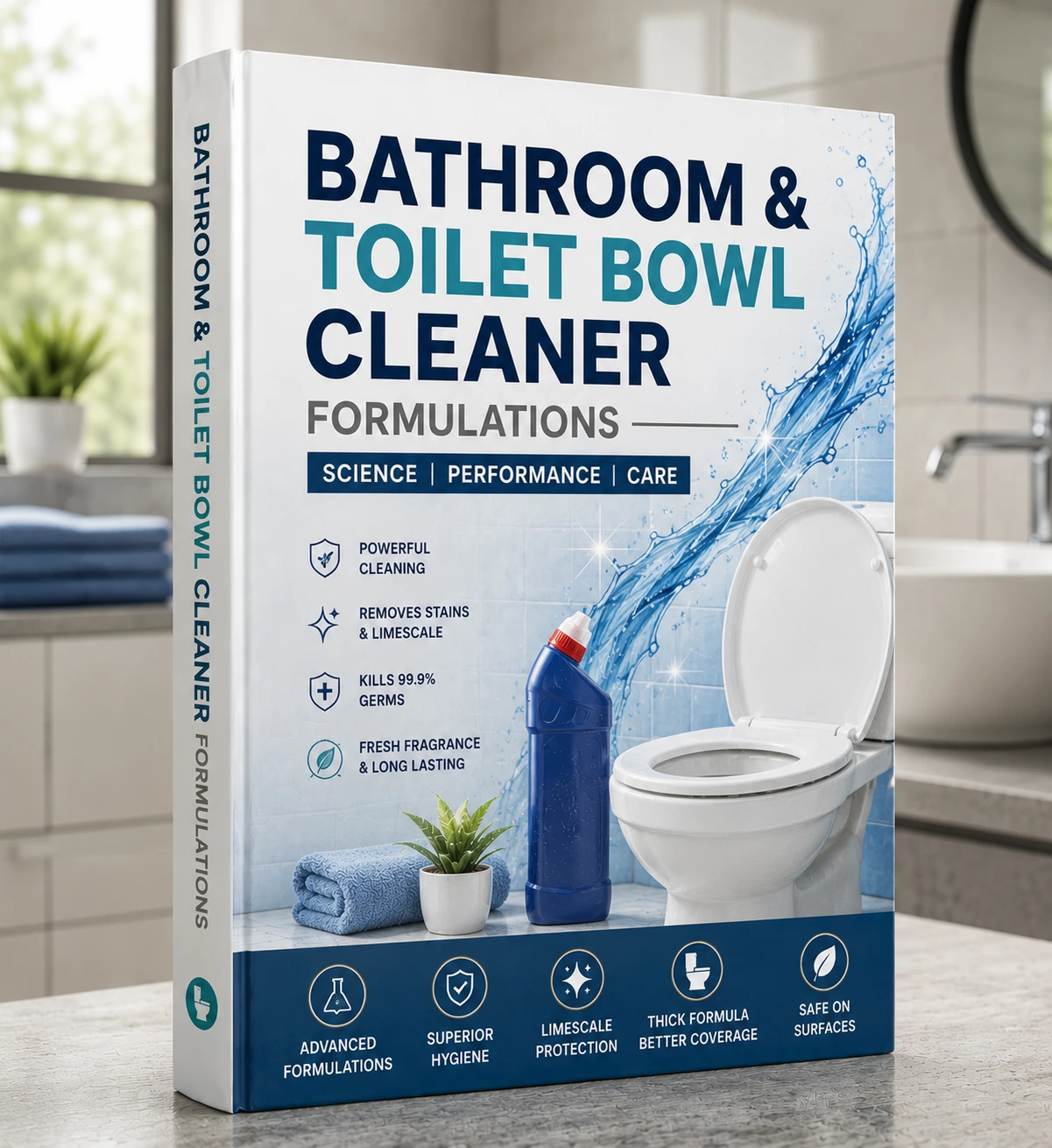
Bathroom & Toilet Bowl Cleaners — Formulation & Technology Guide
About this book
Bathroom & Toilet Bowl Cleaners — Formulation & Technology Guide is a technical reference detailing 32 formulations. Spanning high-cling acidic toilet gels, bleach-based sanitizers, self-adhesive rim discs, eco-sprays, and industrial grout restorer concentrates, it bridges physical chemistry and washroom manufacturing.
The technology
The guide develops the science of washroom hygiene: acidic dissolution of calcium and uric scale, active chlorine oxidation of biological soil, and the rheological dynamics of vertical cling. It explains viscoelastic surfactant gelling, GHS safety rules for acid-bleach separation, and the incorporation of active bacterial spores for probiotic waste digestion.
Inside the formulations
All 32 formulations are presented across Economy, Mid-range, Premium, and Specialty tiers in 8 categories. Each block details exact phase-structured compositions (% w/w), systematic IUPAC/INCI ingredient names, blending sequences, QC test targets (pH, viscosity, active matter, spore count), stability warnings, and detailed scientific bases.
What you get
- 32 starting formulations across 8 bathroom cleaner sub-categories
- Detailed component tables with IUPAC/INCI names, weight %, and functions
- QC test methods and specification targets mapped to IS 13961 and ASTM standards
- Detailed manufacturing SOPs for liquid gels, extruded blocks, and gel stamps
- Troubleshooting matrices for viscosity loss, dye oxidation, and metal etching
Technical details
- Format
- A4 PDF · instant digital download
- Extent
- ~150 pages · 32 formulations · 8 sub-categories
- Standards
- IS 13961, ASTM E70/D2196, EN 1276, EN 1650, ISO 2271
- Tiers
- Economy · Mid-range · Premium · Specialty
- Audience
- Washroom chemical manufacturers · contract packers · chemists
- Series
- Household & Industrial Cleaners Series · Volume 3 · Book 3.02
Struggling with uric scale, soap scum, or bleach stability issues? Access 32 validated starting-point formulations covering acidic, alkaline, and probiotic bathroom cleaners.
Who is this book for?
Washroom Chemical Manufacturer
You blend household or institutional washroom chemicals and need stable, highly effective descalers and disinfecting gels.
Contract Packaging Specialist
You bottle trigger sprays and toilet cleaners and need ready-to-fill formulations with certified antimicrobial efficacy.
Formulation Chemist
You need robust reference formulations for vertical cling gels, color-safe mold removers, eco-sprays, and probiotic rim blocks.
Table of Contents
- Product category overview & substrates
- Acid scale dissolution & bleach oxidation chemistry
- Viscoelastic micellar gelling & vertical cling physics
- Specifications, grade structures, and BIS IS 13961 benchmarks
- Acidic Toilet Bowl Cleaners — F1 to F4 (Economy → Specialty)
- Alkaline & Bleach-Based Toilet Gels — F5 to F8
- Ready-to-Use (RTU) Disinfectant Sprays — F9 to F12
- Soap Scum & Limescale Removers (Acidic) — F13 to F16
- Mold & Mildew Stain Cleaners (Oxidizing) — F17 to F20
- In-Tank & Rim Block Cleaners (Cistern/Rim) — F21 to F24
- Bio-Based & Eco-Friendly Bathroom Cleaners — F25 to F28
- Heavy-Duty Tile & Grout Cleaners (Concentrates) — F29 to F32
- Acid-resistant and titanium mixing vessel plant setup
- Liquid and solid block manufacturing sequences & SOPs
- Scale-up notes: viscoelastic surfactant shearing & thermal bleach control
- 21 primary ingredients with IUPAC/INCI names and CAS numbers
- Supplier substitution protocols for thickeners and scale inhibitors
- Cost-tier registration and Bill of Materials breakdown
- Diagnosing micellar gelling collapse, dye fading, and acid gas evolution
- Failure diagnostic matrices for physical and chemical separation
- Test method references (ASTM, ISO, IS, EN)
See what's inside
Frequently asked questions
They are validated starting points. You will need to bench-test and adapt treat rates to your specific raw material lots, but you start from a working formulation — not a blank sheet.
The handbook is a PDF — high-resolution A4, printable, with bookmarks and a linked table of contents. You receive an instant download link and it is also available in your library indefinitely.
Up to 5 downloads are included with your purchase. If you need more, contact us and we will reset your download limit.
Yes. The handbook opens with a fundamentals section that explains the underlying chemistry and ingredient functions before presenting formulations — so beginners can follow the rationale, not just the recipe.
Standard polymers like Xanthan Gum are rapidly decomposed by sodium hypochlorite. SLES and Lauramine Oxide form rod-like mixed micelles under high pH and salinity, creating a viscoelastic gel network that resists bleach oxidation.
Formulations utilize organic acids (lactic, citric, sulfamic) which are less corrosive than hydrochloric acid. For heavy-duty trade acids, specialized corrosion inhibitors like Propargyl Alcohol Ethoxylate are added to passivate metal fittings.
Yes. The sanitizing and disinfecting sprays are formulated with quat actives (DDAC/BAC) or organic acids to pass EN 1276 and EN 1650 standards under dirty conditions.