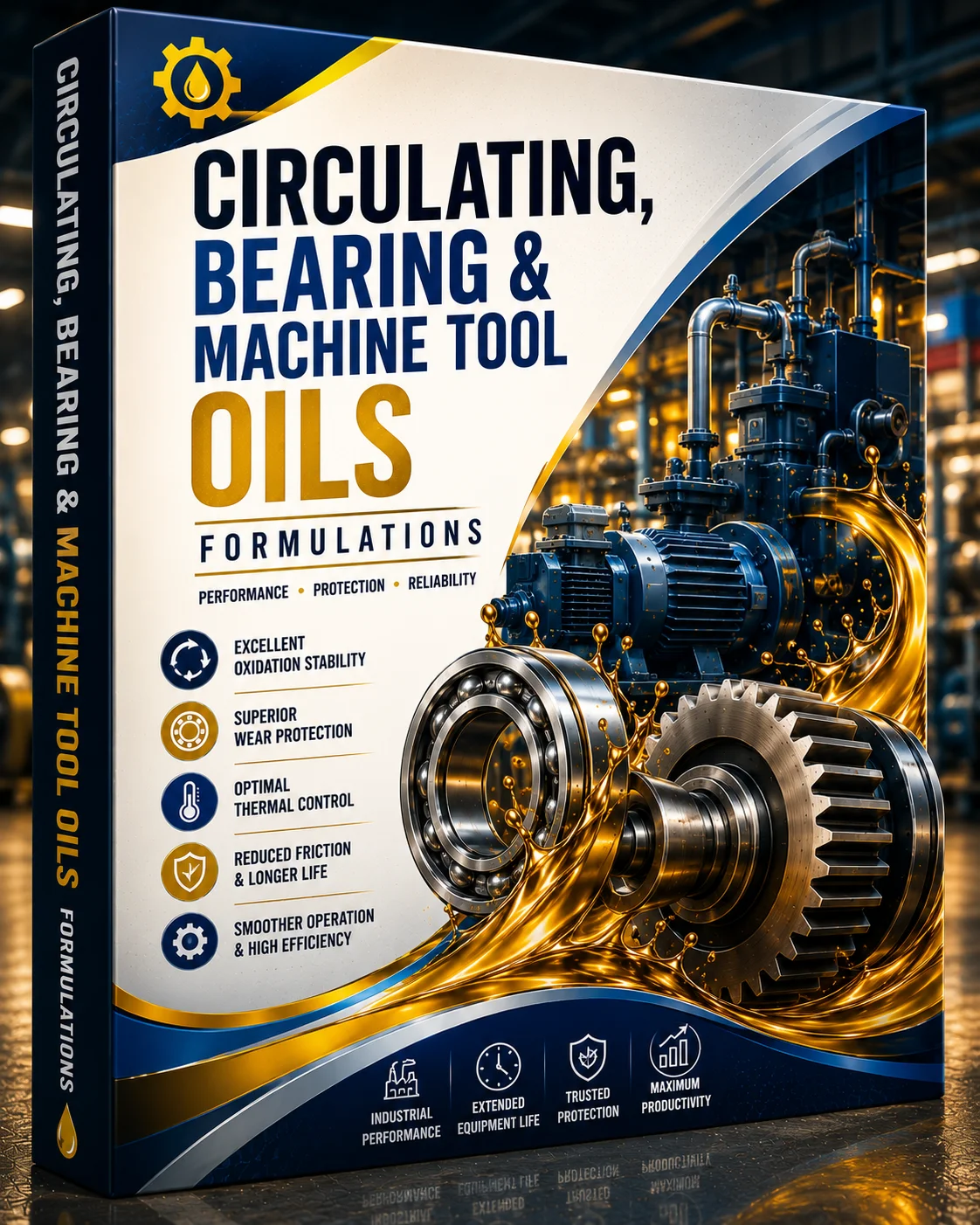
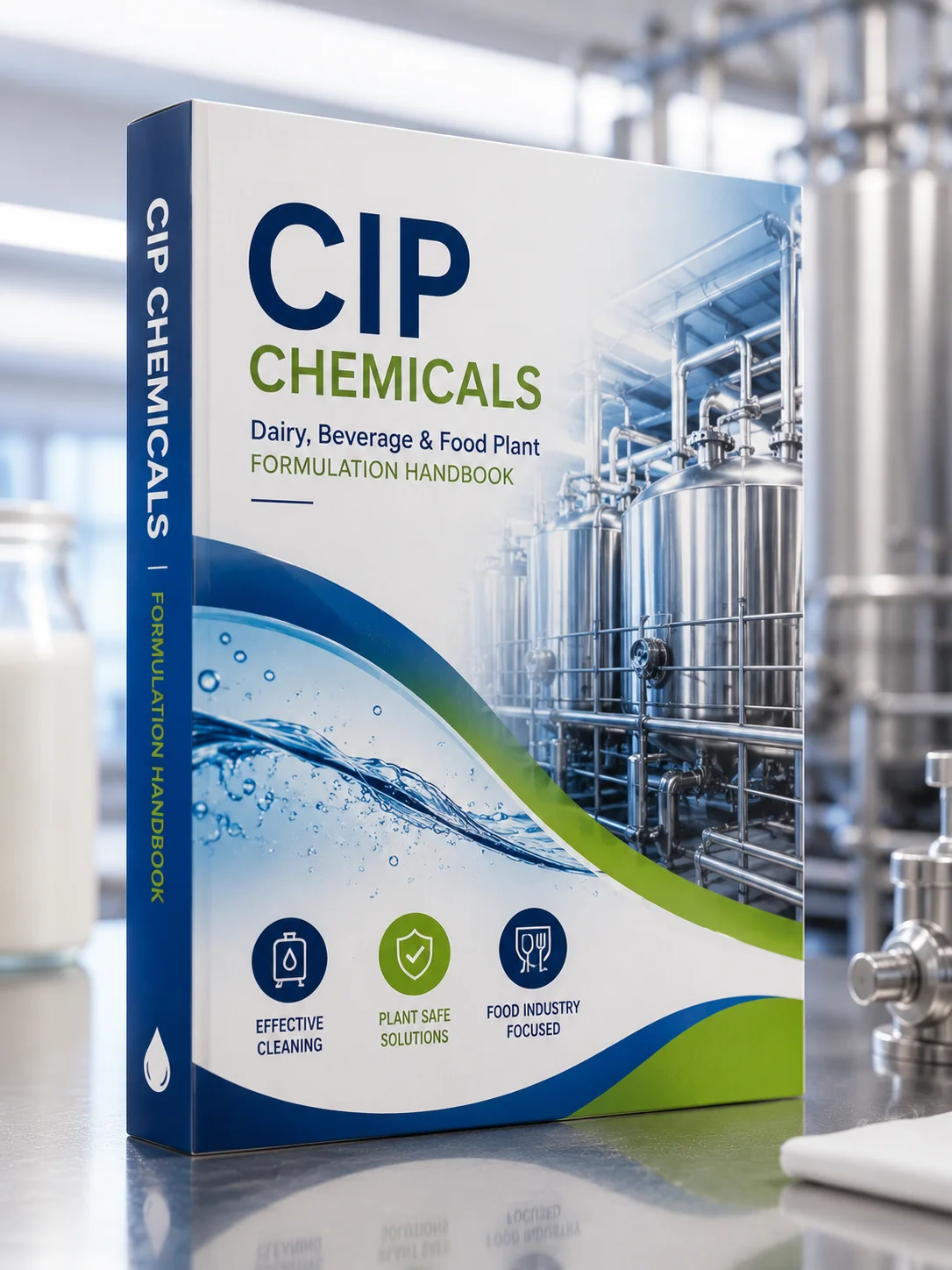
CIP Chemicals — Dairy, Beverage & Food Plant Formulation Handbook
About this book
CIP Chemicals — Dairy, Beverage & Food Plant Formulation Handbook is a print-grade technical reference covering 40 validated starting-point formulations across the full Clean-in-Place chemistry stack — alkaline and chlorinated alkaline cleaners, mineral and organic acid descalers, single-phase combination cleaners, foam cleaners for open-plant surfaces, and chlorine-, peracetic-acid- and QAC/iodine-based sanitising systems. Written for dairy and beverage plant chemists, CIP chemical manufacturers and food-plant QA leads, every formulation is anchored to the TACT process-validation model and the HACCP-aligned documentation a hygiene audit will expect.
The technology
The handbook develops CIP chemistry through its two governing mechanisms: alkaline saponification and protein peptization (sodium/potassium hydroxide hydrolysing milk-fat triglycerides and denaturing residual protein above pH 12), and acid dissolution of mineral scale (phosphoric, nitric and citric acid neutralising the calcium carbonate, phosphate and oxalate complexes that form milkstone and beerstone). Chelation chemistry — HEDP phosphonate and sodium gluconate sequestering Ca²⁺/Mg²⁺ to prevent redeposition — is treated mechanistically throughout. Sanitising chemistry covers hypochlorite and NaDCC oxidation, the peracetic acid/hydrogen peroxide equilibrium system that sustains active concentration over shelf life, and quaternary ammonium/iodophor chemistry for residual-film and no-rinse applications.
Inside the formulations
All 40 formulations are structured across Economy, Mid-range, Premium and Specialty tiers in 10 sub-categories. Each block gives a 100 kg reference batch component table with INCI/IUPAC names, % w/w and sourcing tier, condensed manufacturing method with order-of-addition and temperature checkpoints, QC targets (titratable alkalinity/acidity, available chlorine or PAA concentration, pH) tied to cited test methods, stability and shelf-life notes, variants and modifications, and a scientific basis explaining the chemistry behind every component.
What you get
- 40 starting-point formulations across 10 CIP and sanitising sub-categories
- Component tables with INCI/IUPAC names, % w/w, mechanism and sourcing tier
- QC targets for titratable alkalinity/acidity, available chlorine, PAA concentration and pH
- Manufacturing SOPs with order-of-addition, exotherm control and pilot-batch checklist
- 19-material raw materials reference with CAS numbers and substitution notes
- Troubleshooting tables covering chelant exhaustion, oxidant decomposition and biofilm remediation
Technical details
- Format
- A4 PDF · instant digital download
- Extent
- ~140 pages · 40 formulations · 10 sub-categories
- Standards
- FSSAI · 3-A Sanitary Standards · EU food-contact regulations · REACH/SVHC · EPA/FIFRA
- Tiers
- Economy · Mid-range · Premium · Specialty
- Audience
- Dairy/beverage plant chemists · CIP chemical manufacturers · food plant QA leads
- Series
- Household & Industrial Cleaners Series · Volume 5 · Book 5.03
Clean-in-Place failures show no visible sign until a HACCP audit traces milkstone, biofilm or chelant exhaustion back to the chemistry — get 40 validated CIP formulations across alkaline, acid, sanitising and combination systems built around the TACT model from day one.
Who is this book for?
Dairy / Beverage Plant Chemist
You run or specify CIP chemistry for dairy, brewery or beverage processing lines and need validated alkaline, acid and sanitising formulations that hold up to real milkstone, beerstone and biofilm soil loads — not theoretical starting points.
CIP Chemical Manufacturer
You blend or toll-manufacture CIP chemicals and want to expand from single-function caustic or acid cleaners into chlorinated alkaline, single-phase combination, foam, and peracetic-acid sanitising systems with full HACCP-aligned documentation.
Food Plant Engineer / QA Lead
You manage hygiene validation for food-contact equipment and need to understand the chemistry behind TACT-model CIP design, chelant exhaustion, oxidant decomposition, and the documentation a HACCP audit will expect from your chemical supplier.
Table of Contents
- CIP chemistry: saponification, protein peptization, chelation, acid descaling of milkstone/beerstone
- Sanitising mechanisms: hypochlorite, peracetic acid/H₂O₂ equilibrium, QAC, iodophor
- TACT model (Time, Temperature, Action, Concentration) and process validation
- Food-contact compliance anchors: FSSAI, 3-A Sanitary Standards, REACH/SVHC, HACCP
- F1–F4: Alkaline CIP Cleaners (Caustic-Based)
- F5–F8: Chlorinated Alkaline Cleaners
- F9–F12: Acid CIP Cleaners (Mineral & Organic)
- F13–F16: Single-Phase Combination Cleaners
- F17–F20: Foam Cleaners for Open-Plant/Surface CIP
- F21–F24: Sanitisers — Chlorine-Based
- F25–F28: Sanitisers — Peracetic Acid (PAA) Based
- F29–F32: Sanitisers — Quaternary Ammonium & Iodine-Based
- F33–F36: Acid Descalers / Mineral Scale Removers
- F37–F40: Clean-Out-of-Place (COP) Tank & Parts Soak Cleaners
- 316L and acid-resistant vessel setup for alkaline vs. acid/oxidant batching
- Manufacturing sequence SOPs with order-of-addition and temperature checkpoints
- Scale-up notes: exotherm control, PAA decomposition risk, hypochlorite addition timing
- Batch record template and pilot-batch checklist
- 19 raw materials with CAS numbers, use levels and sourcing tiers
- HEDP, sodium gluconate and sodium metasilicate selection criteria
- Cost-tier guide and substitution notes for specialty sanitising actives
- Chelant exhaustion and milkstone/beerstone redeposition diagnostics
- Oxidant decomposition (chlorine, PAA) during storage and point-of-use re-assay
- Biofilm remediation cycles and stability failure reference
See what's inside
Frequently asked questions
They are validated starting points. You will need to bench-test and adapt treat rates to your specific raw material lots, but you start from a working formulation — not a blank sheet.
The handbook is a PDF — high-resolution A4, printable, with bookmarks and a linked table of contents. You receive an instant download link and it is also available in your library indefinitely.
Up to 5 downloads are included with your purchase. If you need more, contact us and we will reset your download limit.
Yes. The handbook opens with a fundamentals section that explains the underlying chemistry and ingredient functions before presenting formulations — so beginners can follow the rationale, not just the recipe.
TACT stands for Time, Temperature, Action (flow velocity) and Concentration — the four validated process parameters that determine whether a CIP cycle achieves its cleaning and sanitising target. Every formulation in this handbook states its design contact time, temperature and use concentration so it can be validated against the TACT model for your specific circuit.
Protein and fat soils require alkaline saponification and peptization; mineral scale (milkstone, beerstone) requires acid dissolution. No single pH addresses both mechanisms, so dairy and beverage CIP circuits run a two-step alkaline/acid sequence — covered as separate, dedicated sub-categories rather than a compromise single-step product.
Part 5 explains that chelant exhaustion is progressive and invisible until milkstone or beerstone has already redeposited across multiple cycles. The handbook recommends routine calcium-ion assay on spent cleaning solution rather than relying on visual inspection, and ties HEDP/sodium gluconate treat rates to your site's actual water hardness.
Specialty-tier sanitiser formulations (chlorine, PAA and QAC/iodine sub-categories) are explicitly flagged where third-party log-reduction validation is required for HACCP audit claims, with `[verify]` markers rather than invented numbers — so you know exactly what additional testing your specific claim needs.