Coolants & Brake Fluids — Industrial Formulation Handbook (Volume 2)
About this book
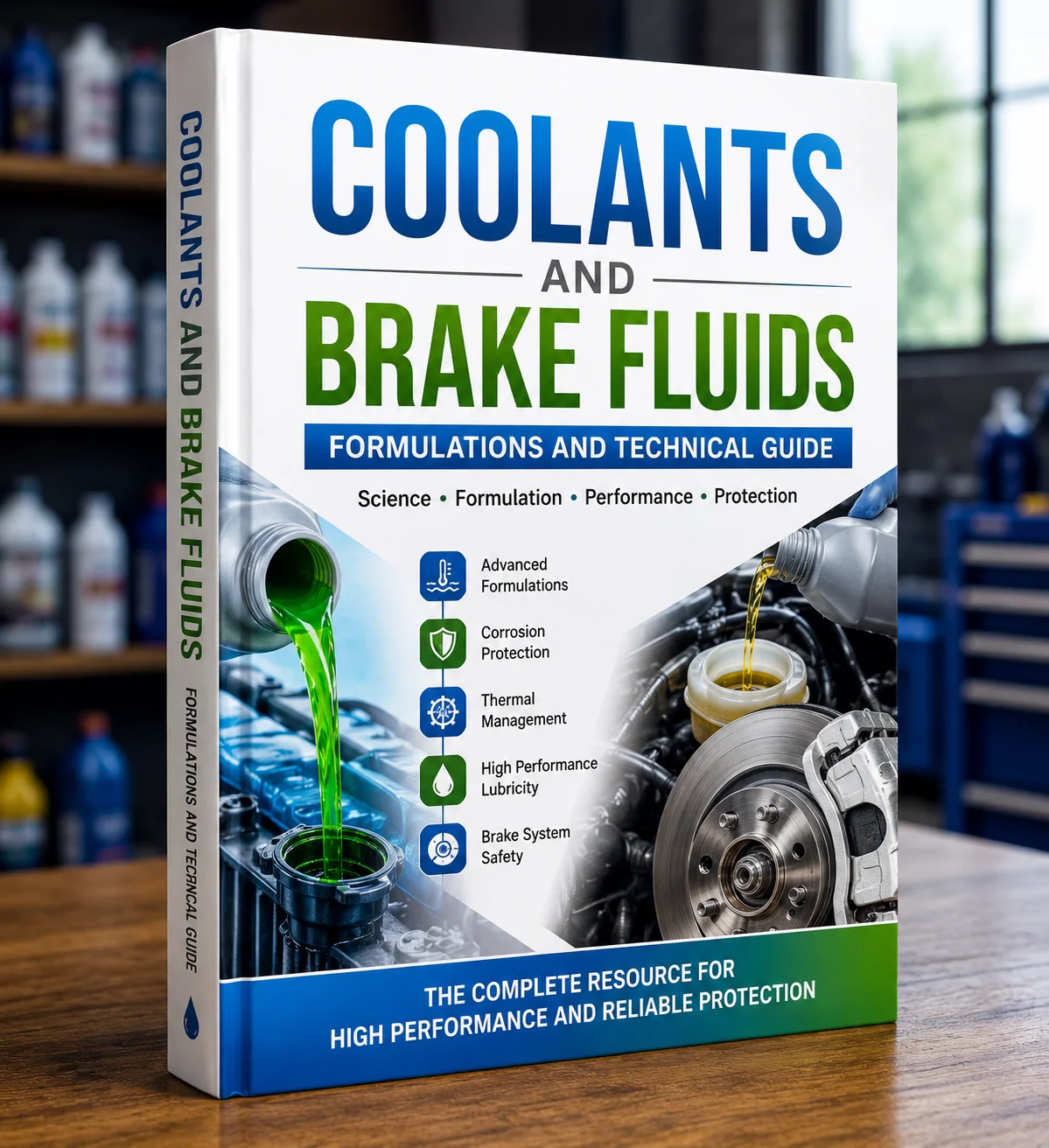
Coolants & Brake Fluids — Industrial Formulation Handbook is a focused technical reference covering the two hydraulic and heat-transfer fluids every vehicle depends on — engine coolants and brake fluids — as 120 validated starting-point formulations across Economy, Mid-range, Premium and Specialist tiers. It spans the full coolant technology spectrum: IAT green coolants to BS 6580 / ASTM D3306, OAT extended-life organic-acid systems, HOAT hybrid coolants, heavy-duty diesel coolants to ASTM D4985, and low-conductivity EV/hybrid battery cooling fluids. The brake-fluid section covers the complete DOT range: DOT 3 glycol-ether, DOT 4 and DOT 4 LV borate-ester, DOT 5.1 non-silicone synthetic and DOT 5 silicone, all benchmarked to FMVSS 116 and ISO 4925. It is the companion volume to the Engine Oils Handbook, completing the core automotive fluid range.
The technology
Coolant chemistry is developed from the glycol base fluid up: monoethylene and monopropylene glycol physical properties, the corrosion inhibitor toolkit (borates, silicates, phosphates, nitrites/nitrates, molybdates, tolyltriazole/benzotriazole yellow-metal passivators, sebacate and 2-EHA carboxylate organic acids), and how each inhibitor protects a different metal substrate — borate for ferrous metals, silicate for aluminium, azoles for copper/brass, nitrite for cavitation in heavy-duty diesel. Reserve alkalinity, pH buffering and inhibitor depletion kinetics are explained as the fundamental drivers of service interval. Brake-fluid chemistry is treated through the glycol-ether family (TEGME, DEGME, DEGBE) and borate-ester wet-ERBP stabilisation, with the hygroscopic water absorption mechanism that depresses boiling point over time, and how DOT 5.1 and DOT 5 silicone address that differently.
Inside the formulations
All 120 formulations are structured across Economy, Mid-range, Premium and Specialist tiers. Every coolant formulation gives inhibitor package composition (% w/w), glycol:water ratio, reserve alkalinity, pH, boil point and freeze point by dilution, manufacturing sequence and QC targets with cited ASTM test methods. Every brake-fluid formulation gives component table (base glycol-ether / borate-ester / pH buffer / corrosion inhibitor / antioxidant — % w/w), dry and wet ERBP, viscosity at –40°C, pH and rubber-swell compliance data.
What you get
- 120 starting-point formulations across engine coolants and brake fluids
- IAT / OAT / HOAT / NOAT / EV low-conductivity coolant formulations with inhibitor % w/w
- Heavy-duty diesel coolant (ASTM D4985) with SCA nitrite/molybdate package
- DOT 3 / DOT 4 / DOT 4 LV / DOT 5.1 / DOT 5 silicone brake-fluid formulations
- QC targets: ERBP (dry/wet), viscosity –40°C, pH, metal corrosion — tied to FMVSS 116 / ISO 4925 / ASTM
- Coolant concentrate and ready-mix 33% / 50% dilution guidance with freeze/boil tables
- Manufacturing SOPs and blending sequences for all coolant and brake-fluid types
- Corrosion inhibitor depletion, service-interval science and SCA supplementation guidance
Technical details
- Format
- A4 PDF · instant digital download
- Extent
- ~180 pages · 120 formulations · 6 sub-categories
- Coolant Standards
- BS 6580 · ASTM D3306 · D4985 · D6210 · VW TL 774F · G11/G12/G13
- Brake Fluid Standards
- FMVSS 116 · ISO 4925 Class 3/4/6 · SAE J1703 · ASTM D3665
- Tiers
- Economy · Mid-range · Premium · Specialist
- Audience
- Coolant manufacturers · brake-fluid producers · automotive blenders · entrepreneurs
- Series
- Lubricants & Automotive Fluids Series · Volume 2
Coolant and brake-fluid chemistry is heavily specification-driven — get 120 validated formulations across IAT, OAT, HOAT, EV and DOT 3/4/5.1 grades with ASTM, BS 6580 and FMVSS 116 compliance data built in.
Who is this book for?
Coolant Manufacturer
You manufacture or want to manufacture engine coolants and need validated formulations for IAT, OAT, HOAT, NOAT and EV low-conductivity grades that meet BS 6580, ASTM D3306, D4985 and OEM top-up specifications.
Brake Fluid Producer
You are entering or expanding in the brake-fluid market and need validated formulations for DOT 3, DOT 4, DOT 4 LV, DOT 5.1 and DOT 5 silicone grades with FMVSS 116 / ISO 4925 compliance targets and test method references.
Automotive Chemical Blender
You already blend automotive fluids and want to add coolants and brake fluids to your range without commissioning fresh R&D — you need working starting points across all grades with blending SOPs and QC specifications.
Table of Contents
- Monoethylene glycol (MEG) and monopropylene glycol (MPG) base fluids
- IAT inhibitor technology: borate, silicate, phosphate, nitrite
- OAT organic acid technology: sebacate, 2-EHA, benzoate, carboxylate
- HOAT hybrid: silicate-OAT and phosphate-OAT systems
- Reserve alkalinity, pH control and corrosion protection mechanisms
- IAT green coolant — BS 6580, ASTM D3306 compliant
- OAT extended-life coolant — ASTM D3306 / D6210 organic acid
- HOAT hybrid coolant — BS 6580 / VW TL 774F
- NOAT nitrite-OAT for mixed fleet use
- Concentrate and ready-mix 33% / 50% / pre-diluted grades
- Heavy-duty diesel coolant (ASTM D4985 / ASTM D6210)
- Fully formulated heavy-duty coolant with supplemental coolant additives (SCAs)
- EV and hybrid vehicle low-conductivity coolant (conductivity <200 µS/cm)
- Racing and high-performance coolant (water-free glycol systems)
- Radiator flush and cooling system cleaner formulations
- Glycol-ether chemistry: TEGME, DEGME, DEGBE base fluids
- Borate-ester chemistry and wet ERBP stabilisation
- Dry ERBP and wet ERBP — FMVSS 116 specification limits
- Low-temperature viscosity (-40°C) and lubricity requirements
- ISO 4925 Class 3, 4, 6 and DOT 5 comparison table
- Economy DOT 3 glycol-ether formulation (dry ERBP ≥205°C)
- Standard DOT 4 borate-ester formulation (dry ERBP ≥230°C)
- Premium synthetic DOT 4 high-performance formulation
- DOT 4 LV low-viscosity formulation (ISO 4925 Class 6)
- Anti-corrosion additive systems for copper, aluminium and cast iron
- DOT 5.1 non-silicone synthetic brake fluid (dry ERBP ≥260°C)
- Silicone-based DOT 5 brake fluid (PDMS, non-hygroscopic)
- Motorsport and racing brake fluid formulations
- Long-life brake fluid with antioxidant and anti-corrosion package
- QC test protocol: ERBP, viscosity, pH, rubber swell, metal corrosion
See what's inside
Frequently asked questions
They are validated starting points. You will need to bench-test and adapt treat rates to your specific raw material lots, but you start from a working formulation — not a blank sheet.
The handbook is a PDF — high-resolution A4, printable, with bookmarks and a linked table of contents. You receive an instant download link and it is also available in your library indefinitely.
Up to 5 downloads are included with your purchase. If you need more, contact us and we will reset your download limit.
Yes. The handbook opens with a fundamentals section that explains the underlying chemistry and ingredient functions before presenting formulations — so beginners can follow the rationale, not just the recipe.
Yes. Every coolant formulation is presented as a concentrate (typically 95–97% glycol) with dilution guidance for ready-mix production at 33%, 40% and 50% coolant-to-water ratios, with freeze-point and boil-point tables at each dilution.
Yes. QC targets for dry and wet ERBP, kinematic viscosity at –40°C, pH (8.0–11.5), water tolerance and metal corrosion are all tied to FMVSS 116 and ISO 4925 test methods for each DOT grade.
IAT uses inorganic inhibitors (borate, silicate, phosphate) consumed in 2 years / 40,000 km. OAT uses organic acids (carboxylates) for 5-year / 150,000 km service — aluminium-safe but not cast-iron protective without molybdate. HOAT combines silicate (fast-acting film) with OAT (longevity). NOAT adds nitrite for cavitation protection in heavy-duty diesels. The handbook includes a selection guide keyed to application, then full formulations for each type.
Yes. EV battery cooling circuits require conductivity below 200 µS/cm (often below 50 µS/cm) to prevent stray-current corrosion in battery packs. The formulation uses ultra-pure MEG with low-dose organic inhibitors selected for minimal ionic contribution — fundamentally different from conventional fully-formulated coolant chemistry.
Yes. Heavy-duty diesel formulations address cavitation pitting of wet cylinder liners with SCA (supplemental coolant additive) nitrite/molybdate packages. Racing coolants address water-wetter chemistry and glycol-free formulations for maximum heat transfer. Both are covered as distinct sub-categories with independent formulation sets.