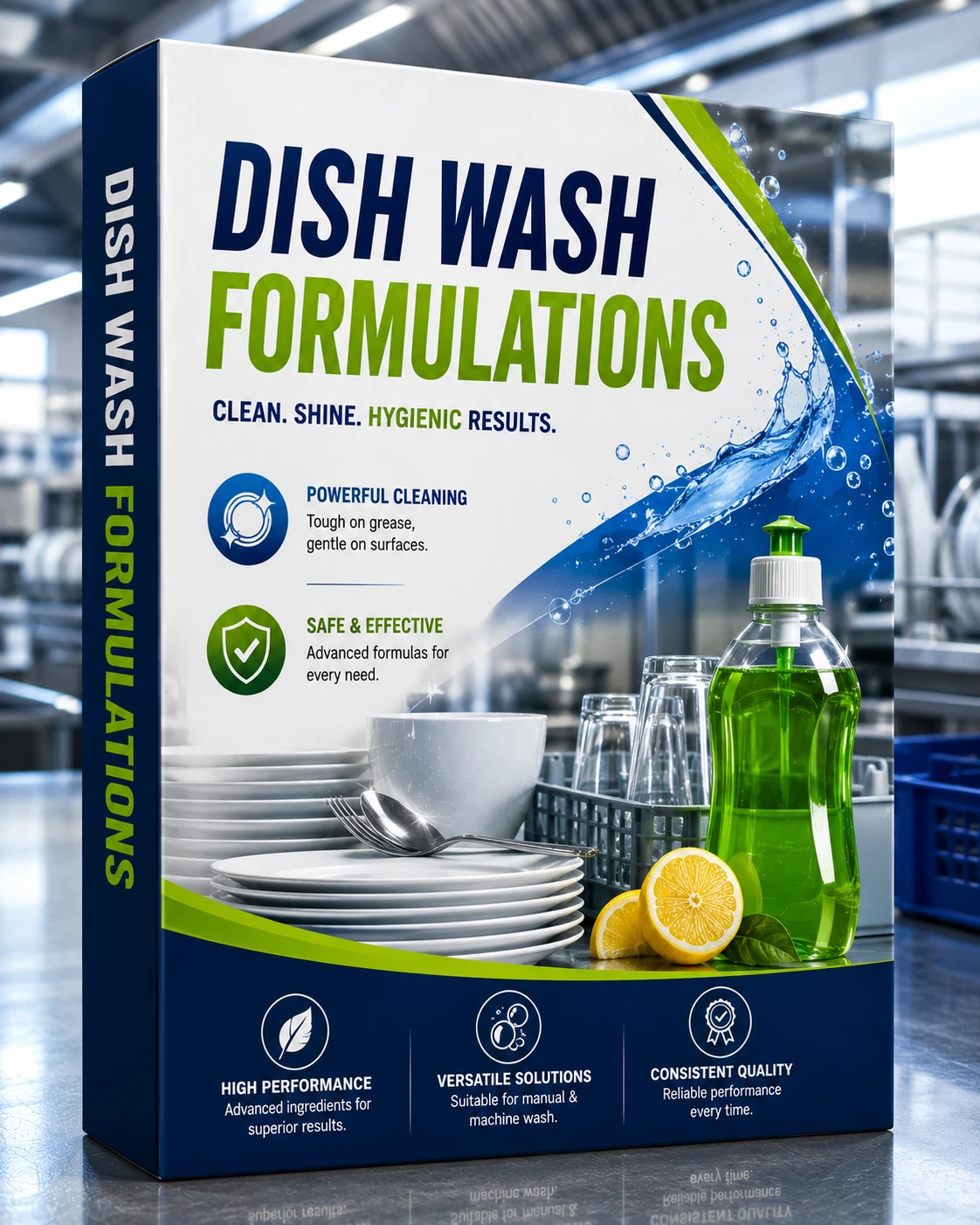
Dishwashing Products — Manual, Automatic & Rinse Aid Formulation Handbook
About this book
Dishwashing Products — Manual, Automatic & Rinse Aid Formulation Handbook is a print-grade technical reference covering 32 validated starting-point formulations across the full dishwashing chemistry spectrum — high-foam manual liquids, low-foam automatic powders/tablets/gels, residential and commercial rinse aids, commercial/industrial warewash detergents, eco-friendly and sensitive-skin manual cleaners, and glassware/barware cleaners. Written for household and institutional cleaning manufacturers, commercial kitchen suppliers and R&D chemists, every formulation addresses the foam-control and substrate-protection trade-offs that define this category.
The technology
The handbook develops dishwashing chemistry through three operating regimes. Manual dishwashing relies on high-foaming anionic surfactants (SLES, LAS) paired with amphoteric foam boosters (CAPB, amine oxides) that adsorb at the oil-water interface and suspend soil in micelles. Automatic warewash suppresses foam using EO/PO block copolymer nonionics, where PO blocks disrupt the air-water surfactant film, while soluble chelants (GLDA, sodium citrate) sequester Ca²⁺/Mg²⁺ to prevent scale. Enzymatic cleaning — proteases hydrolysing peptide bonds, amylases cleaving starch glucosidic bonds — combines with sodium percarbonate oxidative destaining (releasing the perhydroxyl anion that decolorizes tannin stains) in modern phosphate-free automatic formulations. Rinse aids lower water surface tension below 30 mN/m to sheet rather than bead, eliminating spotting.
Inside the formulations
All 32 formulations are structured across Economy, Mid-range, Premium and Specialty tiers in 8 sub-categories. Each block gives a component table with INCI/IUPAC names, % w/w and sourcing tier, condensed manufacturing method, QC targets tied to BIS IS 13986/15152 and ASTM D3556/D4009/D1173, stability and shelf-life notes, variants and modifications, and a scientific basis explaining the mechanism behind every component.
What you get
- 32 starting-point formulations across 8 dishwashing and rinse-aid sub-categories
- Component tables with INCI/IUPAC names, % w/w, mechanism and sourcing tier
- QC targets tied to BIS IS 13986/15152, ASTM D3556 (glass etching), D4009 (foam), D1173
- Manufacturing SOPs with enzyme/oxidiser segregation protocols and batch record template
- Raw materials reference covering surfactants, builders, enzymes and bleach actives
- Troubleshooting tables covering glass etching, spotting and foam-control failure modes
Technical details
- Format
- A4 PDF · instant digital download
- Extent
- ~130 pages · 32 formulations · 8 sub-categories
- Standards
- BIS IS 13986/15152 · ASTM D3556/D4009/D1173/D820 · OECD 301B · REACH · GHS/CLP
- Tiers
- Economy · Mid-range · Premium · Specialty
- Audience
- Cleaning product manufacturers · commercial kitchen suppliers · R&D chemists
- Series
- Household & Industrial Cleaners Series · Volume 2 · Book 2.01
Manual dishwashing wants high foam; automatic warewash needs zero foam or the pump cavitates — get 32 validated formulations across both formats plus rinse aids, built around the foam-control and substrate-protection trade-offs that drive every decision in this category.
Who is this book for?
Household & Institutional Cleaning Manufacturer
You produce or toll-manufacture dishwashing liquids, automatic tablets/gels and rinse aids and need validated formulations spanning manual high-foam systems through low-foam enzymatic automatic detergents, built to BIS IS 13986/15152 and ASTM benchmarks.
Commercial Kitchen / Warewash Supplier
You supply restaurants, hotels and institutional kitchens and need commercial warewash detergents and rinse aids that perform in 60–180 second high-temperature spray cycles without glass etching or spotting.
R&D Chemist
You need reference formulations covering the full foam-control spectrum — high-foam manual, zero-foam automatic, sheeting rinse aids — with enzyme, builder and chelant systems explained mechanistically for benchmarking or new product development.
Table of Contents
- Foam control trade-off: high foam required for manual, detrimental to automatic pump cavitation
- Surfactant chemistry: SLES/LAS anionics, amine oxide/CAPB amphoterics, EO/PO low-foam nonionics
- Builder and chelant systems: GLDA, sodium citrate, sodium metasilicate, glass corrosion inhibition
- Enzymatic and oxidative chemistry: protease/amylase digestion, sodium percarbonate destaining
- Standards: BIS IS 13986/15152, ASTM D3556/D4009/D1173
- Manual Dishwashing Liquids
- Automatic Dishwashing Powders & Tablets
- Automatic Dishwashing Liquids & Gels
- Residential Rinse Aids
- Commercial & Industrial Warewash Detergents
- Commercial Rinse Aids & Sanitisers
- Eco-Friendly & Sensitive Skin Manual Cleaners
- Glassware & Barware Cleaners
- Equipment and plant setup for manual liquid vs. automatic powder/tablet/gel lines
- Manufacturing sequence SOPs with enzyme/oxidiser segregation protocols
- Scale-up notes and batch record template
- Raw materials reference covering surfactants, builders, enzymes and bleach actives
- Glass corrosion inhibitor and hydrotrope selection notes
- Cost-tier guide by formulation tier
- Glass etching, spotting and film deposition diagnostics
- Enzyme/oxidiser incompatibility and foam-control failure modes
- Stability failure reference for liquids, gels and tablets
See what's inside
Frequently asked questions
They are validated starting points. You will need to bench-test and adapt treat rates to your specific raw material lots, but you start from a working formulation — not a blank sheet.
The handbook is a PDF — high-resolution A4, printable, with bookmarks and a linked table of contents. You receive an instant download link and it is also available in your library indefinitely.
Up to 5 downloads are included with your purchase. If you need more, contact us and we will reset your download limit.
Yes. The handbook opens with a fundamentals section that explains the underlying chemistry and ingredient functions before presenting formulations — so beginners can follow the rationale, not just the recipe.
High foam is a visual indicator of cleaning activity that consumers expect in manual dishwashing, but in automatic machines foam causes cavitation in wash pumps, dropping water pressure and causing mechanical failure or poor cleaning. This is why manual formulations use high-foaming anionics (SLES, LAS) while automatic formulations use low-foam EO/PO block copolymer nonionics — the handbook treats these as structurally distinct sub-categories rather than one compromise formula.
High alkalinity and builders can leach silicates from glass, causing permanent cloudiness. The formulations in this book balance alkaline cleaning power against glass corrosion inhibitors — sodium metasilicate, zinc sulfate or sodium zincate — which form a protective passivation layer on glassware, with ASTM D3556 etching-rating QC targets specified.
Yes. All formulations target 0.0% phosphate (as P₂O₅) per CPCB and EU regulatory restrictions, using GLDA, sodium citrate and polyacrylate-based builder systems in place of phosphate builders, with the same hard-water sequestration performance verified against IS 13986/15152 targets.
Liquid chlorine bleach and active oxygen from percarbonate oxidise the methionine and tryptophan residues in an enzyme's active site, instantly denaturing it. The handbook explains this incompatibility explicitly and shows how dry formulations co-granulate or physically separate enzymes from percarbonate particles to prevent in-storage degradation.