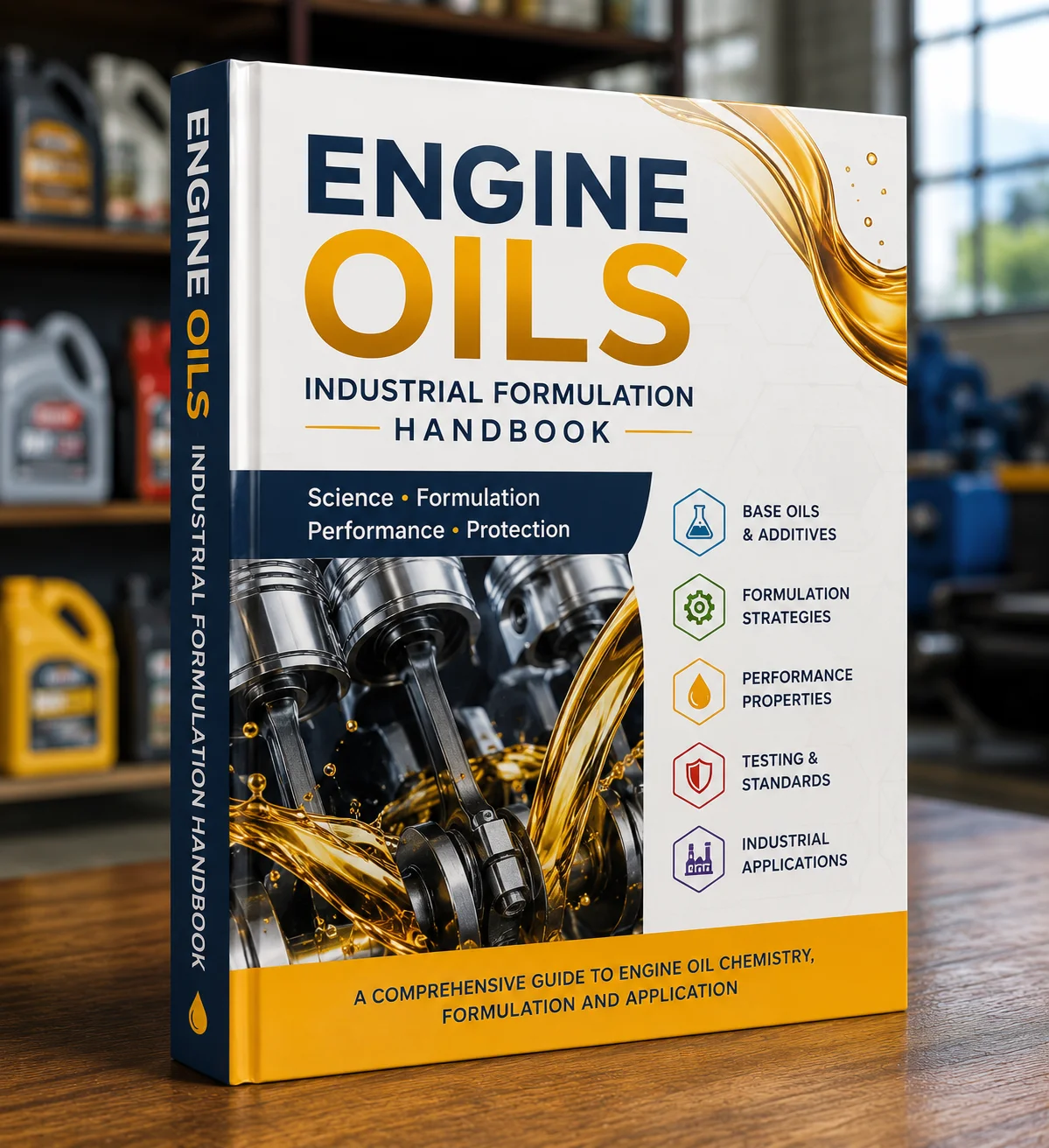
Engine Oils — Industrial Formulation Handbook (Volume 1)
About this book
Engine Oils — Industrial Formulation Handbook is a print-grade technical reference spanning the entire commercial engine-oil range — from petrol passenger-car oils (PCMOs) and heavy-duty diesel engine oils (HDEOs) to motorcycle 4-stroke, 2-stroke, marine, gaseous-fuel, agricultural, racing and mono-grade products. With 162 validated starting-point formulations across 11 categories and four performance tiers (Economy, Mid-range, Premium, Specialist), it gives lubricant blenders, R&D chemists and entrepreneurs the technical foundation to develop, manufacture and quality-control engine oil products without starting from a blank sheet. Every formulation is anchored to current industry specifications — API SP, CK-4, FA-4, ACEA A3/B4, C3, C5, E6, E9, ILSAC GF-6, JASO MA2, FD — and to the SAE J300 viscosity grades that define each market segment.
The technology
The handbook develops lubricant science from first principles: the API base-oil group system (Group I solvent-refined mineral, Group II VHVI, Group III synthetic, Group IV PAO, Group V esters), the kinematic viscosity / CCS / HTHS specification triangle that governs SAE J300 grade assignment, and the additive toolkit that makes modern engine oils perform. Every additive class is treated mechanistically: overbased calcium and magnesium sulfonates and phenates for acid neutralisation and detergency; zinc dialkyldithiophosphate (ZDDP) for anti-wear film and antioxidant function; polyisobutylene succinimide dispersants for soot and varnish suspension; hindered phenol and amine antioxidants for oxidative stability; olefin copolymer (OCP) and hydrogenated styrene-diene (HSD) viscosity index improvers; pour-point depressants; organic friction modifiers. Modern specification pressures are addressed in full: LSPI prevention chemistry (calcium-to-magnesium ratio, boron, MoDTC), the SAPS constraints that protect DPF and TWC hardware, FA-4 ultra-low-viscosity diesel chemistry, and the high-HTHS requirements for motorsport and high-temperature service.
Inside the formulations
All 162 formulations are structured across Economy (mineral), Mid-range (semi-synthetic), Premium (full-synthetic) and Specialist (PAO/ester) tiers within each of the 11 engine-oil categories. Every formulation gives a 100 kg reference batch component table (base oil / additive package / viscosity modifier / pour-point depressant / friction modifier — % w/w and sourcing tier), target SAE grade and HTHS viscosity, API/ACEA/JASO performance category, blending method and sequence, QC targets with cited ASTM test methods, stability notes, variants and the scientific basis anchored to the additive chemistry.
What you get
- 162 starting-point engine oil formulations across 11 categories
- Coverage from 0W-16 low-viscosity PCMOs to SAE 60 mono-grades and PAO racing oils
- API SP / CK-4 / FA-4 · ACEA C3 / E9 · JASO MA2 / FD · ILSAC GF-6 compliant formulations
- Component tables: base oil, additive package, VII and PPD with % w/w and sourcing tier
- QC targets tied to ASTM D445, D5293, D4683, D2272, D4951, D664 test methods
- Blending SOPs, failure-mode tables and product-range architecture for all 11 categories
- Raw materials reference: base oils, additive packages, VIIs and friction modifiers with supplier notes
- LSPI, DPF, SAPS and HTHS compliance guidance integrated into each formulation
Technical details
- Format
- A4 PDF · instant digital download
- Extent
- ~200 pages · 162 formulations · 11 categories
- Grades
- SAE 0W-16 to 20W-50 · mono-grades 30–60 · 2-stroke
- Standards
- SAE J300 · API · ACEA · ILSAC GF-6 · JASO · NMMA · ASTM · BIS
- Tiers
- Economy (mineral) · Mid-range (semi-synthetic) · Premium (full-synthetic) · Specialist (PAO/ester)
- Audience
- Lubricant blenders · R&D chemists · production managers · entrepreneurs
- Series
- Lubricants & Automotive Fluids Series · Volume 1
Stop spending months developing engine oil formulations from scratch — get 162 validated starting-point formulations across every SAE grade, engine type and performance category, ready to bench-test and manufacture today.
Who is this book for?
Lubricant Blender
You blend or toll-manufacture engine oils and need credible starting formulations across SAE 0W-20 to 20W-50, API SP/CK-4 and ACEA C3/E9 — to cut your R&D cycle from months to weeks.
Entrepreneur Entering Lubes
You want to launch an engine oil brand across passenger car, diesel, motorcycle or racing segments but need the technical foundation: base-oil selection, additive chemistry, viscosity grades and QC specifications.
R&D Chemist
You work in lubricant development and need reference formulations across petrol, diesel, motorcycle, 2-stroke, marine, gaseous-fuel and racing categories to benchmark your work or accelerate new grade development.
Table of Contents
- API base-oil group system: Group I mineral, Group II VHVI, Group III synthetic, Group IV PAO, Group V ester
- SAE J300 viscosity classification: kinematic viscosity, HTHS, CCS and MRV
- API, ACEA, ILSAC and JASO performance categories
- Additive chemistry: ZDDP, overbased detergents, succinimide dispersants, antioxidants, VII, PPD, friction modifiers
- LSPI, SAPS limits, DPF and catalyst compatibility
- Economy mineral: SAE 10W-30, 15W-40, 20W-50 (API SN/SL)
- Semi-synthetic mid-range: SAE 5W-30, 10W-40 (API SN Plus)
- Full-synthetic premium: SAE 5W-30, 5W-40 (API SP / ILSAC GF-6)
- Low-viscosity synthetic: SAE 0W-16, 0W-20 (LSPI protection, fuel economy)
- PAO/ester specialist: SAE 5W-50 high-HTHS race-derived grades
- Mono-grade SAE 30, 40, 50 mineral diesel oils
- Multi-grade SAE 15W-40 and 10W-30 (API CF-4 / CH-4)
- Modern CI-4+, CJ-4 low-SAPS (DPF-compatible)
- API CK-4 and FA-4 ultra-low-viscosity diesel
- ACEA E6, E9 long-drain heavy-duty formulations
- 4-stroke motorcycle oils (JASO MA, MA2) SAE 10W-30, 10W-40
- 2-stroke pre-mix and self-mix oils (JASO FC, FD, ISO-L-EGD)
- Marine stationary diesel (NMMA, Caterpillar, MAN B&W)
- CNG/LPG gaseous-fuel engine oils — ashless anti-wear
- Agricultural tractor transmission and engine oils (UTTO/STOU)
- PAO-based motorsport oils: SAE 10W-60, 5W-50 high-HTHS
- Ester-based track and endurance racing formulations
- Straight mineral mono-grades: SAE 30, 40, 50, 60
- High-zinc, high-phosphorus classic car formulations
- Break-in and running-in engine oil formulations
- Blending vessel setup and sequence SOPs
- QC test methods: ASTM D445, D5293, D4683, D2272, D4951, D664
- Failure-mode tables for 11 categories
- Raw materials reference: base oils, additive packages, viscosity index improvers
- Sourcing tiers and additive package supplier substitution guide
See what's inside
Frequently asked questions
They are validated starting points. You will need to bench-test and adapt treat rates to your specific raw material lots, but you start from a working formulation — not a blank sheet.
The handbook is a PDF — high-resolution A4, printable, with bookmarks and a linked table of contents. You receive an instant download link and it is also available in your library indefinitely.
Up to 5 downloads are included with your purchase. If you need more, contact us and we will reset your download limit.
Yes. The handbook opens with a fundamentals section that explains the underlying chemistry and ingredient functions before presenting formulations — so beginners can follow the rationale, not just the recipe.
They are validated starting points. You will need to run bench tests and adapt additive treat rates to your specific base-oil lots and target specifications — but you start from a working base, not a blank sheet.
Yes. Low-viscosity PCMO grades including 0W-16 and 0W-20 are covered with LSPI protection chemistry (reduced calcium, controlled molybdenum friction modifier), along with all SAE grades from 0W-20 through 20W-50.
API SN, SN Plus, SP (petrol), CF, CH-4, CI-4+, CJ-4, CK-4, FA-4 (diesel), and ACEA A3/B4, C2, C3, C5, E4, E6, E7, E9 are all covered with corresponding formulation approaches and SAPS constraints.
Yes. The handbook covers 4-stroke motorcycle oils to JASO MA2, 2-stroke pre-mix and injector oils to JASO FC/FD and ISO-L-EGD, plus marine 2-stroke crosshead and trunk-piston oils as separate categories.
Racing formulations use Group IV PAO and Group V ester base stocks for superior thermal stability, with high-HTHS viscosity (>3.5 mPa·s) for film protection at race temperatures, elevated ZDDP for high-rpm valvetrain loading, and ester lubricity for friction reduction under extreme conditions.