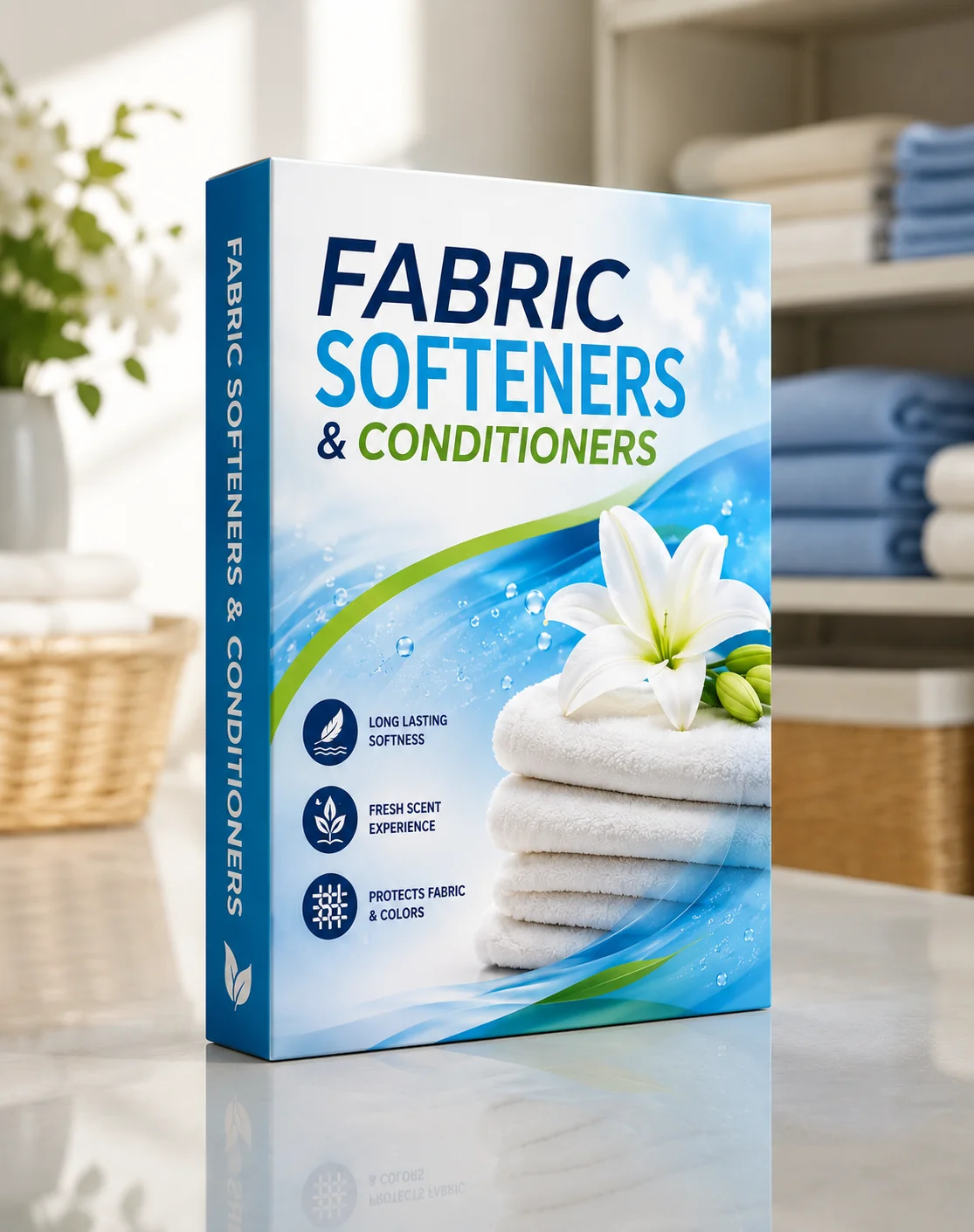
Fabric Softeners & Conditioners — Formulation & Manufacturing Guide
About this book
Fabric Softeners & Conditioners — Formulation & Manufacturing Guide is a print-grade technical reference covering 32 validated starting-point formulations across standard rinse-cycle, ultra-concentrate, ester-quat biodegradable, fragrance-enhanced, sensitive-skin/baby, anti-static, industrial/institutional and dryer-sheet fabric softener formats. Written for fabric care manufacturers, brand owners and R&D chemists, every formulation is engineered around the central operating constraint of this category: efficient cationic deposition after 50–200-fold rinse dilution, against competing residual anionic surfactant from the wash cycle.
The technology
The handbook develops the softening mechanism from first principles: cotton and synthetic fibres carry a net negative surface charge, and quaternary ammonium cations — permanently positive regardless of pH — adsorb via coulombic attraction and ion exchange, with the dialkyl tails orienting outward to create a lubricious, anti-static surface. Ester-quat chemistry is treated in depth: the hydrolytically labile ester linkage that gives >80% OECD 301B primary biodegradability versus <20% for conventional DSDMAC/DHTDMAC, and the pH 2.5–3.5 stability window every other ingredient must respect. Silicone co-actives — Dimethicone for general lubricity, Amodimethicone for selective high-charge-site deposition — and the molecular basis of anti-static performance on low-moisture-regain synthetics are both covered mechanistically.
Inside the formulations
All 32 formulations are structured across Economy, Mid-range, Premium and Specialty tiers in 8 sub-categories. Each block gives a component table with INCI names, % w/w and sourcing tier, condensed manufacturing method (aqueous emulsification or anhydrous hot-melt impregnation), QC targets tied to ISO 2871-2/ASTM E70/ISO 11930/OECD 301B, stability and shelf-life notes, variants and modifications, and a scientific basis explaining the mechanism behind every component.
What you get
- 32 starting-point formulations across 8 fabric softener and conditioner sub-categories
- Component tables with INCI names, % w/w, mechanism and sourcing tier
- QC targets tied to ISO 2871-2, ASTM E70, ISO 11930, OECD 301B, EU Regulation 648/2004
- Manufacturing sequences for aqueous emulsification and anhydrous hot-melt substrate impregnation
- 29-compound raw materials reference with CAS numbers and C16:C18 ester-quat blending notes
- 13 failure-mode troubleshooting table and accelerated stability protocol
Technical details
- Format
- A4 PDF · instant digital download
- Extent
- ~130 pages · 32 formulations · 8 sub-categories
- Standards
- ISO 2871-2 · ASTM E70 · ISO 11930 · OECD 301B · EU Regulation 648/2004 · IEC 61340-4-1 · IFRA Category 4
- Tiers
- Economy · Mid-range · Premium · Specialty
- Audience
- Fabric care manufacturers · brand owners · R&D chemists
- Series
- Household & Industrial Cleaners Series · Volume 1 · Book 1.03
Fabric softener actives must deposit efficiently after a 50–200× rinse dilution, against residual anionic surfactant from the wash cycle competing for the same fibre surface — get 32 validated ester-quat, silicone-boosted and anti-static formulations engineered for that exact constraint.
Who is this book for?
Fabric Care Manufacturer
You produce or toll-manufacture fabric softeners and conditioners and need validated ester-quat formulations spanning standard rinse-cycle, ultra-concentrate, fragrance-boosted and industrial/institutional grades — built for the rinse-dilution deposition window, not just lab-bench performance.
Brand Owner Entering Fabric Care
You want to launch a fabric softener or dryer-sheet line and need the technical foundation: ester-quat biodegradability under EU Regulation 648/2004, silicone co-active selection, and the pH 2.5–3.5 stability window that governs every other ingredient choice.
R&D Chemist
You need reference formulations covering anti-static synthetic-fibre conditioning, sensitive-skin/baby formats, encapsulated fragrance delivery and dryer-sheet substrate impregnation, with the electrostatic adsorption mechanism explained at the molecular level.
Table of Contents
- Electrostatic adsorption: quaternary ammonium cations bonding to anionic fibre surfaces
- Ester-quat chemistry and OECD 301B biodegradability vs. conventional DSDMAC/DHTDMAC
- Silicone co-actives: Dimethicone lubricity vs. Amodimethicone selective high-charge-site deposition
- pH dependence: ester bond stability at pH 2.5–3.5, hydrolysis above pH 7
- EU Regulation 648/2004 biodegradability mandate and phase-out of conventional dialkyl quats
- Sub-category 1: Standard Rinse-Cycle Liquid Fabric Softener (Consumer Concentrate)
- Sub-category 2: Ultra-Concentrate Liquid Fabric Softener (3×–5×)
- Sub-category 3: Ester-Quat Biodegradable Fabric Softener
- Sub-category 4: Fragrance-Enhanced Fabric Conditioner (Encapsulated / Booster)
- Sub-category 5: Sensitive Skin & Baby Fabric Conditioner
- Sub-category 6: Anti-Static Fabric Conditioner for Synthetic Fibres
- Sub-category 7: Industrial & Institutional Fabric Softener (Commercial Laundry)
- Sub-category 8: Dryer Sheet / Tumble Dryer Fabric Softener Substrate
- Aqueous emulsification: anchor agitator and rotor-stator homogenisation sequences
- Anhydrous hot-melt substrate impregnation for dryer sheets
- Scale-up notes and batch record template
- 29-compound raw materials reference with CAS numbers
- C16:C18 ester-quat blending and Krafft temperature management
- Cost-tier guide and substitution notes
- 13 failure modes: deposition failure, viscosity drift, fragrance fade
- Accelerated stability protocol
- Anti-static and synthetic-fibre conditioning diagnostics
See what's inside
Frequently asked questions
They are validated starting points. You will need to bench-test and adapt treat rates to your specific raw material lots, but you start from a working formulation — not a blank sheet.
The handbook is a PDF — high-resolution A4, printable, with bookmarks and a linked table of contents. You receive an instant download link and it is also available in your library indefinitely.
Up to 5 downloads are included with your purchase. If you need more, contact us and we will reset your download limit.
Yes. The handbook opens with a fundamentals section that explains the underlying chemistry and ingredient functions before presenting formulations — so beginners can follow the rationale, not just the recipe.
Ester-quat hydrolysis rate is strongly pH-dependent — the ester bond is stable at pH 2.5–3.5 and hydrolyses progressively above pH 5.0, accelerating significantly above pH 7. This constraint governs the choice of every co-ingredient in the formulation: thickeners, preservatives and functional additives must all remain stable and functional within this narrow pH window, which the handbook treats as the central formulation constraint, not a footnote.
The softening mechanism — coulombic adsorption and hydrophobic tail orientation — is identical. The difference is biodegradability: ester-quats incorporate hydrolytically labile ester linkages that cleave under esterase action into fully biodegradable fatty acid and amino alcohol fragments (>80% primary biodegradability under OECD 301B), while conventional DSDMAC/DHTDMAC achieve <20% in 28 days and have been phased out of mainstream EU consumer products under Regulation 648/2004.
Anti-static performance follows directly from cationic surface deposition — the positively charged quat coating raises fibre surface conductivity and dissipates triboelectric charge in low-moisture-regain synthetics. Higher cationic deposition yields better static dissipation, which is why Sub-category 6 uses the same electrostatic adsorption science as the standard softener formulations, tuned for synthetic fibre surface chemistry.
Yes. Sub-category 8 covers anhydrous hot-melt substrate impregnation, where the cationic active is melt-coated onto a nonwoven substrate and released by heat transfer during tumble drying — a fundamentally different manufacturing process from the aqueous emulsification used for liquid softeners, covered separately in Part 3.