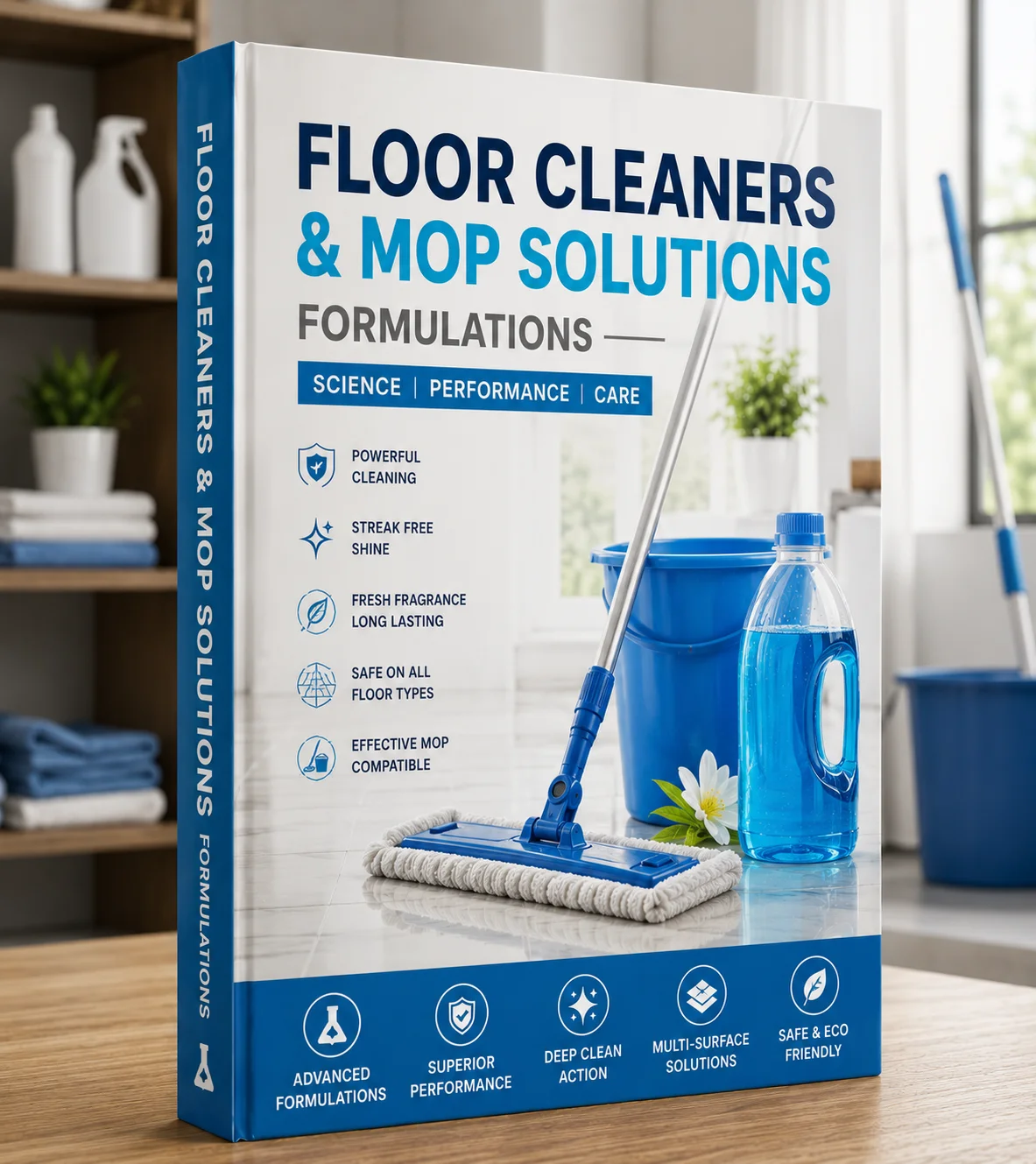
Floor Cleaners & Mop Solutions — Formulation Handbook
About this book
Floor Cleaners & Mop Solutions — Formulation Handbook covers 32 validated starting-point formulations across 8 floor care sub-categories — neutral everyday cleaners, alkaline tile and grout degreasers, wood soap and polish cleaners, anti-static ESD floor cleaners, disinfectant floor cleaners, no-rinse laminate and LVT cleaners, enzymatic pet odour eliminators, and automatic scrubber machine degreasers. Every formulation is designed for its substrate: pH-sensitive wood, laminate and LVT at pH 6–8; alkaline-tolerant ceramic and porcelain tile at pH 9–11; food-safe disinfectant systems using QAC actives. Written for floor care manufacturers, janitorial product suppliers and R&D chemists who need to deliver streak-free, residue-free, surface-safe results across the full floor care range.
The technology
The handbook develops floor care chemistry by substrate type. Wood and timber: wood-soap fatty acid chemistry (potassium cocoate + linseed oil soap) that cleans while depositing a conditioning film; low-alkalinity surfactant selection (APG, cocamidopropyl betaine) to avoid finish swelling; pH 6–8 buffering to protect lacquer and wax finishes. Ceramic and porcelain: alkaline builder systems (sodium carbonate, sodium metasilicate) for grease and mineral soil removal; acid descaling cycles. LVT and laminate: no-rinse, fast-drying formulation with low-foam nonionic surfactants (C9–11 EO7) and minimal water retention to prevent edge swelling. ESD anti-static: conductive polymer (polythiophene) or ionic surfactant (DDAC) network that maintains surface resistivity in the 10⁶–10⁹ Ω range. Enzymatic odour elimination: protease and lipase for urea and protein soil degradation; encapsulated fragrance for long-lasting neutralisation. Automatic scrubber degreasers: low-foam, concentrated (1:20 to 1:50 dilution), pH 10–11, with anti-foam system matched to pad scrubbing equipment.
Inside the formulations
All 32 formulations are structured across Economy, Mid-range, Premium and Specialty tiers in 8 sub-categories. Each block gives component table with INCI name, % w/w, function, sourcing tier, dilution factor, pH at use, manufacturing SOP, QC targets (pH, viscosity, foam height, anti-static surface resistivity where relevant, microbial counts for disinfectant grades) and troubleshooting notes for streaking, residue and surface damage.
What you get
- 32 starting formulations across 8 floor care sub-categories
- Substrate-specific pH design: wood/LVT (pH 6–8), tile/grout (pH 9–11), disinfectant (pH 6–8 QAC)
- Wood-soap fatty acid formulations for timber floor care with conditioning function
- ESD anti-static floor cleaner with conductive polymer network and resistivity targets
- Enzymatic pet odour eliminators: protease + lipase + encapsulated fragrance systems
- No-rinse LVT and laminate formulations with fast-dry, low-foam nonionic surfactant systems
- Automatic scrubber machine degreasers: low-foam, 1:20–1:50 concentrate, pH 10–11
- QC targets: IS 8399, ASTM, streaking, residue, foam, surface resistivity, microbial count
Technical details
- Format
- A4 PDF · instant digital download
- Extent
- ~135 pages · 32 formulations · 8 sub-categories
- Standards
- IS 8399 · ASTM · EN 1276 (disinfectant efficacy) · GHS · EU Ecolabel criteria
- Tiers
- Economy · Mid-range · Premium · Specialty
- Audience
- Floor care manufacturers · janitorial suppliers · R&D chemists
- Series
- Household & Industrial Cleaners Series · Volume 3 · Book 3.05
Floor care chemistry is substrate-specific — the wrong pH or solvent destroys wood, stone or LVT. Get 32 validated floor cleaner and mop solution formulations built for every surface type.
Who is this book for?
Floor Care Product Manufacturer
You blend or package floor cleaning products and need validated starting formulations across neutral, alkaline, disinfecting, enzymatic and specialist floor care types.
Facilities and Janitorial Supplier
You supply commercial cleaning chemicals to hospitality, healthcare and retail and need a product range covering every floor substrate from hardwood to ESD tiles.
R&D Chemist
You need reference formulations with QC targets, raw material profiles and troubleshooting guidance for modern no-rinse, anti-static and pet odour enzyme systems.
Table of Contents
- Floor substrate chemistry and pH sensitivity
- Surfactant selection for no-streak, no-residue cleaning
- Enzymatic odour removal mechanisms
- Anti-static ESD protection and conductivity
- Standards and test methods (IS 8399, ASTM)
- Neutral Floor Cleaners — F1 to F4
- Alkaline Tile & Grout Cleaners — F5 to F8
- Wood Soap / Polish Cleaners — F9 to F12
- Anti-Static ESD Floor Cleaners — F13 to F16
- Disinfectant Floor Cleaners — F17 to F20
- No-Rinse Laminate & LVT Cleaners — F21 to F24
- Enzymatic Pet Odour Removers — F25 to F28
- Automatic Scrubber Degreasers — F29 to F32
- Compounding SOPs for RTU and concentrate formats
- Enzyme addition and stabilisation protocols
- Scale-up notes for ESD and no-rinse systems
- Raw materials with INCI names, CAS numbers and sourcing tiers
- Enzyme supplier substitution guide
- Cost-tier register and BoM analysis
- Streaking, residue and foam diagnostic matrices
- Wood and LVT surface damage prevention
- Stability and shelf-life failure tables
See what's inside
Frequently asked questions
They are validated starting points. You will need to bench-test and adapt treat rates to your specific raw material lots, but you start from a working formulation — not a blank sheet.
The handbook is a PDF — high-resolution A4, printable, with bookmarks and a linked table of contents. You receive an instant download link and it is also available in your library indefinitely.
Up to 5 downloads are included with your purchase. If you need more, contact us and we will reset your download limit.
Yes. The handbook opens with a fundamentals section that explains the underlying chemistry and ingredient functions before presenting formulations — so beginners can follow the rationale, not just the recipe.
Yes. Sub-categories 1, 3 and 6 are specifically designed for pH-sensitive substrates (wood, LVT, laminate) with pH ranges of 6–8 and no alkaline builders that could damage finishes.
Yes. F25–F28 use protease and lipase enzyme blends with encapsulated fragrance to break down urea and protein soils at the molecular level.