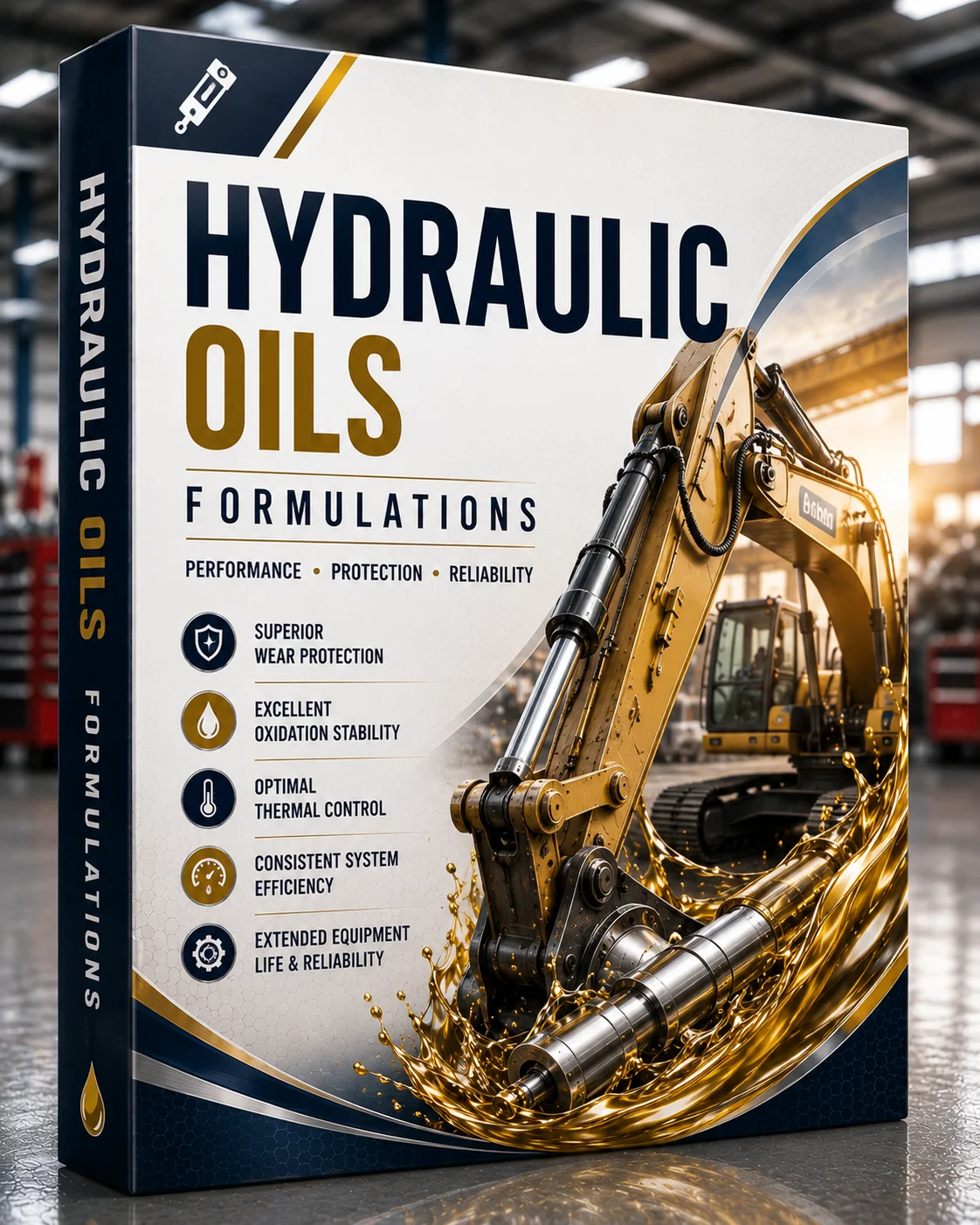
Heavy-Duty Diesel Engine Oils (HDEO) — Formulation Handbook
About this book
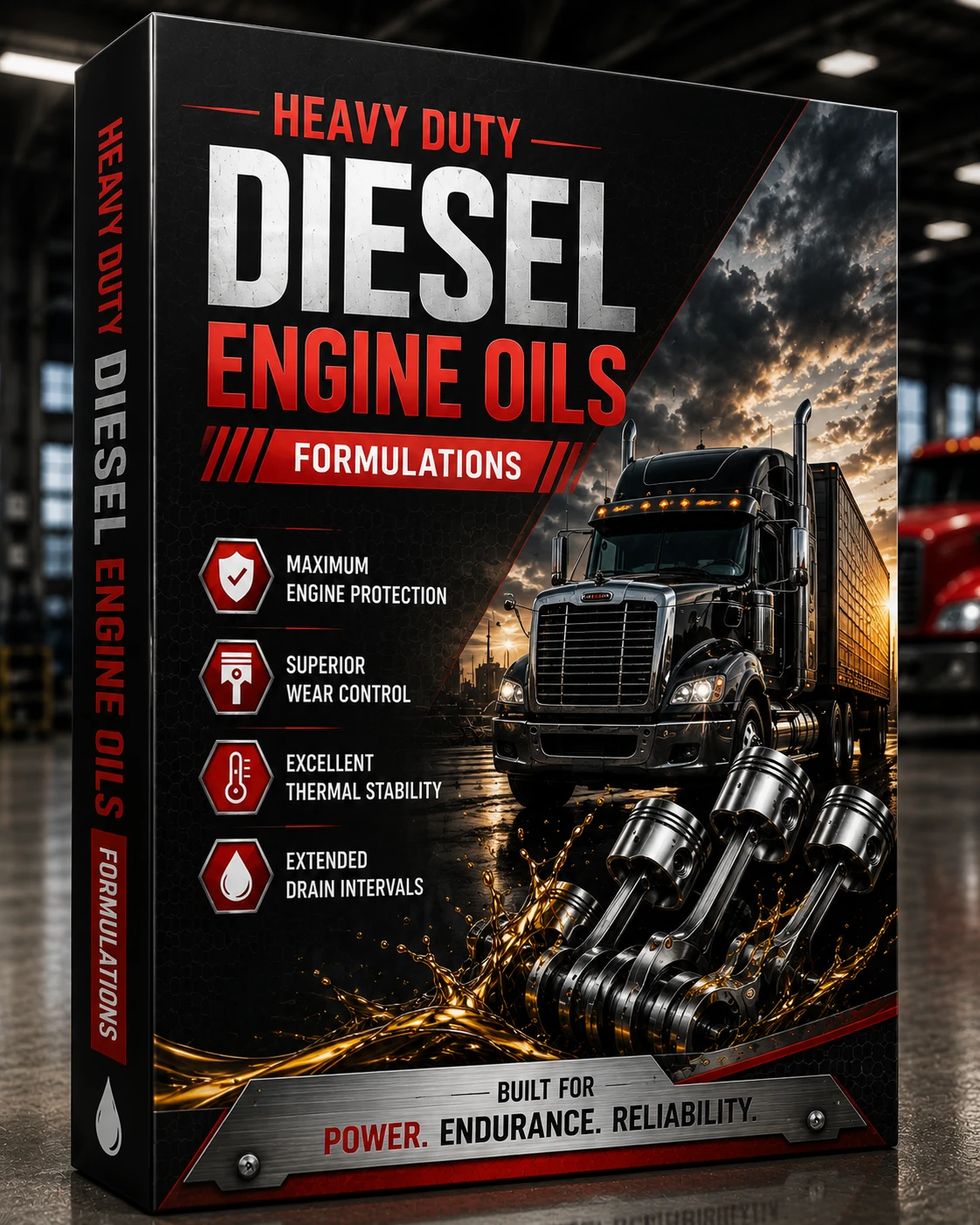
Heavy-Duty Diesel Engine Oils (HDEO) — Formulation Handbook is a professional-grade technical reference covering 50 starting-point formulations across 10 sub-categories. Built for lubricant blenders, R&D chemists, and automotive entrepreneurs, it covers the complete commercial diesel range: from high-TBN mono-grades for developing markets to synthetic API CK-4 multigrades, fuel-economy FA-4 oils, heavy-duty off-highway blends, and ultra-premium low-SAPS long-drain formulations.
The technology
The handbook explores the physical chemistry of compression-ignition engine lubrication, including the tribochemistry of ZDDP film formation under extreme loading, organic molybdenum boundary lubrication, and soot-dispersancy mechanisms under high EGR rates. It breaks down the formulation rules for base oils (API Groups I to V), metallic detergents (sulphonates, salicylates, phenates), ashless dispersants (borated and bis-PIBSI), polymer viscosity index improvers (OCP/PMA), and pour point depressants.
Inside the formulations
Each of the 50 formulations is presented in a structured card containing a 100 kg reference batch table (% w/w, component function, and sourcing tier), calculated TBN and ash contributions, target specifications (API, ACEA, OEM), manufacturing SOP, QC limits (KV100, KV40, VI, CCS, HTHS, Flash Point, Pour Point, NOACK), stability notes, and variants.
What you get
- 50 starting-point heavy-duty diesel engine oil formulations across 10 sub-categories
- Coverage of API CK-4, FA-4, and ACEA E6, E7, E9, E11 sequences
- Detailed component tables showing base oils, additives, VIIs, and PPDs with % w/w
- Soot management and dispersancy rules for high-EGR operations
- QC targets for KV100, CCS, HTHS, NOACK, and sulphated ash
- Blending SOPs, scale-up rules, and troubleshooting guides for batch failures
- Raw materials registry with chemical descriptions and sourcing options
Technical details
- Format
- A4 PDF · instant digital download
- Extent
- ~100 pages · 50 formulations · 10 sub-categories
- Standards
- API CK-4 / FA-4 · ACEA E6/E7/E9/E11 · IS 13656:2022 · OEM Approvals
- Tiers
- Economy (mineral) · Mid-range (semi-synthetic) · Premium (synthetic) · Specialist (PAO/ester)
- Audience
- Lubricant blenders · R&D chemists · transport fleet engineers · entrepreneurs
- Series
- Lubricants & Automotive Fluids Series · Volume 1 · Book 1.02
Accelerate your heavy-duty lubricant development — get 50 validated starting-point formulations across mono-grades, multigrades, off-highway, long-drain, and Low-SAPS categories, fully mapped to API CK-4 and ACEA E6/E9.
Who is this book for?
Commercial Lube Blender
You blend or contract-manufacture lubricants for transport fleets, bus services, or construction fleets, and need validated starting-point formulations from SAE 40 mono-grades to synthetic 10W-30 CK-4.
R&D Chemist
You work in industrial formulation and need a solid reference for soot dispersancy, TBN management in high-sulphur markets, and shear-stability criteria to benchmark your products.
Automotive Fluid Entrepreneur
You want to launch an own-brand heavy-duty oil series for transport companies and need a clear formulations reference, sourcing tips, and scale-up guidance.
Table of Contents
- Performance Classifications: API CK-4, FA-4, ACEA E6/E7/E9 sequences, IS 13656:2022
- Viscosity Grade Selection: SAE J300 specification limits, grade select by climate
- Base Oil Chemistry: API Groups I to V, selection criteria, solvency and NOACK limits
- Additive Chemistry: Metallic detergents, PIBSI dispersants, ZDDP, antioxidants, VIIs, PPDs, friction modifiers
- SAPS limits & DPF/SCR compatibility, soot management under EGR, TBN consumption pathways
- Sub-cat 1: SAE 40 Mono-Grade HDEO [Mineral] (F1–F3)
- Sub-cat 2: SAE 50 Mono-Grade HDEO [Mineral] (F4–F6)
- Sub-cat 3: Standard SAE 15W-40 HDEO [Mineral/Semi-Syn] (F7–F9)
- Sub-cat 4: Premium SAE 15W-40 HDEO [Syn] (F10–F12)
- Sub-cat 5: Multigrade HDEO — 10W-30 to 20W-50 [Mineral/Semi-Syn] (F13–F20)
- Sub-cat 6: SAE 5W-30/5W-40 HDEO [Syn] (F21–F30)
- Sub-cat 7: SAE 10W-30 FA-4 HDEO (F31–F34)
- Sub-cat 8: Off-Highway & Construction HDEO (F35–F40)
- Sub-cat 9: Premium Long-Drain HDEO [PAO/Ester] (F41–F45)
- Sub-cat 10: Low-SAPS HDEO for DPF/SCR [Syn] (F46–F50)
- Blending vessel geometry and agitator setups
- Dosing sequences and temperature profiles
- SOPs for blending, filtration, and drumming
- Pilot batch protocols and laboratory scale-up rules
- Sourcing base oils (Group I, II, III, PAO, Esters)
- Additive package options and supplier equivalents
- VII polymer types (OCP vs. PMA) and shear stability indices
- Friction modifiers, pour point depressants, and antifoams
- Resolving cold-cranking simulator (CCS) failures
- Correcting out-of-spec viscosity at 100°C
- Handling foam (Sequence I-III) and air entrapment issues
- Resolving water contamination and additive drop-out
- HDEO Technical Glossary
- ASTM & ISO test methods reference list
- CAS number registry for core HDEO raw materials
See what's inside
Frequently asked questions
They are validated starting points. You will need to bench-test and adapt treat rates to your specific raw material lots, but you start from a working formulation — not a blank sheet.
The handbook is a PDF — high-resolution A4, printable, with bookmarks and a linked table of contents. You receive an instant download link and it is also available in your library indefinitely.
Up to 5 downloads are included with your purchase. If you need more, contact us and we will reset your download limit.
Yes. The handbook opens with a fundamentals section that explains the underlying chemistry and ingredient functions before presenting formulations — so beginners can follow the rationale, not just the recipe.
Yes, it provides starting formulations designed to meet current performance standards, including API CK-4, FA-4, and European ACEA E6/E9 sequences, incorporating SAPS constraints (ash, phosphorus, sulphur) required for modern DPF/SCR aftertreatment.
CK-4 formulations maintain a high HTHS viscosity (≥ 3.5 mPa·s) for maximum hardware protection and backward compatibility, while FA-4 formulations are low-viscosity (HTHS 2.9–3.2 mPa·s) designed specifically for modern fuel-economy engines.
Yes, the handbook covers mono-grade and standard multigrade formulations with elevated TBN levels (up to 14–16 mg KOH/g) utilizing robust calcium sulphonate/phenate detergent packages to neutralise acids in markets where fuel sulphur exceeds 500 ppm.
Yes, Sub-category 9 covers premium long-drain formulations using Group IV PAO and Group V ester co-bases combined with low-SSI polymers (SSI ≤ 15) to achieve 100,000+ km drain capabilities.