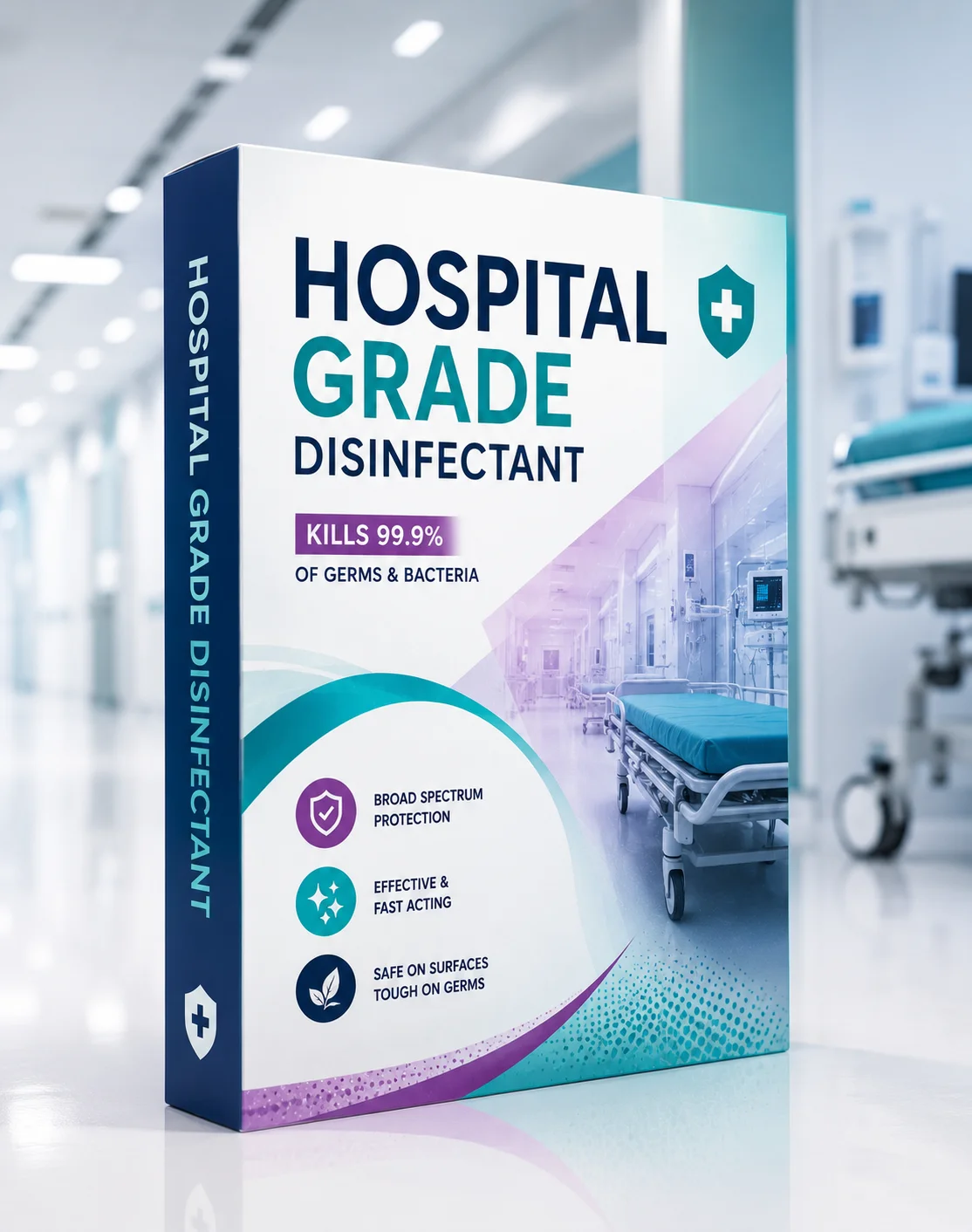
Hospital-Grade Disinfectants & Sanitisers — Formulation & Standards Guide
About this book
Hospital-Grade Disinfectants & Sanitisers — Formulation & Standards Guide is a print-grade technical reference covering 36 validated starting-point formulations across the full hospital disinfection stack — alcohol-based hand rubs (surgical and hygienic), quaternary ammonium and chlorine-releasing surface disinfectants, peracetic acid and hydrogen peroxide high-level disinfectants, glutaraldehyde and OPA cold sterilants for endoscope reprocessing, chlorhexidine and iodophor antiseptics, enzymatic instrument pre-cleaning, phenolic disinfectants and no-touch foam sanitising systems. Written for infection-control leads, CSSD/endoscopy reprocessing managers and disinfectant manufacturers, every formulation is mapped to the Spaulding classification and the EN/ASTM efficacy standard its kill-level claim requires.
The technology
The handbook develops each disinfectant mechanism mechanistically: alcohol protein denaturation and membrane disruption at the 60–80% v/v concentration window where water content drives denaturation throughout the organism; quaternary ammonium cationic membrane disruption, potentiated against Gram-negative organisms by EDTA outer-membrane permeabilisation; chlorine and NaDCC non-specific oxidation with sporicidal dosing for C. difficile-relevant claims; the peracetic acid/hydrogen peroxide equilibrium system that sustains high-level disinfection capacity over shelf life; glutaraldehyde and OPA protein cross-linking via free amine reaction for cold sterilisation; chlorhexidine cationic substantivity for persistent antisepsis; and multi-enzyme (protease/amylase/lipase) pre-cleaning to prevent soil-shielded disinfection failure.
Inside the formulations
All 36 formulations are structured across Economy, Mid-range, Premium and Specialty tiers in 9 sub-categories. Each block gives a 100 kg reference batch component table with INCI/IUPAC names, % w/w and sourcing tier, condensed manufacturing method, QC targets naming the specific EN/ASTM test method (EN 1276, EN 13727, EN 14476, EN 13624, EN 14348, EN 13704, EN 1500, EN 12791), stability and shelf-life notes, variants and modifications, and a scientific basis explaining the mechanism behind every component.
What you get
- 36 starting-point formulations across 9 disinfectant and antiseptic sub-categories
- Component tables with INCI/IUPAC names, % w/w, mechanism and sourcing tier
- QC targets referencing EN 1276/13727/14476/13624/14348/13704/1500/12791
- Manufacturing SOPs with explosion-proof and ventilated-area handling guidance
- 28-material raw materials reference with CAS numbers and substitution notes
- Troubleshooting tables covering active-concentration decay and pre-clean failure modes
Technical details
- Format
- A4 PDF · instant digital download
- Extent
- ~135 pages · 36 formulations · 9 sub-categories
- Standards
- EU BPR · US EPA/FIFRA · India CDSCO/BIS · WHO hand hygiene · CDC guidelines · NABH
- Tiers
- Economy · Mid-range · Premium · Specialty
- Audience
- Infection-control leads · CSSD/endoscopy reprocessing managers · disinfectant manufacturers
- Series
- Household & Industrial Cleaners Series · Volume 5 · Book 5.04
An under-strength disinfectant looks identical to a fully effective one — surfaces appear clean either way. Get 36 validated formulations across every Spaulding-classified kill level, with point-of-use concentration verification built into every QC target.
Who is this book for?
Hospital Infection-Control Lead
You manage infection-control chemistry for wards, theatres and isolation units and need validated alcohol, QAC, chlorine, PAA and phenolic disinfectant formulations mapped to the Spaulding classification and the EN efficacy standard your kill claim requires.
Endoscope Reprocessing / CSSD Manager
You run instrument reprocessing for endoscopy or sterile services and need high-level disinfectant and cold-sterilant chemistry — glutaraldehyde, OPA, PAA — alongside the enzymatic pre-cleaning formulations that prevent residual soil from shielding organisms in narrow lumens.
Disinfectant Manufacturer
You formulate or toll-manufacture biocidal products and want to expand from a single chemistry family into the full hospital-grade range — antiseptics, surface disinfectants, cold sterilants and no-touch foam sanitisers — with EN/ASTM-referenced QC targets and GHS-compliant safety data built in.
Table of Contents
- Disinfectant chemistry: protein denaturation, oxidation, cross-linking, halogenation
- Spaulding classification and the sanitisation → high-level disinfection → sterilisation hierarchy
- Soil tolerance and organic-challenge testing under EN "dirty conditions"
- EN/ASTM efficacy standards and BPR/EPA/CDSCO/NABH compliance anchors
- F1–F4: Alcohol-Based Hand Rub Disinfectants (Surgical & Hygienic)
- F5–F8: Quaternary Ammonium (QAC) Surface Disinfectants
- F9–F12: Chlorine-Releasing Disinfectants
- F13–F16: Peracetic Acid & Hydrogen Peroxide High-Level Disinfectants
- F17–F20: Glutaraldehyde & OPA Cold Sterilants
- F21–F24: Iodophor & Chlorhexidine Antiseptics
- F25–F28: Enzymatic Pre-Cleaning & Instrument Decontaminants
- F29–F32: Phenolic Disinfectants
- F33–F36: Foam & No-Touch Hand Sanitising Systems
- Explosion-proof and ventilated-area handling for alcohol and aldehyde batching
- Manufacturing sequence SOPs by chemistry family with segregated production lines
- Scale-up notes: alcohol evaporative loss, aldehyde vapour exposure, enzyme hot-spots
- Pilot-batch checklist including third-party efficacy validation sign-off
- 28 raw materials with CAS numbers, use levels and sourcing tiers
- DDAC/ADBAC, glutaraldehyde/OPA and chlorhexidine selection and substitution notes
- Cost-tier guide for specialty biocidal actives and enzymes
- Active-concentration decay diagnostics for chlorine, PAA and aldehyde products
- Enzymatic pre-clean failure and endoscope channel biofilm root-cause analysis
- Persistence loss in chlorhexidine/iodophor antiseptics and stability failure reference
See what's inside
Frequently asked questions
They are validated starting points. You will need to bench-test and adapt treat rates to your specific raw material lots, but you start from a working formulation — not a blank sheet.
The handbook is a PDF — high-resolution A4, printable, with bookmarks and a linked table of contents. You receive an instant download link and it is also available in your library indefinitely.
Up to 5 downloads are included with your purchase. If you need more, contact us and we will reset your download limit.
Yes. The handbook opens with a fundamentals section that explains the underlying chemistry and ingredient functions before presenting formulations — so beginners can follow the rationale, not just the recipe.
The Spaulding classification (critical / semi-critical / non-critical) determines the minimum disinfection level a device or surface requires. Every formulation in this handbook states which kill level it achieves — sanitisation, low/intermediate disinfection, high-level disinfection or sterilisation — so you select the right sub-category for the device classification you are reprocessing, not just the strongest available chemistry.
Residual blood, mucus or tissue protein that escapes pre-cleaning can shield embedded organisms from high-level disinfectant chemistry entirely, regardless of how rigorously the disinfection step is performed. Part 5 identifies inadequate pre-cleaning — particularly in narrow-lumen endoscope channels — as a leading root cause of reprocessing-related infection-control incidents, which is why F25–F28 are dedicated protease/amylase/lipase formulations, not an afterthought.
Every QC target in this book names the test method (iodometric titration for chlorine/PAA, GC for alcohol, HPLC for chlorhexidine/OPA) specifically so you can verify point-of-use concentration rather than trusting the labelled strength. Part 5 explains why under-strength disinfectant shows no visible sign of failure — surfaces look identical whether the active concentration is at full strength or has decayed below the validated threshold.
Yes. F35 is a non-alcohol benzalkonium chloride foam sanitiser formulated specifically for environments where alcohol vapour presents an ignition risk or is otherwise restricted, with the QAC mechanism's slower kill kinetics and correspondingly longer validated contact time explained.