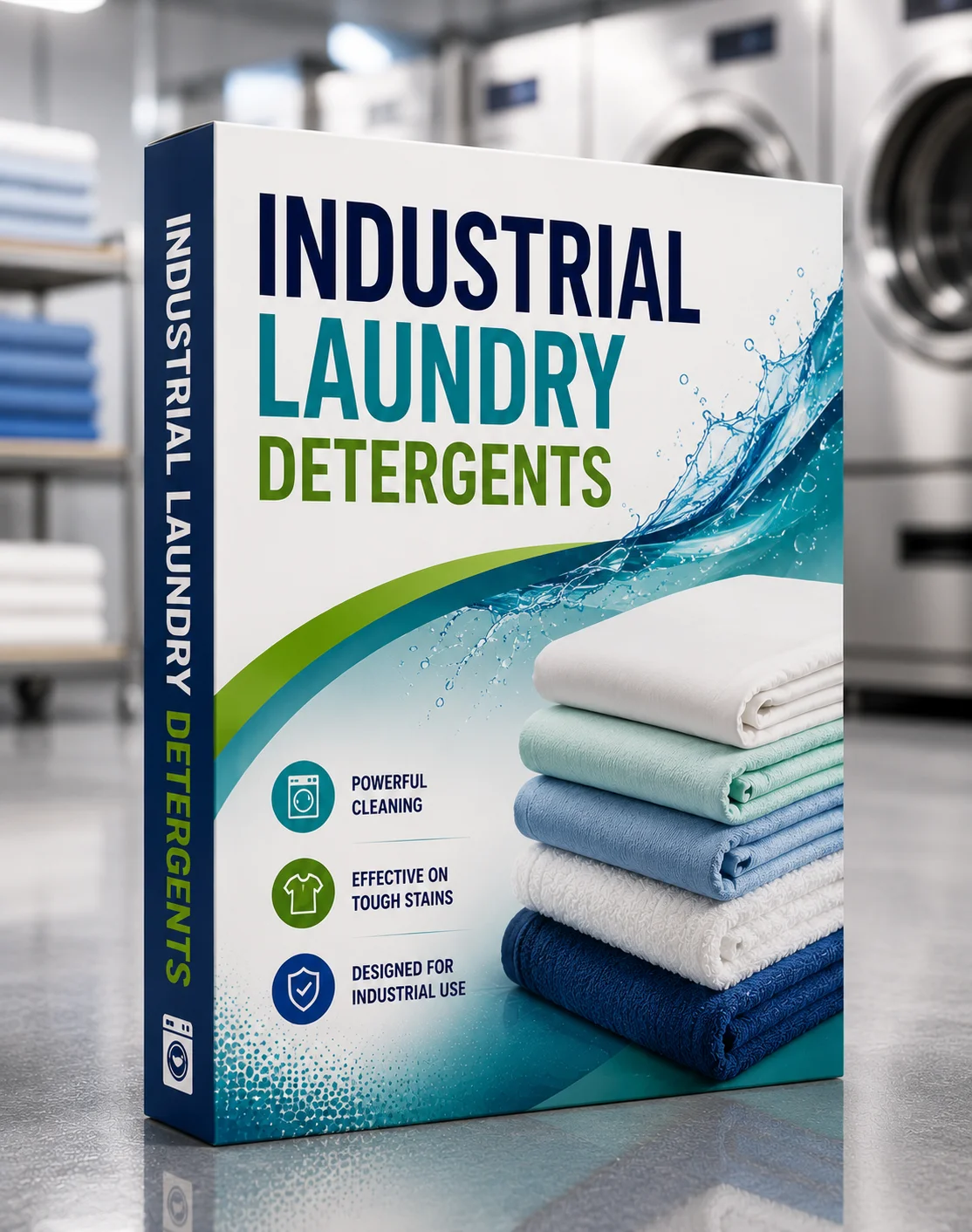
Industrial Laundry Detergents — Heavy-Duty & Institutional Formulation Guide
About this book
Industrial Laundry Detergents — Heavy-Duty & Institutional Formulation Guide is a print-grade technical reference covering 40 validated starting-point formulations across the full institutional laundry spectrum — heavy-duty powder and liquid concentrates, healthcare and medical linen, food-service and HACCP-compliant, workwear and flame-retardant fabric care, hotel/hospitality on-premise laundry, tunnel/continuous-batch-washer systems, cold-water/energy-efficient grades, chemothermal disinfection and sports/technical fabric care. Written for industrial laundry operators, healthcare/food-service linen managers and detergent manufacturers, every formulation is engineered for 50–300 kg loads, water hardness up to 400 mg/L, and the EN 14065 RABC, EN 1276 and EN ISO 11612 standards that govern institutional laundry.
The technology
The handbook develops detergency at institutional scale across its four governing forces: wetting (LABS reducing surface tension from ~72 to ~30 mN/m above CMC), emulsification (nonionic alcohol ethoxylates and APGs solubilising oily soil into mixed micelles), suspension (CMC-Na and AA/MA copolymer anti-redeposition agents creating electrostatic repulsion at –25 to –40 mV zeta potential) and enzymatic soil breakdown (serine proteases, α-amylases, lipases, cellulases and mannanases reducing soil molecular weight for micelle encapsulation). Bleaching and disinfection chemistry covers sodium percarbonate/TAED low-temperature activation, peracetic acid chemothermal disinfection validated to EN 1276, and QAC/hypochlorite disinfection compatibility constraints. Builder chemistry — STPP, Zeolite 4A, and the phosphate-free gluconate/citrate/AA-MA copolymer triad — is selected against the calcium/magnesium sequestration demand of institutional water hardness.
Inside the formulations
All 40 formulations are structured across Economy, Mid-range, Premium and Specialty tiers in 10 sub-categories. Each block gives a component table with INCI/IUPAC names, % w/w and mechanism of action, QC targets and stability data for every formulation, condensed manufacturing method, and a scientific basis grounded in the enzyme, builder and bleach activation chemistry developed in Part 1.
What you get
- 40 starting-point formulations across 10 industrial laundry sub-categories
- Component tables with INCI/IUPAC names, % w/w, mechanism of action and sourcing tier
- QC targets and stability data referencing EN 14065 RABC, EN 1276 and EN ISO 11612
- Manufacturing SOPs for liquid and powder production with batch record template and scale-up notes
- 45+ compound raw materials index with CAS numbers, cost tiers and substitution guide
- Sub-category failure-mode troubleshooting tables and stability failure reference
Technical details
- Format
- A4 PDF · instant digital download
- Extent
- ~150 pages · 40 formulations · 10 sub-categories
- Standards
- EN 14065 (RABC) · EN 1276 · EN ISO 11612 · EU Regulation 648/2004 · HACCP
- Tiers
- Economy · Mid-range · Premium · Specialty
- Audience
- Industrial laundry operators · healthcare/food-service linen managers · detergent manufacturers
- Series
- Household & Industrial Cleaners Series · Volume 1 · Book 1.07
Industrial laundry runs 50–300 kg loads at up to 95°C against 400 mg/L hard water — domestic detergent chemistry breaks down at this scale. Get 40 validated heavy-duty formulations across healthcare, food-service, flame-retardant and chemothermal disinfection laundry, built for institutional volume.
Who is this book for?
Industrial Laundry Operator
You run or supply an industrial or institutional laundry — hotel, healthcare, food-service or workwear — and need heavy-duty powder and liquid detergent formulations validated for 50–300 kg loads, hard water up to 400 mg/L, and EN 14065 RABC process-hygiene compliance.
Healthcare/Food-Service Linen Manager
You manage laundry for hospitals or food-service operations and need detergents that meet EN 14065 RABC microbiological exit criteria or HACCP fragrance/dye/OBA-free requirements, with chemothermal or chemical disinfection pathways correctly validated.
Detergent Manufacturer
You manufacture laundry chemicals and want to expand from consumer-scale formulations into the institutional segment — heavy-duty powder/liquid concentrates, flame-retardant fabric care, tunnel washer chemistry and chemothermal disinfection systems — with full enzyme and bleach activation technology.
Table of Contents
- Detergency at scale: wetting, emulsification, suspension and anti-redeposition at 50–300 kg/95°C
- Builder and sequestrant chemistry: STPP, Zeolite 4A, phosphate-free gluconate/citrate/AA-MA triad
- Enzyme technology: protease, amylase, lipase, cellulase, mannanase — pH and temperature optima
- Bleaching and disinfection: sodium percarbonate/TAED, peracetic acid chemothermal, QAC, hypochlorite
- EN 14065 (RABC), EN 1276, EN ISO 11612 (FR fabric) and HACCP compliance framework
- Heavy-Duty Powder Detergent
- Heavy-Duty Liquid Concentrate
- Healthcare & Medical Linen
- Food Service & HACCP-Compliant
- Workwear & Flame-Retardant Fabric
- Hotel & Hospitality OPL
- Tunnel / Continuous Batch Washer
- Cold-Water & Energy-Efficient
- Chemothermal Disinfection
- Sports & Technical Fabric
- Equipment and plant setup for powder and liquid heavy-duty production
- Manufacturing sequence SOPs with enzyme stabilisation protocols
- Scale-up notes and batch record template
- 45+ compound raw materials index with CAS numbers and cost tiers
- Builder and enzyme substitution guide
- Sourcing tiers by formulation segment
- Sub-category failure-mode troubleshooting tables and stability failure reference
- Enzyme denaturation and bleach activation diagnostics
- FR fabric pH-ceiling and HACCP fragrance/dye/OBA-free compliance failures
See what's inside
Frequently asked questions
They are validated starting points. You will need to bench-test and adapt treat rates to your specific raw material lots, but you start from a working formulation — not a blank sheet.
The handbook is a PDF — high-resolution A4, printable, with bookmarks and a linked table of contents. You receive an instant download link and it is also available in your library indefinitely.
Up to 5 downloads are included with your purchase. If you need more, contact us and we will reset your download limit.
Yes. The handbook opens with a fundamentals section that explains the underlying chemistry and ingredient functions before presenting formulations — so beginners can follow the rationale, not just the recipe.
Industrial laundry processes 50–300 kg loads at temperatures up to 95°C against water hardness reaching 400 mg/L CaCO₃ — conditions that overwhelm domestic-scale surfactant and builder systems. Every formulation in this book is built for that scale, with builder loadings, enzyme stability and bleach activation calibrated to institutional volume and hardness, not retail-pack chemistry.
EN 14065 (Risk Analysis and Biocontamination Control) is the process-hygiene standard for laundry supplying healthcare, food-service and pharmaceutical sectors. It requires documented risk assessment, defined critical control points, validated wash processes and microbiological exit criteria (<2.5 CFU/cm² total bacterial count). The Healthcare & Medical Linen and Chemothermal Disinfection sub-categories are built around this standard's thermometry and chemical dosing log requirements.
Yes — this is a regulatory liability the handbook addresses directly. FR garment care labels specify a maximum wash pH and prohibit bleach for fabrics like Proban, Pyrovatex and Nomex; exceeding the stated pH or using bleach can reduce FR performance below the rated EN ISO 11612 value. The Workwear & Flame-Retardant Fabric sub-category formulates within these pH-ceiling constraints explicitly.
Chemothermal disinfection combines moderate wash temperature with a chemical disinfectant (typically peracetic acid) to achieve the log-reduction that either alone could not deliver economically — useful where full thermal disinfection (≥65°C sustained) is impractical. The Chemothermal Disinfection sub-category formulates PAA systems validated to EN 1276 5-log-reduction criteria at 40°C/10-minute contact, as an EN 14065-accepted alternative pathway to thermal-only disinfection.