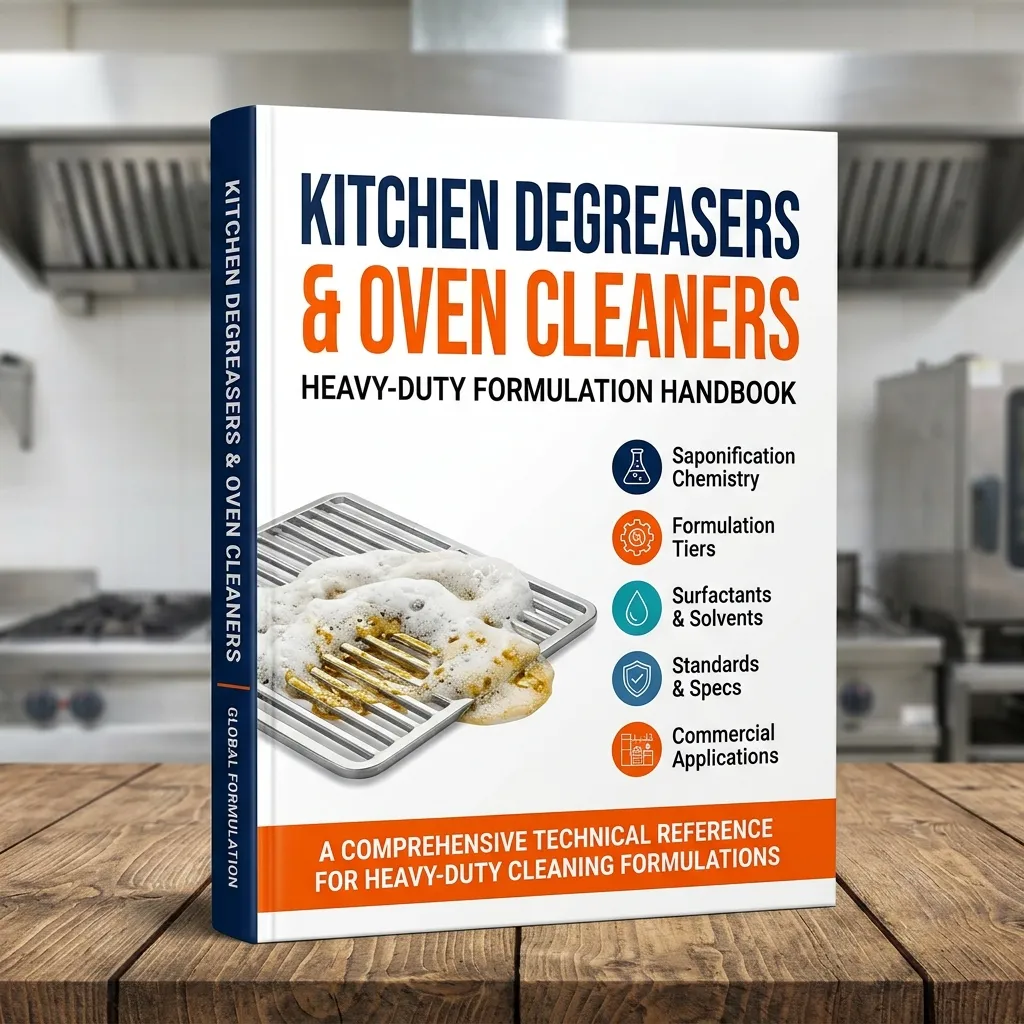
Kitchen Degreasers & Oven Cleaners — Heavy-Duty Formulation Handbook
About this book
Kitchen Degreasers & Oven Cleaners — Heavy-Duty Formulation Handbook is a technical reference detailing 32 formulations. Spanning caustic oven gels, trigger foams, aluminum-safe range hood sprays, commercial boil-outs, and duct-cleaning concentrates, it bridges organic solvent swelling and alkaline saponification chemistry.
The technology
The handbook covers the science of grease removal: triglyceride saponification by hydroxides, solvent penetration of cross-linked lipid networks, and silicate passivation of soft metals. It details high-temperature humectants, aerosol propellants, and biodegradable chelants like GLDA.
Inside the formulations
All 32 formulations are presented across Economy, Mid-range, Premium, and Specialty tiers in 8 categories. Each block details exact compositions (% w/w), systematic IUPAC/INCI ingredient names, blending sequences, QC test targets, stability warnings, and detailed scientific bases.
What you get
- 32 starting formulations across 8 kitchen cleaning sub-categories
- Detailed component tables with IUPAC/INCI names, weight %, and functions
- QC test methods and specification targets mapped to IS 16419 and ASTM standards
- Detailed manufacturing SOPs for liquid gels, aerosol concentrates, and powders
- Troubleshooting matrices for gel syneresis, aluminum staining, and foam control
Technical details
- Format
- A4 PDF · instant digital download
- Extent
- ~150 pages · 32 formulations · 8 sub-categories
- Standards
- IS 16419, ASTM E70/D2196/D4488, EN 1276, ISO 2271
- Tiers
- Economy · Mid-range · Premium · Specialty
- Audience
- Industrial kitchen chemical manufacturers · contract packers · chemists
- Series
- Household & Industrial Cleaners Series · Volume 3 · Book 3.03
Baked-on carbon and polymerised grease are the hardest soils to clean — this handbook gives you 32 validated formulations to strip them safely and quickly.
Who is this book for?
Commercial Kitchen Supplier
You supply restaurants and catering services and need professional-grade cleaners, griddle gels and hood degreasers that perform under tough kitchen conditions.
Auto & Kitchen Care Brand Builder
You want to launch high-margin grease-cleaning products and need a complete technical foundation covering caustic, solvent-based and aluminum-safe options.
R&D Chemist
You need reference formulations across multiple substrates and temperature profiles to benchmark your existing work or accelerate new product development.
Table of Contents
- Triglyceride saponification
- Solvent grease swelling mechanisms
- Substrate constraints and aluminum safety
- Surfactant and builder stability in high pH
- Caustic Oven & Grill Gels (F1–F4)
- Aerosol & Clinging Foam Oven Cleaners (F5–F8)
- High-temperature griddle foam
- RTU Kitchen Degreaser Sprays (F9–F12)
- Aluminium-Safe Kitchen Degreasers (F13–F16)
- Dip tank concentrates
- Commercial Deep-Fat Fryer Boil-Outs (F17–F20)
- Heavy-Duty Hood & Exhaust Duct Degreasers (F29–F32)
- High-pressure foam systems
- Eco-Friendly Bio-Based Degreasers (F21–F24)
- Concentrated Sanitising Degreasers (F25–F28)
- Dual-action sanitizers
- Compounding SOPs
- Exothermic safety management
- Supplier substitution guide
- Troubleshooting matrices
See what's inside
Frequently asked questions
They are validated starting points. You will need to bench-test and adapt treat rates to your specific raw material lots, but you start from a working formulation — not a blank sheet.
The handbook is a PDF — high-resolution A4, printable, with bookmarks and a linked table of contents. You receive an instant download link and it is also available in your library indefinitely.
Up to 5 downloads are included with your purchase. If you need more, contact us and we will reset your download limit.
Yes. The handbook opens with a fundamentals section that explains the underlying chemistry and ingredient functions before presenting formulations — so beginners can follow the rationale, not just the recipe.
We use Sodium Metasilicate or Potassium Silicate, which deposits a protective amorphous silicate film over the aluminum substrate, blocking alkaline attack.
Boil-outs operate near 100 °C. We utilize low-foam EO/PO block copolymers (like Pluronic PE 6100) that maintain detersive wetting without building a foam blanket, preventing boil-over.
Yes. Premium and specialty griddle cleaners incorporate glycerin and glycols as high-boiling carriers to prevent flashing, allowing KOH to work effectively at 80–150 °C.