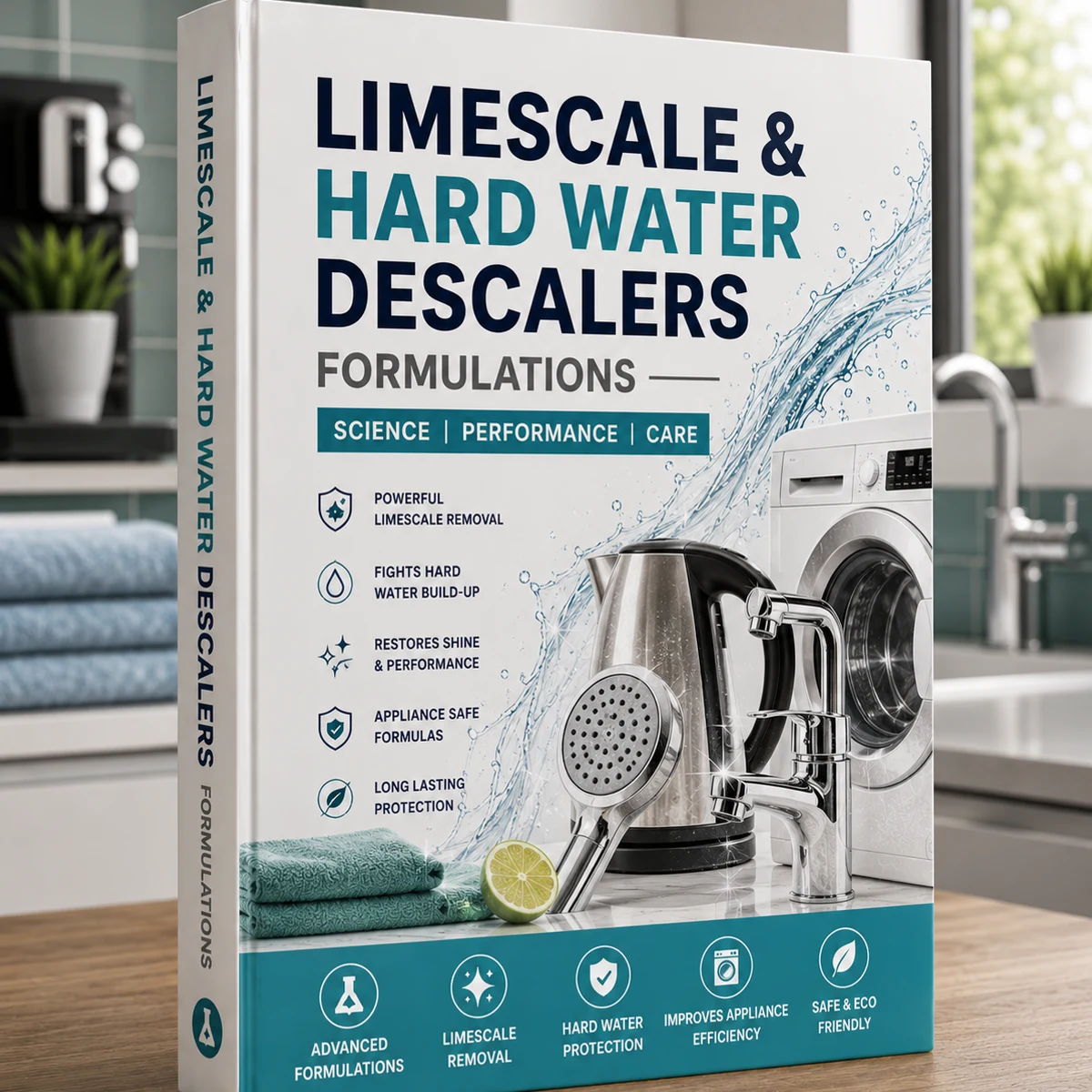
Limescale & Hard-Water Descalers — Technical Formulation Guide
About this book
Limescale & Hard-Water Descalers — Technical Formulation Guide covers 32 validated starting-point formulations across 8 descaler sub-categories — household bath and shower sprays, domestic appliance descalers (kettles, coffee machines, dishwashers), heavy-duty toilet bowl descaler gels, industrial boiler and heat exchanger CIP acids, food-plant CIP acidic cleaners, specialty glass and metal stain removers, eco-friendly organic-acid descalers, and automotive radiator flushes. The full acid toolkit is covered: citric, lactic, sulfamic, phosphoric, acetic, malic, hydrochloric (industrial), and chelant-based sequestrant descalers — each selected for its substrate safety, scale dissolution rate and regulatory status.
The technology
The handbook develops descaler chemistry from the scale mineralogy up: calcium carbonate (CaCO₃) proton-attack dissolution kinetics, gypsum (CaSO₄) and silica scale chemistry that resists simple acid attack, and the chelant competition equilibrium that makes EDTA and HEDP effective against calcium and magnesium even in near-neutral pH. Acid selection is framed by substrate safety: citric acid for food-contact aluminium and stainless steel (pH 2–3, <2% for appliances); sulfamic acid for descaling without strong-acid fumes; phosphoric acid for steel and industrial surfaces; HCl for industrial boilers with benzimidazole-type corrosion inhibitor protection. Corrosion inhibitor chemistry is treated in depth: propargyl alcohol ethoxylate and quinoline derivatives that form a protective film on metal substrates in the presence of strong acid, passivating carbon steel at pH <1. Eco-descaler technology covers citric + lactic + malic acid blends with naturally-derived GLDA sequestrant — meeting EU Ecolabel criteria without sacrificing performance.
Inside the formulations
All 32 formulations are structured across Economy, Mid-range, Premium and Specialty tiers in 8 sub-categories. Each block gives component table with INCI/IUPAC name, % w/w, function, sourcing tier, manufacturing SOP (including acid-handling and exotherm safety), QC targets (pH, total acidity, calcium dissolution rate, corrosion coupon test), stability data and substrate compatibility matrix.
What you get
- 32 starting formulations across 8 descaler sub-categories
- Household appliance descalers: citric, lactic, sulfamic acid systems for food-contact compliance
- Industrial boiler and heat exchanger CIP acids with corrosion inhibitor (benzimidazole, propargyl)
- Food-plant CIP acidic cleaners compliant with food-contact material regulations
- Eco-friendly organic-acid descalers: citric + lactic + malic + GLDA — EU Ecolabel-eligible
- Heavy-duty toilet bowl descaler gels: HCl-based with corrosion inhibitor and HPAM thickener
- Component tables, % w/w, manufacturing SOPs and acid-handling safety protocols
- QC targets: pH, total acidity, calcium dissolution rate, metal corrosion coupon test, ASTM/ISO methods
Technical details
- Format
- A4 PDF · instant digital download
- Extent
- ~130 pages · 32 formulations · 8 sub-categories
- Acids Covered
- Citric · lactic · sulfamic · phosphoric · acetic · malic · HCl · EDTA / HEDP / GLDA chelants
- Standards
- ASTM · ISO · GHS · EU Ecolabel criteria · food-contact material regulations
- Tiers
- Economy · Mid-range · Premium · Specialty
- Audience
- Household chemical manufacturers · industrial maintenance suppliers · R&D chemists
- Series
- Household & Industrial Cleaners Series · Volume 3 · Book 3.06
Hard water scale destroys appliances and surfaces — get 32 validated descaler formulations from household bath sprays to industrial boiler CIP acids, ready for commercial manufacture.
Who is this book for?
Household Chemicals Manufacturer
You blend domestic cleaning products and want to extend into the high-value descaler category with validated formulations for kettles, showers and dishwashers.
Industrial Maintenance Supplier
You supply descaling chemicals to food plants, boiler rooms and heat exchanger maintenance teams and need formulations that meet food-contact and industrial safety standards.
R&D Chemist
You need reference formulations across organic and mineral acid systems, sequestrant-based descalers and eco-certified alternatives with full QC targets.
Table of Contents
- Limescale chemistry — calcium carbonate, gypsum and silica scale
- Acid dissolution mechanisms — citric, lactic, sulfamic, phosphoric, hydrochloric
- Sequestrant and chelant descaling chemistry
- Substrate safety and corrosion inhibition
- Standards and test methods (ASTM, ISO)
- Household Bath & Shower Descalers — F1 to F4
- Appliance Descalers (Kettles & Coffee Makers) — F5 to F8
- Heavy-Duty Toilet Bowl Descaler Gels — F9 to F12
- Industrial Boiler & Heat Exchanger Descalers — F13 to F16
- Food-Plant CIP Acidic Cleaners — F17 to F20
- Specialty Glass & Metal Stain Removers — F21 to F24
- Eco-Friendly Organic Descalers — F25 to F28
- Automotive Radiator Flushes — F29 to F32
- Compounding SOPs for liquid, gel and powder descalers
- Acid handling and safety protocols
- Scale-up notes for CIP and food-grade systems
- Raw materials with INCI names, CAS numbers and sourcing tiers
- Corrosion inhibitor supplier substitution guide
- Cost-tier register and BoM analysis
- Scale dissolution failure and pH drift diagnostic matrices
- Metal etching and substrate damage prevention
- Stability and shelf-life failure tables
See what's inside
Frequently asked questions
They are validated starting points. You will need to bench-test and adapt treat rates to your specific raw material lots, but you start from a working formulation — not a blank sheet.
The handbook is a PDF — high-resolution A4, printable, with bookmarks and a linked table of contents. You receive an instant download link and it is also available in your library indefinitely.
Up to 5 downloads are included with your purchase. If you need more, contact us and we will reset your download limit.
Yes. The handbook opens with a fundamentals section that explains the underlying chemistry and ingredient functions before presenting formulations — so beginners can follow the rationale, not just the recipe.
Yes. F17–F20 (CIP cleaners) use food-grade phosphoric and citric acid systems compliant with food-contact regulations, with no hazardous corrosion inhibitors.
Yes. F25–F28 use citric, lactic and malic acid with naturally-derived sequestrants — suitable for eco-label certification and green product positioning.