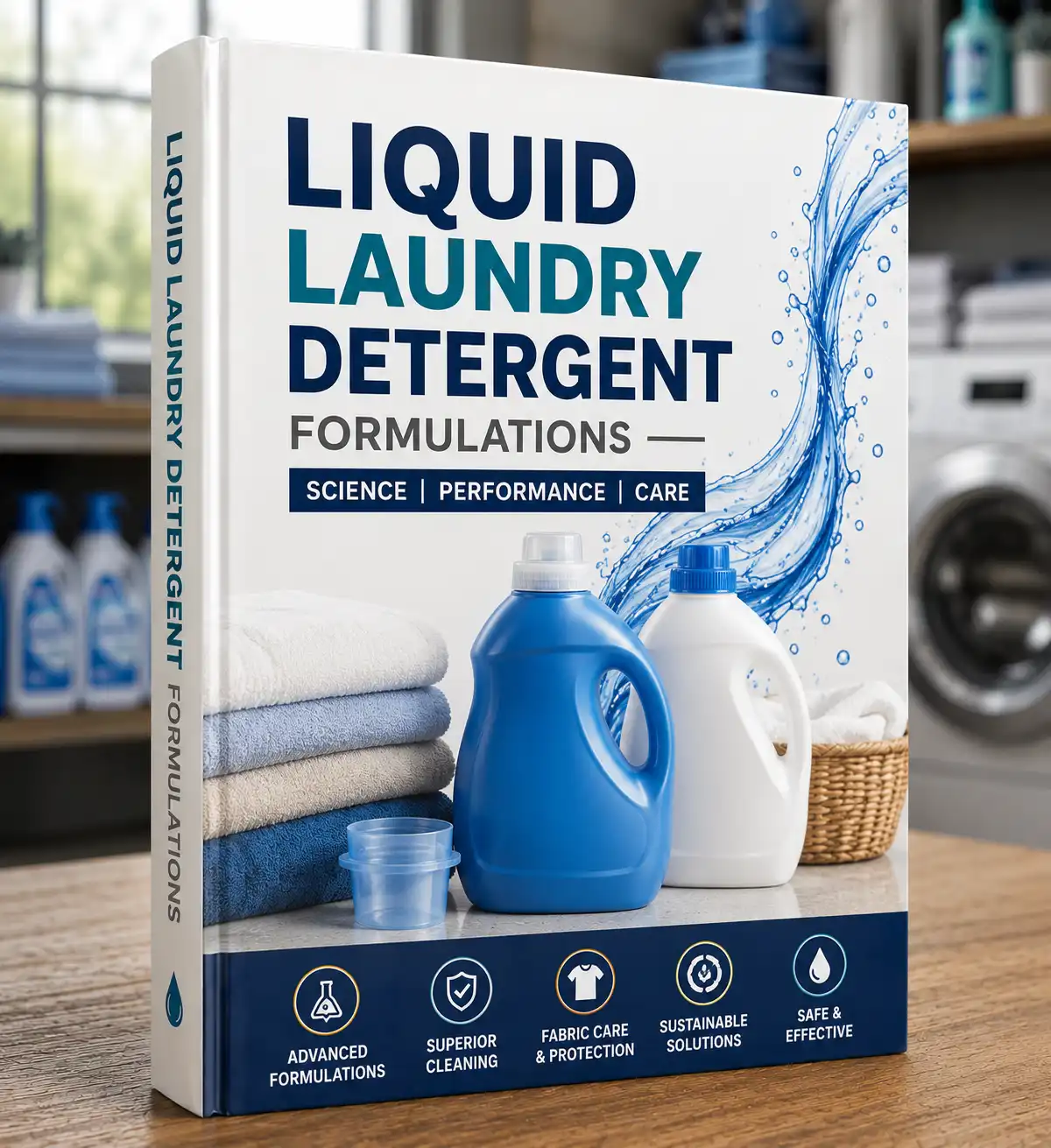
Liquid Laundry Detergents — Formulation Handbook
About this book
Liquid Laundry Detergents — Formulation Handbook is a print-grade technical reference covering 30 validated starting-point formulations across the full range of liquid laundry detergent types. It spans economy private-label through specialty export-grade products, enzyme-free through full 4-enzyme bio packages, consumer through heavy-duty institutional grades, and conventional through certified-natural formulations — all in one volume with full manufacturing guidance.
The technology
The handbook builds every formulation on established surfactant science — SLES, AOS, LABS, alcohol ethoxylates, APG and CAPB — with the builder and chelant systems (trisodium citrate, MGDA, GLDA, EDTA) that make them function in hard water. Enzyme chemistry is treated in depth: the serine hydrolase mechanism of subtilisin, lipase interfacial activation, amylase glycosidic bond cleavage, and the CaCl₂ + boronate ester + propylene glycol stabiliser system that keeps enzymes active in liquid storage. Cold-active enzyme engineering, soil anti-redeposition polymers (CMC, PVP, terephthalate-PEG), optical brighteners, dye transfer inhibition, ultra-concentrate hydrotrope systems and ECOCERT-compliant natural surfactant blends are all addressed with mechanistic depth.
Inside the formulations
All 30 formulations are structured across Economy, Mid-range, Premium and Specialty tiers in 8 sub-categories. Each block includes a component table with INCI names, % w/w as supplied (commercial grade noted), and a mechanistic Function entry for every ingredient — not just a label. Every block includes a condensed manufacturing method, QC targets with cited test methods (ASTM, IS 4955, ISO 2271), stability and shelf-life notes, variants and modifications, and a scientific basis anchored to published technical literature.
What you get
- 30 starting-point formulations across 8 liquid laundry detergent sub-categories
- Component tables with INCI names, % w/w, mechanism and sourcing tier
- QC targets tied to IS 4955, ISO 2271, ASTM D1173/D2196/E70, ISO 11930
- 15-step master manufacturing SOP with 7 Critical Control Points and batch record template
- 35-material raw materials reference with CAS numbers, substitution notes and cost-tier guide
- 40+ failure-mode troubleshooting entries across physical stability, enzyme, pH, foam, colour and microbial categories
Technical details
- Format
- A4 PDF · instant digital download
- Extent
- ~170 pages · 30 formulations · 8 sub-categories
- Standards
- IS 4955 (BIS), ISO 2271, ASTM, EU 648/2004, OECD 301B/D, ISO 11930, GHS
- Tiers
- Economy · Mid-range · Premium · Specialty
- Audience
- Detergent manufacturers · formulation chemists · brand launchers
- Series
- Household & Industrial Cleaners Series · Volume 1 · Book 1.02
Stop guessing surfactant ratios and enzyme stabiliser systems — get 30 validated liquid laundry detergent formulations from economy to ultra-concentrate, bio to baby-safe, ready to manufacture today.
Who is this book for?
Detergent Manufacturer
You blend or toll-manufacture laundry products and need credible, print-grade starting formulations across every tier and product type — from economy private-label to premium export-grade bio concentrates.
Brand Launcher
You're entering the liquid laundry market and need the technical foundation: surfactant systems, enzyme packages, chelant chemistry and manufacturing SOPs — without commissioning a full R&D programme.
Formulation Chemist
You work in detergent R&D and want a structured reference covering cold-active bio systems, ultra-concentrates, colour care, dark-garment care, industrial grades and certified-natural formulations.
Table of Contents
- Surfactant action and soil removal mechanism
- Builder and chelant chemistry (citrate, MGDA, GLDA, EDTA)
- Enzyme chemistry — protease, lipase, amylase, cellulase
- Optical brighteners, anti-redeposition polymers
- Grade structure and specification targets (IS 4955, EU 648/2004)
- Standard General-Purpose Liquid — F1 to F4 (Economy SLES/LAS-Na → Specialty coco-glucoside)
- Concentrated Liquid 2×–5× — F5 to F8 (hydrotrope-adjusted, sodium cumene sulfonate)
- Bio Liquid enzyme-containing — F9 to F12 (protease, lipase, amylase, cellulase, cold-active F12)
- Non-Bio / Sensitive Skin — F13 to F16 incl. F16 baby pH 6.5–7.5, sulfate-free, enzyme-free
- Colour Care and Dark Garment — F17 to F19 (dye-transfer inhibitor, low-OBA, neutral pH)
- Cold-Water Performance and Ultra-Concentrate — F20 to F22 (elevated nonionic:anionic, cold-active enzymes)
- Heavy-Duty Industrial Laundry — F23 to F26 (pH 10.5–11.5, chelant-boosted, hot-wash 60–85°C)
- Natural / Plant-Based incl. Eco-Concentrate — F27 to F30 (APG + AOS, ECOCERT-eligible F29, 5× eco-concentrate F30)
- Vessel construction, agitator selection and enzyme addition rules
- 15-step master SOP with 7 Critical Control Points
- Batch record template
- Scale-up notes: NaCl viscosity, APG handling, foam management
- 35 raw materials — INCI name, CAS number, use level, sourcing tier
- Supplier and substitution notes for every specialty material
- Cost-tier guide and BoM architecture by formulation tier
- 6 failure-mode tables covering 40+ symptoms
- Narrative on enzyme thermal denaturation, concentrate phase separation, sodium benzoate pH failure
- Quick-reference 27-row stability failure table
See what's inside
Frequently asked questions
They are validated starting points. You will need to bench-test and adapt treat rates to your specific raw material lots, but you start from a working formulation — not a blank sheet.
The handbook is a PDF — high-resolution A4, printable, with bookmarks and a linked table of contents. You receive an instant download link and it is also available in your library indefinitely.
Up to 5 downloads are included with your purchase. If you need more, contact us and we will reset your download limit.
Yes. The handbook opens with a fundamentals section that explains the underlying chemistry and ingredient functions before presenting formulations — so beginners can follow the rationale, not just the recipe.
Yes. Sub-category 6 (F20–F22) is dedicated to cold-water performance with elevated nonionic:anionic ratios and cold-active enzyme variants. Sub-category 3 also includes F12, a specialty cold-active bio formulation with all four cold-active enzymes.
Yes. Every enzyme-containing formulation includes the full CaCl₂ + sodium tetraborate + propylene glycol stabiliser package with treat rates and the mechanism behind each component explained.
Yes. F16 is a specialty near-neutral-pH (6.5–7.5) baby and newborn formulation using APG + CAPB with no sulfates, no enzymes, no colorant and no OBA — fragrance-free with ISO 11930 challenge testing specified.
Yes. F23–F26 cover economy through specialty commercial laundry service grade, including a pH 10.5–11.5 high-alkalinity institutional product designed for automated dispensing at 60–85 °C.
Yes. F27–F30 cover mid-range natural (APG + AOS), premium natural with enzymes, an ECOCERT-eligible eco-label candidate (F29), and a 5× natural eco-concentrate (F30).