Lubricants & Auto Care Range — Industrial Formulation Handbook
About this book
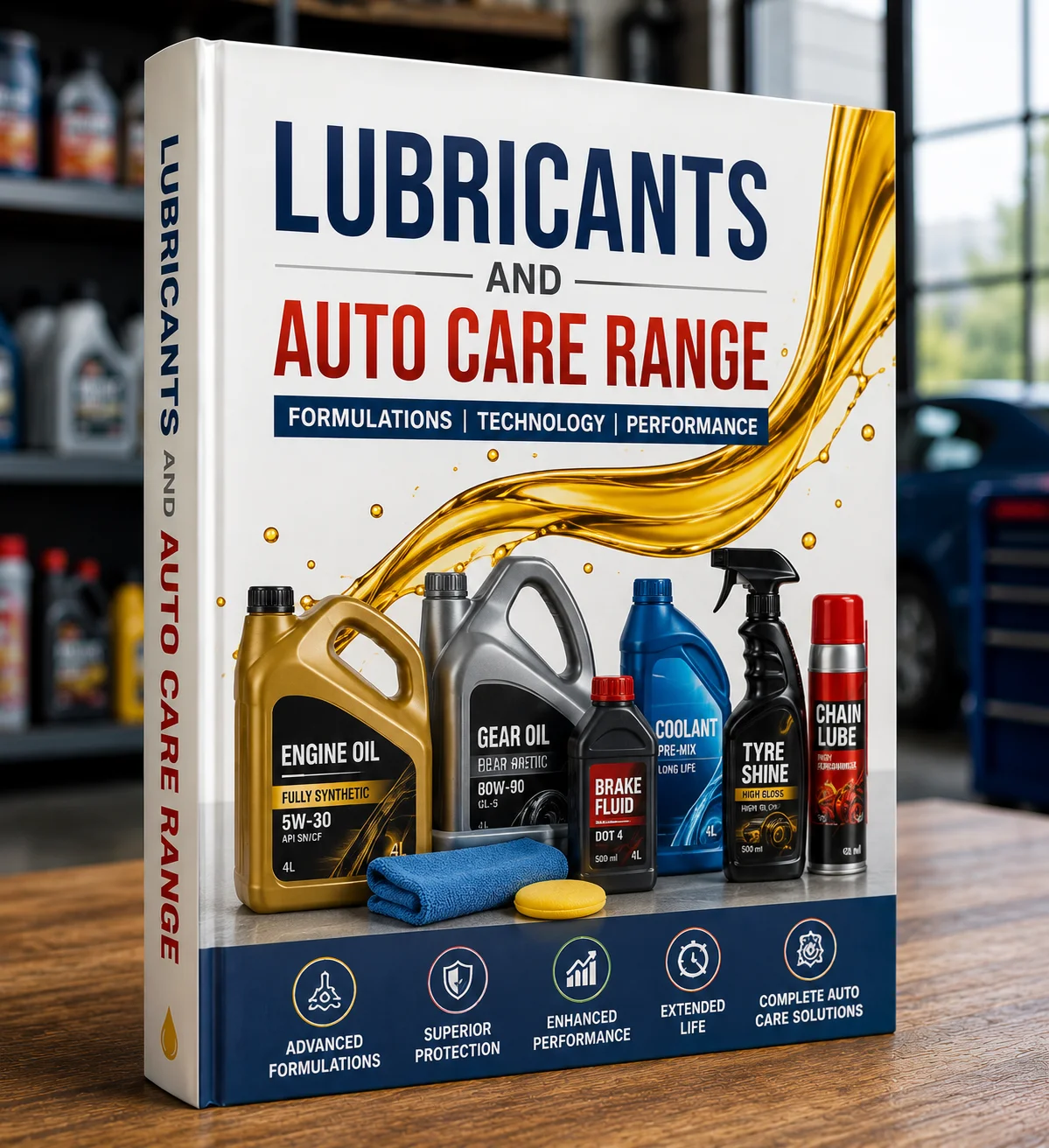
Lubricants & Auto Care Range — Industrial Formulation Handbook is a comprehensive strategy-and-formulation guide for the automotive lubricants and detailing market. It spans seven product families — engine oils, brake fluids, fork oils and gear fluids, engine coolants and antifreeze, automotive cleaners, detailing products, and polishes and surface protection — treated as a single manufacturable range. Written for lubricant blenders, auto-care brand builders and entrepreneurs, it covers the complete product architecture from economy private-label blends to premium synthetic and specialty grades, with the technical depth to understand and adapt every formulation.
The technology
The handbook develops the distinct chemistry of each product family from first principles. Engine oils: API base-oil groups I–V, SAE J300 viscosity grades, additive functions (ZDDP, detergents, dispersants, antioxidants, VIIs). Brake fluids: glycol-ether and borate-ester chemistry, ERBP specification and FMVSS 116/ISO 4925 requirements. Coolants: monoethylene glycol and monopropylene glycol base fluids, IAT/OAT/HOAT/NOAT inhibitor technology, corrosion protection for aluminium, cast iron and yellow metals. Gear fluids: EP additive chemistry (sulphur-phosphorus GL-4/GL-5), ATF friction-modifier systems, CVT fluid shear stability. Automotive cleaners: alkaline degreaser chemistry, surfactant-solvent systems, emulsification and rinsing. Detailing: carnauba wax emulsification, silicone tyre dressing technology, polymer sealant film formation, abrasive finishing with cutting compounds.
Inside the formulations
The handbook carries worked formulations across all seven product families, each with a component table (% w/w, function, sourcing tier), manufacturing sequence, blending SOP and QC targets tied to the relevant specification standard. Market-segmentation tables define economy, mid-range, premium and specialist positioning for each category, and failure-mode guidance covers the most common blending and performance defects.
What you get
- Formulations across all seven automotive product families in one volume
- Engine oils SAE 10W-30 to 10W-60 · API SN through SP · ACEA A3/B4
- Brake fluids: DOT 3, DOT 4, DOT 4 LV, DOT 5.1 with FMVSS 116 / ISO 4925 data
- Coolants: IAT, OAT, HOAT, EV/hybrid low-conductivity formulations
- Gear fluids: MTF (GL-4/GL-5), ATF (DEXRON VI), CVT, PSF formulations
- Automotive degreasers, detailing products, polishes and surface protection chemistry
- Component tables, manufacturing SOPs and QC targets for all categories
- Market-segmentation tables and tier-appropriate cost architecture
Technical details
- Format
- A4 PDF · instant digital download
- Coverage
- Engine oils · brake fluids · fork oils · gear fluids · coolants · cleaners · polishes
- Standards
- API · ACEA · JASO · ILSAC · SAE J300 · FMVSS 116 · ISO 4925 · BS 6580 · ASTM · BIS
- Tiers
- Economy · Mid-range · Premium · Specialist
- Audience
- Lubricant blenders · auto-care manufacturers · brand builders · entrepreneurs
- Series
- Lubricants & Automotive Fluids Series · Volume 3
Launch a complete automotive lubricants and detailing range — engine oils, brake fluids, coolants, fork oils, gear oils, degreasers and polishes — from one validated technical reference without commissioning a separate R&D programme for each category.
Who is this book for?
Auto-Care Brand Builder
You're building a full automotive care range and need validated formulations across multiple categories — from engine oils and brake fluids through to tyre dressings and carnauba polishes — in one cohesive reference.
Workshop Product Supplier
You supply garages, service centres and fleet operators and want to launch own-brand workshop fluids — brake fluid, ATF, coolant, power steering fluid and degreasers — with correct DOT, OAT and ATF specifications.
Lubricant Entrepreneur
You want to enter the high-margin automotive care market and need a structured, manufacturable product range covering all seven product families with clear tier positioning and sourcing guidance.
Table of Contents
- Economy mineral SAE 10W-30, 15W-40, 20W-50 (API SN)
- Semi-synthetic SAE 5W-30, 10W-40 (API SN Plus)
- Full-synthetic SAE 5W-40, 0W-40 (API SP)
- High-performance SAE 5W-50, 10W-60 (ACEA A3/B4)
- Additive package and base oil selection guide
- DOT 3 polyalkylene glycol-ether brake fluid (FMVSS 116)
- DOT 4 high-boiling-point borate-ester brake fluid
- DOT 4 LV low-viscosity brake fluid (ISO 4925 Class 6)
- DOT 5.1 non-silicone synthetic high-performance brake fluid
- Dry and wet ERBP targets, viscosity at –40°C
- Motorcycle front fork oil SAE 5, 10, 15, 20 grades
- Manual transmission fluid (GL-4, GL-5, MT-1)
- Automatic transmission fluid (ATF DEXRON VI, MERCON V)
- CVT fluid and DCT fluid formulations
- Power steering fluid and hydraulic power fluid
- IAT green monoethylene glycol coolant (BS 6580 / ASTM D3306)
- OAT extended-life coolant (organic acid technology)
- HOAT hybrid coolant (silicate + OAT)
- EV/hybrid low-conductivity coolant
- Concentrate and ready-mix 33%/50% dilution grades
- Engine degreaser concentrate and RTU spray
- All-purpose car cleaner (APC) — interior and exterior
- Tyre and plastic trim dressing (silicone and water-based)
- Interior care: dashboard, leather and fabric cleaners
- Wheel cleaner and iron fallout remover
- Carnauba-wax polish paste and liquid
- Synthetic polymer paint sealant
- Cutting compound and swirl remover
- Glass cleaner and windscreen treatment
- Clay bar lubricant and detailing spray
See what's inside
Frequently asked questions
They are validated starting points. You will need to bench-test and adapt treat rates to your specific raw material lots, but you start from a working formulation — not a blank sheet.
The handbook is a PDF — high-resolution A4, printable, with bookmarks and a linked table of contents. You receive an instant download link and it is also available in your library indefinitely.
Up to 5 downloads are included with your purchase. If you need more, contact us and we will reset your download limit.
Yes. The handbook opens with a fundamentals section that explains the underlying chemistry and ingredient functions before presenting formulations — so beginners can follow the rationale, not just the recipe.
Yes. Each formulation includes a component table with % w/w, a manufacturing sequence, blending SOP and QC targets tied to the relevant standard — so you can go straight from the handbook to the blending floor.
Yes. The handbook treats the chemistry behind each product family: carnauba-wax emulsification, silicone crosslinking in tyre dressings, polymer paint sealant formation, abrasive grading in cutting compounds, and the surfactant systems in clay lubricants.
Yes. DOT 3, DOT 4, DOT 4 LV and DOT 5.1 are covered with glycol-ether and borate-ester chemistry, FMVSS 116 / ISO 4925 compliance data, dry and wet ERBP targets, kinematic viscosity at –40°C, and formulation rationale for each grade.
Yes. A dedicated low-conductivity EV/hybrid coolant formulation is included, designed to protect aluminium components in battery cooling circuits with minimal ionic contamination — distinct from conventional passenger car coolant chemistry.
Yes. Formulations include BIS/IS standard references alongside international API, ACEA and FMVSS specifications, with Indian market context, local raw material sourcing tiers and tier-appropriate cost positioning across economy through premium grades.