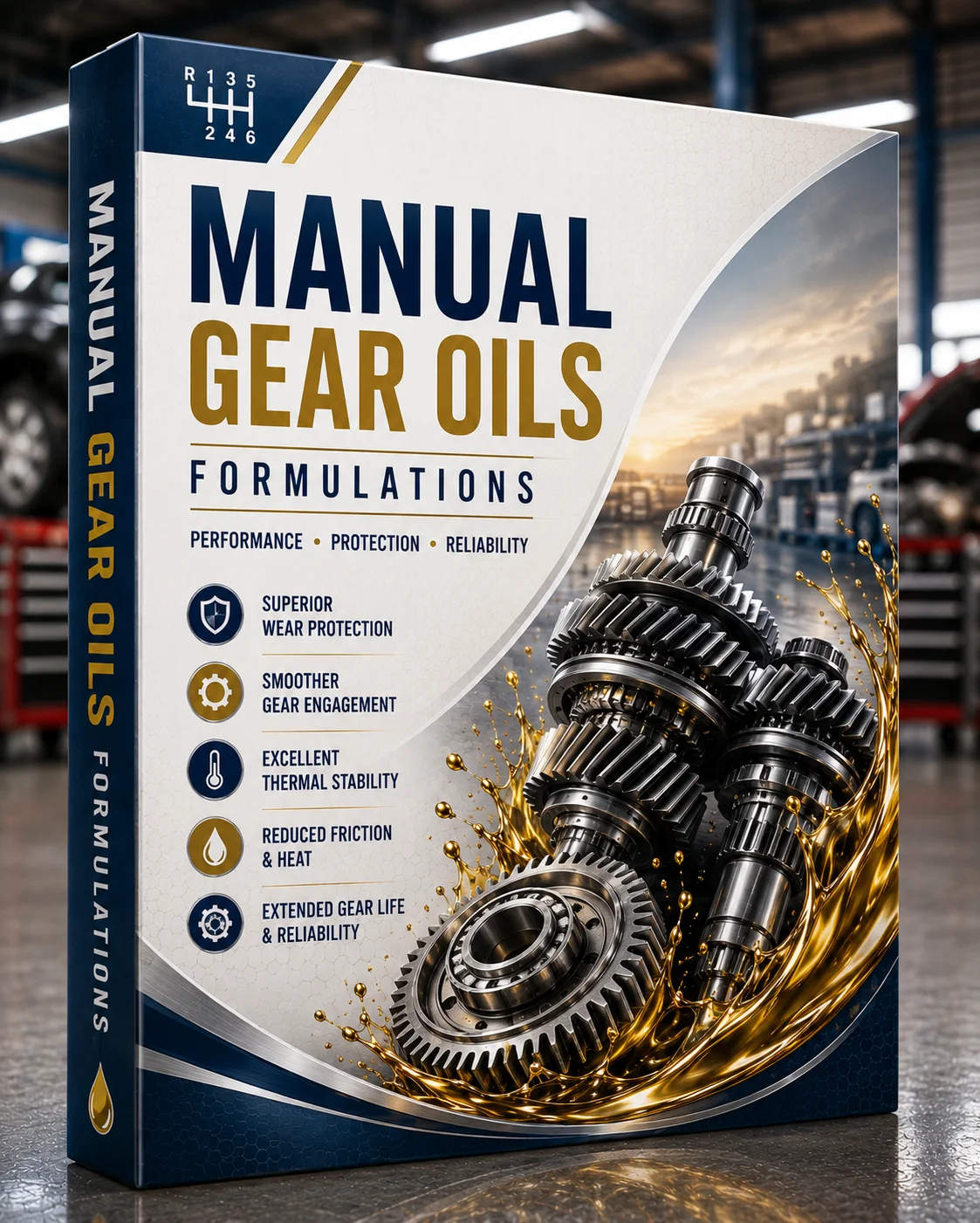
Manual Transmission, Axle & Industrial Gear Oils — Formulation Handbook
About this book
Manual Transmission, Axle & Industrial Gear Oils — Formulation Handbook is a comprehensive technical formulations reference covering 52 starting-point formulations across 13 sub-categories, spanning automotive axle and manual transmission oils, limited slip differential and UTTO fluids, industrial enclosed gear oils from ISO VG 220 to 680, worm gear oil, and open gear/slewing ring lubricant. It gives gear oil blenders, drivetrain engineers, and lubricant entrepreneurs the chemical foundation to manufacture gear oils across all five API base oil groups.
The technology
The handbook covers gear oil chemistry from first principles: the hydrodynamic-to-boundary lubrication transition at the gear mesh and how viscosity, surface roughness, and entrainment velocity govern it; EP/antiwear film-forming chemistry using active-sulphur additives, and the specific steel-on-bronze compatibility constraint that governs worm gear oil formulation; friction modifier chemistry for limited-slip differentials and synchroniser-compatible transmission oils; and base oil selection across API Groups I–V matched to the wide temperature range (−40°C to 200°C transient) automotive applications demand versus the long-drain, contamination-tolerant profile industrial gearboxes need.
Inside the formulations
All 52 formulations are structured across Economy, Mid-range, Premium, and Specialty tiers spanning the 13 sub-categories. Each formulation provides a component table (% w/w and sourcing tier), target SAE or ISO VG grade, EP/AW and friction-modifier treat rates, blending sequence, and QC release targets aligned with 4-ball EP/wear, FZG scuffing, and copper corrosion test methods.
What you get
- 52 starting-point gear oil formulations across 13 sub-categories
- Automotive axle/manual transmission, LSD, UTTO, and industrial enclosed gear oil coverage
- Dedicated worm gear and open gear/slewing ring lubricant formulations
- Detailed component tables with % w/w, EP/AW treat rates, and sourcing tier guidance
- Friction-modifier dosing guidance for limited-slip differentials and synchroniser compatibility
- QC targets for 4-ball EP/wear, FZG scuffing, copper corrosion, and demulsibility
- Troubleshooting guide: micropitting, scuffing, bronze corrosion, and friction drift
Technical details
- Format
- A4 PDF · instant digital download
- Extent
- ~200 pages · 52 formulations · 13 categories
- Grades
- SAE 70W-75 to 85W-140 · ISO VG 220 to 680 · UTTO 10W-30/10W
- Standards
- API GL-4/GL-5/MT-1 · AGMA 9005 · ASTM 4-ball EP/wear · FZG scuffing test
- Tiers
- Economy (mineral) · Mid-range (synthetic blend) · Premium (full synthetic) · Specialty (LSD/worm/open gear)
- Audience
- Gear oil blenders · drivetrain engineers · plant maintenance engineers · lubricant entrepreneurs
- Series
- Lubricants & Automotive Fluids Series · Volume 2 — Drivetrain & Transmission Fluids
Formulate manual transmission, axle, and industrial enclosed gear oils — mineral and synthetic, automotive and industrial — with 52 validated starting-point formulations spanning SAE and ISO VG grades across AGMA Grade 2 to Grade 8+ service.
Who is this book for?
Gear Oil Blender
You manufacture or contract-blend manual transmission, axle, and industrial gear oils and need validated starting formulations across mineral and synthetic base stocks with correct EP/AW treat rates and friction-modifier dosing.
Drivetrain / Plant Maintenance Engineer
You specify or maintain manual gearboxes, axles, or industrial enclosed gearboxes and need a technical reference on EHD/boundary lubrication regimes and yellow-metal compatibility to evaluate supplier oils.
Lubricant Brand Entrepreneur
You want to add a gear oil range spanning automotive axles to heavy industrial gearboxes to your lubricants portfolio, tiered from mineral SAE 80W-90 through full-synthetic and worm-gear-specific chemistries.
Table of Contents
- Lubrication regimes at the gear mesh: hydrodynamic/EHD, mixed-film, and boundary lubrication
- EP/antiwear film-forming chemistry: active-sulphur EP additives and the steel-on-bronze worm gear constraint
- Base oil selection across API Groups I–V by viscosity and performance tier
- Friction modifier chemistry for limited-slip differentials and synchroniser compatibility
- Water tolerance and demulsibility: industrial gearbox drainage vs. UTTO wet-brake requirements
- SAE 80W-90 mineral and SAE 75W-90 synthetic axle/manual transmission gear oil
- SAE 85W-140 mineral and SAE 75W-140 synthetic heavy-duty axle & final drive oil
- SAE 70W-75/70W-80 light manual transmission oil and SAE 75W-80/75W-85 passenger car transaxle oil
- Limited slip differential (LSD) oil with friction-modifier chemistry, SAE 75W-90/80W-90
- Universal Tractor Transmission Oil (UTTO) for combined transmission/hydraulic/wet-brake service, SAE 10W-30/10W
- ISO VG 220/320 industrial enclosed gear oil, mineral and synthetic
- ISO VG 460/680 heavy industrial gear oil for high-load, low-speed service
- Worm gear oil (PAG/compounded type) formulated for steel-on-bronze compatibility
- Open gear and slewing ring lubricant for exposed, contaminant-prone applications
- Blending sequences for EP additive packages and friction-modifier incorporation
- QC testing: 4-ball EP/wear, FZG scuffing, copper corrosion, demulsibility, and low-temperature viscometrics
- Troubleshooting guide: micropitting, scuffing, bronze corrosion, and synchroniser friction drift
See what's inside
Frequently asked questions
They are validated starting points. You will need to bench-test and adapt treat rates to your specific raw material lots, but you start from a working formulation — not a blank sheet.
The handbook is a PDF — high-resolution A4, printable, with bookmarks and a linked table of contents. You receive an instant download link and it is also available in your library indefinitely.
Up to 5 downloads are included with your purchase. If you need more, contact us and we will reset your download limit.
Yes. The handbook opens with a fundamentals section that explains the underlying chemistry and ingredient functions before presenting formulations — so beginners can follow the rationale, not just the recipe.
Active-sulphur EP additives that protect steel-on-steel gear contacts corrode bronze alloys under the sliding contact conditions found in worm gearboxes. The handbook formulates worm gear oil (Sub-category 12) as a dedicated PAG/compounded chemistry engineered specifically for steel-on-bronze compatibility, rather than applying a standard EP gear oil package.
Automotive axle and manual transmission oils are formulated for wide temperature swings (−40°C cold-start to 140°C sustained, with 200°C transient gear-mesh spikes) and moderate drain intervals. Industrial enclosed gear oils run at more constant elevated temperature with heavier contamination exposure and much longer drain targets (4,000–8,000 hours), which shifts the formulation emphasis toward oxidative stability and demulsibility over the wide-temperature viscometrics automotive oils need.
Yes. LSD oils require friction modifiers dosed to give the specific static/dynamic friction characteristic the clutch pack needs to prevent chatter — this is a distinct formulation requirement from a standard axle oil’s EP package, and the handbook treats it as its own sub-category with dedicated friction-modifier guidance.
Yes, wherever both are commercially relevant — for example SAE 80W-90 mineral and SAE 75W-90 synthetic axle oils, or ISO VG 220/320 industrial gear oil in both mineral and synthetic versions — each treated as its own formulation cluster with its own tier structure, not a single formula with a base-oil substitution note.