Marine Engine Oils — Formulation Handbook (Volume 1)
About this book
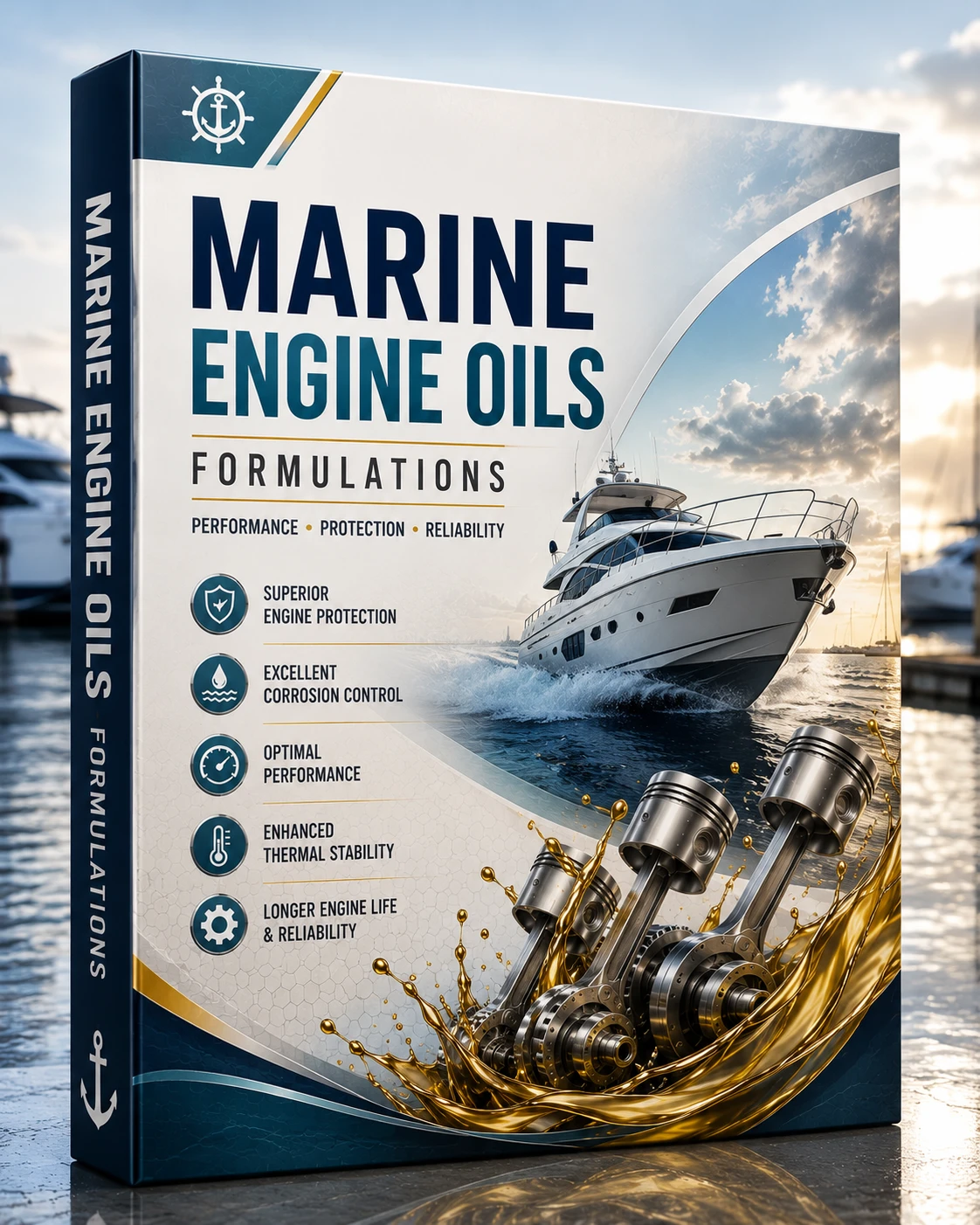
Marine Engine Oils — Formulation Handbook is a technical formulations reference guide covering slow-speed two-stroke crosshead cylinder oils and medium-speed four-stroke trunk piston engine oils (TPEO). With 40 validated starting-point formulations across 10 sub-categories and four performance tiers (Economy, Mid-range, Premium, Specialty), it provides lubricant blenders, R&D chemists, and technical directors with the chemical foundation to blend, manufacture, and verify high-quality marine lubricants that meet modern regulatory (IMO MARPOL Annex VI) and engine builder specifications.
The technology
The handbook covers the chemistry of marine engine lubricants from first principles: overbased calcium sulphonate, calcium phenate, and calcium salicylate detergents; the mechanism of acid neutralisation via colloidal calcium carbonate cores; ashless antiwear phosphate esters vs ZDDP; PIB-succinimide dispersants for soot control; and Group I, II, III, IV PAO, and Group V ester base oil solvency. It addresses the post-IMO 2020 global sulphur cap constraints and dual-fuel LNG lubrication chemistry.
Inside the formulations
All 40 formulations are structured across Economy (mineral), Mid-range, Premium, and Specialty (synthetic) tiers. Each formulation provides a 200 kg reference batch component table (% w/w and sourcing tier), viscosity grade (SAE 50 monograde for cylinder lubricants, SAE 30/40 for TPEO), target physical and chemical specs, blending sequence SOPs, QC target ranges, and the scientific basis for the formulation balance.
What you get
- 40 starting-point marine engine oil formulations across 10 sub-categories
- Cylinder lubricants from BN 40 to BN 100 for VLSFO, HFO, MGO, and LNG service
- TPEO formulations from BN 15 to BN 55 in SAE 30 and SAE 40 viscosity grades
- Detailed component tables with % w/w, function, and sourcing tier
- Step-by-step manufacturing SOPs, pilot blending checklists, and filterability pre-checks
- QC targets mapped to ASTM D445, D2896, D92, D97, and D892 test methods
- Failure-mode troubleshooting tables covering haze, sediment, and foam defects
- Scientific basis detailing detergent balance, solvency mechanisms, and seal compatibility
Technical details
- Format
- A4 PDF · instant digital download
- Extent
- ~170 pages · 40 formulations · 10 categories
- Grades
- SAE 50 monograde (cylinder oils) · SAE 30 & 40 (TPEO)
- Standards
- SAE J300 · API CF/CF-4/CI-4 · ISO 8217 · IMO MARPOL Annex VI · ASTM · BIS
- Tiers
- Economy (mineral) · Mid-range · Premium · Specialty (synthetic)
- Audience
- Lubricant blenders · R&D chemists · plant managers · technical directors
- Series
- Lubricants & Automotive Fluids Series · Volume 4
Launch a complete marine engine oils range — slow-speed cylinder lubricants and medium-speed trunk piston engine oils — with 40 validated starting-point formulations covering every BN level and fuel type, ready to manufacture today.
Who is this book for?
Marine Lubricant Blender
You blend or manufacture marine engine oils and need validated formulations across slow-speed crosshead cylinder oils (BN 40 to 100) and trunk piston engine oils (BN 15 to 55) to secure engine builder approvals.
Technical Director
You oversee lubricant R&D and need a robust chemical reference guide covering overbased detergents (sulphonates, phenates, salicylates), base oil solvency, and additive package design for high-acid and low-ash environments.
Operations Manager
You manage blending plants and need practical, step-by-step SOPs, manufacturing guidelines, QC target limits, and failure-mode analysis to blend high-TBN marine lubricants safely.
Table of Contents
- Slow-speed two-stroke crosshead engines vs. medium-speed four-stroke trunk piston engines
- Overbased detergents: sulphonate, phenate, salicylate chemistries and TBN carrier systems
- Base oil selection (Group I, II, III, IV PAO, and Group V esters) and solvency compatibility
- Additive chemistry: ashless antiwear phosphate esters, ZDDP, dispersants, antioxidants, VIIs, PPDs
- IMO MARPOL Annex VI regulations: global sulphur caps (0.5% S and 0.1% S ECAs) and dual-fuel engines
- Economy mineral SAE 50 cylinder lubricants for standard feed rates
- Mid-range Group II formulations with balanced sulphonate/phenate/salicylate systems
- Premium low-deposit Group II/III formulations for Swirl Injection Principle (SIP) lubricators
- Specialty Group IV PAO/ester synthetic cylinder oils for extreme load and feed rates
- Cylinder lubricants for slow-speed engines burning high-sulphur heavy fuel oil (HFO)
- High-solvency Group I bright stock blends for detergent solubility
- Premium corrosion-resistant formulations for engines fitted with scrubbers
- Advanced low-feed-rate BN 100 formulations with salicylate detergency
- Cylinder lubricants for VLSFO/MGO service under IMO 2020 restrictions
- Group II and Group III low-ash formulations
- LNG dual-fuel engines: zero-sulphur gas combustion acid neutralization
- Low-ash salicylate-dominant TBN architectures to prevent piston crown deposits
- Recirculating crankcase lubricants for medium-speed four-stroke trunk piston engines
- TPEO SAE 30 & SAE 40, BN 30-40 mineral formulations for distillate fuel
- TPEO SAE 40, BN 15-20 low-BN formulations for ultra-low-sulphur distillate
- TPEO SAE 40, BN 40-55 mineral formulations for high-sulphur residual fuel blends
- High-performance synthetic extended-drain TPEO (Group III/PAO)
- Standard mineral auxiliary engine lubricants, SAE 40, BN 12-15
- Modern synthetic low-SAPS auxiliary lubricants for EGR and SCR systems
- Viscosity J300 specifications and ASTM test methods
- Agitation, Tip Speed, and Earthing requirements in high-solvency blending
- Pilot blend scale-up protocol and batch verification checklist
- Filterability pre-check (ISO 13357) for high-detergent campaigns
- Failure-mode analysis: haze, sediment, air entrainment, and foam troubleshooting
See what's inside
Frequently asked questions
They are validated starting points. You will need to bench-test and adapt treat rates to your specific raw material lots, but you start from a working formulation — not a blank sheet.
The handbook is a PDF — high-resolution A4, printable, with bookmarks and a linked table of contents. You receive an instant download link and it is also available in your library indefinitely.
Up to 5 downloads are included with your purchase. If you need more, contact us and we will reset your download limit.
Yes. The handbook opens with a fundamentals section that explains the underlying chemistry and ingredient functions before presenting formulations — so beginners can follow the rationale, not just the recipe.
Slow-speed two-stroke crosshead engines isolate the cylinder from the crankcase. Cylinder oil is a total-loss lubricant injected directly onto the liner and consumed in one pass, requiring high BN (up to 100) to neutralise acids. Four-stroke trunk piston engines use a recirculating system where TPEO must lubricate bearings, gears, and pistons, requiring soot dispersancy, oxidation stability, and filterability.
The formulations are explicitly categorised by fuel sulphur service: BN 70/100 for high-sulphur heavy fuel oil (HFO) with scrubbers, BN 40 for very-low-sulphur fuel oil (VLSFO, ≤ 0.5% S), and low-BN/low-ash formulations for LNG dual-fuel applications where gas combustion produces minimal acid.
High-TBN formulations (BN 70–100) carry up to 35% overbased detergent additives. The book details how Group I base oils and bright stocks are used to provide the high aromatic solvency needed to keep these additives in stable solution without haze or sedimentation.
Yes. Every formulation specifies concrete QC targets and acceptable ranges with cited ASTM standards — including ASTM D445 for viscosity, D2896 for TBN, D92 for flash point, D97 for pour point, and D892 for foaming tendency.