Multi-Surface Cleaners & All-Purpose Sprays — Formulation Handbook
About this book
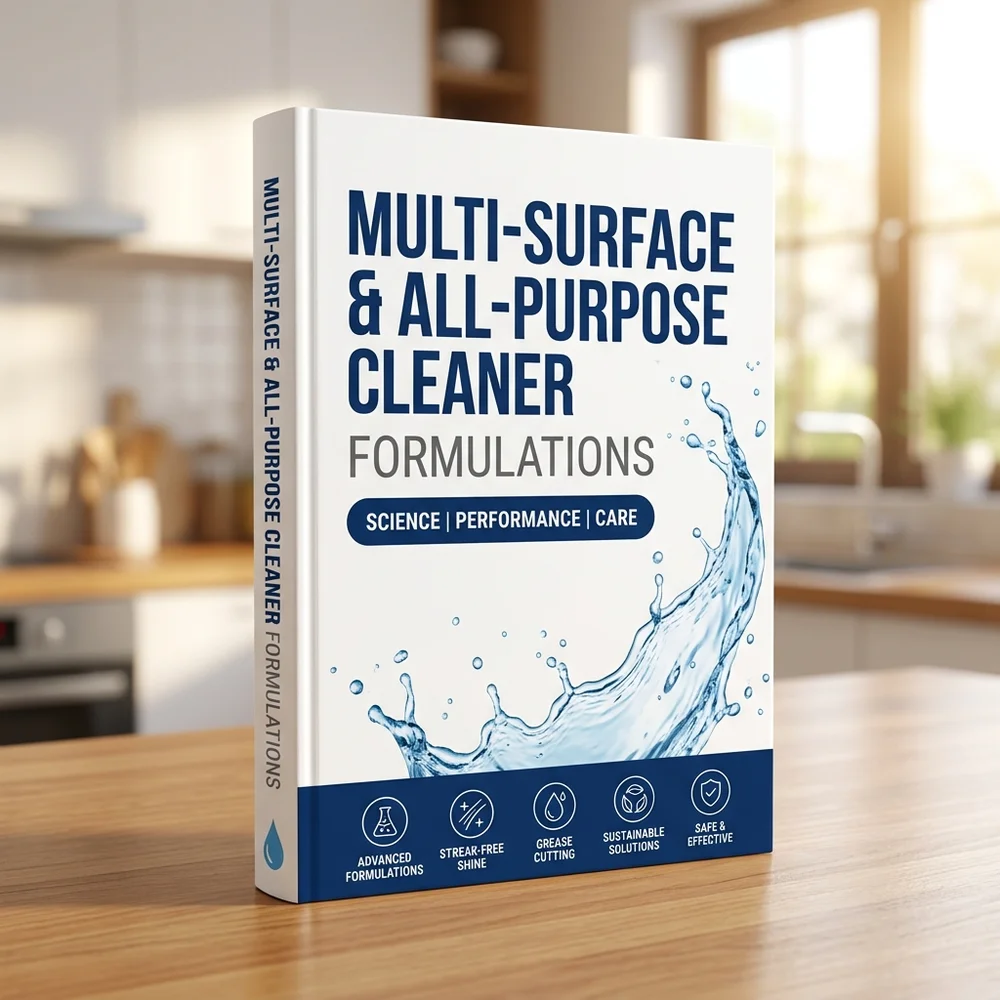
Multi-Surface Cleaners & All-Purpose Sprays — Formulation Handbook is a professional technical reference covering 32 starting formulations. From ready-to-use household sprays and heavy degreasers to streak-free glass cleaners and disinfecting sprays, this volume delivers complete manufacturing blueprints.
The technology
The handbook grounds every formulation in interfacial science: wetting kinetics, micellar soil displacement, and the role of co-solvents (IPA, butyl glycol) in grease cutting and drying rates. It details builder chemistry (citrates, GLDA, MGDA) and acidic descaling mechanisms (acetic, citric, lactic acids), alongside antistatic protection (silicone emulsions, cationic polymers) and disinfection chemistry (quaternary ammonium compounds).
Inside the formulations
The 32 formulations are presented across Economy, Mid-range, Premium, and Specialty tiers in 8 categories. Each block details % w/w, IUPAC/INCI ingredient names, blending sequences, QC test targets (pH, density, active matter, cloud point), stability warnings, and mechanistic chemistry bases.
What you get
- 32 starting formulations across 8 surface cleaner sub-categories
- Detailed component tables with IUPAC/INCI names, weight %, and functions
- QC test methods and specification targets mapped to IS 8399 and ASTM standards
- 12-step master manufacturing SOP with batch record templates and process control limits
- Troubleshooting matrices for residue, clouding, nozzle clogging, and active loss
Technical details
- Format
- A4 PDF · instant digital download
- Extent
- ~135 pages · 32 formulations · 8 sub-categories
- Standards
- IS 8399, ASTM D4488/D3556, GHS, REACH, EPA Safer Choice
- Tiers
- Economy · Mid-range · Premium · Specialty
- Audience
- Household chemical blenders · contract packagers · R&D chemists
- Series
- Household & Industrial Cleaners Series · Volume 3 · Book 3.01
Designing surface cleansers requires balancing grease removal, streak-free drying, and surface safety — get 32 validated starting-point formulations ready for commercial blending.
Who is this book for?
Household Products Producer
You manufacture home care products and want a full range of sprays and concentrates with high efficacy and premium aesthetics.
Contract Packager
You bottle household liquids and need ready-to-use formulas for glass, kitchen degreasing, sanitizing, and wood polishing.
R&D Chemist
You need reference formulations for streak-free glass, bio-based green sprays, acidic descalers, and antistatic cleaners with detailed QC specs.
Table of Contents
- Surfactant wetting kinetics and micellar displacement
- Builder and chelant chemistry (citrate, EDTA, organic acids)
- Solvent coupling and evaporation rate (glycol ethers, isopropyl alcohol)
- Substrate safety: metal corrosion and plastics stress-cracking
- Specifications and standards (IS 8399, ASTM)
- Ready-to-Use (RTU) Sprays — F1 to F4 (Economy → Specialty)
- Dilutable Concentrates — F5 to F8
- Multi-Surface Degreasing Sprays — F9 to F12
- Streak-Free Glass Cleaners — F13 to F16
- Bio-Based Cleaners — F17 to F20
- Disinfecting Sprays (QAC base) — F21 to F24
- Vinegar-Based Acidic Cleaners — F25 to F28
- Antistatic & Polish Sprays — F29 to F32
- Blending vessel sizing, low-shear agitation, and filling lines
- 12-step master manufacturing SOP and batch record template
- Scale-up notes: volatile coupling, emulsification, and foam prevention
- 35 raw materials with systematic IUPAC/INCI names, CAS numbers, and function details
- Supplier substitution guide for specialty solvents and biocides
- Cost-tier register and formulation BoM analysis
- Solving cloud point separation, streak residues, nozzle clogging, and biocide deactivation
- Failure diagnostic matrices for physical and chemical instability
- Stability failure testing registers
See what's inside
Frequently asked questions
They are validated starting points. You will need to bench-test and adapt treat rates to your specific raw material lots, but you start from a working formulation — not a blank sheet.
The handbook is a PDF — high-resolution A4, printable, with bookmarks and a linked table of contents. You receive an instant download link and it is also available in your library indefinitely.
Up to 5 downloads are included with your purchase. If you need more, contact us and we will reset your download limit.
Yes. The handbook opens with a fundamentals section that explains the underlying chemistry and ingredient functions before presenting formulations — so beginners can follow the rationale, not just the recipe.
Yes. Formulations are designed with specific pH windows and chelating levels to avoid etching or stress-cracking. Glass cleaners are surfactant-optimized to ensure streak-free drying.
Yes. Sub-category 6 is dedicated to disinfecting sprays based on Benzalkonium Chloride and Didecyldimethylammonium Chloride, including a food-contact safe rinse-free sanitizer.
Sub-category 5 (F17–F20) covers bio-based surface cleaners using plant-derived APGs, natural organic acids, and bio-based solvents, suitable for eco-label certification.