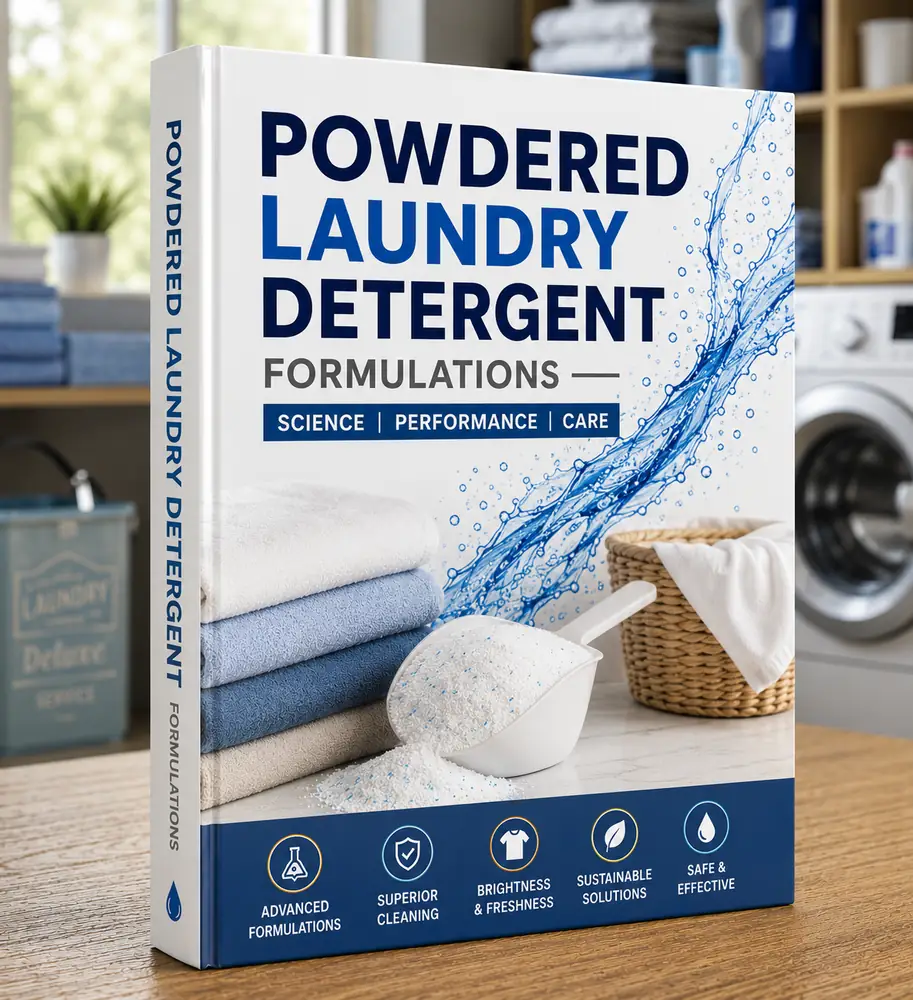
Powder Laundry Detergents — Formulation Handbook
About this book
Powder Laundry Detergents — Formulation Handbook is a professional print-grade reference featuring 32 validated starting formulations for powder laundry detergents. Spanning economy retail sachets to premium enzymatic concentrates and industrial-strength builders, this volume bridges physical chemistry and manufacturing reality.
The technology
The handbook develops the physical chemistry of solid-state detergents: dry neutralization of sulfonic acid, active builder systems (STPP, Zeolite A, sodium carbonate, disodium octaborate), and structural silicates that control particle integrity and prevent caking. It details active oxygen bleaching systems (percarbonate + TAED), enzyme stability in dry state (granulated proteases, amylases, cellulases), optical brighteners, and anti-redeposition polymers (CMC).
Inside the formulations
All 32 formulations are structured in a four-tier architecture (Economy, Mid-range, Premium, Specialty) across 8 sub-categories. Each includes exact % w/w, systematic INCI/IUPAC ingredient names, dry-mix or tower sequences, QC test targets (bulk density, active matter, alkalinity, moisture), stability guides, and detailed scientific bases.
What you get
- 32 starting formulations across 8 powder laundry detergent sub-categories
- Exact w/w composition, raw material grade selection, and chemical functions
- QC test methods and specification targets mapped to IS 4955 and ASTM standards
- Detailed dry-blending and dry-neutralization manufacturing sequences with scale-up guides
- Troubleshooting matrices for caking, poor solubility, and active degradation
Technical details
- Format
- A4 PDF · instant digital download
- Extent
- ~150 pages · 32 formulations · 8 sub-categories
- Standards
- IS 4955, ASTM D501, ISO 2271, EU CLP, GHS
- Tiers
- Economy · Mid-range · Premium · Specialty
- Audience
- Powder blenders · chemical manufacturers · entrepreneurs
- Series
- Household & Industrial Cleaners Series · Volume 1 · Book 1.01
Stop dealing with powder caking and low active formulation headaches — get 32 validated starting powder formulations from mass-market to premium enzymatic, ready for immediate pilot trial.
Who is this book for?
Powder Blender
You manufacture or package powder detergents and need reliable starting formulations to reduce costs, avoid lumping, and optimize active levels.
Brand Owner
You want to launch a powder laundry detergent brand in price-sensitive regions and need stable, cost-effective formulations with guaranteed performance.
R&D Chemist
You need reference formulations covering STPP-free, builders-heavy, enzymatic, color-safe, and eco-certified powder variants with standard QC benchmarks.
Table of Contents
- Surfactant selection (LAS-Na, nonionics)
- Builder systems (STPP, Zeolite A, Sodium Carbonate, Silicates)
- Bleaching systems (Sodium Percarbonate, TAED activator)
- Anti-redeposition & optical brighteners
- Standards and specifications (IS 4955, ASTM)
- Standard Machine Powders — F1 to F4 (Economy → Specialty)
- Concentrated/Compact Powders — F5 to F8
- Hand-Wash Powders — F9 to F12
- Colour-Care Powders — F13 to F16
- Bio/Enzymatic Powders — F17 to F20
- Non-Bio Sensitive Powders — F21 to F24
- Industrial/Institutional Laundry Powders — F25 to F28
- Natural/Eco-Certified Powders — F29 to F32
- Spray drying vs dry neutralization vs dry mixing process flow
- Equipment setup: ribbon blenders, post-addition systems
- 12-step manufacturing SOP and batch record template
- Scale-up notes: bulk density adjustment, moisture control, lumping avoidance
- 35 master raw materials with CAS numbers and sourcing tiers
- Supplier substitution guide for specialty active builders and optical brighteners
- Cost-tier guide and formulation bill-of-materials analysis
- Diagnosing powder caking, poor solubility, spotting, active loss
- Failure matrices covering physical, chemical, and packaging defects
- Stability failure testing registers
See what's inside
Frequently asked questions
They are validated starting points. You will need to bench-test and adapt treat rates to your specific raw material lots, but you start from a working formulation — not a blank sheet.
The handbook is a PDF — high-resolution A4, printable, with bookmarks and a linked table of contents. You receive an instant download link and it is also available in your library indefinitely.
Up to 5 downloads are included with your purchase. If you need more, contact us and we will reset your download limit.
Yes. The handbook opens with a fundamentals section that explains the underlying chemistry and ingredient functions before presenting formulations — so beginners can follow the rationale, not just the recipe.
Yes. Both phosphate-containing (for regions where STPP is permitted) and phosphate-free/zeolite-based formulations are provided across all tiers to meet varying regional environmental regulations.
Premium and specialty formulations detail the incorporation of Sodium Percarbonate activated by Tetraacetylethylenediamine (TAED) to deliver low-temperature active oxygen bleaching.
No. The manufacturing guide covers both spray-drying tower operations and dry-mixing/agglomeration methods, which require much lower capital expenditure.