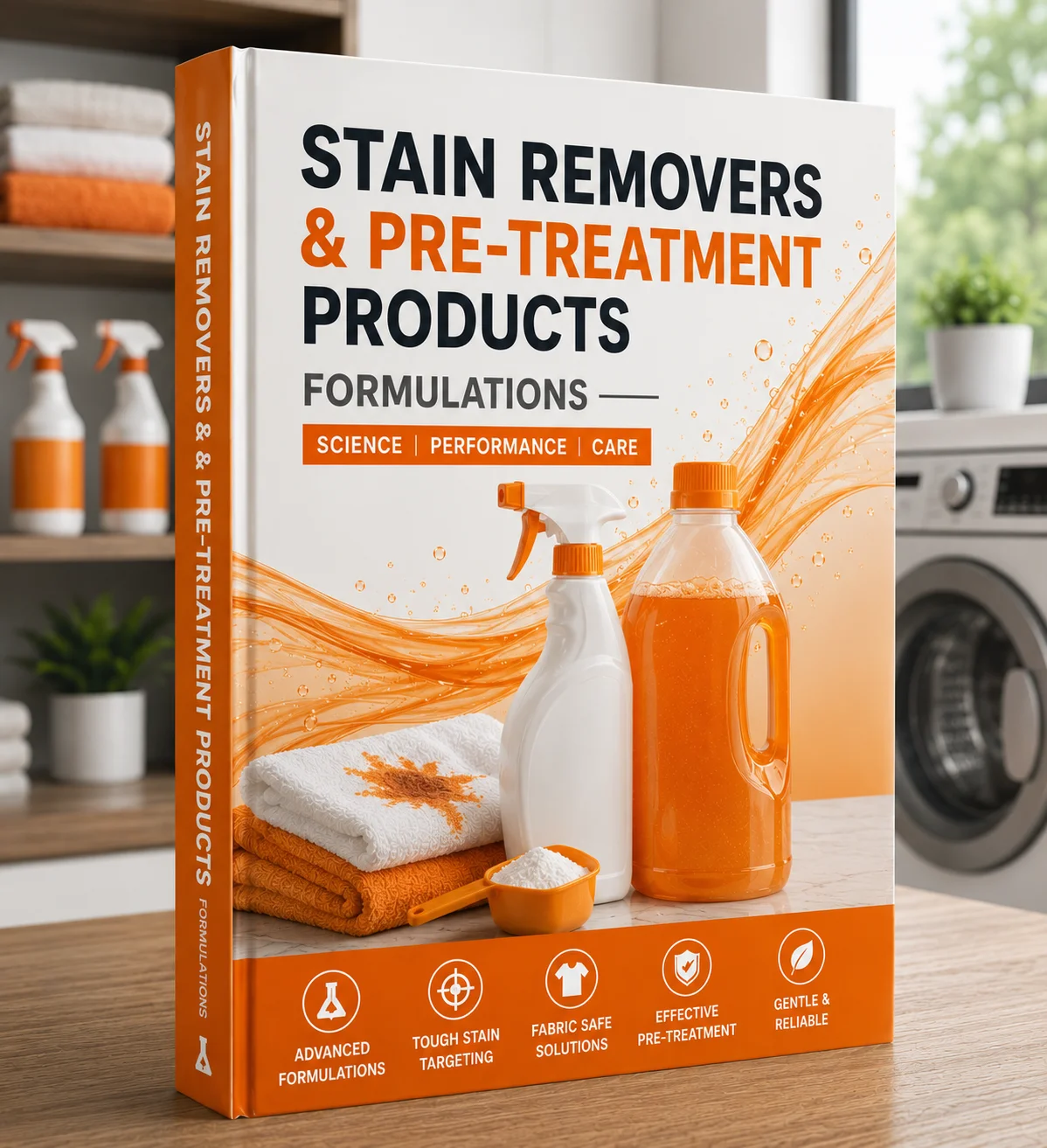
Stain Removers & Pre-Treatment Products — Technical Formulation Handbook
About this book
Stain Removers & Pre-Treatment Products — Technical Formulation Handbook covers 32 validated starting-point formulations across 8 stain remover and pre-treatment sub-categories — from enzyme-enriched trigger sprays and gel applicators, oxygen-bleach soaking powders and in-wash liquid boosters, on-the-go stain pens, solid stain bars and specialty acidic rust removers, through to solvent-based grease, ink and tar removers. The full stain-type spectrum is covered: protein (blood, grass), tannin (tea, wine, coffee), lipid (cooking oil, grease), mineral (rust, iron, hard water) and oxidisable soils (ink, dye transfer). Written for laundry product manufacturers, brand owners and R&D chemists who need to move from stain chemistry to manufacturable, shelf-stable product.
The technology
The handbook develops the chemistry of stain removal mechanistically for each stain class. Protein and lipid stains: serine hydrolase (subtilisin) and lipase interfacial activation mechanisms, enzyme–substrate specificity, enzyme stabilisation with CaCl₂ + borate ester + propylene glycol in liquid products. Oxygen bleach: sodium percarbonate (2Na₂CO₃·3H₂O₂) decomposition kinetics, peracetic acid/H₂O₂ generation from TAED bleach activator at wash temperatures 30–60°C, and the oxidation pathways that break chromophore bonds in organic stains. Mineral stains: proton-attack dissolution of iron(III) oxide and calcium carbonate by oxalic and dicarboxylic acids, chelant competition equilibria with EDTA. Solvent systems: terpene (d-limonene) penetration of cross-linked lipid networks, glycol-ether solvency and fabric compatibility.
Inside the formulations
All 32 formulations are structured across Economy, Mid-range, Premium and Specialty tiers in 8 sub-categories. Each block gives component table with INCI name, % w/w, function, sourcing tier, manufacturing method, QC targets (pH, viscosity, enzyme activity, active oxygen, solvency), stability and shelf-life notes, fabric safety guidance and troubleshooting.
What you get
- 32 starting formulations across 8 stain remover and pre-treatment sub-categories
- Enzyme systems (protease, lipase, amylase) with CaCl₂ + borate stabilisation protocols
- Sodium percarbonate + TAED oxygen-bleach formulations for 30°C, 40°C and 60°C performance
- Acidic rust and mineral stain remover formulations (oxalic acid, EDTA chelant)
- Solvent-based grease, ink and tar removers (d-limonene, glycol-ether, ethyl acetate)
- INCI-named component tables, % w/w, manufacturing SOPs and QC targets
- Fabric safety matrix: enzyme/bleach/solvent compatibility with wool, silk, cotton, polyester, acetate
- Troubleshooting: enzyme deactivation, percarbonate decomposition, dye stripping, tip clogging
Technical details
- Format
- A4 PDF · instant digital download
- Extent
- ~140 pages · 32 formulations · 8 sub-categories
- Standards
- IS 4955 · ASTM D · ISO 105 (colour-fastness) · GHS · EU 648/2004
- Tiers
- Economy · Mid-range · Premium · Specialty
- Audience
- Laundry product manufacturers · R&D chemists · stain remover brand owners
- Series
- Household & Industrial Cleaners Series · Volume 1 · Book 1.04
Stain removal is chemistry under time pressure — get 32 validated pre-treatment and stain remover formulations covering enzyme trigger sprays, oxygen-bleach soakers, solvent pens, rust removers and in-wash boosters, ready for commercial manufacture.
Who is this book for?
Laundry Product Manufacturer
You produce laundry accessories and want to extend your range into high-margin pre-treatment sprays, oxygen-bleach soaking powders, in-wash liquid boosters and stain pens with validated enzyme and bleach chemistry and full sourcing guidance.
Brand Owner
You want to launch a stain remover line across multiple formats — spray, gel, pen, bar and powder — and need the technical foundation covering protease/lipase/amylase enzyme systems, sodium percarbonate + TAED oxygen bleach, chelant rust removal and solvent-based grease formulations.
R&D Chemist
You need reference formulations for speciality stain types — protein (blood, grass), lipid (grease, oil), tannin (wine, tea, coffee), mineral (rust, iron), oxidisable (dye, ink) — with full QC targets, enzyme stabilisation protocols and troubleshooting guidance.
Table of Contents
- Stain classification: protein (blood, grass), tannin (tea, wine, coffee), lipid (grease, oil), mineral (rust, iron, hard water)
- Enzyme chemistry: subtilisin protease, CALB lipase, fungal amylase, cellulase for pilling
- Sodium percarbonate oxygen bleach: activation by TAED (tetraacetylethylenediamine) at 30–60°C
- Solvent and surfactant penetration: glycol-ether solvents, nonionic surfactants, hydrotropes
- Fabric safety: dye compatibility, colour-fastness testing, synthetic and natural fibre constraints
- Pre-Wash Trigger Sprays — F1 to F4: SLES/LAS-Na + protease + lipase enzyme systems
- Pre-Wash Gel Applicators — F5 to F8: high-viscosity hydroxyethylcellulose gel, brush applicator
- Oxygen-Active Soaking Powders — F9 to F12: sodium percarbonate + TAED + TAED at 30/40/60°C
- On-the-Go Stain Remover Pens — F13 to F16: aqueous enzyme + surfactant with pen/roller delivery
- Solid Stain Remover Bars — F17 to F20: saponified fatty acid base + enzyme + OBA
- High-Potency In-Wash Liquid Boosters — F21 to F24: 2× surfactant concentrate + chelant + enzymes
- Specialty Acidic Rust & Mineral Removers — F25 to F28: oxalic acid, dicarboxylic acids, EDTA chelant
- Solvent-Based Grease, Ink & Tar Removers — F29 to F32: d-limonene, glycol-ether, ethyl acetate systems
- Cold-blend and heated-vessel SOPs for liquid, gel and pen fill formats
- Enzyme addition sequence: temperature limits, CaCl₂ stabiliser pre-addition
- Sodium percarbonate handling: moisture exclusion, exotherm control, TAED dispersion
- Solid bar manufacturing: saponification temperature, enzyme post-addition, mould-fill
- Scale-up notes: viscosity management, foam control and packaging compatibility
- 35 raw materials with INCI names, CAS numbers, use level and sourcing tiers
- Enzyme supplier substitution guide: Novozymes, BASF, DSM-Firmenich grades
- TAED bleach activator grades and treat rates for 30/40/60°C performance
- Solvent safety: flash point, VOC, skin compatibility for pen and spray formats
- Cost-tier register and BoM analysis by formulation tier
- Enzyme thermal deactivation and metal ion denaturation (Fe³⁺, Cu²⁺)
- Sodium percarbonate premature decomposition: moisture, pH, heavy metal catalysis
- Fabric damage: bleach over-exposure, solvent fibre swelling, dye stripping
- Pen roller clogging and gel phase separation diagnostic matrices
- Stability and shelf-life accelerated storage test registers
See what's inside
Frequently asked questions
They are validated starting points. You will need to bench-test and adapt treat rates to your specific raw material lots, but you start from a working formulation — not a blank sheet.
The handbook is a PDF — high-resolution A4, printable, with bookmarks and a linked table of contents. You receive an instant download link and it is also available in your library indefinitely.
Up to 5 downloads are included with your purchase. If you need more, contact us and we will reset your download limit.
Yes. The handbook opens with a fundamentals section that explains the underlying chemistry and ingredient functions before presenting formulations — so beginners can follow the rationale, not just the recipe.
Yes. Sub-categories 1, 2, 4, 5 and 6 use enzyme systems (protease, lipase, amylase in various combinations). Sub-category 3 (F9–F12) uses sodium percarbonate activated by TAED for oxygen bleach release at 30–60°C — with enzyme-free and enzyme-compatible variants.
Yes. F25–F28 are dedicated acidic formulations using oxalic acid, glutaric/succinic dicarboxylic acid blends and EDTA chelant to dissolve iron oxide (rust), manganese deposits and hard-water mineral stains from fabric without damaging fibres or stripping dyes.
Pens require a low-viscosity, non-drying aqueous formulation that does not block the pen fibre tip or ball roller, with minimal foaming to prevent leakage. The active system (enzyme + surfactant) is similar to a trigger spray but solvent content is controlled for packaging compatibility and skin safety at point-of-contact application.
Yes. F29–F32 cover solvent-based systems using d-limonene (bio-based terpene degreaser), dipropylene glycol monomethyl ether, ethyl acetate and isopropyl alcohol for removing polymerised grease, printer ink, tar and adhesive residues from fabric without saponification.
Delicate-fabric safety is addressed for every sub-category. Enzyme-based formulations flag protease as unsuitable for wool and silk (protein fibres) and recommend lipase-only or surfactant-only systems. Acidic rust removers specify pH monitoring and rinse requirements. Solvent-based formulations identify cellulose acetate and rayon as at-risk substrates.