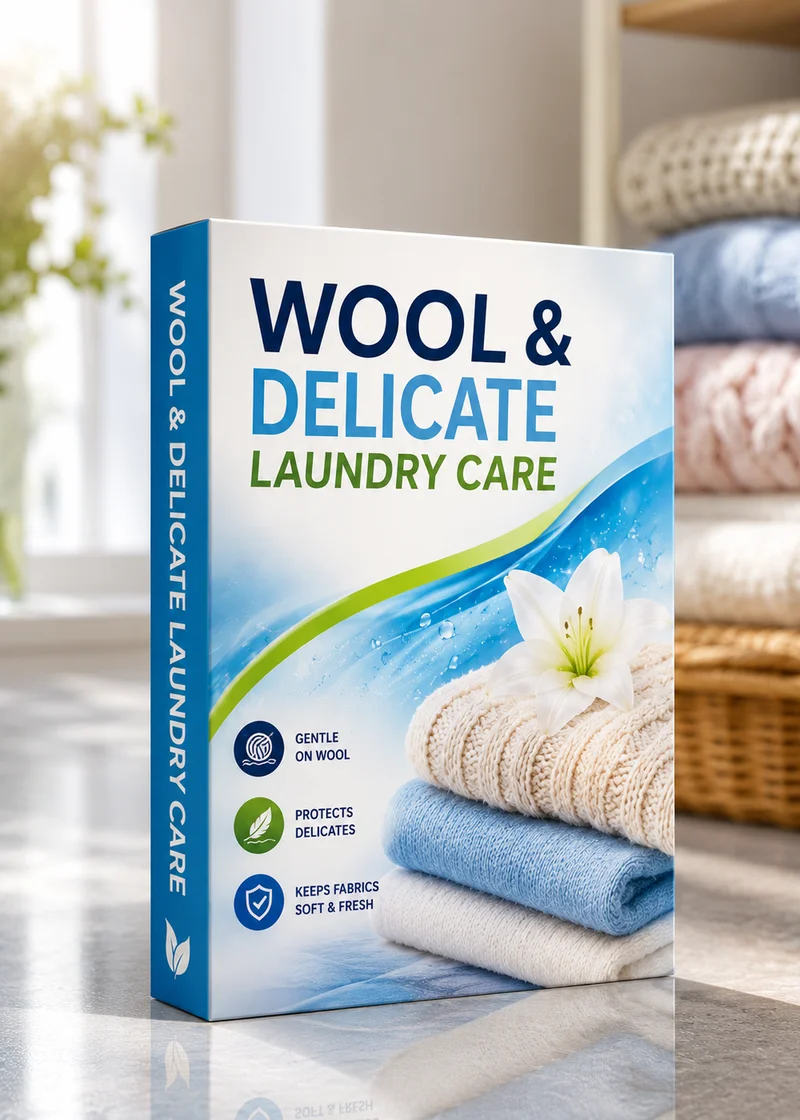
Wool & Delicates Laundry Care — Specialty Formulation Handbook
About this book
Wool & Delicates Laundry Care — Specialty Formulation Handbook is a print-grade technical reference covering 36 validated starting-point formulations across liquid and powder wool detergents, rinse conditioners, hand-wash bars and tablets, stain pre-treatment, refresher sprays, anti-moth sachets, silk/lace-specific formulations and dissolvable wool wash sheets. Written for laundry care manufacturers, luxury garment care brands and R&D chemists, every formulation is built around the protein-fibre chemistry that standard laundry detergent science cannot safely address — wool keratin and silk fibroin structure, the felting mechanism, and the mandatory protease-exclusion rule that governs every formulation in the book.
The technology
The handbook develops protein-fibre science from first principles: wool keratin's alpha-helix structure stabilised by disulphide bonds, and silk fibroin's beta-sheet structure — both vulnerable to protease digestion and high-pH alkaline attack in ways that cellulosic fibres are not. Felting (the directional frictional effect from wool cuticle scale asymmetry) and its mitigation via PVA-88/PVP K30 anti-felting polymers are treated mechanistically, alongside the pH 6.0–7.5 wash / 4.5–5.5 rinse window built around wool's isoelectric point (~4.9). Nonionic-dominant surfactant systems (Alcohol Ethoxylate C12-15 7EO, Coco Glucoside, Lauryl Glucoside) and amphoteric co-surfactants are selected for mildness on protein fibres, with biodegradable chelants (GLDA, sodium gluconate) and rinse conditioning via PEG-7 Glyceryl Cocoate and amino silicone.
Inside the formulations
All 36 formulations are structured across Economy, Mid-range, Premium and Specialty tiers in 9 sub-categories. Each block gives a component table with INCI/IUPAC names, % w/w and sourcing tier, manufacturing sequence by format (liquid, powder, bar, tablet or PVA wash sheet), the mandatory protease-exclusion QC protocol with casein plate assay verification, stability and shelf-life notes, and a scientific basis explaining the protein-fibre chemistry behind every component.
What you get
- 36 starting-point formulations across 9 wool and delicates care sub-categories
- Component tables with INCI/IUPAC names, % w/w, mechanism and sourcing tier
- Mandatory protease-exclusion QC protocol with casein plate assay verification for every formulation
- Manufacturing sequences for liquid, powder, bar, tablet and PVA wash-sheet formats
- 25-compound raw materials index with CAS numbers and supplier examples
- Regulatory overview: EU Regulation 648/2004, REACH, IFRA, Woolmark ISO 3758, IWTO specifications
Technical details
- Format
- A4 PDF · instant digital download
- Extent
- ~115 pages · 36 formulations · 9 sub-categories
- Standards
- EU Regulation 648/2004 · REACH · IFRA · ISO 3758 (Woolmark) · IWTO specifications
- Tiers
- Economy · Mid-range · Premium · Specialty
- Audience
- Laundry care manufacturers · luxury garment care brands · R&D chemists
- Series
- Household & Industrial Cleaners Series · Volume 1 · Book 1.06
Standard laundry enzymes and alkaline detergents destroy wool keratin and silk fibroin structure — get 36 validated formulations built around the protease-exclusion rule and pH window that protein fibres actually require.
Who is this book for?
Laundry Care Manufacturer
You produce fabric care products and want to extend into wool and delicates care — liquid and powder detergents, rinse conditioners, hand-wash bars and wash sheets — without risking the felting and fibre damage that standard laundry chemistry causes on protein fibres.
Luxury Garment Care Brand
You serve premium textile and luxury garment care markets and need formulations validated against Woolmark care labelling (ISO 3758) and IWTO specifications, with anti-felting and silk/lace-specific chemistry built in.
R&D Chemist
You need reference formulations for protein-fibre-safe surfactant systems, anti-felting polymers and rinse conditioning, with the mandatory protease-exclusion QC protocol and casein-plate verification method explained.
Table of Contents
- Wool keratin alpha-helix and disulphide bond chemistry; silk fibroin beta-sheet structure
- Felting mechanism (directional frictional effect) and anti-felting strategies
- pH management for protein fibres: wash pH 6.0–7.5, rinse pH 4.5–5.5 below isoelectric point ~4.9
- Nonionic-dominant surfactant systems and biodegradable chelants (GLDA, sodium gluconate)
- Mandatory protease exclusion: casein plate assay verification protocol
- Liquid Wool & Delicates Detergents
- Wool-Safe Powder Detergents
- Wool Rinse Conditioners
- Hand-Wash Bars & Tablets for Delicates
- Stain Pre-Treatment for Delicates
- Refresher & Odour-Neutralising Sprays
- Anti-Moth & Protective Sachets
- Specialist Formulations for Silk & Lace
- Wool Wash Sheets & Dissolvable Film
- Manufacturing sequences for liquid, powder, bar, tablet and PVA wash-sheet formats
- Accelerated stability protocol
- Protease exclusion QC protocol at every production batch
- 25-compound raw materials index with CAS numbers and supplier examples
- Anti-felting polymer (PVA-88, PVP K30) selection notes
- Cost-tier guide
- EU Regulation 648/2004, REACH and IFRA compliance overview
- Woolmark care labelling (ISO 3758) and IWTO specifications
- Glossary of 15 technical terms
See what's inside
Frequently asked questions
They are validated starting points. You will need to bench-test and adapt treat rates to your specific raw material lots, but you start from a working formulation — not a blank sheet.
The handbook is a PDF — high-resolution A4, printable, with bookmarks and a linked table of contents. You receive an instant download link and it is also available in your library indefinitely.
Up to 5 downloads are included with your purchase. If you need more, contact us and we will reset your download limit.
Yes. The handbook opens with a fundamentals section that explains the underlying chemistry and ingredient functions before presenting formulations — so beginners can follow the rationale, not just the recipe.
Wool keratin and silk fibroin are themselves proteins. Protease enzymes that digest protein-based stains in standard laundry detergents would attack the fibre structure itself, irreversibly weakening or destroying wool and silk garments. All 36 formulations exclude protease entirely and are verified with a mandatory casein plate assay at production — this is treated as a non-negotiable QC gate, not a formulation preference.
Wool's isoelectric point is approximately pH 4.9. The handbook specifies wash pH 6.0–7.5 (mild alkaline-neutral, sufficient for soil removal without damaging keratin disulphide bonds) and rinse pH 4.5–5.5 — below the isoelectric point — which closes the fibre's cuticle scales and reduces felting tendency, in addition to neutralising any residual alkalinity from the wash step.
Felting is driven by the directional frictional effect — wool fibre cuticle scales create asymmetric friction that causes fibres to migrate and interlock irreversibly under mechanical action and moisture. The handbook's anti-felting formulations use PVA-88 and PVP K30 polymers that deposit a smoothing film over the cuticle scales, reducing the directional friction differential that drives fibre migration.
Yes. Sub-category 8 (Specialist Formulations for Silk & Lace) is dedicated separately from the wool-focused sub-categories, since silk fibroin's beta-sheet structure and lace's delicate open-weave construction have different mechanical and chemical sensitivities than wool keratin — covered with their own surfactant and conditioning chemistry rather than a generic "delicates" formulation.