Acoustic and Thermal Insulation Adhesives in Building Construction
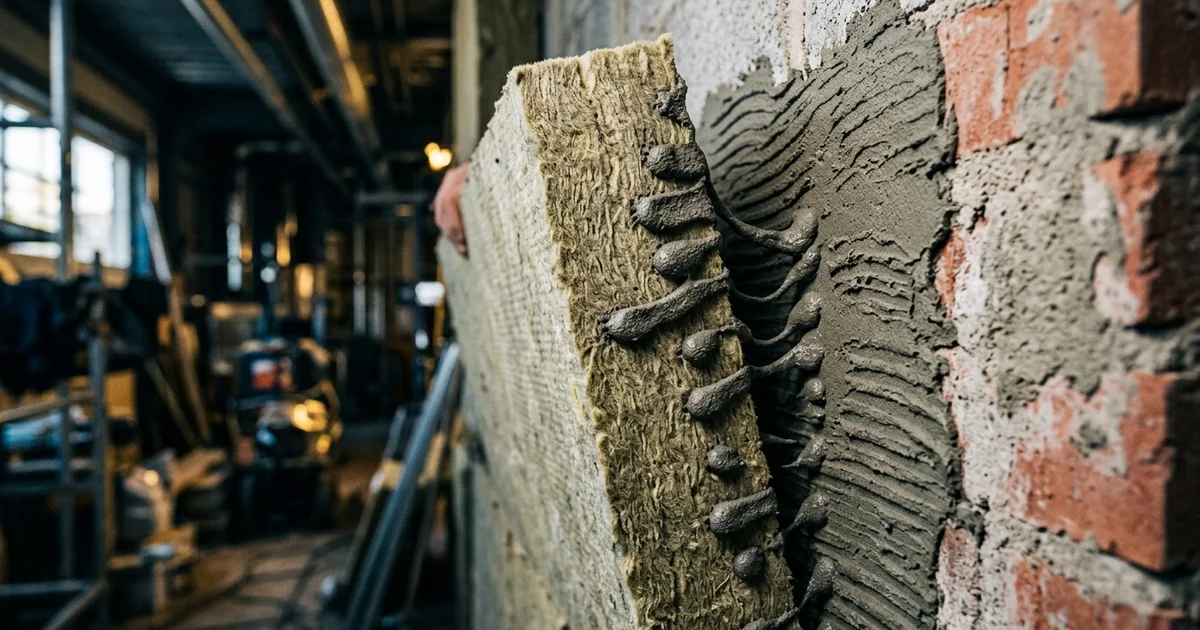
A contractor finishes an exterior insulation and finish system on a mid-rise building, and eighteen months later a facade inspector finds hollow-sounding panels where the adhesive never developed a real bond to the masonry beneath. The insulation board itself was correctly specified, the R-value calculation was right, and the finish coat looked flawless — the adhesive was the point of failure, and nobody had tested it. Insulation adhesive construction chemistry sits at exactly this kind of blind spot: it is treated as a minor line item behind the insulation product itself, when in practice it is the single component deciding whether a thermal or acoustic assembly performs for decades or fails within a few seasons. This article explains the adhesive chemistries actually used to bond acoustic and thermal insulation panels to walls, ceilings, and building envelopes, how bead pattern and substrate compatibility drive real-world performance, and how bond strength is actually tested in the field. It is written for engineers, contractors, and manufacturers specifying or formulating insulation bonding systems.
Why Insulation Adhesive Construction Is a System Decision
Insulation adhesive construction is frequently specified as an afterthought to the insulation product itself, chosen from whatever a supplier bundles with the board rather than evaluated against the actual substrate, panel weight, and exposure conditions of the project. That approach ignores that the adhesive bond line is a genuine engineering interface: it has to transfer load from the panel to the structure, tolerate thermal and moisture cycling over the building's service life, and in many assemblies contribute to a tested fire or acoustic rating. Treating adhesive selection as interchangeable across projects is how facades end up with panels that debond, sag, or fail a pull test years before the insulation material itself would have degraded.
- Substrate variability drives real bond performance — concrete, masonry, metal stud, and gypsum board each present a different surface chemistry and porosity that the adhesive must actually bond to.
- Panel weight sets the mechanical demand — a lightweight acoustic ceiling tile and a dense mineral wool facade board place very different shear and tensile loads on the same bond line.
- Moisture and thermal cycling test the bond over years, not days — a bond that passes initial pull testing can still fail after repeated freeze-thaw or humidity cycling if the chemistry was not selected for that exposure.
- Fire and acoustic ratings can depend on the adhesive specifically — substituting an adhesive in a tested assembly is not a like-for-like swap, a point this article returns to later.
Understanding insulation adhesive construction as a system starts with knowing what the three dominant adhesive chemistries actually are and where each one earns its place. Broader formulation context for this product category is available in the construction chemicals knowledge base.
The Three Dominant Adhesive Chemistries
Nearly every insulation bonding application in building construction is served by one of three adhesive families, each built on a distinct cure chemistry that suits a different combination of substrate, insulation type, and installation condition. Knowing which family a given product belongs to — rather than judging it only by its trade name — is the fastest way to understand what it will and will not do on a real jobsite.
- Polyurethane foam adhesives — one- or two-component moisture-cure or chemically-cured foams that expand slightly after dispensing, filling minor substrate irregularities and bonding well to both mineral wool and rigid foam boards without adding significant moisture to the assembly.
- Cementitious polymer-modified adhesive mortars — a Portland cement base modified with redispersible polymer powder, trowel-applied and the standard choice in EIFS because it shares cure chemistry with the base coat and mesh layer applied over it.
- Acrylic and MS-polymer construction adhesives — one-part, moisture- or air-cure adhesives offering flexibility and gap-filling ability, commonly used for interior acoustic panel installation over drywall, metal framing, or existing painted surfaces.
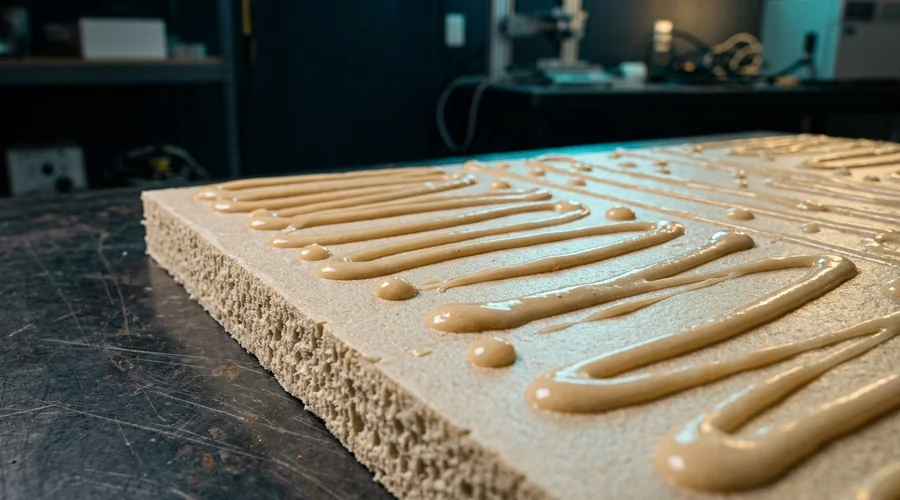
Knowing the three chemistries is only half the specification problem — how the adhesive is physically applied to the panel matters just as much as which chemistry was chosen, which is where bead pattern comes in.
Bead Pattern and Coverage: Why Application Geometry Matters
The geometry of how adhesive is applied to a panel back — a full bed, a ribbon-and-dot pattern, or a perimeter-and-dot pattern — has as much influence on long-term performance as the adhesive chemistry itself, because it determines both the actual bonded contact area and whether moisture or air pressure behind the panel has anywhere to go. Manufacturers specify a minimum percentage-of-coverage figure for a reason, and installers who apply adhesive by habit rather than to that specification are a common source of field failures that get blamed on the adhesive product.
- Full-surface bedding — maximizes bonded contact area and is common on flat, dry, well-prepared substrates, but can trap moisture behind the panel if the assembly has no other drainage path.
- Ribbon-and-dot pattern — a common EIFS and rainscreen approach that leaves open channels for drainage and air-pressure equalization while still meeting minimum coverage requirements.
- Perimeter-and-dot pattern — concentrates adhesive at panel edges where wind uplift and mechanical stress are highest, with interior dots providing supplementary contact.
- Coverage percentage verification — manufacturers typically specify a minimum percentage of the panel's back surface that must show adhesive contact, checked by periodically removing a panel during installation and inspecting the adhesive transfer pattern.
Getting bead pattern and coverage right is a quality-control issue as much as a design one, and it sets up the next variable that determines whether a given adhesive chemistry will actually work: what insulation material it is being asked to bond to.
Matching Adhesive to Insulation Material
Mineral wool, expanded polystyrene (EPS), extruded polystyrene (XPS), and polyisocyanurate boards each present a different surface for an adhesive to grip, and a chemistry that bonds beautifully to one can actively damage another. This is one of the most common and most avoidable mistakes in insulation adhesive construction, and it is entirely preventable by checking compatibility before specification rather than after installation.
| Insulation Type | Surface Character | Compatible Adhesive Chemistries | Key Compatibility Risk |
|---|---|---|---|
| Mineral wool | Open, fibrous, high-density | Cementitious mortar, PU foam adhesive | Over-penetration wastes adhesive without improving bond |
| Expanded polystyrene (EPS) | Closed-cell, low density, bead structure | Solvent-free acrylic, low-solvent PU foam | Solvent attack dissolves cell structure |
| Extruded polystyrene (XPS) | Closed-cell, smoother skin, denser than EPS | Solvent-free acrylic, compatible PU foam | Same solvent sensitivity as EPS, less porous surface for mechanical bond |
| Polyisocyanurate (polyiso) | Closed-cell, facer-skinned (foil or fiberglass) | Cementitious mortar (facer-dependent), compatible PU | Bond is often to the facer, not the foam core — facer type must be checked |
This same compatibility discipline applies just as strictly on the acoustic side of the product, where a lighter interior panel is being bonded to drywall or framing rather than a masonry facade. Acoustic panel adhesive chemistry generally leans toward acrylic and MS-polymer systems precisely because they offer enough flexibility and gap-filling ability to accommodate slightly uneven interior substrates without the added weight or cure time of a cementitious mortar. Confirming compatibility against the specific board manufacturer's approved list — not a generic adhesive datasheet — is the step that prevents a technically sound adhesive chemistry from becoming a field failure on the wrong substrate.
Bond Strength Testing and Failure Modes
An adhesive's technical data sheet numbers mean little until the actual installed bond has been tested on the real substrate, under real installation conditions, because lab-reported values assume ideal application that a jobsite rarely delivers exactly. Direct pull-off testing is the standard field and lab method used to verify that an installed insulation adhesive system is actually performing to specification, and reading the failure mode correctly is as important as reading the numeric result.
- Direct pull (tensile) testing — a steel test disc is bonded to the panel face and pulled perpendicular to the wall with a calibrated tester, following methods such as ASTM C297 or ASTM E2134 for EIFS assemblies.
- Cohesive failure (pass) — the insulation board itself tears before the adhesive bond releases, showing the bond exceeded the material's own internal strength.
- Adhesive failure (investigate) — failure occurs cleanly at the substrate-adhesive or adhesive-panel interface, pointing to a bonding, surface-preparation, or chemistry-compatibility problem rather than a weak insulation board.
- Substrate contamination as a root cause — dust, release agents, or paint residue on the substrate is one of the most frequent reasons a technically correct adhesive still fails a pull test.
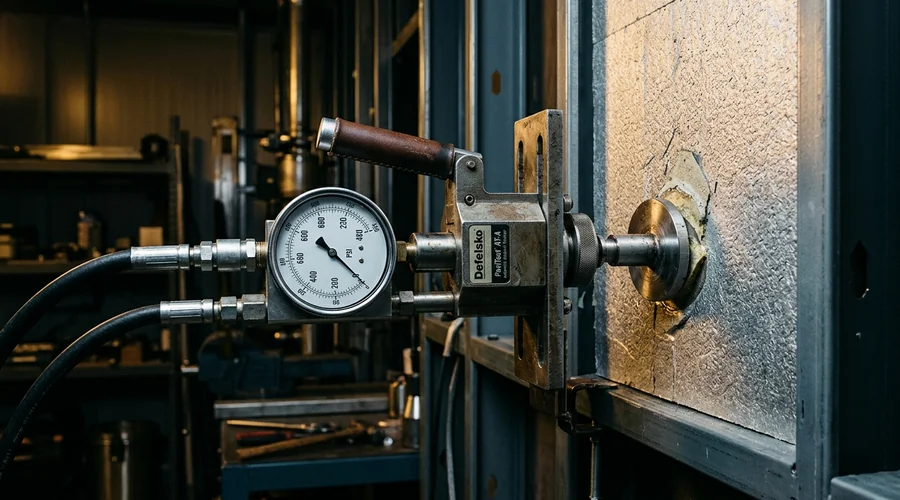
Bond testing confirms that an installed system will hold mechanically, but two additional constraints — fire performance and acoustic function — narrow adhesive selection even further in many commercial and multi-family projects.
Fire Rating and Acoustic Performance Constraints
In fire-rated wall and ceiling assemblies, the adhesive is not an interchangeable commodity behind the insulation — it is a named component of a tested and listed assembly, and swapping it for an unlisted product can invalidate the entire assembly's rating even when the insulation and facing materials stay the same. This is a compliance issue as much as a technical one, and it is frequently missed by contractors focused on the visible insulation product rather than the adhesive holding it in place.
- Surface burning characteristics — tested under ASTM E84, covering flame spread and smoke development contribution of the full assembly, adhesive included.
- Full assembly fire-resistance rating — tested under ASTM E119, where the adhesive's behavior under sustained fire exposure is part of what determines the assembly's rated performance, not just the insulation material alone.
- Listed assembly documentation — the adhesive must be named in the specific tested assembly listing, not merely "compatible" in a general technical sense, to preserve the rating.
- Acoustic panel weight and mounting — heavier ceiling-mounted acoustic panels often require mechanical fasteners as a backup to adhesive bonding, since an adhesive-only bond rated for a lighter panel can be under-specified for a denser one.
Fire and acoustic requirements narrow the field of acceptable adhesives considerably on regulated projects, which makes the final specification decision less about finding the single best adhesive and more about finding the one that satisfies every constraint the project actually has.
Selecting and Specifying the Right System
Choosing an insulation adhesive system correctly means working through substrate, insulation type, load, and regulatory constraints in sequence rather than defaulting to whatever a supplier bundles with the insulation board. A structured specification process catches the compatibility and rating issues that field failures usually trace back to, well before installation begins.
- Confirm substrate and insulation compatibility — check the insulation manufacturer's approved adhesive list against the actual wall or ceiling substrate on the project.
- Match adhesive chemistry to panel weight and orientation — vertical facade panels, overhead ceiling tiles, and horizontal roof insulation each place different mechanical demands on the bond line.
- Verify fire and acoustic listing requirements — confirm whether the project requires a specific tested assembly and, if so, that the adhesive is named in that listing.
- Specify bead pattern and coverage percentage — don't leave application geometry to installer habit; put a minimum coverage percentage in the specification and verify it during installation.
- Test before full-scale application — a pull test on a representative mockup panel and substrate combination catches compatibility problems before they show up across an entire facade.
For manufacturers developing a new insulation adhesive product — whether entering the category for the first time or reformulating an existing line to meet tightening VOC or fire-performance requirements — this is exactly the kind of multi-variable formulation problem where construction chemicals formulation consulting, building envelope product development, and EIFS adhesive manufacturer support shorten the path from lab chemistry to a field-proven product. Working through these constraints methodically, ideally with construction adhesive contract formulation support where in-house R&D capacity is limited, is what turns a bonded assembly into one that performs reliably for the life of the building rather than becoming a warranty claim.
Frequently Asked Questions
What type of adhesive is used to bond insulation panels to a wall or facade?
The right adhesive depends on the insulation material and the substrate, but three chemistries dominate insulation adhesive construction: polyurethane foam adhesives, cementitious polymer-modified adhesive mortars, and acrylic or MS-polymer construction adhesives. Polyurethane foam adhesives expand slightly after application, filling minor substrate irregularities and bonding well to both mineral wool and expanded or extruded polystyrene (EPS/XPS) boards without adding significant moisture to the assembly.
Cementitious adhesive mortars are the standard choice in EIFS (exterior insulation and finish systems) because they bond well to concrete, masonry, and mesh-reinforced base coats and share the same cure chemistry as the rest of the system. Acrylic and MS-polymer adhesives are used where flexibility and a moisture-cure or one-part application matter more than the mechanical strength of a cementitious bond, such as interior acoustic panel installation over drywall or metal framing.
Why does the adhesive bead pattern matter for insulation panel bonding?
Bead pattern controls how much of the panel back actually contacts the substrate and, critically, how trapped air and moisture can escape or drain from behind the panel. A full-surface bed of adhesive maximizes bond area and is common for rigid foam boards on a flat, dry substrate, but it can trap moisture against certain substrates if the assembly is not otherwise designed to manage water.
Perimeter-and-dot or ribbon-and-dot patterns leave open channels behind the panel that let any incidental moisture drain and let air pressure equalize, which is why most EIFS and rainscreen manufacturers specify a percentage-of-coverage bead pattern rather than a full bed. Getting the bead pattern wrong is a common cause of adhesive failure that looks like a bad adhesive when the real problem was a coverage or drainage design choice.
How is insulation adhesive bond strength actually tested?
The standard method is a direct pull (tensile) adhesion test, where a steel test disc is bonded to the face of the installed insulation panel and then pulled perpendicular to the wall using a calibrated pull tester until failure occurs, following methods such as ASTM C297 or ASTM E2134 for EIFS assemblies. The result that matters most is not just the peak force but where the failure occurred.
Adhesive failure at the substrate-adhesive interface or adhesive-panel interface indicates a bonding problem, while cohesive failure within the insulation board itself (the foam tears before the bond releases) is generally considered a pass, since it shows the adhesive bond exceeded the insulation material's own internal strength. Manufacturers and installers use this failure-mode distinction, not just the numeric pull value, to judge whether an adhesive system is performing correctly on a given substrate.
Can the same adhesive be used for both mineral wool and polystyrene insulation boards?
Not always, and treating the two as interchangeable is a common specification mistake. Mineral wool is an open, fibrous, relatively high-density material that needs an adhesive with enough body and surface contact to grip the fiber structure without over-penetrating and wasting material, and it tolerates cementitious adhesives well because both are inorganic and compatible long-term.
Expanded and extruded polystyrene boards are closed-cell, lightweight, and chemically sensitive to certain solvents; a solvent-based adhesive or an incompatible polyurethane formulation can attack and dissolve the foam surface, which is why polystyrene-rated adhesives are explicitly formulated to be solvent-free or low-solvent and compatible with the polymer. Always confirm chemical compatibility against the specific insulation manufacturer's approved adhesive list rather than assuming a general-purpose construction adhesive is safe for a given board type.
What causes acoustic panel adhesive bonds to fail over time?
The most common failure modes are substrate contamination at installation, moisture cycling behind the panel, and adhesive selection that ignores the panel's weight and expected movement. Dust, release agents, or paint residue on the substrate prevents the adhesive from developing a proper mechanical and chemical bond even when the adhesive itself is correctly formulated and applied.
Repeated humidity or temperature cycling can stress a bond that was never designed for dynamic movement, particularly with heavier acoustic panels or in environments with large seasonal swings. Selecting an adhesive rated below the panel's actual installed weight, or skipping mechanical fasteners as a backup on heavier ceiling-mounted panels, is also a frequent root cause traced back to under-specification rather than a defective adhesive product.
Do fire-rated buildings require special insulation adhesives?
Yes. In fire-rated wall and ceiling assemblies, the adhesive is not a cosmetic afterthought — it is part of the tested and listed assembly, and substituting an unlisted adhesive can invalidate the assembly's fire rating even if the insulation and facing materials are unchanged.
Fire-rated assemblies are tested as a complete system under standards such as ASTM E84 for surface burning characteristics and full assembly fire-resistance ratings under ASTM E119, and the adhesive's contribution to flame spread, smoke development, and bond integrity under fire exposure is part of what was actually tested. Specifiers and installers on fire-rated projects need to confirm the adhesive is named in the listed assembly documentation, not simply compatible in a general sense, before substituting any product.
Why would a building product manufacturer need a formulation consultant for an insulation adhesive?
Formulating an insulation adhesive that performs reliably across multiple substrate and insulation combinations, meets fire and VOC regulatory limits, and holds up in accelerated weathering testing is a genuinely difficult multi-variable chemistry problem, not a simple mixing exercise. A formulation consultant brings tested raw-material knowledge, access to relevant ASTM and EN test protocols, and experience troubleshooting the specific failure modes — bond failure, foam attack, moisture sensitivity — that show up only after a product reaches the field.
This is especially valuable for a manufacturer entering insulation adhesives for the first time or reformulating an existing product to meet tightening VOC or fire-performance requirements, where getting the chemistry wrong is far more expensive to fix after a product launch than before it.
Formulating an Insulation Adhesive Product?
Global Formulation provides insulation adhesive formulation consulting, building envelope product development, and EIFS adhesive manufacturer support through construction adhesive contract formulation.
Talk to Our Formulation Team