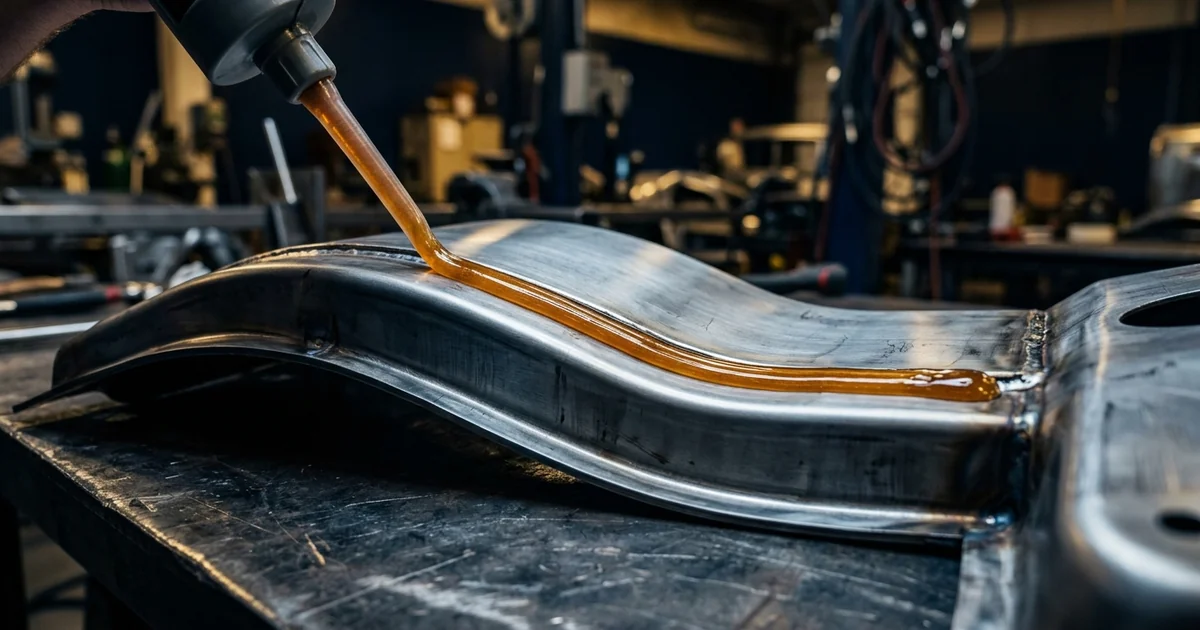
A modern car body can weigh noticeably less than its predecessor from a decade ago and still pass the same crash-safety tests, and automotive structural adhesive bonding is one of the main reasons why. Spot welding alone cannot join the mix of steel, aluminum, and composite panels that lightweight vehicle architectures now combine, and welding dissimilar metals directly against each other invites galvanic corrosion that a weld line does nothing to stop. Automakers need a joining technology that bonds those dissimilar materials, survives crash loading, and fits into an assembly line built around welding robots and paint-bake ovens rather than a separate cure step. This guide breaks down how weld-bonding, toughened epoxy chemistry, and multi-material joint design actually work together in body-in-white assembly, and connects those choices to the broader adhesives and sealants formulation chemistry Global Formulation covers.
Why Modern Vehicle Bodies Can't Rely on Welds and Rivets Alone
Resistance spot welding built the modern automobile, and it remains the fastest, cheapest way to join two sheets of steel — but it only works reliably on steel-to-steel joints, and the lightweighting push that has defined vehicle design for the past two decades keeps adding materials spot welding simply cannot handle. Aluminum resists conventional resistance spot welding because of its lower melting point, higher thermal conductivity, and a tenacious surface oxide layer that interferes with forming a reliable weld nugget, and composite panels made from carbon-fiber-reinforced polymer cannot be resistance welded at all. Automakers responded by mixing steel, aluminum, magnesium and composite panels within the same body structure to hit weight targets without sacrificing stiffness, which means the joining technology has to work across material combinations a single welding process was never designed to handle.
- Steel-to-steel — resistance spot welding remains standard and cost-effective.
- Aluminum-to-aluminum or aluminum-to-steel — the oxide layer and thermal mismatch make conventional spot welding unreliable, pushing manufacturers toward self-piercing rivets, weld-bonding, or adhesive-only joints.
- Composite-to-metal — carbon-fiber and other composite panels cannot be welded at all, so adhesive bonding is often the only viable structural joining method.
- Dissimilar metals in direct contact — create a galvanic corrosion risk that welding does nothing to prevent.
| Joining method | Works on aluminum/mixed materials | Corrosion isolation | Fits existing paint-bake cure cycle |
|---|---|---|---|
| Resistance spot weld only | Unreliable on aluminum | None — direct metal contact | N/A — no cure step |
| Weld-bonding | Steel-focused; limited on aluminum | Yes — adhesive layer isolates contact | Yes — cures in bake oven |
| Self-piercing rivet + adhesive | Yes — standard for aluminum-intensive bodies | Yes — adhesive layer isolates contact | Yes — cures in bake oven |
| Adhesive bond only | Yes, including composites | Yes — full separation | Yes — cures in bake oven |
None of these material combinations can be solved by choosing a better welding robot — they require a fundamentally different joining chemistry, and that's exactly the gap structural adhesive bonding fills.
Weld-Bonding: Combining a Continuous Adhesive Bond with Spot Welds
Weld-bonding is not a replacement for spot welding on steel structures — it's a hybrid process that layers a continuous structural adhesive bond line underneath a pattern of conventional spot welds, and the combination outperforms either joining method used alone. The process applies a bead or film of structural epoxy adhesive between two steel panels before they're assembled, then spot welds directly through the still-wet adhesive at the normal weld locations, and the assembly moves on to the paint line where the adhesive cures during the body's e-coat bake cycle. That sequencing matters: the spot welds provide immediate handling and fixturing strength the moment the weld gun fires, while the adhesive — still uncured at that point — adds no strength yet but sets up a continuous bond line that carries the real structural and fatigue load once cured.
- Discrete load points — spot welds alone concentrate load at individual weld nuggets, creating stress risers that are the typical origin of fatigue cracking in a welded-only joint.
- Continuous load path — an adhesive bond line spreads that same load across the entire bonded area, reducing peak stress and meaningfully improving fatigue life over spot welds alone.
- Immediate handling strength — the spot welds carry the panel through the assembly line before the adhesive cures, something a purely adhesive-bonded joint cannot offer on its own.
Weld-bonding solves the steel-to-steel timing problem neatly, but aluminum and composite panels bring an additional complication weld-bonding alone doesn't address: what happens when two genuinely different materials are bonded together permanently.
Multi-Material Bonding: Avoiding Galvanic Corrosion and Managing CTE Mismatch
Bonding aluminum to steel, or a carbon-fiber composite to aluminum, introduces two problems a same-material joint never faces, and both come down to the fact that the two materials are chemically and physically different from each other. The first is galvanic corrosion: when two dissimilar metals are in direct electrical contact in the presence of an electrolyte such as road salt or humidity, the more anodic metal — aluminum, in an aluminum-steel pairing — corrodes preferentially, a well-documented electrochemical process that can progressively weaken a joint over years of service. A structural adhesive bond line physically separates the two metal surfaces, acting as an electrical insulator between them and removing the direct metal-to-metal contact galvanic corrosion requires, which is a benefit welding and mechanical fastening alone cannot offer.
- Electrical isolation — adhesive bond lines separate dissimilar metals, removing the direct contact galvanic corrosion depends on.
- Thermal expansion mismatch — coefficient of thermal expansion differs significantly between materials such as aluminum, steel and carbon-fiber composite, so a bonded joint experiences differential expansion and contraction across temperature swings that a rigid weld cannot accommodate.
- Stress absorption — a toughened, moderately flexible adhesive bond line can absorb some of that CTE-driven stress instead of concentrating it at a single rigid joint, reducing the risk of delamination or cracking over repeated thermal cycling.
- Supplementary fastening — where a bond line alone isn't sufficient, self-piercing rivets or flow-drill screws are frequently combined with the adhesive, since aluminum's oxide layer and lower melting point make spot welding aluminum-rich joints unreliable.
Isolating dissimilar materials and absorbing thermal mismatch depends entirely on the adhesive itself having the right balance of strength and flexibility, which comes down to how the epoxy chemistry is formulated.
Crash-Durable Adhesive Chemistry: Toughened Structural Epoxies
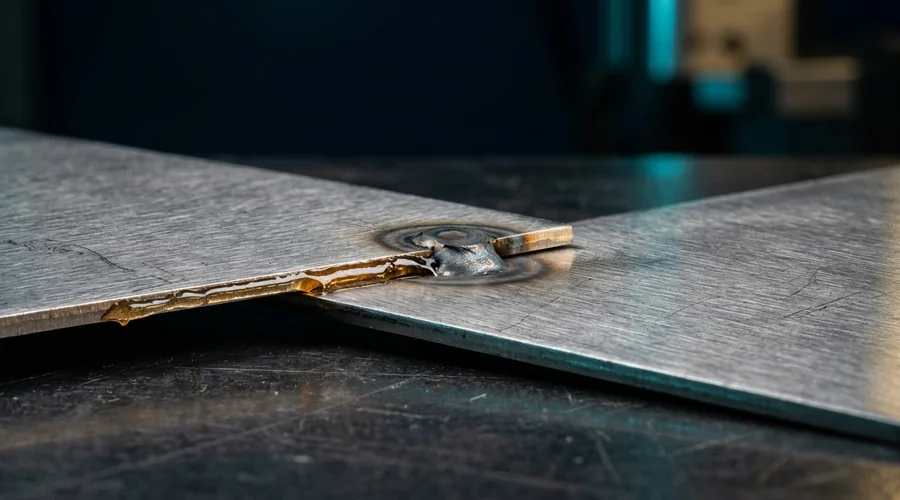
A standard rigid epoxy adhesive is strong in tension and shear but brittle under the sudden, high-strain-rate impact loading a crash event produces, which makes it a poor match for a structural joint that has to survive a collision rather than just static loading. Automotive structural adhesives solve this with toughened epoxy chemistry, most commonly using core-shell rubber particles dispersed through the epoxy matrix — a chemistry covered in more technical depth in our guide to epoxy adhesive toughening — which absorb and dissipate impact energy that a purely rigid epoxy network would instead channel straight into a brittle crack.
- Peel and impact strength — core-shell rubber toughening improves both substantially over an untoughened epoxy, without sacrificing the high shear strength the joint needs under normal driving loads.
- Temperature-range ductility — toughened epoxies are formulated to maintain ductility across the temperature range a vehicle actually experiences, since a formulation that toughens well at room temperature but turns brittle in cold weather defeats the purpose.
- Impact-relevant validation — crash-durable adhesive performance is validated specifically under impact-relevant test conditions, not just standard static lap-shear testing, because a joint that performs well under slow loading can still fail differently under the high strain rates of an actual collision.
Getting the adhesive chemistry right only matters if the finished joint can actually be manufactured on a real assembly line, which is where cure behavior becomes the next constraint.
Curing Integration: How Structural Adhesive Fits the Paint-Bake Oven
Automotive assembly lines are built around a fixed sequence of stations, and adding a dedicated adhesive-cure oven somewhere in body-in-white assembly would be a significant capital and cycle-time cost most manufacturers aren't willing to absorb. Structural adhesives solve this by being formulated as one-part, heat-activated, latent-cure epoxy systems — stable at room temperature for extended periods so they can be applied, stored and handled without curing prematurely, and then curing only when they pass through the elevated-temperature e-coat and paint-bake ovens the body already travels through as part of normal paint processing.
- No mixing step — one-part latent-cure chemistry needs no metering or mixing on the line, unlike a two-part epoxy that must be combined immediately before application.
- Piggybacked cure cycle — curing rides on the existing e-coat/paint-bake thermal cycle, avoiding a separate cure oven and the capital cost and cycle-time penalty that would add.
- Balancing act — formulators must weigh shelf stability at room temperature against a fast, complete cure once the body reaches bake-oven temperature; a system that's too reactive risks partial curing in storage, while one that's too stable risks an incomplete cure if the bake cycle runs shorter than expected.
A structural adhesive that cures reliably in the paint oven still depends entirely on the surfaces it's bonding being properly prepared before the adhesive is ever applied.
Surface Preparation and Joint Design for Structural Bonding
An adhesive bond is only as strong as the surface it's bonded to, and automotive structural bonding surfaces arrive from the stamping plant coated in stamping oils, mill scale, or a native oxide layer that will compromise adhesion if the adhesive is applied directly over it. Surface preparation strategy differs meaningfully by substrate: aluminum in particular needs a pretreatment that manages its oxide layer, often a chromate-free conversion coating similar to the technology covered in our chromate-free conversion coatings guide, since an untreated aluminum oxide layer forms a weak boundary layer that can fail even when the adhesive itself remains intact.
- Degreasing — removes stamping oils and handling residue that would otherwise sit between the adhesive and the substrate as a weak boundary layer.
- Reactive-metal pretreatment — aluminum and other reactive surfaces typically need a chemical pretreatment or conversion coating rather than degreasing alone, addressed in more depth in our guide to aluminium substrate surface treatment.
- Bond line thickness and overlap — engineered deliberately, since a joint that's too thin risks stress concentration while excessive overlap adds weight without a proportional strength gain.
- Loading direction — joint design accounts for peel-dominant versus shear-dominant loading, since structural adhesives are considerably stronger in shear than in peel, and good joint geometry avoids placing the bond in a pure-peel configuration wherever possible.
Correct surface preparation and joint geometry set the ceiling on how strong a bond can be — but a manufacturer only knows if that ceiling was actually reached through dedicated mechanical testing.
Testing and Validating Automotive Structural Bond Performance
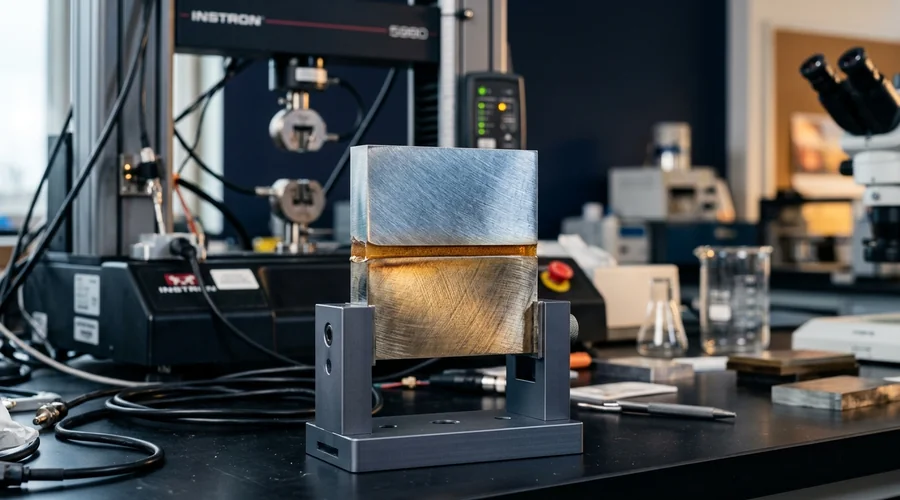
A structural adhesive joint that looks correct after assembly still has to be validated against standardized mechanical tests before it can be trusted in a vehicle that will see years of real-world loading and, potentially, a crash event. Static lap-shear testing establishes basic bond strength under simple tension, but automotive structural joints are evaluated well beyond that baseline because crash and durability performance depend on properties a single static test can't capture.
- Lap-shear testing under standards such as ASTM D1002 establishes baseline shear strength between bonded substrates.
- T-peel and wedge-impact testing evaluate the bond's resistance to peel-dominant loading and sudden impact, far more representative of crash-relevant failure modes than static shear alone.
- Fatigue testing under cyclic loading validates the durability benefit weld-bonding and continuous adhesive bond lines are specifically chosen to provide over spot welds alone.
- Environmental durability testing — humidity, salt-spray, and thermal cycling exposure followed by re-testing mechanical strength — confirms the bond retains performance once the corrosion and CTE-mismatch conditions discussed earlier in this guide actually occur over time.
Weld-bonding, multi-material corrosion isolation, toughened epoxy chemistry, oven-integrated curing, disciplined surface preparation, and standardized mechanical validation are not independent choices — they're a single connected formulation and process decision, and skipping validation on any one of them is what turns a bond that looked fine on the line into a warranty claim or, worse, a crash-performance failure years later.
Frequently Asked Questions
What is weld-bonding, and why do automakers use it instead of just welding?
Why can't aluminum body panels just be spot welded like steel?
What stops steel and aluminum from corroding when they're bonded together in the same vehicle body?
How does a structural adhesive cure without a dedicated oven on the assembly line?
What makes an adhesive 'crash-durable' compared to a standard structural epoxy?
Can structural adhesive bonding fully replace welds and rivets in a car body?
What testing confirms an automotive structural adhesive joint will hold up in real use?
Need Expert Formulation Support?
Our team provides end-to-end technical consultancy — from structural adhesive chemistry and joint design to surface pretreatment strategy and plant setup for adhesive and sealant manufacturers.
Get a Free Consultation