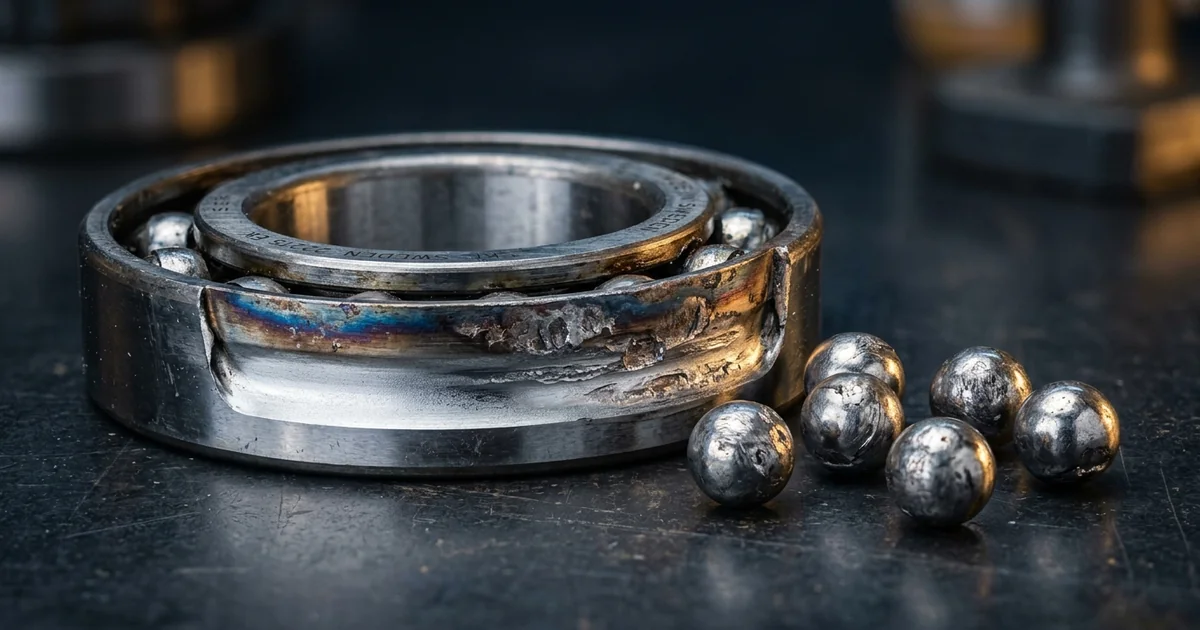
Bearing failure from lubrication rarely arrives as a surprise, yet the root cause is almost always argued about after the fact. A production line stops, a gearbox is opened, and a scored, discoloured bearing lands on the maintenance bench with two competing explanations already in the room: the oil ran out, or dirt got in. Getting that answer wrong is expensive, because a starvation fix and a contamination fix have almost nothing in common — one lives in the re-lubrication schedule and lubricant selection, the other in the seals and filtration. This guide walks through how lubricant starvation and contamination each damage a rolling element bearing, how to tell them apart from the surface evidence and the lubricant sample you already have, and how to build a corrective plan that actually stops the recurrence. The goal is a confident root cause finding, not another bearing in the failed-parts drawer.
Understanding the Problem: What Bearing Failure from Lubrication Looks Like
Most premature bearing failures trace back to the lubricant rather than to fatigue or manufacturing defects, and the two dominant lubrication-related mechanisms are starvation and contamination. Starvation is a film problem: the elastohydrodynamic oil layer that should separate the rolling elements from the raceway becomes too thin, and the surfaces touch under load. Contamination is a foreign-material problem: hard particles or water enter the contact and damage the surfaces mechanically or chemically while the film may still be present. Both end in the same place — a rough, damaged raceway and rising vibration — but they get there by different routes.
The commercial impact is driven by how the failure presents. Starvation failures can develop fast, sometimes within a single shift once the film collapses, and they often take the shaft, seals, and housing with them. Contamination failures usually develop slowly, with vibration creeping up over weeks as micro-pitting spreads, which gives more warning but also means the damage is widespread by the time anyone acts. In both cases the replacement bearing fails again on the same timescale if the root cause is misidentified.
Industries most exposed include any operation with high dust loads, water washdown, or aggressive re-lubrication practices: cement and mining, pulp and paper, food processing, steel, and general rotating equipment in poorly sealed environments. Wherever bearings run hot, run fast, or run in dirty air, the risk of a lubrication-related failure rises sharply, and the ability to read the failed surface becomes a core maintenance skill rather than a specialist luxury.
Root Causes: The Mechanisms Behind Starvation and Contamination Failure
Starvation and contamination attack a bearing through fundamentally different physics, and understanding which one is in play is the first decision in any corrective plan. Starvation is about the oil film failing to form or failing to survive the heat it generates. Contamination is about particles or water entering a contact that the lubricant cannot exclude. The mechanisms below explain why each failure mode produces its characteristic damage pattern, which is what makes them distinguishable on the bench.
How Lubricant Starvation Destroys a Bearing
In a healthy bearing, a film only a fraction of a micrometre thick keeps the rolling element and raceway apart under enormous contact pressure. When supply drops, viscosity falls, or temperature rises, that film thins until asperities touch. The friction from that contact generates heat faster than the bearing can conduct it away, so temperature spikes, the oil thins further, and the film collapses entirely. From there, adhesive wear smears and transfers metal, the raceway roughens, hardness drops in the overheated zone, and the bearing can seize. The damage is concentrated in the load zone because that is where contact pressure and film demand are highest.
- Inadequate supply — too little grease, too long a re-lubrication interval, blocked oil passages, or a failed lubricator starve the contact directly.
- Wrong lubricant selection — a base oil viscosity too low for the speed and temperature never builds a full film even when supply is correct.
- Grease behaviour — a grease that has bled its oil, hardened, or been churned and thrown clear of the raceway stops delivering oil to the contact.
- Excess heat — high ambient temperature, overload, or misalignment thins the oil in service and pushes a marginal film into collapse.
How Contamination Destroys a Bearing
Contamination damage depends on particle size relative to the oil film. Particles smaller than the film pass through harmlessly, and particles far larger cannot enter the contact. The dangerous size is the range that is bigger than the film but small enough to be dragged in — these get rolled into the raceway and act as indenters, leaving dents with raised edges that then become stress raisers for surface-origin spalling. Because contaminant particles circulate with the lubricant, the damage appears around the full raceway circumference rather than only in the load zone.
- Hard particle ingress — silica dust, weld spatter, grinding swarf, and casting sand enter through failed seals, during careless assembly, or with contaminated new lubricant.
- Internally generated debris — wear particles from gears or a previously damaged bearing recirculate and indent otherwise healthy surfaces.
- Water contamination — free or emulsified water displaces the oil film, corrodes the raceway to a roughened matte finish, and can drive hydrogen-assisted cracking under load.
- Lubricant degradation products — oxidation sludge and additive precipitate act as soft contaminants that block passages and reduce effective film life.
| Feature | Lubricant Starvation | Contamination |
|---|---|---|
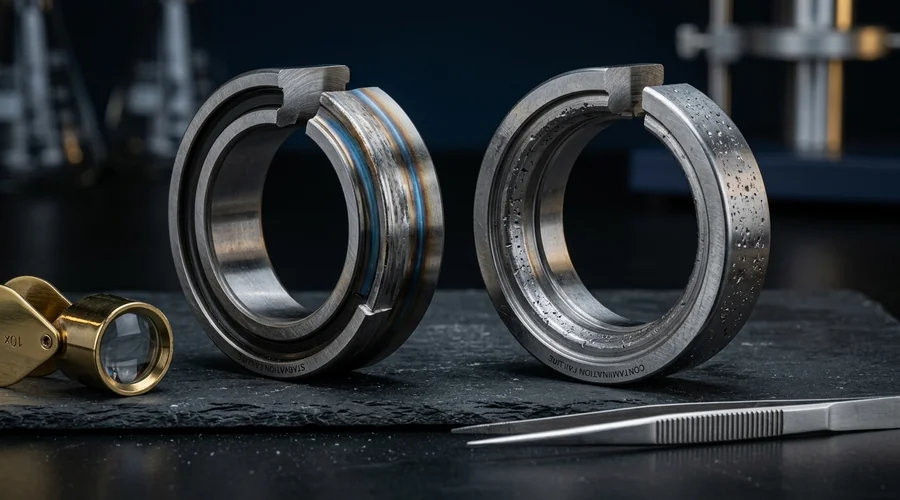
| Damage location | Concentrated in the load zone | Distributed around full raceway circumference |
| Surface appearance | Heat discolouration, smeared metal, polished or frosted track | Dents with raised edges, scratches, micro-pitting |
| Failure speed | Often rapid once film collapses | Usually progressive over weeks |
| Lubricant sample signature | High wear metals, low external particulate, possible thermal degradation | High silicon or particle count, free water, external debris |
| Primary corrective domain | Re-lubrication schedule and lubricant selection | Sealing, filtration, and lubricant handling |
Diagnosis: How to Confirm the Root Cause
Confirming whether a bearing failed from starvation or contamination is a process of reading evidence in the right order, not a single test. The mistake that keeps failures recurring is jumping to the raceway and guessing before the lubricant sample and the operating history have been reviewed. Work through the accessible evidence first, then let the bearing teardown confirm what the earlier steps already suggested.
- Review the operating history — a temperature log showing a rapid climb before failure supports starvation, while a slow rise in vibration over weeks supports progressive contamination damage.
- Analyse the used lubricant — high wear metals with low silicon and low particle count point to starvation; elevated silicon, high ISO particle counts, or free water point to contamination.
- Inspect the seals and housing — worn, hardened, or displaced seals and visible ingress paths are direct evidence of a contamination route before the bearing is even opened.
- Read the raceway damage pattern — check whether damage is concentrated in the load zone or distributed around the circumference, and whether it is heat-marked and smeared or mechanically dented.
- Examine the rolling elements and cage — matching wear on the balls or rollers and cage pocket damage help confirm the mechanism and its severity.
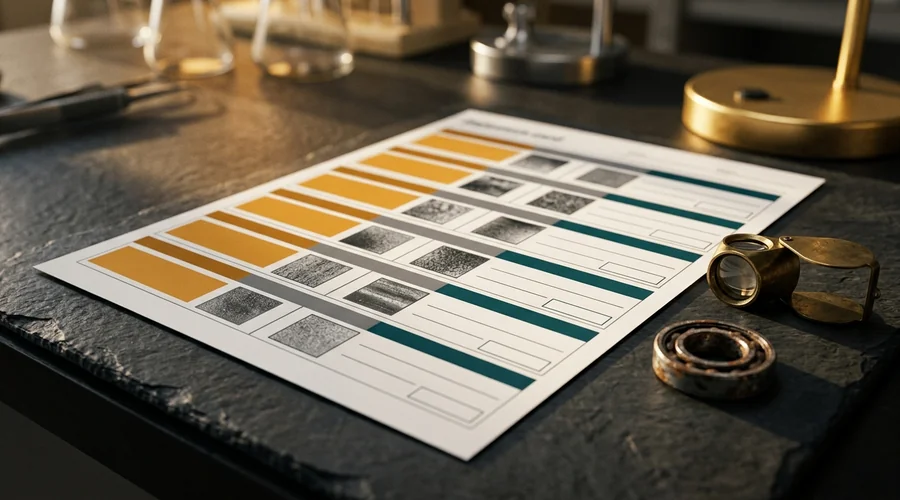
Two independent lines of evidence pointing the same way is the standard for a confident finding. Standardised bearing failure classification frameworks such as those published by bearing manufacturers' inspection services give a common vocabulary for describing the damage, which matters when the finding has to be defended to a supplier or an OEM. When the lubricant sample and the surface pattern disagree, that contradiction is itself a signal — usually of a combined failure — and it should be investigated rather than resolved by picking the more convenient answer.
Solution Strategies: Corrective Approaches for Each Mechanism
Once the mechanism is confirmed, the corrective path is specific and the two paths barely overlap. Applying a contamination fix to a starvation failure — new seals on a bearing that actually ran dry — wastes the next service interval while the real cause keeps working. Match the strategy to the confirmed mechanism, and address the mechanism rather than the symptom.
Correcting a Starvation Failure
Starvation is solved by getting the right lubricant to the contact in the right quantity at the right frequency. That means revisiting the re-lubrication interval and volume against the bearing's speed, size, temperature, and orientation, and checking that oil passages, lubricators, and grease paths are actually delivering to the raceway. Lubricant selection is the other half: the base oil viscosity has to be adequate for the operating speed and temperature so a full elastohydrodynamic film can form, and the grease thickener and consistency have to suit the application without bleeding dry or churning out.
- Re-lubrication practice — set interval and quantity from a recognised calculation method, not habit, and account for temperature and contamination severity.
- Lubricant selection — confirm base oil viscosity and viscosity index suit the full operating temperature range, not just startup.
- Delivery verification — inspect passages, drillings, and automatic lubricators to confirm lubricant reaches the load zone.
- Thermal management — address overload, misalignment, and ambient heat that thin the film even when supply is adequate.
Correcting a Contamination Failure
Contamination is solved by keeping foreign material out of the lubricant and out of the bearing. The priority order is exclusion first, then removal: better seals and housing design stop ingress, improved filtration and breathers remove what still gets in, and disciplined lubricant handling prevents dirty grease or water-laden oil from being introduced during service. Where water is the contaminant, the fix extends to identifying the water source — washdown, condensation, or a cooler leak — and to selecting a lubricant with adequate water separation or emulsion control for the environment.
- Exclusion — upgrade seal type, add flingers or labyrinth protection, and close housing ingress paths.
- Removal — improve filtration rating, add or service breathers and desiccant breathers, and control system cleanliness to a target ISO code.
- Lubricant handling — use clean, dedicated transfer equipment and sealed containers, and filter new oil on the way into the system.
- Water control — trace and eliminate the water ingress source and select a lubricant with suitable demulsibility or water tolerance.
Prevention: Process Controls to Avoid Recurrence
Preventing repeat lubrication-related bearing failures means treating the lubricant supply and the contamination barrier as monitored systems rather than assumptions. Sites with the lowest bearing failure rates run a proactive lubrication programme, control system cleanliness to a target, and use vibration or temperature trending to catch a developing failure while intervention is still cheap. The controls below address both mechanisms at once.
- Lubrication programme discipline — documented intervals and quantities per bearing, calculated not guessed, with a record of every re-lubrication performed.
- Lubricant selection review — periodic check that installed lubricants still match current operating speeds, temperatures, and loads after any process change.
- Cleanliness targets — a defined ISO cleanliness code for oil-lubricated systems, with filtration and breathers specified to hold it.
- Storage and handling standards — sealed, labelled containers, dedicated transfer equipment, and new-oil filtration to prevent built-in contamination.
- Condition monitoring — vibration and temperature trending on critical bearings so a slow contamination failure is caught before the raceway is destroyed.
- Failed-bearing analysis — every premature failure inspected and classified, so the corrective action targets a confirmed cause and the pattern is visible across the site.
The single highest-value prevention step is closing the loop: analyse every failed bearing, record the confirmed mechanism, and feed that back into the lubrication and sealing standards. A site that does this consistently converts each failure into a permanent improvement instead of a recurring cost.
When to Escalate to a Specialist
Most lubrication-related bearing failures resolve through structured evidence review and the corrective actions above, but some patterns exceed what in-house maintenance can reliably diagnose. Recognising these early prevents a cycle of replacement bearings that keep failing for a reason nobody has pinned down. The clearest trigger is repetition: the same bearing position failing again after a corrective action means the real cause was missed.
Escalation is appropriate when a failure surface shows features that fit neither starvation nor contamination cleanly, when electrical discharge damage, lubricant incompatibility, or additive depletion is suspected, or when the failure has safety, warranty, or production-critical consequences that justify laboratory metallurgical analysis. Combined failures, where heat damage and distributed denting appear together, also benefit from specialist review because the corrective plan has to address two systems at once and get the sequence right.
Complex cases — a fleet-wide failure pattern, a recent lubricant or process change that coincides with rising failures, or a need to defend a root cause finding to a supplier — warrant a formal failure analysis that combines tribology, lubricant chemistry, and metallurgy. Our team supports root cause analysis and corrective lubrication strategy from failed-part inspection through validated lubricant selection and monitoring programme design.
For related background, see our guide to lubricant formulation fundamentals, our overview of grease NLGI grades and selection, and our explanation of rust preventive oil film chemistry, all of which cover base oil and additive behaviour relevant to bearing film performance.