Drug Excipient Compatibility Study: A Preformulation Guide
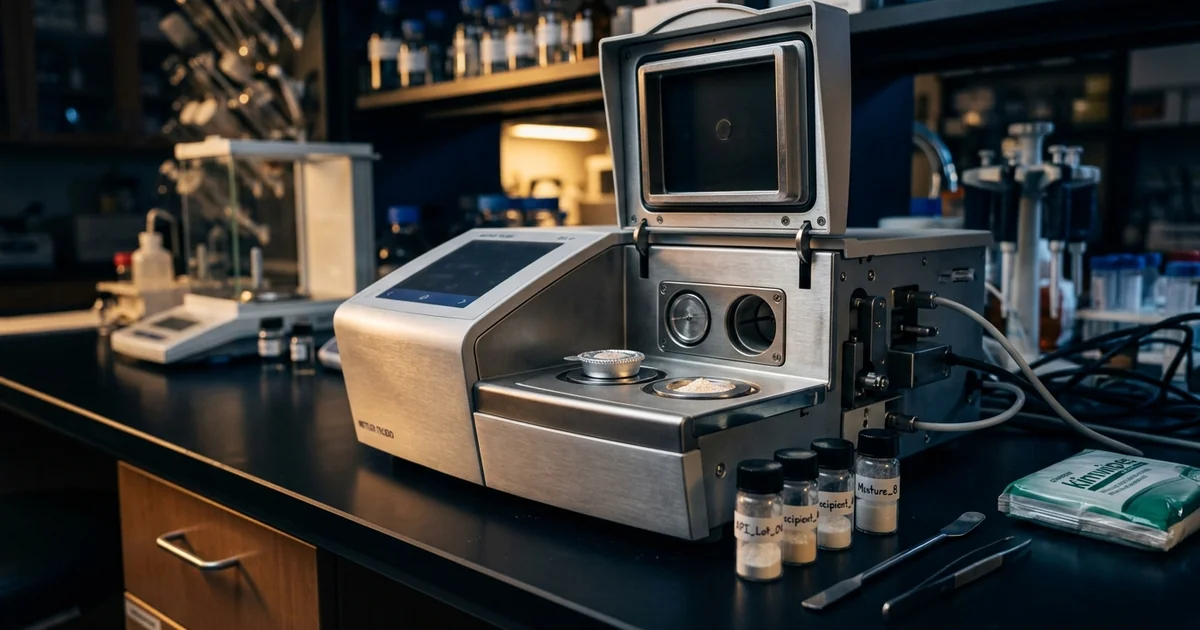
A formulation that fails stability testing at month six, after excipients, packaging, and a manufacturing process have already been locked in, is one of the most expensive mistakes a pharmaceutical development program can make. Most of those failures trace back to the same root cause: a drug excipient compatibility study that was skipped, rushed, or misread during preformulation. Excipients are never truly inert, and the wrong combination can quietly degrade the active ingredient, shift its dissolution behavior, or generate impurities that only show up once it is too late to change course cheaply. This guide walks through how compatibility screening actually works: which analytical methods to use, how to design a binary blend study, how to tell a real chemical interaction from a DSC artifact, and what regulators expect to see in the resulting data. It reflects how Global Formulation approaches preformulation and compatibility screening support for pharmaceutical manufacturers and formulation teams bringing a new drug substance into development.
Why Drug-Excipient Compatibility Studies Can't Be Skipped
Formulation teams under commercial pressure often treat compatibility screening as a box to tick rather than a genuine risk-reduction step, and that shortcut is where most late-stage formulation failures originate. An excipient that looks chemically unremarkable on paper can still catalyze hydrolysis, oxidation, or a solid-state transformation in the drug substance once the two are actually blended and stored. Catching that reaction during a six-week preformulation screen costs a fraction of what it costs to discover it during a pivotal stability study or, worse, after a batch has already shipped. The evidence for this is consistent across the pharmaceutical literature: excipient-driven degradation is one of the most frequently cited root causes of failed stability studies and unexpected impurity findings.
- Cost asymmetry — a compatibility screen costs weeks and milligrams of drug substance; a failed pivotal stability study costs months and a full reformulation cycle.
- Hidden reactivity — excipients that are pharmacologically inactive are not necessarily chemically inert toward a given drug substance.
- Regulatory expectation — reviewers expect excipient selection to be justified by data, not by precedent or convenience alone.
- Irreversible timing — by the time a stability failure surfaces, packaging, process, and often clinical supply decisions are already locked in around the incompatible formula.
Understanding why these studies matter commercially is only half the picture. The next section explains what a drug-excipient interaction actually is at the chemical level, since that mechanism drives every screening decision that follows.
What a Drug-Excipient Interaction Actually Is
A drug-excipient interaction is any physical or chemical change that occurs when the active pharmaceutical ingredient is placed in direct contact with an excipient, beyond what either component does on its own. These interactions split into two broad categories that require different detection strategies and carry very different consequences for the finished product. Chemical interactions alter the drug molecule itself, while physical interactions change its solid-state form without altering its chemical identity. Both categories can compromise a product, but only one of them shows up reliably on a stability-indicating assay.
- Chemical interactions — hydrolysis, oxidation, Maillard-type reactions between a primary amine drug and a reducing-sugar excipient, and excipient-catalyzed degradation are the most commonly reported mechanisms.
- Physical interactions — polymorphic transformation, changes in crystallinity, and moisture-mediated recrystallization can alter dissolution rate and bioavailability without producing a single new chemical impurity.
- Trace-impurity triggers — many excipient-driven degradations are actually caused by trace impurities within the excipient itself, such as residual peroxides in polyethylene glycols or reducing sugars in certain fillers, rather than the labeled excipient compound.
Because chemical and physical interactions leave different fingerprints, no single analytical technique catches both reliably. That gap is exactly why compatibility screening relies on a panel of complementary methods, covered next.
Screening Methods: DSC, TLC, HPLC, and FTIR
Each analytical technique used in compatibility screening answers a slightly different question, and understanding what each one can and cannot detect prevents both false alarms and missed interactions. Differential scanning calorimetry is the fastest and most widely used first-pass method, because it needs only milligram quantities and can screen a large excipient panel within days. Thin-layer chromatography and high-performance liquid chromatography confirm whether an observed thermal anomaly reflects a genuine chemical change, while Fourier-transform infrared spectroscopy adds a functional-group-level view that can catch interactions the other methods miss.
| Method | What It Detects | Speed / Material Need | Key Limitation |
|---|---|---|---|
| DSC | Shifts in melting point, new thermal events, eutectic behavior | Fast; milligram quantities | Prone to false positives from purely physical effects |
| TLC | New spots indicating degradation products | Fast, low-cost; low sensitivity | Cannot quantify degradation, easily misses trace impurities |
| HPLC | Quantitative assay loss and specific degradation products | Slower; requires method development | Needs a stability-indicating method to be meaningful |
| FTIR | Functional-group changes indicating new chemical bonds | Fast; solid-state samples | Insensitive to low-level degradation or trace impurities |
No single method in this table should be trusted alone. The methods below are combined in sequence, DSC for triage and HPLC for confirmation, which is exactly the study design covered next.
Designing a Binary Blend Compatibility Study
A well-designed compatibility study starts with the excipient panel the formulation is genuinely likely to need, rather than screening every excipient a laboratory happens to have on the shelf. Binary blends, drug substance paired one-on-one with a single excipient, remain the standard starting point because they isolate each interaction cleanly before ternary or full-formulation complexity is introduced. The drug substance and each excipient candidate are also run individually as controls, since a control run is the only way to distinguish a genuine interaction in the blend from a property either material already had on its own.
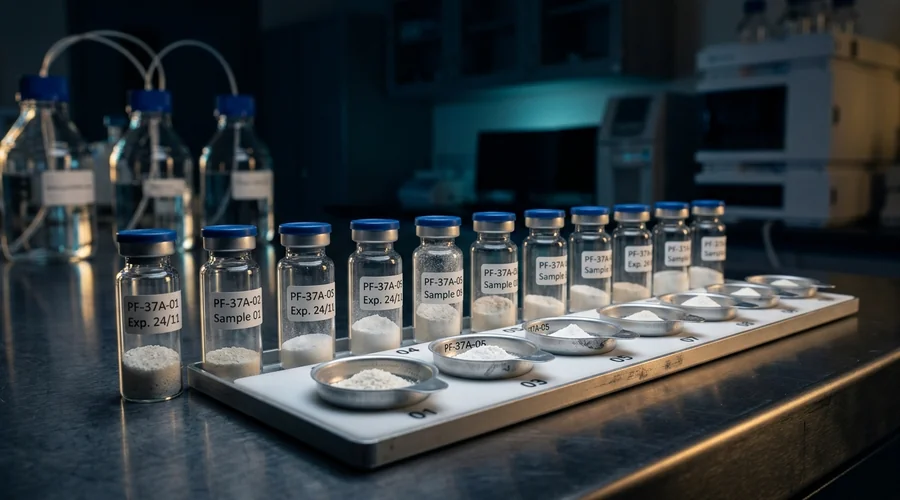
- Panel selection — prioritize excipients the target dosage form actually requires: fillers, binders, disintegrants, or lubricants relevant to the intended route of administration.
- Blend ratio — a one-to-one weight ratio of drug substance to excipient is the standard screening protocol; some labs also run an excipient-heavy ratio for materials expected at high levels in the final formula.
- Controls — pure drug substance and pure excipient must be run under identical conditions alongside every blend, or an apparent interaction cannot be distinguished from an intrinsic property of either component.
- Moisture control — samples should be prepared and stored at controlled humidity, since moisture content differences between batches are a frequent confounder in both DSC and stress-testing results.
With the panel and controls defined, the next step is running the DSC screen itself, and learning to read the resulting thermograms correctly.
Interpreting DSC Data: Real Signals vs Artifacts
DSC interpretation is where most compatibility programs go wrong, because the technique is exquisitely sensitive to changes that have nothing to do with chemical incompatibility. A shifted, broadened, or missing melting endotherm in a physical blend looks alarming on a thermogram, but several purely physical mechanisms can produce exactly that signature without a single chemical bond changing. Learning to tell these apart is the difference between a screening program that correctly flags real risks and one that discards perfectly usable excipients out of caution.
- Eutectic formation — two crystalline solids mixed together can lower each other's effective melting point through simple eutectic behavior, a purely physical phase phenomenon.
- In-situ dissolution — during the DSC heating scan, the drug can dissolve into a lower-melting excipient once it liquefies, which suppresses or shifts the drug's own melting peak without any degradation occurring.
- Peak broadening from particle size or crystallinity — differences in particle size, crystal habit, or residual moisture between the pure component and the ground blend can broaden or shift a peak on their own.
- Overlapping thermal events — when a drug and excipient have melting points close together, their endotherms can overlap on the thermogram in a way that mimics an interaction.
DSC tells a formulator where to look. Confirming what is actually happening requires storing the blend under real stress conditions and watching for chemical change over time, which is the next step in the workflow.
Stress Conditions and Study Duration
Isothermal stress testing exposes the binary blend, along with its pure-component controls, to elevated temperature and humidity for a defined period, then measures the drug substance by a stability-indicating HPLC method to detect assay loss or new degradation products. The conditions borrow conceptually from the accelerated and forced-degradation conditions used in ICH stability testing, though a compatibility screen typically runs shorter and can use more aggressive stress than a formal stability study would, since the goal is to accelerate any reaction enough to observe it within a practical screening timeline.
| Condition Type | Typical Setting | Typical Duration | Purpose |
|---|---|---|---|
| Accelerated (ICH-aligned) | 40°C / 75% relative humidity | 2–4 weeks for screening | Standard moderate stress, comparable to formal stability protocols |
| Elevated open-dish | 50–60°C, ambient or open humidity | 1–2 weeks | Faster triage for highly reactive drug substances |
| Photostability exposure | ICH-aligned light exposure conditions | Single defined exposure | Flags excipients that promote photodegradation |
Choosing a stress condition that is too mild risks missing a slow-developing interaction, while one that is too aggressive can generate degradation pathways that would never actually occur under real storage conditions. Matching the study design to the drug substance's known sensitivity is what separates predictive stress data from noise. Once the stress data confirms which pairs genuinely interact, that information has to translate into an actual excipient shortlist, which the next section covers.
From Screening Data to Excipient Selection Decisions
Compatibility data only has value once it changes a decision, and the transition from raw screening results to an excipient shortlist is where many programs lose the thread. A confirmed interaction does not automatically eliminate an excipient class; it usually eliminates one grade or supplier while leaving related materials from the same class viable. Our guide to excipient selection for oral solid dosage forms covers the broader selection criteria that compatibility data feeds into once an excipient panel has been screened.
- Grade substitution first — different grades of the same excipient class, such as varying molecular weights of polyethylene glycol, can differ substantially in trace impurity content and reactivity.
- Excipient class change — if grade substitution does not resolve a confirmed interaction, moving to a chemically distinct excipient class is the next step, not the first one.
- Formulation-level mitigation — physical separation strategies, such as a barrier coating or a separate granulation step, can sometimes allow an otherwise incompatible pair to coexist in the finished product.
- Documentation trail — every eliminated and retained excipient should carry a documented rationale tied back to specific compatibility data, since this record becomes part of the development justification.
This decision framework matters more for poorly soluble or chemically sensitive drug substances, since compatibility questions often intersect directly with the enhancement strategy required to make the compound bioavailable at all. Once excipient decisions are locked in, the remaining question is what a regulator will expect to see documented, which the next section addresses.
Regulatory Expectations: ICH and FDA Documentation
Regulatory agencies rarely request a standalone compatibility-study report as a submission attachment, but they consistently expect the pharmaceutical development section of a submission to demonstrate that excipient selection followed a systematic, data-driven process. The ICH quality guidelines, particularly Q8(R2) on pharmaceutical development, explicitly frame compatibility between the drug substance and excipients as part of the Quality by Design rationale that supports formulation choices. A submission that cannot point to compatibility evidence behind its excipient selections invites additional reviewer questions later in the process.
- Development rationale — reviewers expect excipient choices, especially unusual ones or those present at high levels, to be justified with supporting data rather than precedent alone.
- Risk-based emphasis — a Quality by Design submission places more weight on demonstrating that compatibility risk was assessed systematically than on any single study format.
- Consistency with stability data — compatibility conclusions should align with, and help explain, the degradation behavior later observed in formal stability studies.
Building this evidence base early, rather than reconstructing it retroactively when a reviewer asks a question, is far cheaper and faster. That same early-stage discipline is also what prevents the common pitfalls covered next.
Common Pitfalls That Produce Misleading Compatibility Data
Even a well-resourced compatibility program can produce misleading conclusions if a handful of common execution mistakes go unchecked. Most of these pitfalls are procedural rather than analytical, meaning they stem from how the study is run rather than a limitation of the instruments themselves. Recognizing them early prevents both false eliminations of usable excipients and, more dangerously, false confidence in excipients that actually do interact.
- Skipping pure-component controls — without a control run under identical conditions, an observed change in the blend cannot be attributed to a real interaction.
- Relying on DSC alone — treating a single thermal anomaly as conclusive proof of incompatibility, without chemical confirmation, is the single most common source of wrongly eliminated excipients.
- Ignoring excipient-lot variability — trace impurities such as residual peroxides or reducing sugars vary between excipient lots and suppliers, so a compatibility conclusion from one lot may not hold for another.
- Using a non-stability-indicating assay — an HPLC method that cannot resolve degradation products from the parent drug will report a false pass even when real degradation is occurring.
Avoiding these pitfalls is largely a matter of study design discipline rather than more expensive instrumentation. That discipline is exactly what separates an in-house program that produces reliable data from one that generates false confidence, which brings the discussion to how to actually structure the program.
Building a Compatibility Testing Program: In-House or Outsourced
Deciding whether to run compatibility screening in-house or through an outsourced partner depends less on cost alone and more on whether the organization already has stability-indicating HPLC method development capability and DSC expertise on hand. A small formulation team building its first solid oral dosage program often lacks both, making a contract research partner the faster and more reliable path to a defensible dataset. Larger organizations with an established analytical group may prefer to run screening in-house, provided the method-development discipline described in this guide is actually followed.
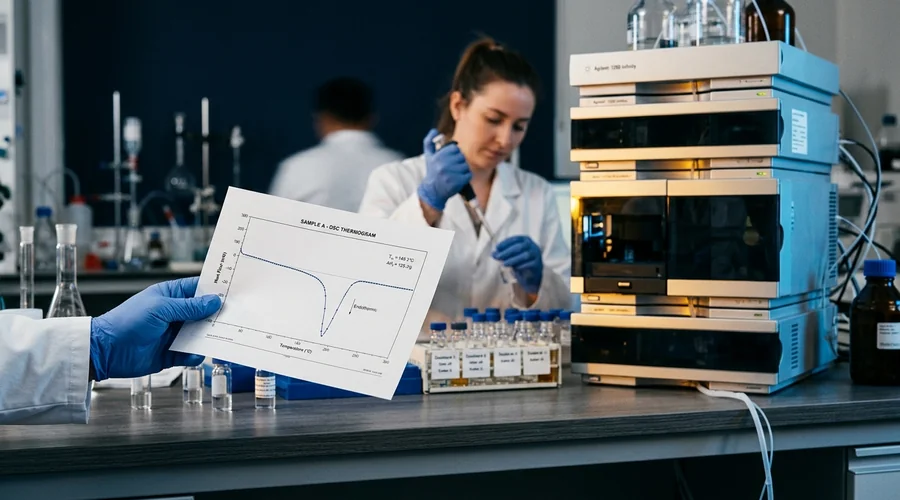
- Define the excipient panel — scope the screen to excipients genuinely relevant to the target dosage form and route of administration.
- Run DSC triage — screen the full panel against pure-component controls to flag candidate pairs for confirmatory testing.
- Confirm flagged pairs — run stability-indicating HPLC and, where useful, FTIR on every DSC-flagged pair before drawing conclusions.
- Document the rationale — record why each excipient was retained or eliminated, tied to specific data, for use in the eventual regulatory submission.
- Feed results into formulation design — hand the confirmed compatible excipient list to the formulation team before process development begins, not after.
Choosing a capable partner for this work matters as much as the study design itself, since a lab with weak stability-indicating method development will produce compatibility data that looks clean but misses real degradation. A strong partner brings both DSC and HPLC capability under one roof, along with direct experience distinguishing physical artifacts from genuine interactions. Our guide to choosing a pharmaceutical formulation consultant covers how to vet a partner for exactly this kind of preformulation work, and our overview of pharmaceutical stability testing under ICH guidelines explains how compatibility conclusions carry forward into the formal stability program that follows.
- Analytical breadth — does the partner run DSC, stability-indicating HPLC, and FTIR internally, or does confirmatory testing require a second vendor and added timeline risk?
- Method development track record — can it demonstrate prior stability-indicating method development for a chemically similar drug substance?
- Data interpretation experience — has it correctly distinguished DSC artifacts from real interactions on past programs, not just generated raw thermograms?
- Regulatory documentation fluency — can its reports be used directly to support an ICH Q8(R2)-aligned development rationale?
A pharmaceutical and healthcare formulation partner active in preformulation work is positioned to carry compatibility findings through to a validated, submission-ready formulation. Global Formulation provides drug-excipient compatibility screening, preformulation characterization, and formulation development support for pharmaceutical manufacturers and entrepreneurs advancing a new drug substance toward commercial scale.
Frequently Asked Questions
What is the difference between a drug-excipient compatibility study and a stability study?
A drug-excipient compatibility study is a preformulation screening exercise. It tests the drug substance against individual excipient candidates, usually as simple binary blends, to flag which materials are safe to carry forward into an actual formulation. A stability study happens later, on the finished formulated product itself, under ICH-defined long-term and accelerated conditions, to establish shelf life and a retest or expiry date.
Compatibility screening is diagnostic and comparative: it is designed to rule excipients in or out before a formula exists. Stability testing is confirmatory: it validates that a formula that has already been selected holds up over its intended shelf life. Skipping compatibility screening does not remove the need for stability testing, but it substantially raises the odds that the stability study will fail.
Which screening technique should be used first, DSC or HPLC?
Differential scanning calorimetry is normally run first because it is fast, needs very little material, and screens many drug-excipient pairs quickly by comparing thermal behavior. It is a useful triage tool for ranking candidates, not a final answer on its own.
Any pair that DSC flags as a possible interaction should then go to HPLC-based isothermal stress testing, storing the physical blend under elevated temperature and humidity and assaying for the parent drug and any new degradation products. HPLC confirms whether a real chemical interaction is occurring, because DSC alone produces enough false positives that its output should never be the sole basis for eliminating an excipient.
Can a DSC compatibility study give a false positive?
Yes, and this is the most common misunderstanding formulators have about the technique. A shifted, broadened, or disappeared melting endotherm in a physical mixture can result from simple physical events, such as eutectic formation, dissolution of the drug into a molten excipient during the heating scan, or particle-size and moisture differences between the pure components and the blend.
None of those effects involve a chemical bond breaking or forming, so treating every DSC anomaly as proof of incompatibility routinely eliminates perfectly usable excipients. The correct response to a DSC flag is confirmatory testing with a chemical method like HPLC or FTIR, not an automatic rejection of the excipient.
How long does a typical drug-excipient compatibility screening program take?
DSC screening across a full excipient panel can usually be completed within one to two weeks, since each thermal run takes only minutes and needs milligram quantities of material. Confirmatory isothermal stress testing takes longer, because samples typically need two to four weeks at elevated stress conditions before an HPLC assay can detect meaningful degradation trends.
A full program covering DSC triage plus HPLC confirmation for the flagged pairs typically runs four to eight weeks from kickoff to a final excipient shortlist, depending on excipient panel size and how many candidates require confirmatory testing. Building this timeline into the project plan early avoids a late-stage scramble when a preferred excipient turns out to be incompatible.
Do regulators require drug-excipient compatibility data for a submission?
Regulators do not usually demand a standalone compatibility-study report as a submission attachment, but they do expect the formulation rationale to demonstrate that excipient selection was evaluated systematically. ICH Q8(R2) explicitly frames compatibility between the drug substance and excipients as part of the pharmaceutical development section that supports a Quality by Design submission.
In practice, reviewers look for evidence that excipient choices were justified by data rather than convenience, especially for any excipient present at an unusually high level or in a novel combination. A documented compatibility screening program is the evidence base that supports that justification during agency review.
What ratio of drug to excipient is used in a binary compatibility study?
The most common approach is a simple one-to-one weight ratio of drug substance to excipient, mixed as a dry physical blend without any processing aids or solvents. Some laboratories also run an excipient-heavy ratio for materials expected to be present at high levels in the final formulation, since a higher excipient proportion can make a weak interaction easier to detect.
This ratio describes an analytical screening protocol, not a finished formulation composition, and it has no bearing on the drug loading or excipient levels that eventually appear in the marketed product. The screening ratio is chosen purely to make an interaction, if one exists, show up clearly in the test data.
What should a company do if a screening study finds an incompatibility?
The first response should be confirmation, not elimination. Confirm the DSC signal with an orthogonal method such as HPLC-based stress testing or FTIR before assuming the excipient is unusable, since a meaningful share of DSC flags turn out to be physical artifacts rather than true chemical interactions.
If the interaction is confirmed as real, the usual next step is substituting a different grade or supplier of the same excipient class, since compatibility can vary between different grades of a chemically similar material. Only after grade substitution fails to resolve the issue does the program typically move to an entirely different excipient class or consider a formulation approach, such as a barrier coating or separate granulation, that physically isolates the incompatible pair.
Screening Excipients for a New Drug Substance?
Global Formulation provides drug-excipient compatibility screening, DSC and stability-indicating HPLC study design, and preformulation support from bench trial through submission-ready documentation.
Talk to Our Formulation Team