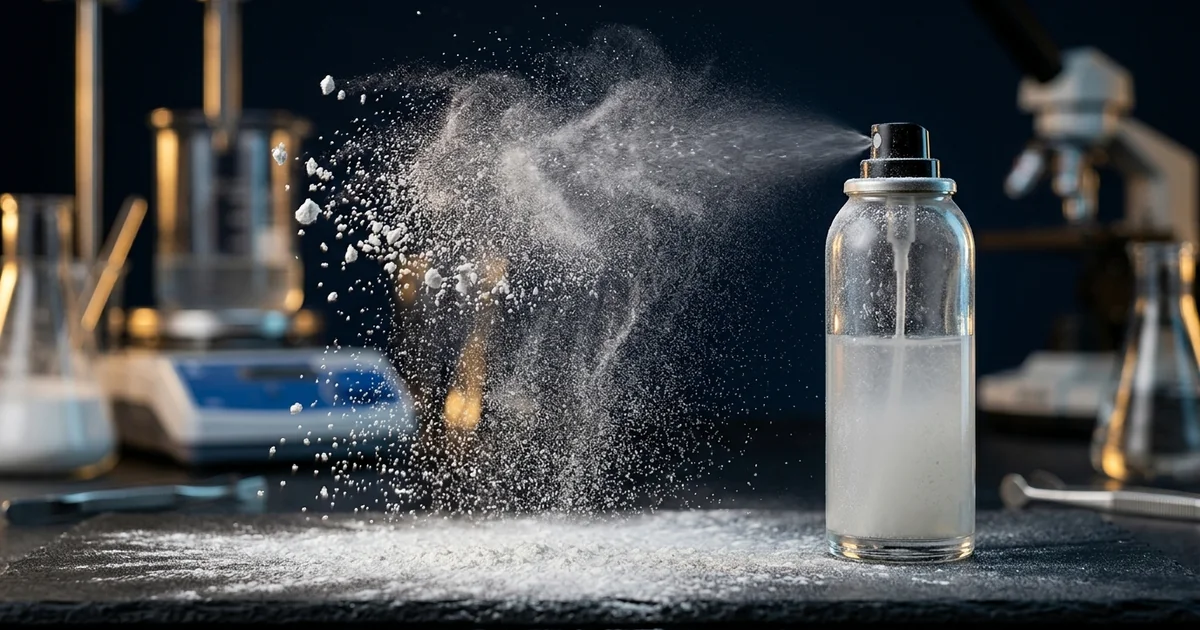
A founder pitching a dry shampoo brand can source a starch, buy some cans, and get something out the door. The real test comes later — a chalky white residue on dark hair, or a can that sprays out clumps instead of a fine powder. Dry shampoo formulation is harder than it looks: the powder has to lift scalp oil fast, vanish into every hair shade, and survive months under pressure without caking inside the can. Miss on any one of those, and returns pile up before a brand ever learns why; get them right, and dry shampoo becomes exactly the repeat-purchase product the category depends on. This guide breaks down how starch and silica absorbent systems actually work, and how aerosol propellant chemistry has to change to carry a suspended powder instead of a liquid. It also covers the testing that separates a formula that works in the lab from one that survives a real bathroom cabinet — the same technical foundation Global Formulation walks early-stage beauty brands through before a single can goes into production.
How Dry Shampoo Actually Removes Oil Between Washes
Hair looks greasy not because dirt has accumulated, but because sebum — the oil the scalp's sebaceous glands produce continuously — has coated the hair shaft near the roots and changed how light reflects off it. Wet shampoo removes that oil chemically, as covered in our shampoo formulation and surfactant selection guide: surfactants emulsify the sebum and rinse it away with water. Dry shampoo has no water and no rinse step, so it solves the same problem through a completely different mechanism — a fine powder applied to the roots that physically adsorbs the oil onto its surface, then gets brushed or shaken back out of the hair, taking the absorbed sebum with it. That single constraint, no water and no rinsing, is what shapes almost every formulation decision that follows.
- Application — powder is deposited at the roots, the only area where sebum genuinely accumulates.
- Adsorption — the powder's particle surface picks up the oil film, either by surface adsorption alone (starch) or a combination of surface adsorption and capillary uptake into a porous particle structure (silica).
- Redistribution — massaging or brushing spreads the powder through the roots so it contacts as much of the oily surface as possible.
- Removal — brushing or shaking removes the oil-loaded powder from the hair, taking the absorbed sebum with it rather than dissolving or rinsing it away.
Everything from here is really a question of which powder performs that adsorption step best, and at what cost to look, feel, and shelf life.
Starch-Based Absorbent Systems: Rice, Corn, and Tapioca Starch
Starch is the oldest and still the most widely used absorbent base in dry shampoo, and it earns that position mainly on cost and familiarity rather than raw performance. Corn starch, rice starch, and tapioca starch are the three most common choices, and each is a natural, biodegradable carbohydrate polymer that formulators can source at commodity-ingredient pricing rather than specialty-chemical pricing. All three work by the same surface-adsorption mechanism, but they differ meaningfully in native particle size, feel on the scalp, and — critically for a dry shampoo brand — how visible the residue is once it's applied.
| Starch source | Native particle size | Feel on scalp | Typical white-cast tendency |
|---|---|---|---|
| Corn starch | Coarser, more irregular granules | Slightly gritty unless finely milled | Higher unless heavily micronized |
| Rice starch | Very fine, small granules | Silky, low grit | Lower — finer native particle size helps it blend in |
| Tapioca starch | Fine, low-protein granules | Smooth, well tolerated on sensitive scalps | Moderate; benefits from micronization |
Starch's low cost and gentle profile explain why it still anchors most mass-market formulas, but its comparatively modest oil-holding capacity is exactly where silica-based systems earn their premium-formula reputation.
Silica-Based Absorbent Systems: Reaching for More Oil-Holding Capacity
Amorphous silica — most commonly fumed silica or precipitated silica — solves the same oil-adsorption problem as starch, but through a material with dramatically more surface area to work with. Where a starch granule is a relatively solid, low-porosity particle, fumed silica is built from microscopic aggregated particles with a specific surface area that industry data commonly places in the hundreds of square meters per gram, as documented generally for the material on Wikipedia's fumed silica entry. That surface area translates directly into oil-holding capacity: a silica-based dry shampoo can typically absorb more sebum per gram of powder than an equivalent starch-based formula, which is why silica shows up disproportionately often in premium and salon-positioned dry shampoo lines.
- Fumed silica — produced by high-temperature vapor-phase synthesis, prized for very high surface area and oil absorption per gram.
- Precipitated silica — produced by a wet chemical precipitation route, generally lower surface area than fumed silica but more cost-effective at scale.
- Silica microspheres — engineered as uniform, rounded particles specifically to improve scalp feel and light diffusion, often blended with a primary absorbent rather than used alone.
Silica's higher absorption capacity and cosmetic-grade purity make it a strong technical choice, but amorphous cosmetic silica is a genuinely different material from the crystalline silica associated with industrial inhalation hazards — a distinction worth making explicit before it's used, which the safety section below addresses directly.
Aerosol Dry Shampoo: Propellant Selection and Keeping Powder Suspended
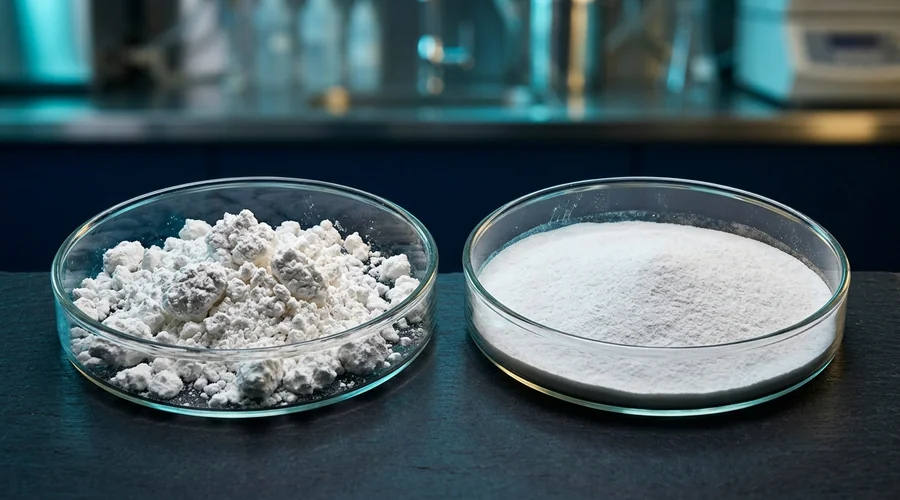
Putting an absorbent powder into an aerosol can introduces a formulation problem that liquid aerosol cosmetics, like hairspray or deodorant body spray, don't have to solve: keeping a solid suspended evenly in a liquefied propellant instead of letting it settle to the bottom of the can. Most aerosol dry shampoos use a liquefied petroleum gas (LPG) blend — typically propane, butane, and isobutane in varying ratios — or dimethyl ether (DME) as the propellant, the same general propellant classes used across pressurized cosmetic aerosols, as covered in more depth in our cosmetics and personal care aerosols guide. The propellant has to keep the powder suspended long enough to spray evenly, and the valve and actuator have to pass that powder through the orifice without clogging — two requirements a liquid-only aerosol formula never has to consider.
- Propellant choice — LPG blends and DME both liquefy under pressure inside the can and vaporize on release, carrying the suspended powder out through the valve.
- Suspension behavior — powder that isn't adequately dispersed settles at the base of the can between uses, which is why powder aerosol cans carry an explicit "shake well before use" instruction.
- Valve and orifice design — powder aerosols typically need a wider valve orifice and a more robust actuator than a liquid spray valve, since fine powder can pack and clog a narrow liquid-spray orifice over repeated use.
- Format alternative — non-aerosol pump and puff-powder formats avoid the propellant-suspension problem entirely, at the cost of a less even, less fine application than a well-formulated aerosol delivers.
Getting the powder out of the can evenly is only half the job — the other half is making sure it disappears into the hair instead of sitting on top of it as a visible cast.
Fragrance, Tinted Powders, and Solving the White-Cast Problem
The single biggest consumer complaint dry shampoo formulators have to design around is the visible white or gray cast a powder-based product can leave on hair, and the problem is worse the darker the hair color. Micronizing the absorbent to a smaller, more uniform particle size is the first line of defense, since smaller particles scatter less visible light and blend into the hair shaft rather than sitting on top of it. Beyond micronization, brands serving a range of hair colors formulate tinted powder variants using cosmetic-grade iron oxide pigments matched to blonde, brunette, and dark hair shade ranges, so the absorbent itself is closer in color to the hair it's applied to.
- Micronization — reducing particle size is the most direct lever for reducing visible cast, and it improves scalp feel at the same time.
- Iron oxide tinting — cosmetic-grade iron oxide pigments, the same pigment class used in color cosmetics generally, are blended into the powder base to match common hair-shade ranges.
- Fragrance encapsulation — microencapsulated fragrance oils release scent gradually as the powder is worked through the hair, masking both the residual sebum odor and any raw-material odor from the absorbent itself.
None of these cosmetic refinements matter if the underlying powder isn't safe to inhale in aerosol form, which is exactly the question formulators have to answer before scale-up.
Scalp and Inhalation Safety: Why the Category Moved Away from Talc
Talc was the original dry shampoo and body powder absorbent for decades, valued for its softness and oil-absorbing surface, but the category has moved substantially toward starch and silica alternatives — a shift also touched on in the talc-free reformulation discussion in our baby products formulation guide. Talc's main liability is a mineral sourcing problem, not a formulation one: talc deposits can occur near asbestos-bearing rock, so unless a talc supply is rigorously sourced and tested, contamination risk exists in a way it simply does not for a corn-derived starch or a synthetically produced silica. That single sourcing risk, more than any performance shortcoming, is what has pushed most new dry shampoo development toward talc-free absorbent systems.
- Sourcing risk — talc's main safety concern stems from geological proximity to asbestos, requiring rigorous mine-level testing that starch and synthetic silica don't need.
- Respirable particle fraction — any fine aerosolized cosmetic powder, regardless of absorbent type, should be formulated with a particle size distribution weighted away from the sub-10-micron respirable range that can reach deeper into the airway.
- Amorphous vs. crystalline silica — the cosmetic-grade amorphous silica used in dry shampoo is a materially different substance from the crystalline silica associated with industrial inhalation hazards in occupational settings, and the two should never be treated as interchangeable in a safety assessment.
- Ingredient documentation — cosmetic-grade absorbents should carry supplier certificates of analysis and align with the ingredient safety framework maintained by bodies such as the US FDA's cosmetic ingredients program.
A talc-free, properly micronized absorbent solves the sourcing and inhalation questions at the formulation level, but a brand still has to prove that performance and safety hold up consistently batch after batch, which is what quality-control testing is for.
Testing and Quality Control for Dry Shampoo Absorbent Performance
A dry shampoo formula that looks and feels right in a small lab batch still needs to be validated against repeatable, quantifiable tests before it can be trusted at commercial scale. Oil absorption capacity, visible residue, particle size distribution, and microbial stability are the four properties that most directly determine whether a formula performs consistently once it leaves the lab.
- Oil absorption capacity testing — measures how many grams of oil a gram of absorbent powder can hold before saturation, using rub-out or wet-point methodology similar in principle to the pigment oil absorption approach described in ASTM D281, adapted to the cosmetic powder being evaluated.
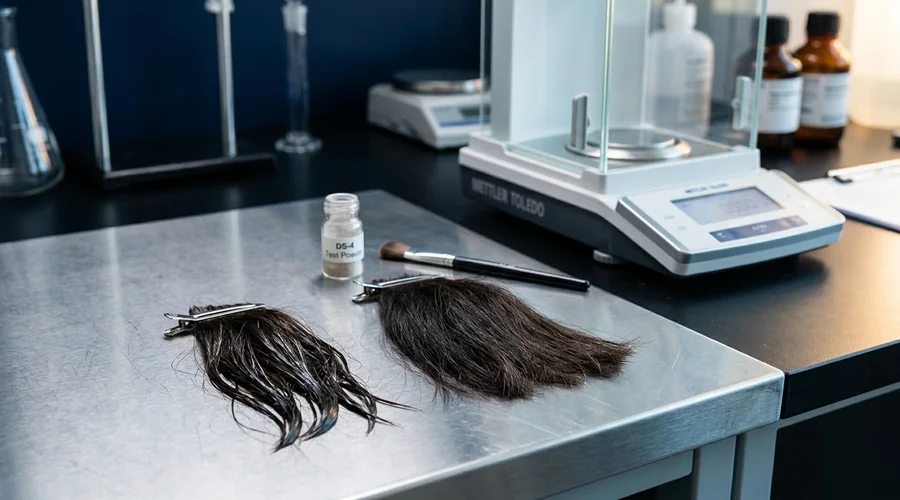
- Visual residue and white-cast panel testing — applies the finished powder to hair swatches spanning light to dark shades under controlled lighting, scoring visible residue after the recommended brushing or shaking step.
- Particle size distribution testing — laser diffraction analysis confirms the powder's size distribution meets both the fine-enough-to-blend-in target and the coarse-enough-to-avoid-respirable-fraction safety target simultaneously.
- Microbial and moisture stability testing — starch-based absorbents are organic carbohydrate materials that can support microbial growth if moisture control fails during manufacturing or storage, so accelerated stability testing under elevated humidity is standard practice before a batch is released.
None of these four tests substitutes for the others — a powder can pass an oil-absorption test and still fail commercially if it leaves a visible cast, or pass a white-cast panel and still create a problem if its particle size distribution skews too fine. A dry shampoo brand choosing between a starch-based, silica-based, or blended absorbent system should treat that choice as inseparable from the propellant, valve, tinting, and testing decisions covered above. Get all of them aligned, and the result is a product that disappears into the hair instead of announcing itself as a compromise.
Frequently Asked Questions
What's the real difference between starch and silica absorbents in dry shampoo?
Why does dry shampoo leave a white cast on dark hair?
Can dry shampoo actually clean hair the way a wet shampoo does?
Is an aerosol can or a powder-puff/pump format better for dry shampoo?
Why are cosmetic brands moving away from talc in dry shampoo?
How much oil can a dry shampoo absorbent actually hold before it stops working?
What propellant is used in aerosol dry shampoo cans?
Need Expert Formulation Support?
Our team provides end-to-end technical consultancy — from absorbent chemistry and aerosol formulation to valve selection and plant setup for cosmetics and personal care brands.
Get a Free Consultation