Efflorescence Concrete: Causes, Prevention and Removal
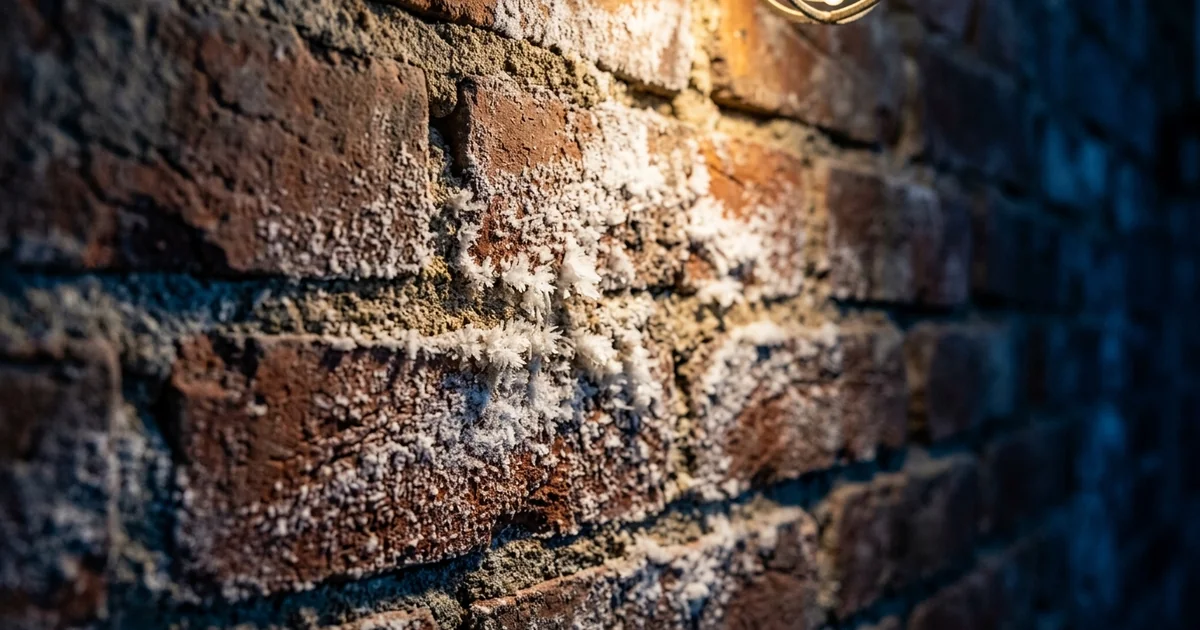
A white powder appears on a new paver, block or wall soon after handover, and the complaint arrives before the invoice is paid. The deposit spoils the look of coloured and dark products most, and it triggers rejected batches, cleaning costs and warranty arguments. Most cases come down to salts, water and evaporation, which a producer can influence long before the product ships. This guide explains the efflorescence concrete and masonry makers face, covering types, chemistry, causes, tests, prevention and removal. It draws on industry datasheets from concrete and brick bodies, plus the formulation support Global Formulation gives construction chemical makers.
Efflorescence Concrete Basics: What the White Deposit Is
Efflorescence is the formation of salt deposits, usually white, on or near the surface of concrete or masonry. The Cement Concrete & Aggregates Australia datasheet calls it generally harmless apart from the discolouration. The Concrete Masonry & Hardscapes Association adds that it does not affect structural performance. Three conditions must meet before it forms: soluble compounds in the material, moisture to dissolve them, and a force such as evaporation or hydrostatic pressure to move the solution.
Remove any one of the three and efflorescence cannot occur. The Brick Industry Association states the same logic for masonry, with the third condition being a pore structure that lets salt solutions reach a surface where water can evaporate. Sources name the types differently, so the table sets out the common terms.
| Term | Meaning | Source |
|---|---|---|
| Primary efflorescence | Efflorescence occurring during hardening of the concrete | CCAA |
| Secondary efflorescence | Efflorescence resulting from weathering of the hardened concrete | CCAA |
| Crypto-florescence or subflorescence | Salt deposited inside the pores below the surface; the force of crystal growth can cause fretting or spalling | CCAA, BIA |
| New building bloom, early age | A fairly uniform deposit from normal water loss after construction, which usually fades with weathering | BIA, CMHA |
| Late age or recurrent | White streaks below joints or in localised areas, showing that water enters the wall at a higher level and that corrective measures are needed | CMHA |
Identification starts with understanding which salts are involved and where they come from, which is a matter of chemistry.
Salt Bloom on a Concrete Surface: Carbonation and Salt Chemistry
Portland cement releases soluble calcium hydroxide as it hydrates, and water can carry that dissolved lime to the surface. At the water and air interface it meets atmospheric carbon dioxide and turns into calcium carbonate. The Concrete Masonry & Hardscapes Association describes the result as a whitish deposit that is only slightly soluble, which is why rain does not simply wash it away. Soluble alkalis from the cement follow a similar route and form carbonates of their own.
| Salt | Typical Origin | Behaviour |
|---|---|---|
| Calcium carbonate | Calcium hydroxide from cement hydration reacting with carbon dioxide | Appears as a white bloom or hard crust; the most troublesome form and difficult to remove (CCAA) |
| Sodium and potassium carbonates | Cement alkalis reacting with carbon dioxide | A soft white fluff that is easily removed and can return after wetting and slow drying (CCAA) |
| Calcium sulphate | Sulphurous gases reacting with the surface layer in damp conditions | A white insoluble salt that rain washes onto the surface (CCAA) |
| Sulphates and chlorides of sodium, potassium, magnesium and calcium | Aggregates, water, admixtures, pigments, soil, sea spray | Soluble salts that the datasheet lists among the causes; rain often washes chlorides off (CCAA, CMHA) |
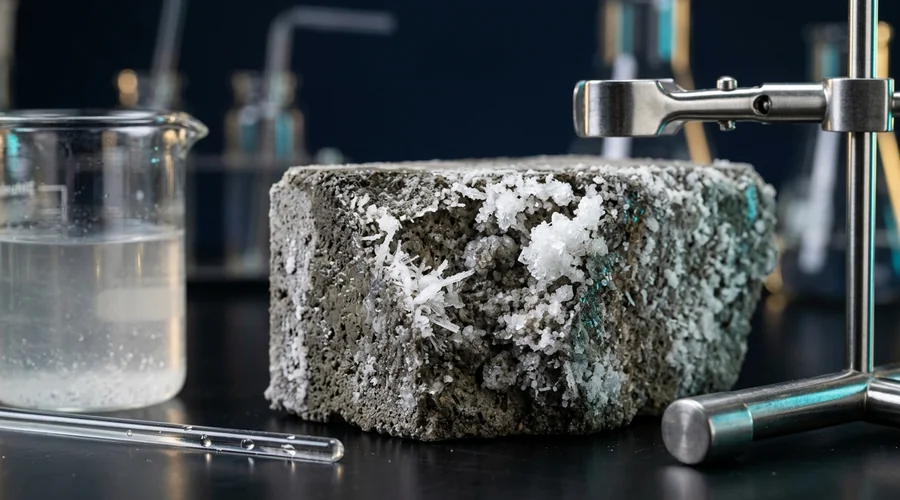
Physical processes decide whether the chemistry shows up on the surface. The CCAA datasheet lists solubility, hygroscopicity, crystal form, pore structure and water movement. Warm water dissolves more of a given salt, so a drop in temperature or a loss of water can push a saturated solution to deposit crystals. Strongly hygroscopic salts such as sodium and potassium hydroxide are unlikely to effloresce until they carbonate.
Pore structure and saturation control the location. In fine pores, capillary action draws water to the exposed face and deposits form there. In coarse pores, free water drops below the surface and crystals form beneath it. The datasheet adds that saturated pores let carbon dioxide and calcium hydroxide meet at the surface, while partly saturated pores carbonate beneath it. In dried pores no carbonation takes place, but later wetting brings a considerable risk of efflorescence.
Chemistry sets the potential, and the mix, the aggregates and the curing set how much of it reaches the surface.
Efflorescence Prevention in Masonry and Concrete Products: Materials and Curing
A producer controls three levers that decide how much salt is available and how easily it moves: the raw materials, the pore structure and the curing. The CCAA datasheet reports that views differ on which factor is the major culprit, and that the exact cause of a given case is usually impossible to deduce with certainty. Controlling every lever together is therefore more reliable than relying on one. The table groups the main factors with their effects.
| Factor | What Raises the Risk | What Lowers It |
|---|---|---|
| Water and pore structure | A high water-cement ratio gives porous products with interconnected micro voids and higher absorption (CCAA) | Denser concrete, though that can raise shrinkage and change masonry texture (CCAA); water-reducing admixtures give less bleed water (Euclid bulletin) |
| Cement | High-alkali cement is more prone to produce efflorescence in mortar and grout (BIA) | Low-alkali cement where available (BIA); CCAA notes that cement type matters only in exceptional cases |
| Supplementary materials | Fly ash and slag high in alkalies and sulphates (CCAA) | Fly ash and slag can be effective in reducing efflorescence (CCAA); pozzolans and silica fume reduce the calcium hydroxide supply (Euclid bulletin) |
| Aggregates and water | Salt-contaminated sand; aggregates containing soluble sulphates, such as some expanded clay, shale and blast furnace slag (CCAA) | Clean, washed sand and potable water free of salts (BIA) |
| Pigments and admixtures | Salt content of pigments and admixtures; dispersing agents used in pigments can raise the potential (CMHA) | Test admixtures of unknown composition before use (BIA, CMHA) |
| Curing | Curing in dry air, exposure of newly cast concrete to free water, and premature drying that interrupts hydration (CCAA) | Avoid premature drying and keep humidity high; carbon dioxide-rich curing and autoclaving can reduce the problem under stated conditions (CCAA) |
The CCAA datasheet reports that carbon dioxide curing of concrete products had a remarkable positive effect at around 5 percent by volume and no influence below 1 percent. It also notes that autoclaving reduces efflorescence provided the materials contain no soluble sulphates. For masonry curing chambers, it warns that saturated conditions with condensation can themselves cause lightening or spots.
Materials and curing set the potential, and diagnosis shows which part of it a particular failure exposed.
Diagnosing Efflorescence: Troubleshooting Steps and Test Methods
Diagnosis comes before any treatment, because the fix for a construction-moisture problem differs from the fix for a leak. The Brick Industry Association's troubleshooting list starts with the age of the structure. A building under a year old usually shows new building bloom from cement salts and construction water, while an older building points to a new water source. Location, mortar condition, flashing and sealant joints then trace the entry path of the water.
- Date the problem — establish when the deposit first appeared relative to completion.
- Map the location — note where on the wall and on the unit, since it points to where water enters.
- Inspect the construction — check joints, flashing, drips, weeps, copings and sills for leaks.
- Review details and test reports — compare drawings with the as-built state and read material tests.
- Identify the deposit — laboratories use X-ray diffraction, petrographic analysis, ion chromatography or chemical analysis.
- Look for stray water — condensation, sprinklers, leaking pipes and drains come last.
| Test | What It Does | Limits |
|---|---|---|
| Puddle test | Distilled water sits on the surface and the dried surface is inspected for efflorescence (CCAA) | Qualitative; the time the water stays on the surface influences the conclusion |
| Lime extraction test | Controlled dripping of distilled water, with the run-off analysed for calcium, sodium and potassium (CCAA) | Improves on the puddle test because extraction time is controlled |
| ASTM C67 efflorescence test | Seven days of partial immersion of brick in distilled water, then drying and visual rating (BIA) | A laboratory product test that is more severe than normal exposure and does not predict service performance; occasionally specified for concrete masonry units because no standard test exists for them (CMHA) |
| Soluble salt analysis | Measures water-soluble salts, with soluble sulphate named as a good indicator of potential (BIA) | Identifies likely sources rather than predicting when efflorescence will show |
The ASTM C1400 guide covers methods for reducing efflorescence potential in new masonry walls, and BIA points specifiers to it for new buildings. A formulator should read test results as a comparison against a control made from the same materials. Our guide to concrete curing compounds covers the curing side of the same defect.
Once the source is identified, prevention becomes a choice between cutting the water, the salts or both.
Preventing Efflorescence: Water Management, Admixtures and Surface Treatments
Prevention works by removing one of the three conditions, and water is the easiest to remove. The CMHA states that of the two controllable factors, soluble salts and moisture, moisture is the more easily avoided. The CCAA datasheet puts it in three words: keep water out. Design details such as flashing, drips, overhangs and tooled joints do that job, and they come first.
| Approach | How It Works | Watch-Out |
|---|---|---|
| Water management | Detailing, flashing, drainage and covering unfinished work limit the water available | Sealant joints age and need maintenance (BIA) |
| Low-salt materials | Potable water, washed sand and low-alkali binders cut the salt supply | Soluble salts cannot be excluded entirely (BIA) |
| Dense, well-cured concrete | Lower permeability slows the movement of salt solutions | Can raise shrinkage risk or change texture (CCAA) |
| Pozzolanic or slag additions | Reduce the calcium hydroxide that carbonates at the surface | High-alkali or high-sulphate materials can work against you (CCAA) |
| Integral water repellents | Reduce water migration through the unit; shown to reduce the tendency to effloresce (CMHA) | Water-soluble soaps and water-soluble alkali silicates can cause efflorescence themselves; fatty acid ester types are reported effective without disturbing hydration (CCAA) |
| Surface-applied water repellents | Applied to newly finished concrete before wetting, they reduce the tendency to effloresce (CCAA) | Salts can crystallise beneath the treated layer and spall or flake the surface; BIA does not recommend coatings as the sole treatment |
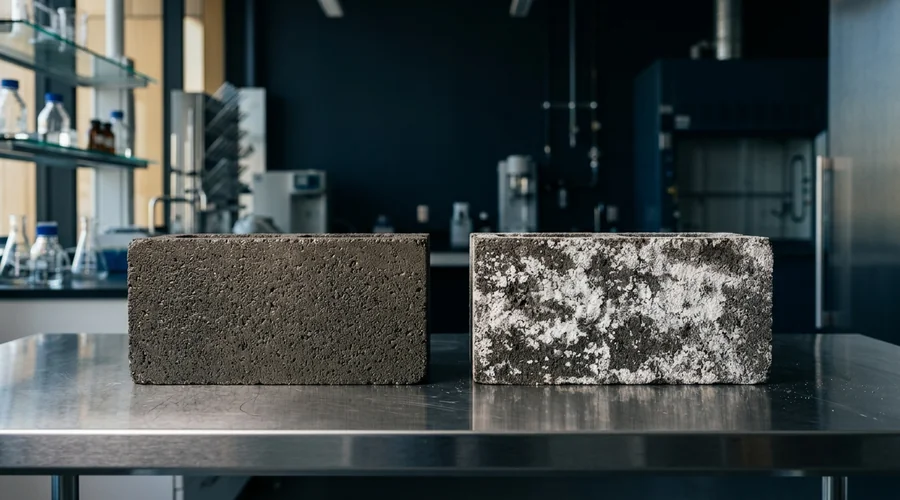
The surface treatment caution deserves emphasis. BIA explains that water and salts travelling towards a coated face can stop at the inner margin of the coating. The water evaporates there and leaves the salts inside the masonry as subflorescence. Our guide to silane, siloxane and acrylic water repellents compares breathability and penetration for exactly this decision. Our guide to crystalline and hydrophobic waterproofing admixtures covers the integral options.
Admixtures deserve their own test. The CMHA notes that most admixtures are proprietary and recommends determining their efflorescence potential by experience or laboratory tests. BIA goes further and advises against admixtures of unknown composition unless they are shown neither to impair bond nor to contribute to efflorescence.
When prevention has failed or arrived late, removal has to follow an order that does not make matters worse.
Efflorescence Removal: An Order of Operations That Does Not Backfire
Removal fails when it is done before the water source is fixed, and it can backfire when water is used carelessly. The CCAA datasheet says that when efflorescence is linked to abnormal wetting, such as faulty drains, those faults must be corrected before removal. Most soluble deposits then come off easily, particularly early on. Hard crusts need stronger measures, and each step brings its own risk to the surface.
- Fix the water source — drains, flashing, joints and sprinklers come first.
- Dry brush early — soluble deposits often lift with a stiff brush soon after forming, and the loose material must be removed completely.
- Wash with care — CCAA warns that washing can bring deposits back as the water evaporates, and BIA advises washing only in warm, dry weather.
- Treat insoluble crusts — CCAA lists high-pressure water, light sand blasting and controlled dilute acid, and it warns that acid and blasting can alter texture and colour.
- Test a small area first — both industry bodies ask for a trial patch before full-scale cleaning.
- Choose acids by substrate — BIA warns that unbuffered hydrofluoric or hydrochloric acid on brick can cause white scum and vanadium or manganese stains.
Our guide to anti-carbonation coatings for concrete covers the related carbonation chemistry from the durability side. A sound removal job leaves the surface ready for a breathable protective treatment, applied only after the mechanism is under control.
For manufacturers, the better lesson is to build these checks into product development, which is where a formulation partner helps.
Working With a Construction Chemicals Formulation Consultant
Efflorescence is a formulation, raw-material and process problem at the same time, so fixes that address only one tend to fail. A construction chemicals formulation consultant audits salt sources, screens admixtures and repellents, and designs comparative tests against controls. Construction chemical product development services extend the work into specifications, technical data and claims that survive customer scrutiny. A contract formulation scale-up partner then carries the validated system into production with batch controls on the salt-bearing inputs.
- Define the product and exposure — pavers, blocks, plaster or mortar, indoor or outdoor, coloured or natural.
- Audit the salt sources — cement alkali, sand, water, pigments and admixtures, including soluble sulphate content.
- Pick the strategy — density and curing, supplementary materials, integral repellent, or surface repellent.
- Screen admixtures and pigments — test each for its own contribution to efflorescence.
- Test against a control — puddle or controlled-wetting tests with matched samples and a stated protocol.
- Check side effects — bond, shrinkage, texture, colour and breathability.
- Scale up and release — set raw-material limits and routine checks for the plant.
Our construction chemicals range shows where these systems sit among admixtures, repellents and coatings. Global Formulation provides raw-material audits, repellent and admixture screening, comparative efflorescence testing and scale-up support for construction chemical manufacturers. Mix proportions, admixture loadings and proprietary ratios stay outside this guide by design.
Frequently Asked Questions
What is efflorescence on concrete and is it harmful?
Efflorescence is the formation of salt deposits, usually white, on or near the surface of concrete or masonry. Water dissolves salts inside the material, carries them to the surface, and leaves them behind when it evaporates.
Cement Concrete & Aggregates Australia describes it as generally harmless apart from the discolouration, and the Concrete Masonry & Hardscapes Association says it does not affect structural performance.
The exception is salt that crystallises inside the pores below the surface, which can cause fretting or spalling.
What causes efflorescence on concrete?
Three conditions must meet: soluble compounds in the material, moisture to dissolve them, and a force such as evaporation or hydrostatic pressure to move the solution. Remove any one and efflorescence does not occur.
In cement-based products, calcium hydroxide from cement hydration travels to the surface and reacts with carbon dioxide to form calcium carbonate. Sodium and potassium alkalis from the cement, and salts from aggregates, water, pigments and admixtures, add to the load.
Efflorescence is more common in winter, because slow evaporation lets the solution reach the surface before the water leaves.
What is the difference between primary and secondary efflorescence?
Cement Concrete & Aggregates Australia defines primary efflorescence as efflorescence occurring during hardening of the concrete, and secondary efflorescence as that resulting from weathering of the hardened concrete.
Masonry sources use a related split. New building bloom appears soon after construction as normal water loss from the materials, and it usually fades with weathering. Late-age or recurrent efflorescence points to water entering the wall and needs corrective action.
Terminology varies between sources, so check which definition a specification or supplier uses.
How do you prevent efflorescence in concrete and masonry?
The most effective step is to keep water out through detailing, flashing, drainage and protection during construction. The second is to cut the supply of soluble salts by using potable water, washed sand and low-salt materials.
Producers can also make denser, well-cured concrete, use supplementary cementitious materials that reduce calcium hydroxide, and add integral water repellents that reduce water migration.
Surface treatments help only when the water mechanism is addressed as well, because a treatment alone can push salts to crystallise beneath the surface.
Do sealers and water repellents stop efflorescence?
A water repellent can reduce efflorescence by reducing the water that a surface absorbs. Cement Concrete & Aggregates Australia notes that treating newly finished concrete before wetting reduces the tendency to effloresce.
The Brick Industry Association warns that a coating that inhibits evaporation can stop salts at the inner edge of the coating. There they crystallise as subflorescence and can spall the surface. It does not recommend coatings as the sole treatment.
Choose a breathable repellent and fix the source of water first.
How is efflorescence removed from concrete?
Correct any abnormal wetting first, because removal without that step lets the deposit return. Soluble salt deposits often come off with a stiff dry brush, especially soon after they form.
Washing can bring more salt to the surface as the water evaporates, so repeated dry brushing is usually the most successful treatment for soluble deposits. Hard insoluble crusts, such as calcium carbonate, need high-pressure water, light sand blasting or controlled dilute acid, tested first on a small area.
Acid can change texture and colour, and the Brick Industry Association warns against unbuffered hydrochloric acid on brick.
How do you test the efflorescence potential of a concrete or masonry product?
Cement Concrete & Aggregates Australia describes a qualitative puddle test, in which distilled water sits on the surface and the dried surface is inspected. It also describes a quantitative lime extraction test with controlled dripping of distilled water.
ASTM C67 includes an efflorescence test for brick, with seven days of partial immersion in distilled water. The Concrete Masonry & Hardscapes Association notes it is occasionally specified for concrete masonry units because no standard test exists for them.
Results compare materials against controls and do not predict service performance exactly.
Fighting Efflorescence in a Concrete or Masonry Product?
Global Formulation supports raw-material salt audits, admixture and water-repellent screening, comparative efflorescence testing and scale-up to a qualified plant.
Talk to Our Formulation Team